
Home Care Software Market Outlook: Size, Share, Trends, Growth Analysis, Competitive Landscape & Forecast, 2026-2033

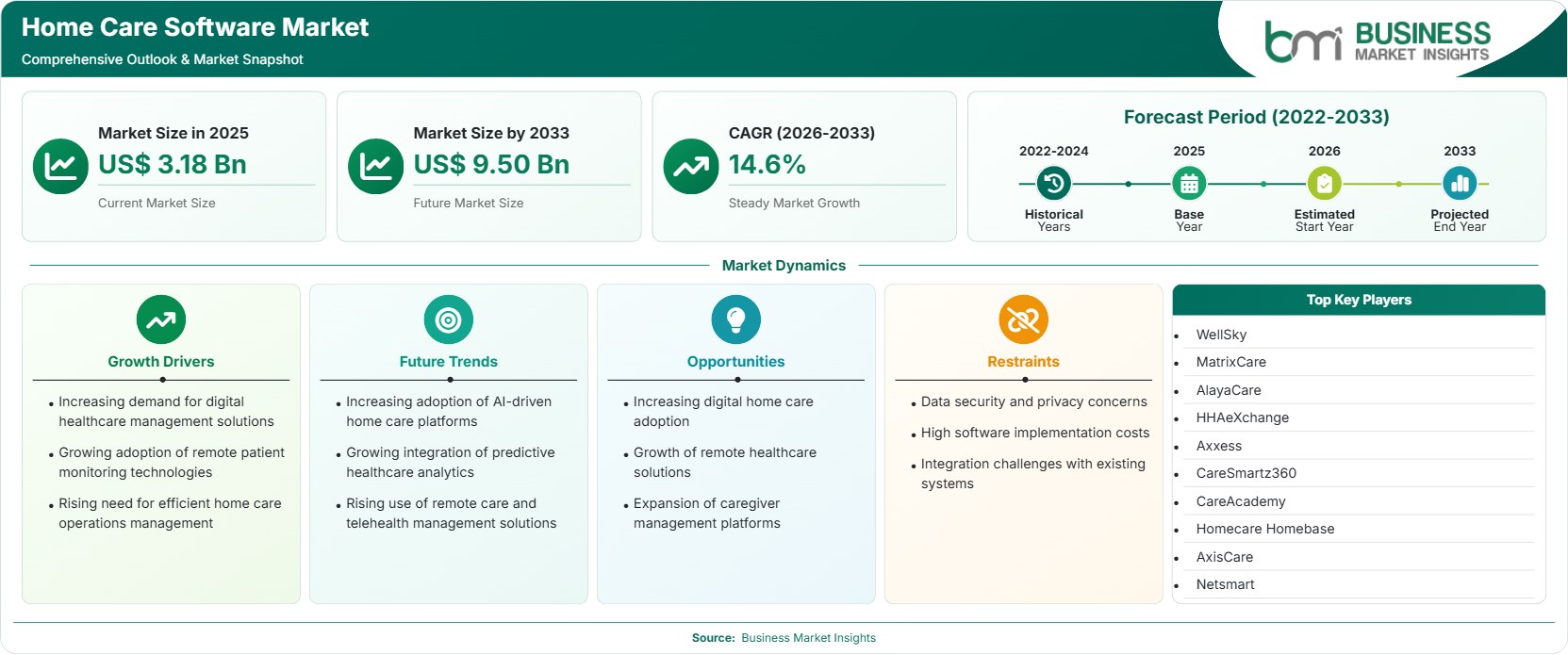
The Home Care Software Market size was valued at US$ 3.18 Billion in 2025 and is projected to reach US$ 9.50 Billion by 2033, growing at a CAGR of 14.6% during 2026–2033, driven by digital healthcare transformation, increasing remote monitoring adoption, demand for efficient caregiver management, and rising need for technology-enabled home care delivery systems.

Report Coverage
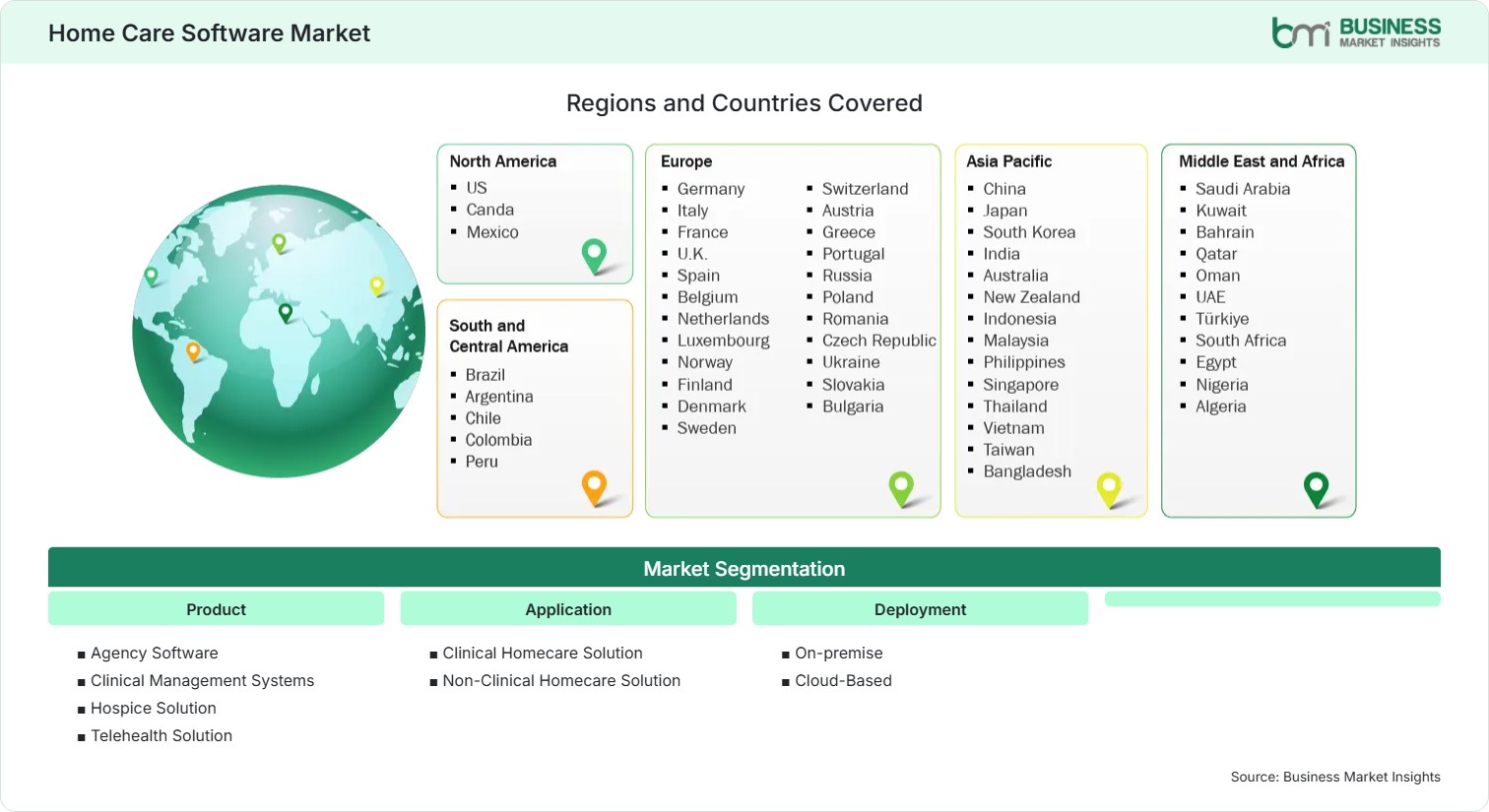
  • Product: Agency Software, Clinical Management Systems, Hospice Solution, Telehealth Solution
  • Application: Clinical Homecare Solution, Non-Clinical Homecare Solution
  • Deployment: On-premise, Cloud-Based
US$ 3.18 Bn Market size in 2025
US$ 9.50 Bn Market Size by 2033
14.6% CAGR, 2026 - 2033
2026-2033 Forecast Period

01 AI Overview

Home Care Software Market Summary

  • North America Region: North America holds a 38%–41% share in 2025 and is projected to grow at a CAGR of 13.8%–14.6% during 2026–2033, supported by advanced healthcare infrastructure, aging population needs, digital health investments, and remote monitoring adoption. The US market is expected to expand at a 14.0%–14.8% CAGR, driven by healthcare digitization, reimbursement support, and demand for efficient home care coordination.
  • Fastest Growing Region: Asia Pacific represents a 22%–25% share in 2025 and is forecast to register the fastest CAGR of 15.8%–16.8%, supported by expanding healthcare access, increasing elderly populations, government digital health programs, and adoption of cloud-based care management platforms.
  • Leading Segment: Cloud-Based Deployment accounts for a 55%–58% share in 2025 and is expected to grow at a CAGR of 15.0%–15.8%, supported by scalable infrastructure, remote accessibility, lower maintenance requirements, and increasing adoption among home care providers.
  • High Growth Segment: Telehealth Solution is projected to expand at a CAGR of 16.5%–17.5%, driven by remote consultations, virtual care delivery, chronic disease management, and integration of connected healthcare technologies.
  • Key Market Opportunity: Expansion of digital home care ecosystems, remote healthcare platforms, and caregiver management solutions creates opportunities for software providers to improve operational efficiency, patient outcomes, and care coordination.
  • Major Market Players: WellSky, MatrixCare, AlayaCare, HHAeXchange, Axxess, CareSmartz360, CareAcademy, Homecare Homebase, AxisCare, Netsmart.
02 Strategic Insights

Home Care Software Market: Strategic Insights

Home Care Software Market Strategic Framework
FREE PDF
Request your free sample
Request free sample
03 Stakeholder View

Key Takeaways

  • The ecosystem is shifting from basic administrative software toward integrated care management platforms combining scheduling, electronic documentation, analytics, billing, and remote monitoring capabilities.
  • Telehealth solutions, caregiver management platforms, and cloud-based systems represent high-growth opportunities as providers seek scalable tools for improving patient engagement and operational efficiency.
  • Artificial intelligence, predictive analytics, automation, and connected healthcare devices are influencing next-generation home care software development strategies.
  • Asia Pacific offers strong expansion potential due to increasing healthcare accessibility, aging demographics, government digital health initiatives, and rising technology adoption.
  • Strategic partnerships between healthcare providers, software companies, and technology firms are accelerating development of connected home care ecosystems.
  • Investment activity is increasing around healthcare technology platforms offering interoperability, workflow automation, and remote care capabilities for distributed healthcare delivery.
04 Geographic Outlook

Home Care Software Market Regional Highlights

North America Home Care Software Market

North America accounted for a 38%–41% of the Home Care Software Market share in 2025 and is projected to grow at a CAGR of 13.8%–14.6% from 2026–2033. The region maintains leadership due to advanced healthcare infrastructure, high technology adoption, strong presence of software providers, and increasing demand for home-based care services. The United States represents the largest contributor, supported by digital health investments and expanding remote care adoption.

  • Healthcare organizations are integrating software platforms to improve scheduling, documentation, compliance management, and caregiver coordination.
  • Aging demographics are increasing demand for technology-enabled home care services and chronic disease management solutions.
  • Remote patient monitoring adoption is accelerating through connected devices and virtual healthcare platforms.
  • Cloud-based healthcare software adoption is increasing due to scalability and improved accessibility.
  • Healthcare providers are prioritizing interoperability to connect home care systems with broader healthcare networks.

US Home Care Software Market

The US accounted for 33%–36% in 2025 and is forecast to grow at a CAGR of 14.0%–14.8% in Home Care Software Market forecasts. Market growth is supported by expanding home healthcare services, digital transformation initiatives, reimbursement developments, and rising demand for efficient care coordination. Software providers are focusing on automation, analytics, and remote monitoring capabilities.

  • Home care agencies are adopting digital platforms to streamline administrative and clinical workflows.
  • Remote monitoring solutions are supporting chronic disease management and reducing unnecessary healthcare visits.
  • Healthcare technology investments are improving patient engagement and caregiver productivity.
  • Software providers are developing integrated solutions to address evolving care delivery requirements.

Europe Home Care Software Market

Europe held a 27%–30% share in 2025 and is expected to grow at a CAGR of 13.9%–14.7% during 2026–2033. The region benefits from healthcare modernization initiatives, increasing elderly populations, and government support for digital healthcare systems. Germany, the United Kingdom, France, and Nordic countries are leading adoption due to strong healthcare infrastructure and technology readiness.

  • European healthcare systems are investing in digital platforms to improve home-based care delivery.
  • Germany is expanding healthcare software adoption through integrated care and digital health initiatives.
  • The United Kingdom is increasing remote healthcare adoption through technology-enabled care programs.
  • France is supporting healthcare digitization through government-backed digital transformation efforts.
  • Data interoperability remains a major focus among European healthcare technology providers.

Asia Pacific Home Care Software Market

Asia Pacific represented a 22%–25% of the Home Care Software Market share in 2025 and is projected to achieve the fastest CAGR of 15.8%–16.8% through 2033. The region is experiencing rapid healthcare digitization due to rising healthcare demand, expanding elderly populations, and government initiatives supporting technology adoption. China, Japan, India, and Southeast Asian markets are driving regional expansion.

  • China is increasing investment in digital healthcare platforms and remote patient monitoring solutions.
  • Japan’s aging population is accelerating demand for efficient home care management technologies.
  • India is adopting cloud healthcare platforms to improve access and care coordination.
  • Southeast Asian countries are developing digital health infrastructure through public and private initiatives.
  • Healthcare providers are increasingly adopting mobile-enabled care management solutions.

Rest of World Home Care Software Market

Rest of World accounted for 8%–11% share in 2025 and is expected to grow at a CAGR of 14.5%–15.5% between 2026–2033. Latin America, the Middle East, and Africa are gradually adopting home care software due to healthcare accessibility challenges, digital transformation initiatives, and increasing demand for efficient healthcare delivery models.

  • Latin American healthcare providers are adopting digital platforms to improve care management efficiency.
  • Middle Eastern countries are investing in healthcare technology as part of modernization programs.
  • African markets are exploring digital healthcare solutions to expand access to remote care services.
  • Public-private partnerships are supporting healthcare technology implementation across developing regions.
  • Cloud-based systems are enabling affordable technology adoption among smaller healthcare providers.
Global Market Geography
FREE PDF
Request your free sample
Request free sample
05 Segment Analysis

Home Care Software Market Segmentation

Product

The product segment covers software solutions designed to support administrative, clinical, communication, and remote care functions within home healthcare organizations. Cloud-enabled platforms, integrated workflows, and interoperability capabilities are increasing adoption across care providers. The product segment continues expanding as agencies seek solutions that improve caregiver coordination, compliance management, and patient engagement. Telehealth and clinical management solutions are gaining momentum due to increasing demand for connected healthcare delivery models.

  • Agency Software: Agency software supports scheduling, billing, documentation, payroll management, and caregiver coordination. Adoption is increasing among home care agencies seeking improved operational efficiency and streamlined administrative workflows.
  • Clinical Management Systems: Clinical management systems enable electronic documentation, care planning, patient monitoring, and compliance tracking. These platforms improve healthcare coordination and support data-driven decision-making among providers.
  • Hospice Solution: Hospice solutions help organizations manage end-of-life care operations through specialized documentation, scheduling, and communication tools designed for personalized patient support.
  • Telehealth Solution: Telehealth solutions are expanding through virtual consultations, remote monitoring, and digital communication tools that enable continuous patient engagement and decentralized healthcare delivery.

Application

The application segment reflects the use of software across clinical and non-clinical home care operations. Clinical applications are gaining importance due to increasing demand for remote monitoring, digital documentation, and coordinated healthcare delivery. Non-clinical solutions continue supporting scheduling, workforce management, and operational administration. The Home Care Software Market scope is expanding as providers integrate multiple applications into unified platforms to improve efficiency, compliance, and service quality.

  • Clinical Homecare Solution: Clinical homecare solutions support patient assessment, care documentation, medication management, and remote monitoring. Increasing chronic disease management needs are strengthening adoption among healthcare providers.
  • Non-Clinical Homecare Solution: Non-clinical solutions improve scheduling, billing, workforce coordination, and administrative management, enabling agencies to optimize operations and reduce manual processes.

Deployment

The deployment segment is influenced by healthcare organizations’ requirements for scalability, accessibility, security, and cost efficiency. Cloud-based deployment is gaining preference due to flexible infrastructure, remote accessibility, and lower maintenance requirements. On-premises systems continue serving organizations requiring greater control over internal data management and customized technology environments.

  • On-premise: On-premises deployment provides organizations with direct control over software infrastructure, data management, and customization capabilities for specific operational requirements.
  • Cloud-Based: Cloud-based deployment is increasing due to scalability, remote accessibility, automatic updates, reduced infrastructure costs, and suitability for distributed home care operations.
06 Market Forces

Home Care Software Market Dynamics

Key Market Drivers

Increasing Demand for Digital Healthcare Management Solutions

The Home Care Software Market growth is strongly influenced by healthcare providers’ transition toward digital management platforms that improve operational efficiency and patient care coordination. Home care agencies are adopting software solutions for scheduling, electronic documentation, billing automation, compliance tracking, and workforce management. Increasing healthcare complexity and the need for coordinated services are encouraging organizations to replace manual processes with integrated platforms.

The Home Care Software Market trends indicate growing preference for interoperable systems capable of connecting caregivers, patients, and healthcare professionals. Digital transformation initiatives across healthcare systems are creating demand for scalable software solutions that support efficient home-based care delivery.

Growing Adoption of Remote Patient Monitoring Technologies

Remote patient monitoring technologies are becoming a major growth driver as healthcare providers seek continuous monitoring solutions for chronic disease management and elderly care. Connected devices, wearable technologies, and telehealth platforms enable caregivers to track patient conditions outside traditional healthcare settings. Increasing acceptance of virtual care models is encouraging software providers to integrate monitoring capabilities into home care platforms.

Healthcare organizations are using real-time data insights to improve intervention timing, reduce hospital readmissions, and enhance patient outcomes. The expansion of connected healthcare ecosystems is expected to increase demand for software solutions that combine remote monitoring, analytics, and care coordination features.

Rising Need for Efficient Home Care Operations Management

Home care providers are increasingly adopting software platforms to manage complex operational requirements, including caregiver scheduling, workforce allocation, compliance documentation, and billing processes. Growing demand for home-based healthcare services is increasing operational pressure on agencies, creating the need for automated management solutions. Software platforms help organizations improve productivity, reduce administrative workloads, and enhance service delivery consistency.

The increasing shortage of healthcare workers is also encouraging adoption of technology solutions that optimize caregiver utilization. Providers are investing in integrated systems that improve communication between caregivers, patients, families, and healthcare organizations.

Key Market Opportunities

Increasing Digital Home Care Adoption

The expansion of digital home care models creates significant opportunities for software developers offering integrated healthcare management solutions. Aging populations, rising chronic disease prevalence, and increasing preference for home-based care are encouraging healthcare providers to adopt technology-enabled services. Digital platforms can support remote communication, care scheduling, patient monitoring, and administrative management through centralized systems.

Emerging markets represent additional Home Care Software Market growth opportunities as healthcare organizations modernize infrastructure and improve access to care. Companies developing affordable, scalable, and interoperable platforms are positioned to benefit from increasing adoption of digital home care ecosystems.

Growth of Remote Healthcare Solutions

Remote healthcare solutions are creating new opportunities as healthcare systems prioritize accessible and cost-efficient care delivery models. Telehealth integration, remote monitoring, virtual consultations, and mobile healthcare applications are becoming important components of modern home care platforms. Software providers are developing solutions that enable real-time communication between patients, caregivers, and healthcare professionals.

Increasing investment in digital health infrastructure is supporting adoption across developed and developing markets. Companies offering secure and user-friendly remote healthcare technologies can capture demand from organizations seeking improved patient engagement and expanded service capabilities.

Expansion of Caregiver Management Platforms

Caregiver management platforms are gaining importance as home care agencies face challenges related to workforce coordination, scheduling efficiency, and service quality. These platforms provide tools for caregiver recruitment, training management, scheduling optimization, performance tracking, and communication. Growing demand for professional home care services is increasing the need for workforce management technologies.

Software providers are enhancing platforms with automation, analytics, and mobile functionality to improve caregiver productivity. Expansion of caregiver networks and increasing reliance on distributed healthcare delivery models are expected to create additional opportunities for specialized management solutions.

Market Restraints and Challenges

Data Security and Privacy Concerns

Factor: Home care software platforms manage sensitive healthcare information, including patient records, medical histories, and personal data, increasing cybersecurity and privacy requirements.

Impact: Data security issues can impede its adoption by healthcare organizations due to risks of data access, cyberattacks, and compliance issues. The organizations will have to invest in technologies such as encryption, access control, and cybersecurity systems to ensure the security of the patient data. More healthcare data regulations make it important for the software companies to improve security constantly.

High Software Implementation Costs

Factor: Implementing advanced home care software requires investment in licensing, integration, training, infrastructure upgrades, and employee adaptation.

Impact: High implementation expenses can restrict adoption among smaller healthcare agencies with limited technology budgets. Organizations may experience operational disruptions during migration from traditional systems to digital platforms. Training requirements and integration with existing healthcare systems can further increase implementation complexity. Software providers need to offer flexible pricing models, user-friendly interfaces, and support services to improve accessibility among smaller and mid-sized home care organizations.

07 Company Analysis

Competitive Landscape

The Home Care Software Market analysis highlights a competitive environment featuring healthcare technology companies specializing in care management, workflow automation, telehealth integration, and digital healthcare solutions. Companies are focusing on expanding software capabilities, improving interoperability, strengthening cybersecurity, and developing platforms that support value-based home care delivery.

Company Name

Overview

Products and Services Relevant to this Market

WellSky

Healthcare technology provider focused on care management solutions.

Home care software, scheduling, clinical documentation, analytics.

MatrixCare

Healthcare software company serving senior care providers.

Home health software, electronic records, care coordination tools.

AlayaCare

Cloud-based home healthcare technology provider.

Care management platforms, scheduling, mobile caregiver solutions.

HHAeXchange

Homecare technology platform connecting providers and payers.

EVV solutions, caregiver management, compliance tools.

Axxess

Healthcare technology company offering home care solutions.

Home health software, clinical documentation, analytics platforms.

CareSmartz360

Home care software provider supporting agency operations.

Scheduling, billing, caregiver management solutions.

CareAcademy

Digital caregiver education and training platform.

Caregiver training, compliance, workforce development tools.

Homecare Homebase

Healthcare software provider for home-based care organizations.

Clinical workflows, patient management, operational software.

AxisCare

Home care software company serving agencies globally.

Scheduling, billing, communication, caregiver management tools.

Netsmart

Healthcare technology company providing care delivery platforms.

Electronic health records, care coordination, analytics solutions.

08 Industry Activity

Recent Developments

July 2026

ResMed announced an agreement to sell its MatrixCare software business to Frazier Healthcare Partners for US$ 490 million. MatrixCare provides software solutions for senior care providers, including home-based care organizations, and the divestment allows ResMed to focus more on its core sleep and respiratory healthcare businesses while MatrixCare continues under new ownership.

April 2026

HHAeXchange launched Revenue Cycle Management (RCM) Services, expanding its homecare management software offering with billing optimization, claims support, denial reduction, and reimbursement workflow solutions for home care providers.

March 2026

AlayaCare launched major AI-powered platform enhancements featuring autonomous AI agents, including workflows for visit verification, administrative automation, and operational support. The update aims to reduce manual work for home care agencies and improve caregiver and client management processes through AI-driven automation.

June 2025

AlayaCare and CBI Home Health renewed their strategic partnership for another three years, continuing the deployment of AlayaCare’s cloud-based home and community care platform across CBI’s operations in Canada. The partnership supports digital transformation through centralized scheduling, clinical workflows, and operational management tools for home care delivery.

10 Trust & Transparency

Research Methodology

The market analysis combines proprietary research with secondary data from government agencies, company disclosures, regulatory filings, industry databases and expert interviews. Market estimates are validated through data triangulation, cross-market benchmarking and analyst review.

View Full Research Methodology

11 Questions Answered

Frequently Asked Questions

What are the major challenges affecting market adoption?

Home Care Software Market report highlights Major challenges, including healthcare data privacy concerns, cybersecurity risks, integration complexity, high implementation costs, and the need for workforce training to effectively use advanced digital platforms.

Why are telehealth solutions important in-home care?

Telehealth solutions enable remote consultations, continuous patient monitoring, virtual communication, and improved access to healthcare services, especially for elderly patients and individuals managing chronic conditions.

How is artificial intelligence influencing home care software development?

Artificial intelligence is improving scheduling optimization, predictive analytics, clinical documentation, workflow automation, and decision support capabilities, enabling providers to deliver more efficient and personalized home care services.

Which deployment model is gaining higher adoption?

Cloud-based deployment is gaining preference due to scalability, remote accessibility, reduced infrastructure requirements, automatic software updates, and suitability for distributed home care organizations.

What factors are driving the Home Care Software Market?

The market is driven by increasing healthcare digitization, rising demand for home-based care services, adoption of remote patient monitoring, caregiver management requirements, and the need for efficient clinical and administrative workflows.

Access the Full Home Care Software Market Report

Get segment-level forecasts, regional estimates, competitive benchmarking, company profiles and downloadable Excel datasets.

Access the full Home Care Software Market Report
350 pages PDF & Excel | 2026-07-28