
Brine Concentration Technology Market Outlook: Size, Share, Trends, Growth Analysis, Competitive Landscape & Forecast, 2026–2033

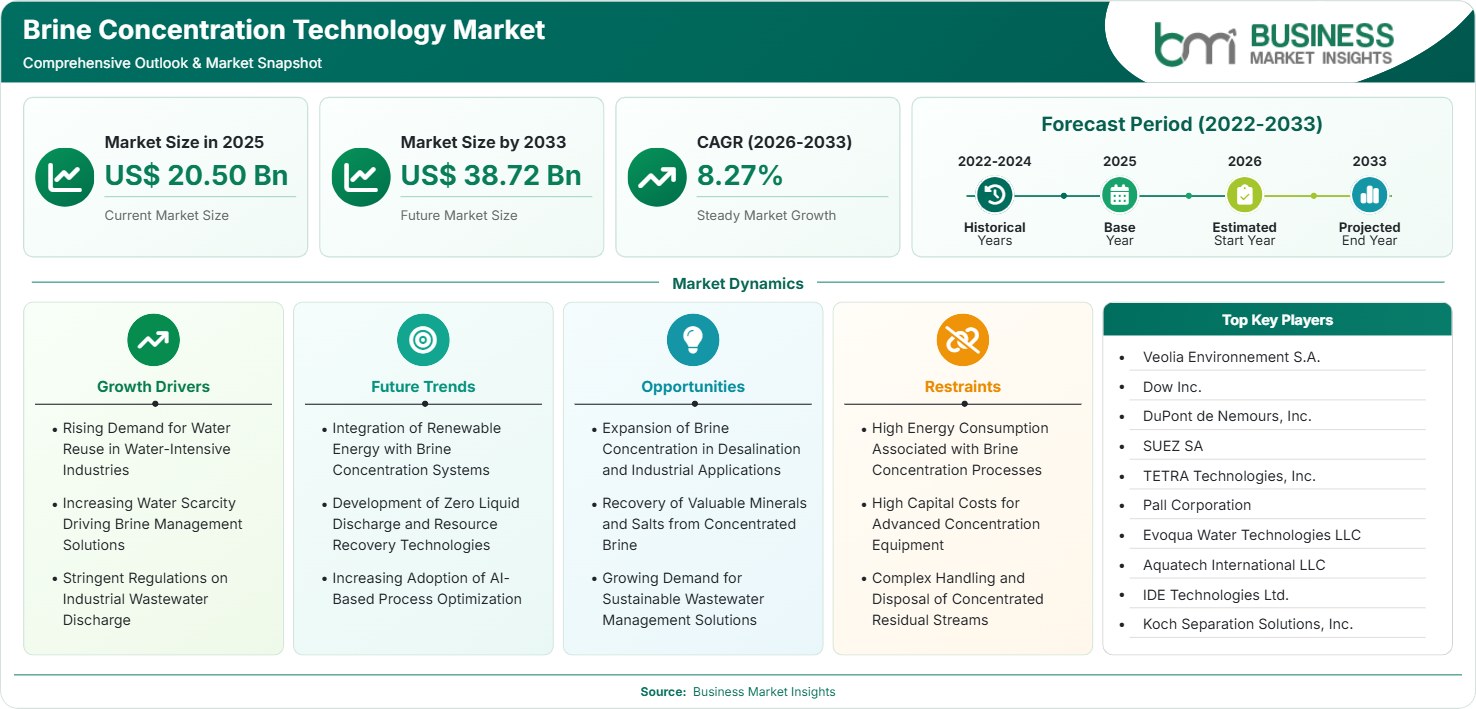
The Brine Concentration Technology market size was valued at US$ 20.50 Billion in 2025 and is projected to reach US$ 38.72 Billion by 2033, growing at a CAGR of 8.27% during 2026–2033, driven by increasing industrial wastewater treatment requirements, rising water scarcity, and opportunities in mineral recovery, desalination, and sustainable resource management.

Report Coverage
  • Technology: High Energy Reverse Osmosis, Closed Circuit Desalination, Vertical Tube Falling Film, Mechanical Vapour Compression
  • Applications: Coal to Chemicals, Food & Beverage, Mineral and Mining, Oil & Gas, Pulp & Paper, Steel & Textile, Power, Others
US$ 20.50 Bn Market size in 2025
US$ 38.72 Bn Market Size by 2033
8.27% CAGR, 2026 - 2033
2026-2033 Forecast Period

AI Overview

Brine Concentration Technology Market Summary

  • North America Region: North America holds a 32%–35% share in 2025, growing with a CAGR of 8.00%–8.50% during 2026–2033, supported by industrial wastewater regulations, desalination expansion, and resource recovery investments. The U.S. market demonstrates strong adoption of advanced concentration systems across energy and manufacturing industries, with a CAGR of 8.10%–8.60% from 2026–2033 due to stricter discharge standards and water reuse initiatives.
  • Fastest Growing Region: Asia Pacific accounts for a 30%–33% share in 2025, expanding at a CAGR of 9.00%–9.50% during 2026–2033, driven by industrialization, freshwater stress, desalination projects, and increasing adoption of zero liquid discharge technologies across emerging economies.
  • Leading Segment: Mechanical Vapour Compression represents a 35%–38% share in 2025, progressing at a CAGR of 8.20%–8.70% during 2026–2033, supported by high evaporation efficiency, industrial wastewater applications, and demand from power, mining, and chemical processing sectors.
  • High Growth Segment: Closed Circuit Desalination is projected to capture a 20%–23% share in 2025, achieving a CAGR of 9.00%–9.50% during 2026–2033, supported by lower energy consumption, improved recovery rates, and growing desalination requirements.
  • Key Market Opportunity: Expansion of advanced concentration systems enables industries to recover valuable minerals, reduce wastewater discharge, improve water efficiency, and support circular economy models through integrated resource recovery solutions.
  • Major Market Players: Veolia Environnement S.A., Dow Inc., DuPont de Nemours, Inc., SUEZ SA, TETRA Technologies, Inc., Pall Corporation, Evoqua Water Technologies LLC, Aquatech International LLC, IDE Technologies Ltd., Koch Separation Solutions, Inc.
Strategic Insights

Brine Concentration Technology Market: Strategic Insights

Brine Concentration Technology Market Strategic Framework
FREE PDF
Request your free sample
Request free sample
Stakeholder View

Key Takeaways

  • The value chain is evolving through stronger collaboration between technology developers, engineering companies, industrial users, and water management providers, enabling integrated concentration systems with improved lifecycle efficiency and operational reliability.
  • Industrial applications including mining, power generation, chemicals, and desalination offer significant expansion potential as companies prioritize wastewater minimization, resource recovery, and compliance with increasingly stringent environmental standards.
  • Technology innovation is shifting toward hybrid membrane and thermal solutions that reduce energy consumption, improve salt recovery rates, and enable customized concentration systems for complex industrial wastewater streams.
  • Asia Pacific presents a strong investment opportunity due to rapid industrialization, increasing freshwater scarcity, and government initiatives supporting desalination, wastewater reuse, and sustainable industrial infrastructure development.
  • Market consolidation is increasing as established water treatment companies acquire specialized technology providers and expand portfolios covering evaporation, membrane separation, and zero liquid discharge solutions.
  • Strategic partnerships between equipment manufacturers and industrial operators are accelerating commercialization of advanced systems designed for high-salinity wastewater and resource recovery applications.
Geographic Outlook

Brine Concentration Technology Market Regional Highlights

North America Brine Concentration Technology Market

North America accounted for a 32%–35% brine concentration technology market share in 2025 and is expected to grow at a CAGR of 8.00%–8.50% during 2026–2033. The region benefits from strict wastewater regulations, industrial water reuse programs, and adoption across energy, chemical, and mining industries. Brine Concentration Technology share remains supported by established treatment infrastructure and increasing demand for sustainable discharge solutions. The Brine Concentration Technology growth outlook is strengthened by investments in advanced desalination and zero liquid discharge systems.

  • The United States represents the largest regional contributor due to industrial wastewater compliance requirements and increasing adoption of advanced concentration equipment across manufacturing sectors.
  • Canada is expanding adoption through mining operations requiring efficient brine management solutions, particularly for mineral extraction and wastewater minimization initiatives.
  • Regulatory focus on water conservation is encouraging industries to invest in closed-loop treatment systems with higher recovery efficiency.
  • Technology providers are developing energy-efficient concentration systems to address operational cost concerns among industrial users.

US Brine Concentration Technology Market

The U.S. accounted for a 25%–28% share of the global market in 2025 and U.S. brine concentration technology market forecast to expand at a CAGR of 8.10%–8.60% between 2026–2033. Industrial wastewater regulations, resource recovery initiatives, and increasing demand from power and chemical industries are shaping adoption. The market benefits from advanced infrastructure, technology availability, and strong investments in water sustainability programs. Growing deployment of zero liquid discharge systems is supporting broader acceptance across industrial applications.

  • Chemical processing industries are adopting concentration systems to manage high-salinity wastewater while improving compliance with environmental standards.
  • Power generation facilities are implementing advanced brine management technologies to reduce wastewater volumes and improve operational sustainability.
  • Mining companies are exploring concentration technologies for recovering valuable minerals from industrial brine streams.

Europe Brine Concentration Technology Market

Europe brine concentration technology market represented a 22%–25% share in 2025 and is estimated to register a CAGR of 7.50%–8.00% during 2026–2033. The region is driven by stringent environmental regulations, circular economy policies, and industrial water efficiency programs. Countries including Germany, France, and the Netherlands are leading adoption, while Spain and Italy demonstrate strong growth potential through desalination and water reuse projects. Increasing sustainability targets are supporting advanced wastewater treatment investments.

  • Germany is advancing adoption through industrial wastewater recycling initiatives and demand for efficient resource recovery technologies.
  • Spain is expanding concentration technology deployment due to desalination requirements and increasing pressure on freshwater resources.
  • France is supporting market development through environmental policies promoting industrial water efficiency and reduced discharge volumes.
  • European manufacturers are focusing on energy optimization to improve the commercial viability of concentration solutions.
  • Regulatory frameworks encouraging circular economy practices are accelerating technology integration across industrial sectors.

Asia Pacific Brine Concentration Technology Market

Asia Pacific brine concentration technology market accounted for a 30%–33% share in 2025 and is expected to achieve the highest CAGR of 9.00%–9.50% during 2026–2033. Industrial expansion, rising water stress, and increasing investments in wastewater treatment infrastructure are accelerating adoption. China, India, Japan, South Korea, and Australia represent key markets, with China and India showing strong growth potential due to manufacturing expansion and government-supported water management programs.

  • China is increasing adoption through chemical, mining, and industrial wastewater treatment applications requiring advanced concentration systems.
  • India is witnessing demand growth due to industrial water scarcity and increasing implementation of zero liquid discharge projects.
  • Japan and South Korea are investing in efficient concentration technologies for advanced manufacturing and semiconductor-related wastewater management.
  • Australia is adopting desalination and resource recovery solutions due to regional freshwater limitations.
  • Industrial modernization initiatives across Asia Pacific are creating opportunities for technology suppliers and engineering service providers.

Rest of World Brine Concentration Technology Market

Rest of World accounted for a 10%–13% share in 2025 and is projected to grow at a CAGR of 7.00%–7.50% during 2026–2033. South and Central America are adopting concentration technologies through mining, energy, and industrial wastewater applications, while Middle East and Africa markets are driven by desalination investments and water scarcity challenges. Countries including Brazil, Chile, Saudi Arabia, and the UAE are strengthening adoption through industrial sustainability programs and water security initiatives.

  • Brazil and Chile are increasing technology adoption through mining activities requiring efficient management of high-salinity wastewater streams and mineral recovery solutions.
  • Middle Eastern countries are investing in advanced desalination infrastructure and concentration systems to improve water availability and reduce disposal challenges.
  • Saudi Arabia and the UAE are supporting market expansion through large-scale water treatment projects and industrial sustainability programs.
  • African markets are exploring concentration technologies for mining operations, municipal water treatment, and industrial wastewater management applications.
  • Latin American industries are adopting resource recovery approaches to improve operational efficiency and reduce environmental impact.
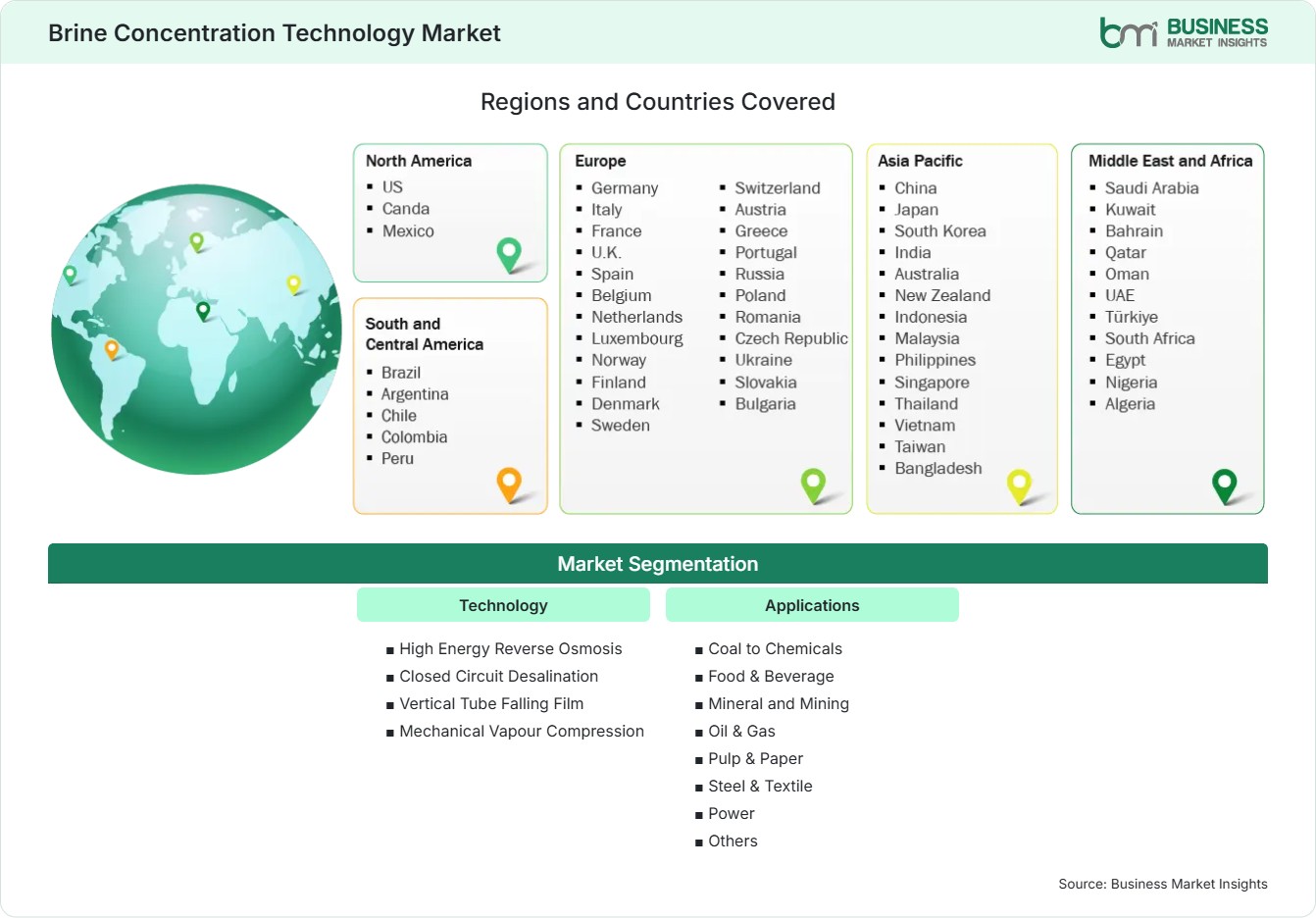
Global Market Geography
FREE PDF
Request your free sample
Request free sample
Segment Analysis

Brine Concentration Technology Market Segmentation

Technology

The technology segment accounted for a 35%–38% brine concentration technology market share in 2025, with a CAGR of 8.20%–8.70% during 2026–2033. Adoption is driven by increasing demand for efficient water recovery, industrial wastewater management, and zero liquid discharge systems. The Brine Concentration Technology scope is expanding as industries seek advanced solutions for reducing disposal costs, recovering valuable resources, and improving sustainability performance across diverse applications.

  • High Energy Reverse Osmosis: High Energy Reverse Osmosis systems improve concentration efficiency by using advanced membrane configurations. These technologies support industrial wastewater treatment, desalination applications, and reduced liquid discharge requirements through improved recovery rates.
  • Closed Circuit Desalination: Closed Circuit Desalination technology enables higher recovery levels with lower energy consumption. It is increasingly adopted in desalination plants and industrial facilities requiring optimized water recovery and minimized brine generation.
  • Vertical Tube Falling Film: Vertical Tube Falling Film systems provide efficient evaporation performance for high-salinity streams. They are used in industries requiring thermal concentration, including chemicals, mining, and industrial wastewater processing applications.
  • Mechanical Vapour Compression: Mechanical Vapour Compression technology remains widely adopted due to energy-efficient evaporation capabilities. It supports large-scale concentration operations in power, chemical, food processing, and mineral recovery industries.

Applications

The applications segment represented a 62%–65% brine concentration technology market share in 2025 and is anticipated to expand at a CAGR of 8.00%–8.50% during 2026–2033. Industrial sectors are implementing concentration technologies to manage wastewater challenges, recover resources, and comply with environmental regulations. Growing adoption across manufacturing and resource-intensive industries is strengthening demand for integrated treatment solutions and sustainable water management practices.

  • Coal to Chemicals: Coal to Chemicals facilities utilize concentration systems to manage complex wastewater streams generated during conversion processes. Adoption is supported by increasing focus on water recycling and environmental compliance.
  • Food & Beverage: Food and beverage industries deploy concentration technologies to reduce wastewater volumes and improve resource efficiency. Growing processing activities and sustainability targets are supporting adoption across production facilities.
  • Mineral and Mining: Mining operations are adopting concentration technologies for mineral recovery, wastewater reduction, and improved management of saline effluents generated during extraction activities.
  • Oil & Gas: Oil and gas companies use concentration systems to treat produced water and industrial brine streams. Technology adoption is driven by stricter environmental standards and operational efficiency requirements.
  • Pulp & Paper: Pulp and paper manufacturers integrate concentration technologies to reduce wastewater discharge and recover process chemicals while improving sustainability performance.
  • Steel & Textile: Steel and textile industries implement concentration solutions for managing industrial wastewater with high dissolved solids and improving compliance with discharge regulations.
  • Power: Power generation facilities adopt concentration technologies to manage cooling water discharge, ash-related wastewater, and high-salinity streams generated during operations.
Market Forces

Brine Concentration Technology Market Dynamics

Rising Demand for Water Reuse in Water-Intensive Industries

The growing water usage within various industries, including mining, electricity production, chemicals, textiles, and food processing, is leading to the demand for advanced brine concentration solutions. There is increased emphasis across industries on adopting water reuse to reduce reliance on freshwater, reduce wastewater generation, and improve operational efficiency. Brine concentration solutions help recover more water by concentrating saline streams that cannot be treated by regular wastewater treatment systems.

Increasing Water Scarcity Driving Brine Management Solutions

The growing shortage of fresh water in industrial zones has led governments and businesses to look for better ways of dealing with the brine problem. Countries experiencing water shortages in the Middle East, Asia Pacific, and some parts of North America have been investing heavily in technologies like desalination, wastewater treatment and water recycling. Brine concentration technologies can be used as solutions for overcoming the problem of saline wastewaters that arise from the desalination process and these factors considered to be brine concentration technology market trend.

Stringent Regulations on Industrial Wastewater Discharge

The increased implementation of stringent environmental policies regarding industrial effluent disposal has boosted the implementation of brine concentration technologies in manufacturing industries. Stringent regulations have been set by regulatory bodies regarding the disposal of wastewater, chemicals, and environmental pollution. Various industries, including mining, oil & gas, energy production, and chemical industries, are increasingly implementing concentration technology in order to adhere to the set standards. Various regions within the industrial sector have zero liquid discharge policies which encourage companies to invest in advanced evaporation and reverse osmosis technologies.

Key Market Opportunities

Expansion of Brine Concentration in Desalination and Industrial Applications

Growing capacities in desalination and industrial wastewater treatment have opened new opportunity for companies specializing in brine concentration technologies. Higher demands for freshwater production in areas facing shortages of freshwater have resulted in increased production of brine that needs proper management. Brine concentration technologies are being considered by various desalination plants to lessen the effects of brine discharge. Moreover, mining, chemicals, power, and manufacturing industries are also using these technologies due to their wastewater production through production processes.

Recovery of Valuable Minerals and Salts from Concentrated Brine

Growing interest in resource recovery from wastewater streams is creating new opportunities for brine concentration technologies beyond conventional treatment applications. Concentrated brine contains valuable materials such as lithium, magnesium, potassium, and industrial salts that can be recovered through advanced processing methods. Increasing demand for critical minerals used in batteries, chemicals, and industrial applications is encouraging companies to explore economically viable extraction techniques. Brine concentration systems support resource recovery by increasing mineral concentration levels and improving downstream extraction efficiency.

Growing Demand for Sustainable Wastewater Management Solutions

The increase in sustainability commitments by industries has raised the demand for sustainable wastewater management technology that minimizes environmental footprint and maximizes efficiency. Industries are moving further than the conventional wastewater management methods and are using technology that allows them to recover water, minimize waste, and optimize operations. Brine concentration systems are useful in sustainable wastewater management as they help to minimize liquid discharge, enhance reuse, and integrate with resource recovery processes.

Market Restraints and Challenges

High Energy Consumption Associated with Brine Concentration Processes

Factor: Brine concentration techniques, especially those involving thermal evaporation, demand considerable amounts of energy for water extraction from salty water flows. Impact: High energy consumption raises production costs and might limit implementation in industries experiencing fluctuations in the price of energy or poor access to cheap sources of energy. Even though the introduction of advanced techniques like mechanical vapour compression, heat recovery, and combined techniques is contributing towards reducing the energy burden, energy use continues to be a significant barrier.

High Capital Costs for Advanced Concentration Equipment

Factor: The adoption of advanced brine concentration systems involves high capital expenditures owing to the use of special machinery, corrosion-resistant material, complex engineering, and installation needs. Impact: Capital-intensive projects may face delays in implementation, particularly for smaller industries with smaller budgets. Big plants might need customized projects depending on the chemical characteristics of the water and treatment capabilities. Although there have been efforts to minimize capital expenditures through modular systems and cost-efficient technologies.

Company Analysis

Competitive Landscape

The Brine Concentration Technology market analysis highlights a competitive environment shaped by global water treatment companies, specialized technology providers, and engineering organizations offering thermal concentration, membrane solutions, and integrated wastewater management systems.

Company Name

Overview

Products and Services relevant to this market

Veolia Environnement S.A.

Global environmental services company providing water management and industrial treatment solutions across multiple sectors.

Brine management, wastewater treatment, desalination solutions, zero liquid discharge systems, and advanced concentration technologies.

Dow Inc.

Multinational materials science company developing membrane technologies for water purification applications.

Reverse osmosis membranes, separation technologies, and advanced materials supporting brine concentration processes.

DuPont de Nemours, Inc.

Technology provider offering advanced water treatment solutions through specialized filtration technologies.

Reverse osmosis membranes, ion exchange technologies, and industrial water treatment solutions.

SUEZ SA

Global water and environmental solutions company supporting industrial water management projects.

Desalination systems, wastewater treatment, resource recovery, and brine management solutions.

TETRA Technologies, Inc.

Energy services company providing water management solutions for industrial applications.

Produced water treatment, water recycling solutions, and concentration technologies for energy sectors.

Pall Corporation

Filtration technology provider serving industrial and water treatment markets worldwide.

Membrane filtration, separation solutions, and advanced purification technologies.

Evoqua Water Technologies LLC

Water treatment company specializing in industrial and municipal water solutions.

Wastewater treatment systems, desalination technologies, and water reuse solutions.

Aquatech International LLC

Engineering company focused on industrial water purification and reuse systems.

Zero liquid discharge systems, evaporation technologies, and brine concentration solutions.

IDE Technologies Ltd.

Desalination and water treatment technology company operating global projects.

Desalination plants, thermal processes, and advanced brine management systems.

Koch Separation Solutions, Inc.

Separation technology company providing filtration and processing solutions.

Membrane filtration, evaporation systems, and industrial concentration technologies.

Trust & Transparency

Research Methodology

The market analysis combines proprietary research with secondary data from government agencies, company disclosures, regulatory filings, industry databases and expert interviews. Market estimates are validated through data triangulation, cross-market benchmarking and analyst review.

View Full Research Methodology

Questions Answered

Frequently Asked Questions

How will future innovations impact the Brine Concentration Technology market Report outlook?

The Brine Concentration Technology Report outlook will be influenced by advancements in membrane materials, digital monitoring, automation, and resource recovery solutions supporting sustainable industrial operations.

What factors influence technology selection for industrial brine treatment projects?

Technology selection depends on wastewater composition, required recovery rate, energy availability, regulatory requirements, and the value potential of recovered resources.

How are companies reducing energy consumption in brine concentration processes?

Companies are developing hybrid membrane-thermal systems, improved evaporation technologies, and energy recovery solutions to lower operational costs and improve overall treatment efficiency.

What role does mineral recovery play in brine concentration systems?

Mineral recovery enables industries to extract valuable materials such as salts and lithium from concentrated streams, improving project economics while reducing wastewater disposal requirements.

Which industries are adopting Brine Concentration Technology market most rapidly?

Industries including mining, power generation, chemicals, desalination, and oil & gas are adopting these systems due to wastewater regulations, resource recovery requirements, and increasing water reuse priorities.

Access the Full Brine Concentration Technology Market Report

Get segment-level forecasts, regional estimates, competitive benchmarking, company profiles and downloadable Excel datasets.

Access the full Brine Concentration Technology Market Report
350 pages PDF & Excel | 2026-08-25
Similar Research

Related Market Reports