BRICS Cancer Hormone Therapy Market (2021–2031)

Historic Data: 2021-2023   |   Base Year: 2024   |   Forecast Period: 2025-2031
Report Content: Market Scope, Market Segmentation, Market Dynamics, and Competitive Analysis

Report Coverage:
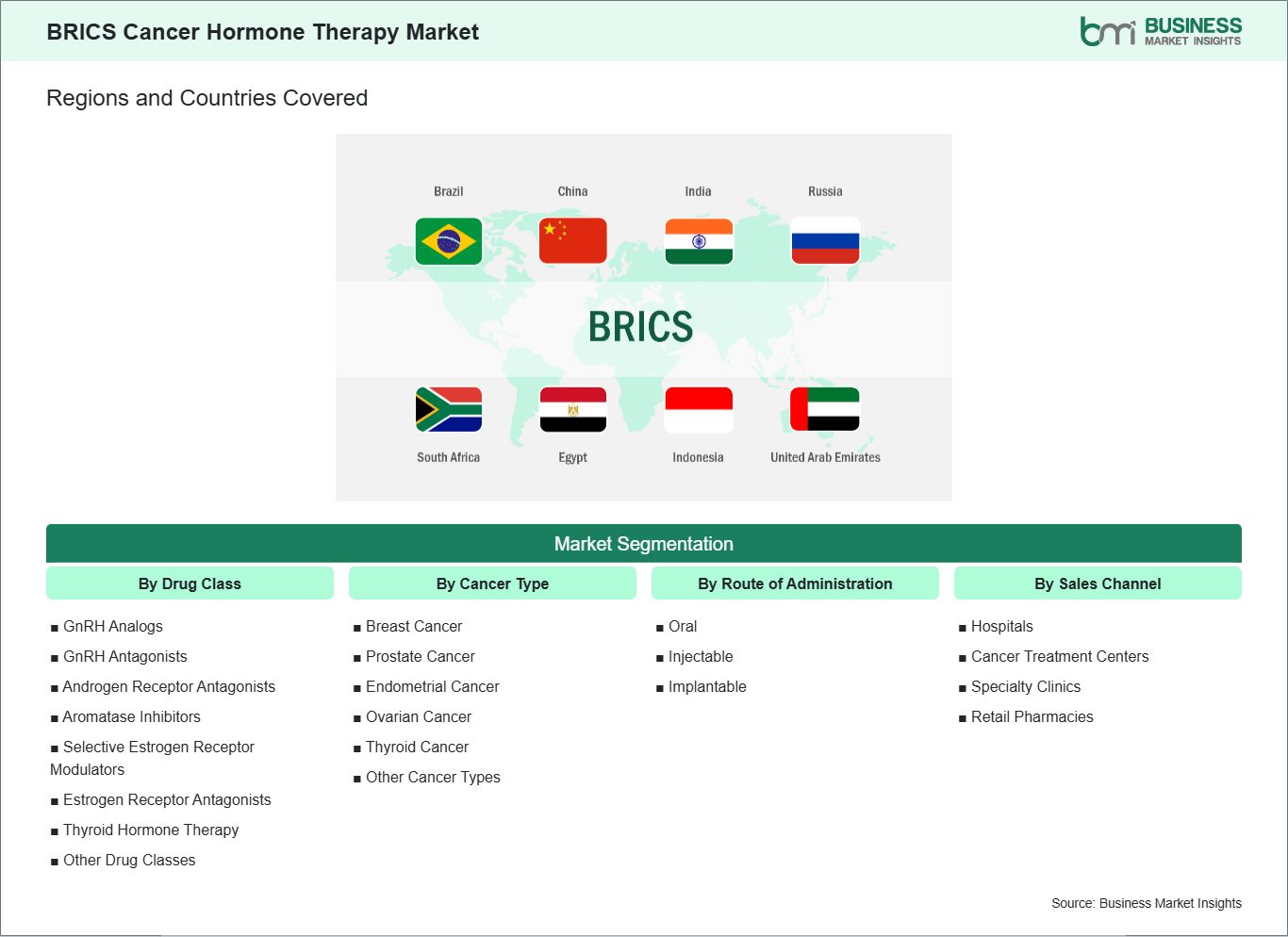
  • Drug Class (GnRH Analogs, GnRH Antagonists, Androgen Receptor Antagonists, Aromatase Inhibitors, Selective Estrogen Receptor Modulators, Estrogen Receptor Antagonists, Thyroid Hormone Therapy, Other Drug Classes)
  • Cancer Type (Breast Cancer, Prostate Cancer, Endometrial Cancer, Ovarian Cancer, Thyroid Cancer, Other Cancer Types)
  • Route of Administration (Oral, Injectable, Implantable)
  • Sales Channel (Hospitals, Cancer Treatment Centers, Specialty Clinics, Retail Pharmacies)

No. of Pages: 125
Report Code: BMIPUB00033437
Category: Life Sciences
BRICS Cancer Hormone Therapy Market
Buy Now

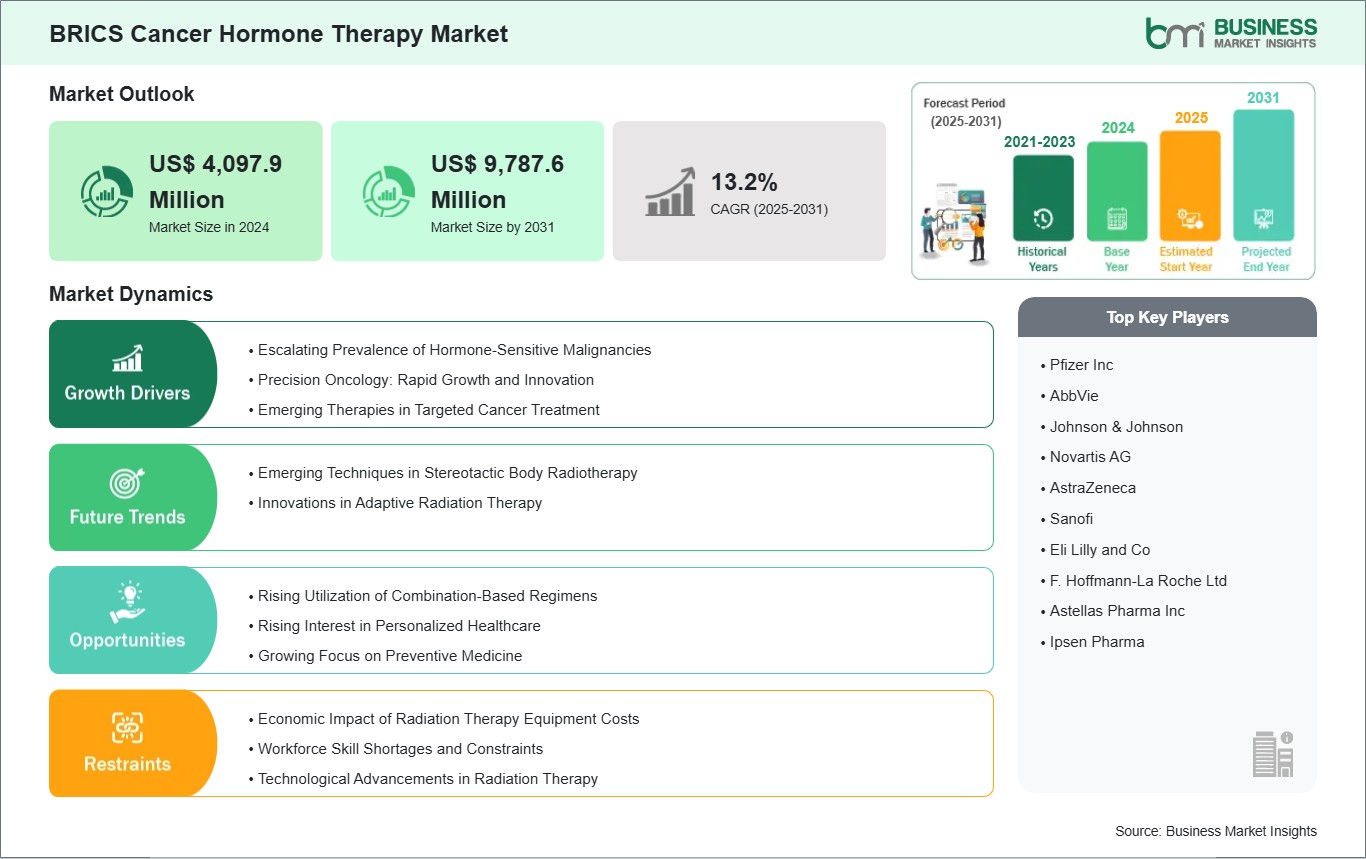
The BRICS cancer hormone therapy market size is expected to reach US$ 9,787.6 million by 2031 from US$ 4,097.9 million in 2024. The market is estimated to record a CAGR of 13.2% from 2025 to 2031.

Executive Summary and BRICS Cancer Hormone Therapy Market Analysis:

The Cancer Hormone Therapy market in the BRICS region is evolving rapidly, driven by increasing awareness of hormone-sensitive cancers such as breast and prostate cancer and a growing focus on personalized treatment approaches. Among the BRICS nations, China plays a leading role, influencing regional trends due to its extensive healthcare infrastructure, emphasis on oncology research, and early adoption of innovative therapies. Across the region, the rising interest in hormone therapy is fueled by a shift towards targeted, less invasive cancer treatments and the integration of hormone therapy with broader cancer management strategies.

Key drivers include advances in therapy design, better diagnostic tools for hormone-responsive cancers, and a growing patient population seeking alternatives to conventional chemotherapy. However, the market faces challenges such as unequal access to healthcare services in rural areas, differences in treatment availability across countries, and variations in awareness and physician adoption. Overall, the BRICS Cancer Hormone Therapy market is marked by a dynamic interplay between medical innovation, clinical demand, and regional healthcare disparities, setting the stage for continued evolution in treatment approaches and patient care strategies.

BRICS Cancer Hormone Therapy Market - Strategic Insights:

global-market-strategic-framework
Get more information on this report

BRICS Cancer Hormone Therapy Market Segmentation Analysis:

Key segments that contributed to the derivation of the BRICS cancer hormone therapy market analysis are drug class, cancer type, route of administration, and sales channel.

  • By drug class, the cancer hormone therapy market is segmented into GnRH analogs, GnRH antagonists, androgen receptor antagonists, aromatase inhibitors, selective estrogen receptor modulators, estrogen receptor antagonists, thyroid hormone therapy, and others. The GnRH analogs segment dominated the market in 2024.
  • By cancer type, the cancer hormone therapy market is segmented into breast cancer, prostate cancer, endometrial cancer, ovarian cancer, thyroid cancer, and others. The breast cancer segment dominated the market in 2024.
  • By route of administration, the cancer hormone therapy is segmented into oral, injectable, and implantable. The oral segment dominated the market in 2024.
  • By sales channel, the cancer hormone therapy market is segmented into hospitals, cancer treatment centers, specialty clinics, and retail pharmacies. The hospitals segment dominated the market in 2024.

BRICS Cancer Hormone Therapy Market Drivers and Opportunities:

Escalating Prevalence of Hormone-Sensitive Malignancies

Breast cancer has emerged as the most common cancer among women across Brazil, Russia, India, and China, with hormone receptor–positive (HR+) subtypes representing a significant share of cases. In men, prostate cancer incidence is increasing, particularly in Russia and Brazil, as life expectancy rises and screening becomes more common. These trends create a growing demand for endocrine therapies across early-stage, adjuvant, and advanced disease settings.

In Brazil and China, expanding urban oncology centers provide broad access to guideline-based care, while rural areas may face delayed diagnoses and limited therapy options. Russia’s well-established oncology network ensures the availability of standard endocrine treatments, but late-stage presentations remain frequent in remote regions. India’s public and private healthcare mix results in variable access, with metropolitan centers offering advanced hormone therapy regimens while smaller hospitals rely on conventional agents.

Beyond breast and prostate cancer, other hormone-sensitive malignancies—including select endometrial and ovarian cancers— contribute to the treatment burden. Improvements in pathology services and hormone receptor testing are gradually enhancing the identification of eligible patients, allowing clinicians to optimize therapy selection and monitor for resistance.

Rising Utilization of Combination-Based Regimens

Combination hormone therapy regimens are integrated into cancer care in the BRICS nations, particularly for advanced or high-risk disease. In HR+ breast cancer, physicians combine aromatase inhibitors or selective estrogen receptor modulators with ovarian suppression or other systemic agents to extend progression-free survival. Such approaches are becoming standard in urban oncology centers in Brazil, China, and Russia, where multidisciplinary teams support evidence-based decision-making.

Prostate cancer management is evolving, with androgen deprivation therapy frequently paired with novel anti-androgens or chemohormonal strategies for metastatic or high-risk patients. In China and Russia, these combinations are supported by national treatment guidelines. In India and Brazil, the adoption is increasing in private and academic hospitals, highlighting growing alignment with international clinical standards.

The expansion of combination regimens is facilitated by increasing access to diagnostic services, pathology, and tumor boards, which help personalize therapy according to disease stage, biomarker status, and patient factors. Regional collaborations and educational initiatives are supporting the standardization of hormone therapy protocols, enabling clinicians to optimize treatment efficacy and reduce adverse effects. Combination hormone therapy is becoming a central feature of modern cancer management across the region.

BRICS Cancer Hormone Therapy Market Size and Share Analysis:

The BRICS cancer hormone therapy market demonstrates steady growth, with size and share analysis highlighting evolving trends and competitive dynamics among key players. The report further examines subsegments categorized within drug class, cancer type, route of administration, and sales channel, highlighting their respective contributions to overall market performance.

By drug class, the GnRH analogs subsegment dominated the market in 2024. Their proven efficacy in hormone-dependent cancers, widespread clinical adoption, established safety profile, and ability to effectively suppress gonadotropin release make them a cornerstone of endocrine-based cancer therapies.

Per cancer type, the breast cancer subsegment dominated the market in 2024, driven by the high global prevalence of breast cancer, increasing awareness and screening programs, strong reliance on hormone-based treatments, and continuous advancements in targeted and combination therapies.

By route of administration, the oral subsegment dominated the market in 2024. Oral therapies are preferred due to their ease of administration, improved patient compliance, convenience for long-term treatment, reduced need for hospital visits, and growing availability of effective oral oncology drugs.

Per sales channel, the hospitals subsegment dominated the market in 2024. Hospitals remain the primary distribution channel as they offer comprehensive cancer care, access to specialized oncology pharmacists, advanced treatment infrastructure, and integrated diagnostic and therapeutic services, ensuring efficient delivery of cancer medications.

BRICS Cancer Hormone Therapy Market Report Highlights:

Report Attribute Details
Market size in 2024 US$ 4,097.9 Million
Market Size by 2031 US$ 9,787.6 Million
CAGR (2025 - 2031)13.2%
Historical Data 2021-2023
Forecast period 2025-2031
Segments Covered By Drug Class
  • GnRH Analogs
  • GnRH Antagonists
  • Androgen Receptor Antagonists
  • Aromatase Inhibitors
  • Selective Estrogen Receptor Modulators
  • Estrogen Receptor Antagonists
  • Thyroid Hormone Therapy
  • Other Drug Classes
By Cancer Type
  • Breast Cancer
  • Prostate Cancer
  • Endometrial Cancer
  • Ovarian Cancer
  • Thyroid Cancer
  • Other Cancer Types
By Route of Administration
  • Oral
  • Injectable
  • Implantable
By Sales Channel
  • Hospitals
  • Cancer Treatment Centers
  • Specialty Clinics
  • Retail Pharmacies
Regions and Countries Covered BRICS
  • Russia
  • Brazil
  • South Africa
  • India
  • China
  • Egypt
  • Indonesia
  • Saudi Arabia
  • United Arab Emirates
Market leaders and key company profiles
  • Pfizer Inc
  • AbbVie
  • Johnson & Johnson
  • Novartis AG
  • AstraZeneca
  • Sanofi
  • Eli Lilly and Co
  • F. Hoffmann-La Roche Ltd
  • Astellas Pharma Inc
  • Ipsen Pharma
Get more information on this report

BRICS Cancer Hormone Therapy Market Report Coverage and Deliverables:

The "BRICS Cancer Hormone Therapy Market Size and Forecast (2021–2031)" report provides a detailed analysis of the market covering below areas:

  • BRICS Cancer Hormone Therapy market size and forecast at regional, and country levels for all the key market segments covered under the scope
  • BRICS Cancer Hormone Therapy market trends, as well as market dynamics such as drivers, restraints, and key opportunities
  • BRICS Cancer Hormone Therapy market analysis covering key market trends, regional framework, major players, regulations, and recent market developments
  • Industry landscape and competition analysis covering market concentration, heat map analysis, prominent players, and recent developments for the BRICS Cancer Hormone Therapy market
  • Detailed company profiles, including SWOT analysis

BRICS Cancer Hormone Therapy Market Geographic Insights:

The geographical scope of the BRICS Cancer Hormone Therapy market report is divided into: Russia, Brazil, South Africa, India, China, Egypt, Indonesia, Saudi Arabia, and the UAE. China held the largest share in 2024.

China dominates the market due to its extensive healthcare system, increasing focus on cancer care, and strong clinical research capabilities. Hormone therapies are integrated into treatment protocols for hormone-sensitive cancers, reflecting growing clinician expertise and patient acceptance. Urban oncology centers, academic hospitals, and specialized cancer institutes are leading the adoption of hormone therapy as part of comprehensive, personalized treatment plans.

China’s pharmaceutical ecosystem supports this dominance, with domestic and multinational companies developing hormone therapy drugs and conducting clinical research locally. These efforts have improved availability and familiarity with newer hormone treatments, enabling physicians to explore combination therapies and tailor treatment strategies to patient needs. Challenges remain, particularly in ensuring equitable access to care in less developed regions and aligning treatment options with healthcare policy priorities. Nevertheless, China’s focus on early detection, treatment innovation, and infrastructure development positions it as a key leader in hormone therapy within the region.

global-market-geography
Get more information on this report

BRICS Cancer Hormone Therapy Market Research Report Guidance:

  • The report includes qualitative and quantitative data in the BRICS cancer hormone therapy market across drug class, cancer type, route of administration, sales channel, and geography.
  • The report starts with the key takeaways (chapter 2), highlighting the key trends and outlook of the BRICS Cancer Hormone Therapy market.
  • Chapter 3 includes the research methodology of the study.
  • Chapter 4 further includes ecosystem analysis.
  • Chapter 5 highlights the major industry dynamics in the BRICS Cancer Hormone Therapy market, including factors that are driving the market, prevailing deterrents, potential opportunities, as well as future trends. Impact analysis of these drivers and restraints is also covered in this section.
  • Chapter 6 discusses the BRICS Cancer Hormone Therapy market scenario, in terms of historical market revenues, and forecast till the year 2031.
  • Chapters 7 to 11 cover the BRICS Cancer Hormone Therapy market segments by drug class, cancer type, route of administration, sales channel, and geography across Russia, Brazil, South Africa, India, China, Egypt, Indonesia, Saudi Arabia, and the UAE. They cover the market revenue, forecast, and factors driving the market.
  • Chapter 12 describes the competitive analysis along with the heat map analysis for the key players operating in the market.
  • Chapter 13 describes the industry landscape analysis. It provides detailed descriptions of business activities such as market initiatives, new developments, mergers, and joint ventures globally, along with a competitive landscape.
  • Chapter 14 provides detailed profiles of the major companies operating in the BRICS Cancer Hormone Therapy market. Companies have been profiled on the basis of their key facts, business descriptions, products, financial overview, SWOT analysis, and key developments.
  • Chapter 15, i.e., the appendix, is inclusive of a brief overview of the company, list of abbreviations, and disclaimer.

BRICS Cancer Hormone Therapy Market News and Key Development:

The BRICS Cancer Hormone Therapy market is evaluated by gathering qualitative and quantitative data post primary and secondary research, which includes important corporate publications, association data, and databases. A few of the key developments in the BRICS cancer hormone therapy market are:

  • In December 2025, Daiichi Sankyo and AstraZeneca announced that their ENHERTU (trastuzumab deruxtecan) was approved by China’s National Medical Products Administration (NMPA) for adult patients with unresectable or metastatic hormone receptor (HR)‑positive, HER2‑low or HER2‑ultralow breast cancer after progression on one or more endocrine therapies, marking a major oncology regulatory milestone in China.
  • In May 2025, AstraZeneca India Pharma Ltd. announced that its antibody‑drug conjugate trastuzumab deruxtecan received Central Drugs Standard Control Organization (CDSCO) approval in India for an additional indication to treat adult patients with unresectable or metastatic HER2‑low and HER2‑ultralow breast cancer who have received at least one endocrine therapy, enhancing targeted therapy options for hormone receptor‑positive breast cancer in the Indian market.

Key Sources Referred:

  • The World Bank
  • World Health Organization (WHO)
  • Center for Disease Control and Prevention (CDC)
  • American Association for Cancer Research (AACR)
  • National Cancer Institute (NCI)
  • American Society of Clinical Oncology (ASCO)
  • European Society for Medical Oncology (ESMO)
  • Company Websites
  • Company Annual Reports
  • Company Investor Presentations

The List of Companies - BRICS Cancer Hormone Therapy Market

  • Pfizer Inc
  • AbbVie
  • Johnson & Johnson
  • Novartis AG
  • AstraZeneca
  • Sanofi
  • Eli Lilly and Co
  • F. Hoffmann-La Roche Ltd
  • Astellas Pharma Inc
  • Ipsen Pharma
Frequently Asked Questions
How big is the BRICS Cancer Hormone Therapy Market?

The BRICS Cancer Hormone Therapy Market is valued at US$ 4,097.9 Million in 2024, it is projected to reach US$ 9,787.6 Million by 2031.

What is the CAGR for BRICS Cancer Hormone Therapy Market by (2025 - 2031)?

As per our report BRICS Cancer Hormone Therapy Market, the market size is valued at US$ 4,097.9 Million in 2024, projecting it to reach US$ 9,787.6 Million by 2031. This translates to a CAGR of approximately 13.2% during the forecast period.

What segments are covered in this report?

The BRICS Cancer Hormone Therapy Market report typically cover these key segments-

  • Drug Class (GnRH Analogs, GnRH Antagonists, Androgen Receptor Antagonists, Aromatase Inhibitors, Selective Estrogen Receptor Modulators, Estrogen Receptor Antagonists, Thyroid Hormone Therapy, Other Drug Classes)
  • Cancer Type (Breast Cancer, Prostate Cancer, Endometrial Cancer, Ovarian Cancer, Thyroid Cancer, Other Cancer Types)
  • Route of Administration (Oral, Injectable, Implantable)
  • Sales Channel (Hospitals, Cancer Treatment Centers, Specialty Clinics, Retail Pharmacies)

What is the historic period, base year, and forecast period taken for BRICS Cancer Hormone Therapy Market?

The historic period, base year, and forecast period can vary slightly depending on the specific market research report. However, for the BRICS Cancer Hormone Therapy Market report:

  • Historic Period : 2021-2023
  • Base Year : 2024
  • Forecast Period : 2025-2031
  • Who are the major players in BRICS Cancer Hormone Therapy Market?

    The BRICS Cancer Hormone Therapy Market is populated by several key players, each contributing to its growth and innovation. Some of the major players include:

  • Pfizer Inc
  • AbbVie
  • Johnson & Johnson
  • Novartis AG
  • AstraZeneca
  • Sanofi
  • Eli Lilly and Co
  • F. Hoffmann-La Roche Ltd
  • Astellas Pharma Inc
  • Ipsen Pharma
  • Who should buy this report?

    The BRICS Cancer Hormone Therapy Market report is valuable for diverse stakeholders, including:

    • Investors: Provides insights for investment decisions pertaining to market growth, companies, or industry insights. Helps assess market attractiveness and potential returns.
    • Industry Players: Offers competitive intelligence, market sizing, and trend analysis to inform strategic planning, product development, and sales strategies.
    • Suppliers and Manufacturers: Helps understand market demand for components, materials, and services related to concerned industry.
    • Researchers and Consultants: Provides data and analysis for academic research, consulting projects, and market studies.
    • Financial Institutions: Helps assess risks and opportunities associated with financing or investing in the concerned market.

    Essentially, anyone involved in or considering involvement in the BRICS Cancer Hormone Therapy Market value chain can benefit from the information contained in a comprehensive market report.

    Available Report Formats

    pdf-format excel-format pptx-format
    Buy Now

    Customization Form

    Please tell us your area of interest
    (Market Segments/ Regions and Countries/ Companies)