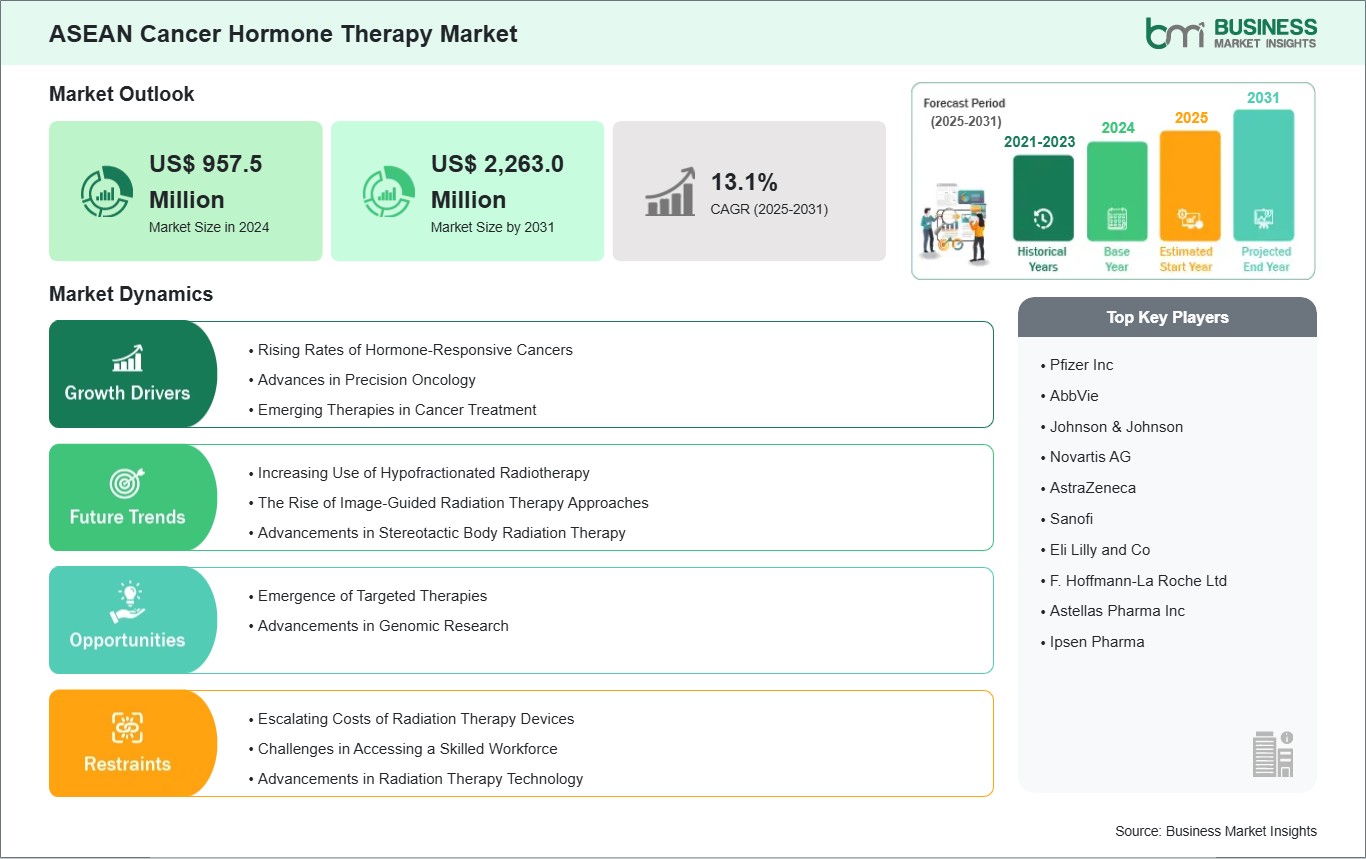
The ASEAN cancer hormone therapy market size is expected to reach US$ 2,263.0 million by 2031 from US$ 957.5 million in 2024. The market is estimated to record a CAGR of 13.1% from 2025 to 2031.
Hormone therapies are recognized for their role in managing hormone-sensitive cancers such as breast and prostate cancer, particularly as countries modernize their healthcare systems and improve early detection capabilities. The adoption of hormone therapy in ASEAN is driven by enhanced clinical guidelines, the integration of endocrine therapies into hospital oncology programs, and the growing availability of trained oncologists in urban centers. Public health initiatives and regional collaborations to improve cancer care access contribute to market growth, especially in countries emphasizing advanced treatment options alongside conventional chemotherapy and radiotherapy. However, healthcare infrastructure varies widely between urbanized nations and lower-income countries, limiting the reach of hormone therapy in rural and underserved areas. Challenges such as cost barriers, inconsistent supply chains, and uneven clinician training affect market penetration, making the therapy more prevalent in high-income urban centers while less accessible in peripheral regions.

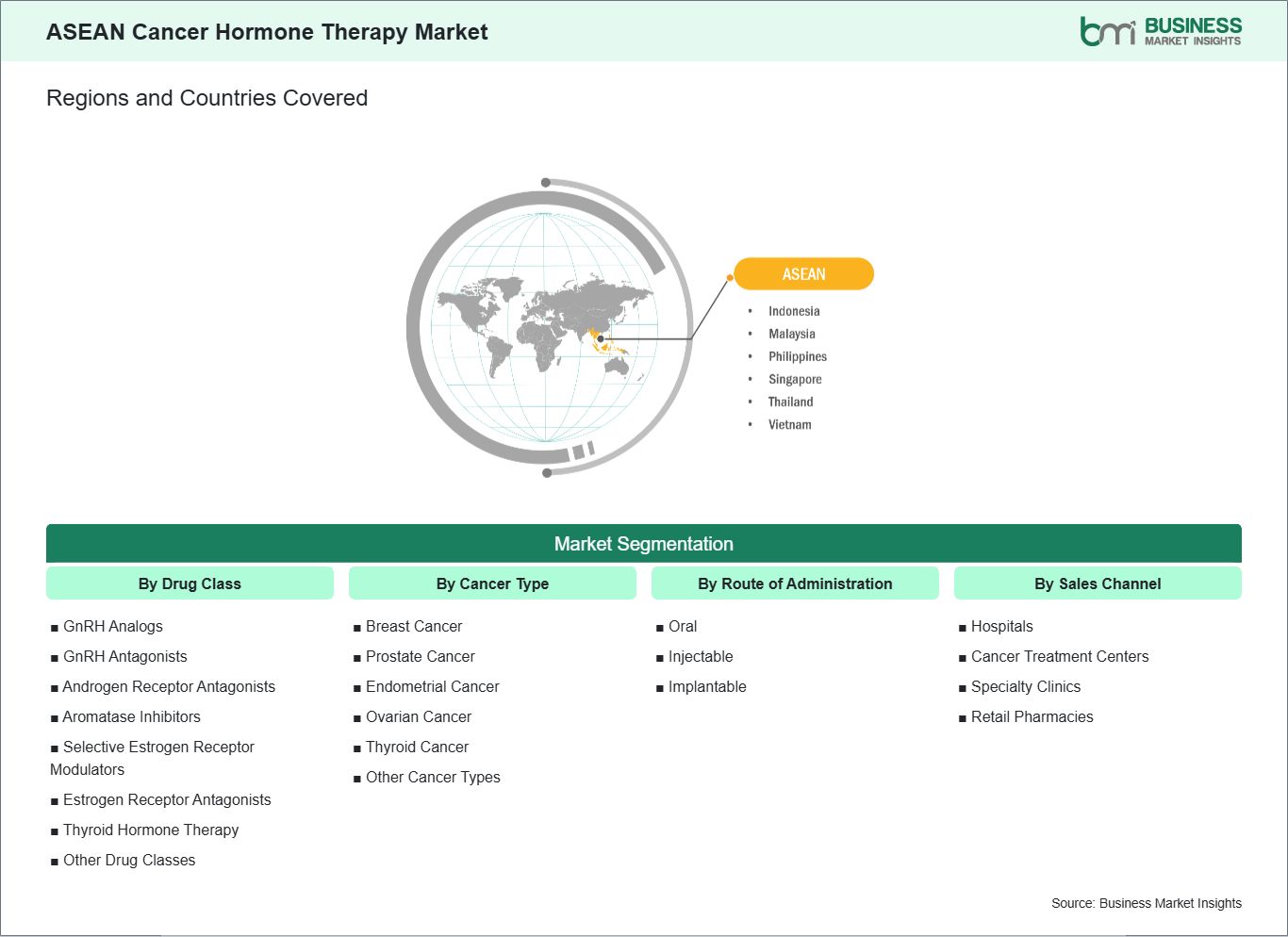
Key segments that contributed to the derivation of the ASEAN cancer hormone therapy market analysis are drug class, cancer type, route of administration, and sales channel.
In the region, hormone-responsive cancers are rising sharply as population growth, urbanization, and lifestyle transitions converge with improved cancer awareness and screening. Breast cancer is the most prevalent malignancy among women across Indonesia, Thailand, Malaysia, Vietnam, and the Philippines, with a substantial proportion classified as estrogen or progesterone receptor–positive. Prostate cancer is increasingly diagnosed in men, particularly in Singapore, Malaysia, and Thailand, reflecting both aging populations and wider use of PSA testing in urban centers. While incidence rates vary, earlier detection and expanding survivorship are driving a steady increase in hormone therapy demand.
Rising obesity, physical inactivity, and adoption of Westernized diets in urban areas elevate estrogen-mediated breast cancer risk, while later age at childbirth and reduced breastfeeding duration are additional factors. In Singapore and Malaysia, national registries indicate that a growing fraction of breast cancer cases are hormone receptor–positive, underscoring the expanding need for endocrine treatment. Male populations are increasingly diagnosed with early-stage prostate cancer, increasing the pool of patients eligible for androgen-deprivation therapy.
Healthcare infrastructure across ASEAN shapes how hormone therapy is deployed. Advanced centers in Singapore, Thailand, and Malaysia are equipped to deliver oral and injectable endocrine therapies, while emerging economies such as Indonesia and the Philippines rely on centralized cancer centers for distribution. National cancer control programs are standardizing hormone therapy protocols, with essential medicines lists supporting access to tamoxifen, aromatase inhibitors, and LHRH analogs. As awareness and early diagnosis improve, long-term management with hormone therapy is expected to become an integral part of oncology care across the region.
Combination therapy involving hormone agents is gaining momentum in ASEAN, particularly in middle- and high-income countries. In hormone receptor–positive breast cancer, combinations of aromatase inhibitors or fulvestrant with CDK4/6 inhibitors or mTOR inhibitors are increasingly adopted in Singapore, Malaysia, and Thailand, supported by public-private reimbursement schemes and guideline endorsements. These regimens allow earlier intervention in advanced disease, increasing treatment duration and per-patient consumption of endocrine agents.
Prostate cancer treatment is evolving toward combination approaches. Androgen-deprivation therapy paired with next-generation androgen receptor inhibitors or chemotherapeutic agents is gradually being introduced in Singapore, Malaysia, and urban hospitals in Thailand. While adoption is uneven in lower-resource settings, sequential hormone strategies are utilized to extend disease control. These combination regimens enhance the role of endocrine therapy as the backbone of multimodal management and create new demand opportunities for oral and injectable formulations.
Policy support, regional partnerships, and clinical capacity building are accelerating combination therapy uptake. Health technology assessments in Singapore and Thailand recognize progression-free survival and patient-reported outcomes, facilitating coverage for advanced regimens. Cross-country training initiatives and regional oncology networks promote adherence to international guidelines, while pharmaceutical access programs improve the availability of newer agents in emerging ASEAN markets. As precision medicine and guideline-driven therapy expand, combination hormone regimens are positioned to drive sustained growth for the ASEAN cancer hormone therapy market.

The ASEAN cancer hormone therapy market demonstrates steady growth, with size and share analysis highlighting evolving trends and competitive dynamics among key players. The report further examines subsegments categorized within drug class, cancer type, route of administration, and sales channel, highlighting their respective contributions to overall market performance.
By drug class, the GnRH analogs subsegment dominated the market in 2024. Their proven efficacy in hormone-dependent cancers, widespread clinical adoption, established safety profile, and ability to effectively suppress gonadotropin release make them a cornerstone of endocrine-based cancer therapies.
Per cancer type, the breast cancer subsegment dominated the market in 2024, driven by the high global prevalence of breast cancer, increasing awareness and screening programs, strong reliance on hormone-based treatments, and continuous advancements in targeted and combination therapies.
By route of administration, the oral subsegment dominated the market in 2024. Oral therapies are preferred due to their ease of administration, improved patient compliance, convenience for long-term treatment, reduced need for hospital visits, and growing availability of effective oral oncology drugs.
Per sales channel, the hospitals subsegment dominated the market in 2024. Hospitals remain the primary distribution channel as they offer comprehensive cancer care, access to specialized oncology pharmacists, advanced treatment infrastructure, and integrated diagnostic and therapeutic services, ensuring efficient delivery of cancer medications.
| Report Attribute | Details |
|---|---|
| Market size in 2024 | US$ 957.5 Million |
| Market Size by 2031 | US$ 2,263.0 Million |
| CAGR (2025 - 2031) | 13.1% |
| Historical Data | 2021-2023 |
| Forecast period | 2025-2031 |
| Segments Covered | By Drug Class
|
| Regions and Countries Covered | ASEAN
|
| Market leaders and key company profiles |
|
The "ASEAN Cancer Hormone Therapy Market Size and Forecast (2021–2031)" report provides a detailed analysis of the market covering below areas:
The geographical scope of the ASEAN Cancer Hormone Therapy market report is divided into: Indonesia, Malaysia, the Philippines, Singapore, Thailand, and Vietnam. Singapore held the largest share in 2024.
Singapore benefits from its highly developed healthcare system, strong regulatory framework, and robust oncology infrastructure. Hospitals routinely offer comprehensive cancer care, integrating hormone therapy as a key treatment for hormone-sensitive cancers such as breast and prostate cancer. Clinical practice emphasizes early detection, personalized treatment plans, and long-term management using endocrine therapies, reflecting patient demand and evidence-based protocols. Singapore’s oncology ecosystem includes specialized cancer centers, advanced diagnostic laboratories, and a well-trained pool of oncologists, allowing for the timely initiation and monitoring of hormone therapy. The government actively promotes access to innovative treatments through healthcare policies and public-private partnerships, which facilitate the use of hormone therapy in public and private sectors. Despite its leadership, Singapore still faces challenges related to the high cost of treatment and the need for continued patient education on long-term adherence to hormone therapy. The country serves as a benchmark within ASEAN, setting standards that influence clinical practices and therapy adoption in neighboring countries with less developed oncology systems.

The ASEAN Cancer Hormone Therapy market is evaluated by gathering qualitative and quantitative data post primary and secondary research, which includes important corporate publications, association data, and databases. A few of the key developments in the ASEAN cancer hormone therapy market are:
The ASEAN Cancer Hormone Therapy Market is valued at US$ 957.5 Million in 2024, it is projected to reach US$ 2,263.0 Million by 2031.
As per our report ASEAN Cancer Hormone Therapy Market, the market size is valued at US$ 957.5 Million in 2024, projecting it to reach US$ 2,263.0 Million by 2031. This translates to a CAGR of approximately 13.1% during the forecast period.
The ASEAN Cancer Hormone Therapy Market report typically cover these key segments-
The historic period, base year, and forecast period can vary slightly depending on the specific market research report. However, for the ASEAN Cancer Hormone Therapy Market report:
The ASEAN Cancer Hormone Therapy Market is populated by several key players, each contributing to its growth and innovation. Some of the major players include:
The ASEAN Cancer Hormone Therapy Market report is valuable for diverse stakeholders, including:
Essentially, anyone involved in or considering involvement in the ASEAN Cancer Hormone Therapy Market value chain can benefit from the information contained in a comprehensive market report.
Please tell us your area of interest
(Market Segments/ Regions and Countries/ Companies)