Market Summary
Executive Summary and Market Analysis
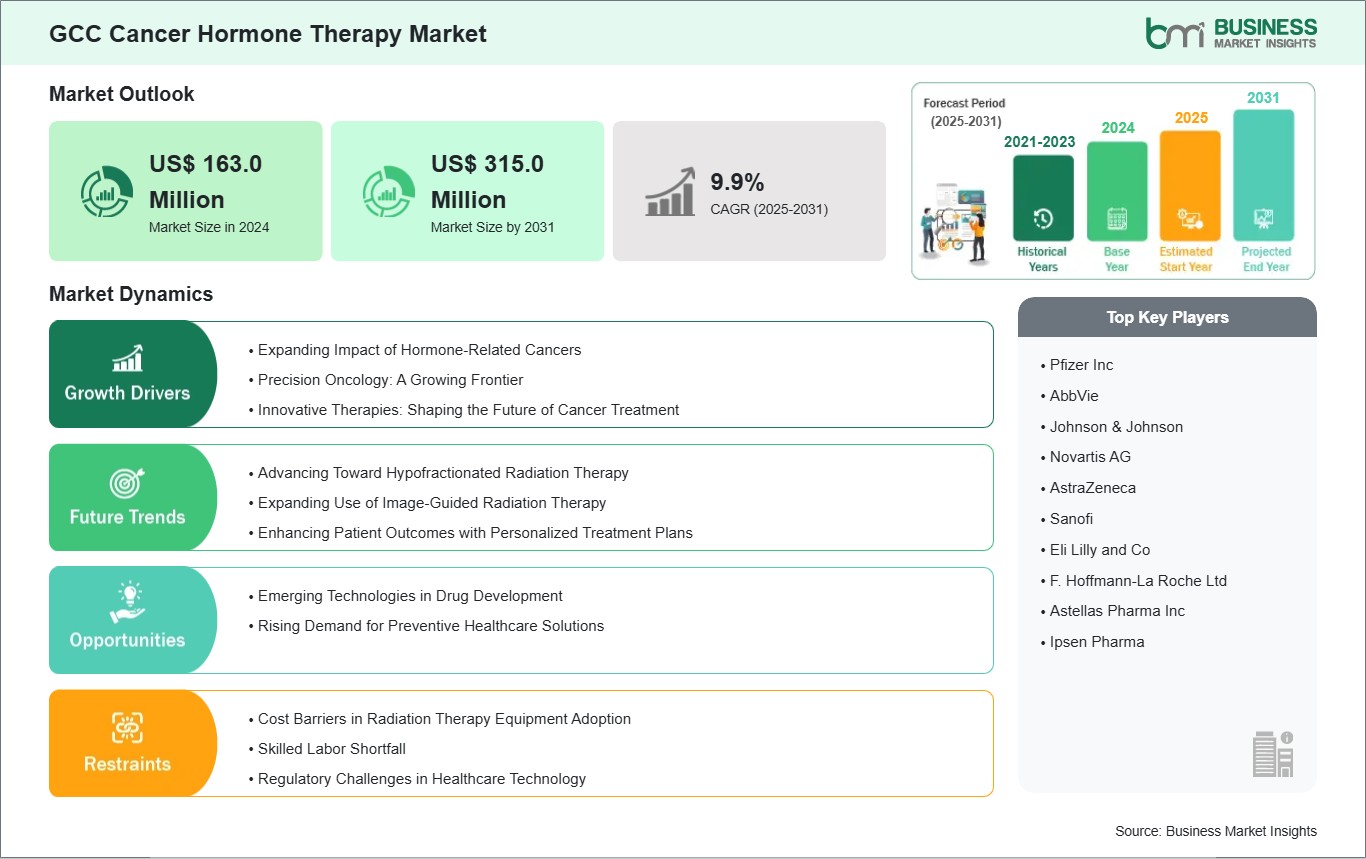
Hormone therapy is recognized as a critical component of cancer management, particularly for breast and prostate cancers, as GCC healthcare systems shift toward comprehensive and long-term treatment strategies. Expansion of tertiary hospitals, investment in specialized cancer centers, and growing adoption of international clinical guidelines are key factors driving the use of hormone therapies. Additionally, the region’s focus on early diagnosis, supported by national cancer screening programs and public health awareness initiatives, has contributed to greater reliance on hormone-based treatment options.
Dependence on imported oncology drugs can create supply and cost challenges, while variations in reimbursement frameworks across GCC countries may limit uniform access to advanced hormone therapies. The concentration of specialized oncology services in major cities restricts accessibility for patients in remote areas. Nevertheless, ongoing healthcare modernization efforts and increasing collaboration with global pharmaceutical companies are expected to improve the availability and integration of hormone therapies across the region.
Segment Analysis
GCC Cancer Hormone Therapy Market Segmentation
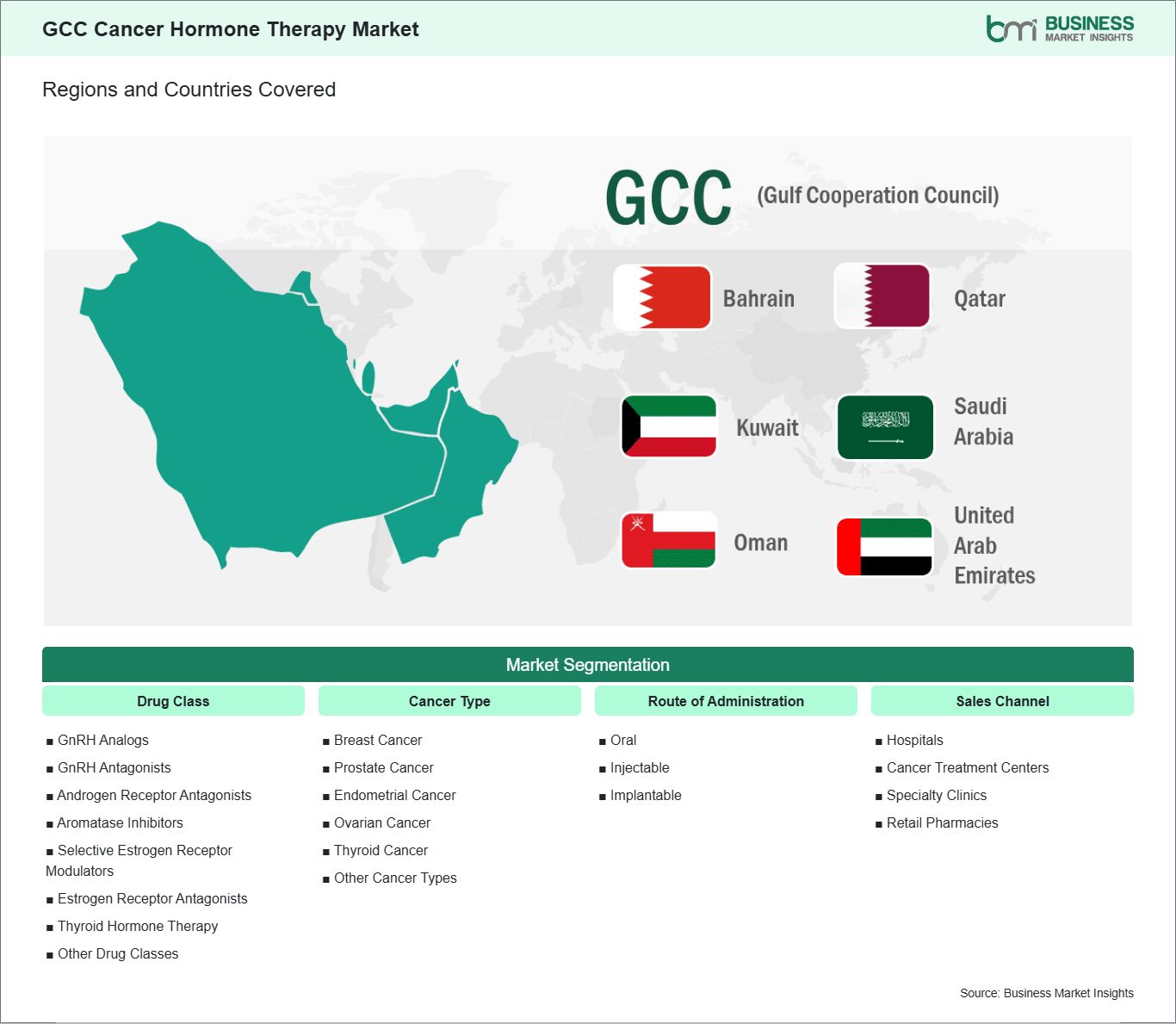
Key segments that contributed to the derivation of the GCC cancer hormone therapy market analysis are drug class, cancer type, route of administration, and sales channel.
- By drug class, the cancer hormone therapy market is segmented into GnRH analogs, GnRH antagonists, androgen receptor antagonists, aromatase inhibitors, selective estrogen receptor modulators, estrogen receptor antagonists, thyroid hormone therapy, and others. The GnRH analogs segment dominated the market in 2024.
- By cancer type, the cancer hormone therapy market is segmented into breast cancer, prostate cancer, endometrial cancer, ovarian cancer, thyroid cancer, and others. The breast cancer segment dominated the market in 2024.
- By route of administration, the cancer hormone therapy is segmented into oral, injectable, and implantable. The oral segment dominated the market in 2024.
- By sales channel, the cancer hormone therapy market is segmented into hospitals, cancer treatment centers, specialty clinics, and retail pharmacies. The hospitals segment dominated the market in 2024.
Market Forces
GCC Cancer Hormone Therapy Market Drivers and Opportunities
Expanding Impact of Hormone-Related Cancers
The GCC countries are experiencing a steady rise in hormone-responsive cancers, driven by population growth, increasing life expectancy, and lifestyle-related risk factors. Breast cancer is the most commonly diagnosed cancer among women across the GCC, with hormone receptor–positive (HR+) disease representing a large proportion of cases. Prostate cancer incidence is increasing among men, particularly in Saudi Arabia and the United Arab Emirates, as awareness and diagnostic capacity improve. These trends are establishing hormone therapy as a cornerstone of cancer management in the region.
Cancer presentation patterns in the GCC reflect progress and ongoing challenges. National screening initiatives and public awareness campaigns have improved early detection in countries such as the UAE and Qatar, enabling wider use of adjuvant endocrine therapy. However, in parts of the region, delayed presentation remains common, leading to greater reliance on systemic hormone therapy in advanced disease settings. Centralized oncology services in cities serve as referral hubs, concentrating expertise and access to guideline-based endocrine treatments.
Other hormone-sensitive malignancies, including select gynecologic cancers, contribute to the growing use of hormone therapies. Expansion of pathology services and routine hormone receptor testing across GCC hospitals has improved patient stratification and treatment planning.
Increasing Preference for Combination Regimens
Combination hormone therapy regimens are incorporated into oncology practice across the GCC, particularly for patients with high-risk or advanced disease. In HR+ breast cancer, endocrine agents such as aromatase inhibitors or selective estrogen receptor modulators are combined with ovarian suppression or other systemic therapies to enhance disease control. Tertiary care centers in Saudi Arabia, the UAE, and Qatar apply multidisciplinary decision-making to guide these combination strategies.
Prostate cancer treatment in the GCC reflects growing use of combination approaches. Androgen deprivation therapy remains foundational but is often paired with additional hormonal agents or supportive therapies to optimize outcomes in metastatic or recurrent disease. Clinical practice in leading regional centers aligns with international guidelines, supported by specialist training and collaboration with global oncology networks.
The adoption of combination regimens is facilitated by strong government investment in healthcare infrastructure and specialist education. Regional oncology conferences, international partnerships, and standardized clinical pathways are enhancing familiarity with multi-agent hormone therapy protocols. Combination hormone therapy is becoming an increasingly sophisticated and integral component of cancer care across the region.
Size and Share Analysis
GCC Cancer Hormone Therapy Market Size and Share Analysis
The GCC cancer hormone therapy market demonstrates steady growth, with size and share analysis highlighting evolving trends and competitive dynamics among key players. The report further examines subsegments categorized within drug class, cancer type, route of administration, and sales channel, highlighting their respective contributions to overall market performance.
By drug class, the GnRH analogs subsegment dominated the market in 2024. Their proven efficacy in hormone-dependent cancers, widespread clinical adoption, established safety profile, and ability to effectively suppress gonadotropin release make them a cornerstone of endocrine-based cancer therapies.
Per cancer type, the breast cancer subsegment dominated the market in 2024, driven by the high global prevalence of breast cancer, increasing awareness and screening programs, strong reliance on hormone-based treatments, and continuous advancements in targeted and combination therapies.
By route of administration, the oral subsegment dominated the market in 2024. Oral therapies are preferred due to their ease of administration, improved patient compliance, convenience for long-term treatment, reduced need for hospital visits, and growing availability of effective oral oncology drugs.
Per sales channel, the hospitals subsegment dominated the market in 2024. Hospitals remain the primary distribution channel as they offer comprehensive cancer care, access to specialized oncology pharmacists, advanced treatment infrastructure, and integrated diagnostic and therapeutic services, ensuring efficient delivery of cancer medications.
Report Coverage
GCC Cancer Hormone Therapy Market Report Coverage and Deliverables
The "GCC Cancer Hormone Therapy Market Size and Forecast (2021–2031)" report provides a detailed analysis of the market covering below areas:
- GCC Cancer Hormone Therapy market size and forecast at regional and country levels for all the key market segments covered under the scope
- GCC Cancer Hormone Therapy market trends, as well as market dynamics such as drivers, restraints, and key opportunities
- GCC Cancer Hormone Therapy market analysis covering key market trends, regional framework, major players, regulations, and recent market developments
- Industry landscape and competition analysis covering market concentration, heat map analysis, prominent players, and recent developments for the GCC Cancer Hormone Therapy market
- Detailed company profiles, including SWOT analysis
Geographic Insights
GCC Cancer Hormone Therapy Market Geographic Insights
The geographical scope of the GCC Cancer Hormone Therapy market report is divided into: Saudi Arabia, the United Arab Emirates (UAE), Qatar, Kuwait, Bahrain, and Oman. Saudi Arabia held the largest share in 2024.
Saudi Arabia dominates the market due to its advanced healthcare infrastructure and strong governmental focus on oncology care. The country has established specialized cancer hospitals and centers of excellence that actively incorporate hormone therapy into standardized treatment protocols for hormone-responsive cancers. National healthcare strategies emphasize early detection, multidisciplinary care, and evidence-based treatment pathways, all of which support increased utilization of hormone therapies.
Saudi Arabia’s healthcare system benefits from centralized planning and funding, enabling access to hormone therapies through public hospitals and specialized institutions. The country plays a leading role in regional clinical research and physician training, enhancing familiarity with evolving hormone therapy approaches. However, challenges remain in ensuring consistent access across regions and managing the high cost associated with advanced hormone treatments. Ongoing healthcare reforms and increased engagement with international pharmaceutical partners are expected to strengthen Saudi Arabia’s leadership in hormone therapy adoption.
Industry Activity
Recent Developments
The GCC Cancer Hormone Therapy market is evaluated by gathering qualitative and quantitative data post primary and secondary research, which includes important corporate publications, association data, and databases. A few of the key developments in the GCC cancer hormone therapy market are:
- In January 2026, CCL Pharmaceuticals & Life Sciences signed strategic collaboration agreements with global partners Chemo and Olpha to expand the introduction of its pharmaceutical brands across GCC markets (including Saudi Arabia, UAE, Qatar, Oman and Bahrain) — a move that strengthens regional distribution infrastructure and may include oncology and hormone-related therapeutic product lines as part of an expanded portfolio.
- In May 2025, the Saudi Food and Drug Authority (SFDA) granted a breakthrough designation to Itovebi (inavolisib), a novel targeted therapy for advanced, endocrine-resistant hormone receptor-positive breast cancer, signaling regulatory support for faster development and potential access in the GCC region.
Trust & Transparency
Research Methodology
The market analysis combines proprietary research with secondary data from government agencies, company disclosures, regulatory filings, industry databases and expert interviews. Market estimates are validated through data triangulation, cross-market benchmarking and analyst
review.
View Full Research Methodology
Key Sources Referred:
The World BankWorld Health Organization (WHO)Center for Disease Control and Prevention (CDC)American Association for Cancer Research (AACR)National Cancer Institute (NCI)American Society of Clinical Oncology (ASCO)European Society for Medical Oncology (ESMO)Company WebsitesCompany Annual ReportsCompany Investor Presentations