Asia Pacific Cancer Hormone Therapy Market (2021–2031)

Historic Data: 2021-2023   |   Base Year: 2024   |   Forecast Period: 2025-2031
Report Content: Market Scope, Market Segmentation, Market Dynamics, and Competitive Analysis

Report Coverage:
  • Drug Class (GnRH Analogs, GnRH Antagonists, Androgen Receptor Antagonists, Aromatase Inhibitors, Selective Estrogen Receptor Modulators, Estrogen Receptor Antagonists, Thyroid Hormone Therapy, Other Drug Classes)
  • Cancer Type (Breast Cancer, Prostate Cancer, Endometrial Cancer, Ovarian Cancer, Thyroid Cancer, Other Cancer Types)
  • Route of Administration (Oral, Injectable, Implantable)
  • Sales Channel (Hospitals, Cancer Treatment Centers, Specialty Clinics, Retail Pharmacies)

No. of Pages: 140
Report Code: BMIPUB00033432
Category: Life Sciences
Asia Pacific Cancer Hormone Therapy Market
Buy Now

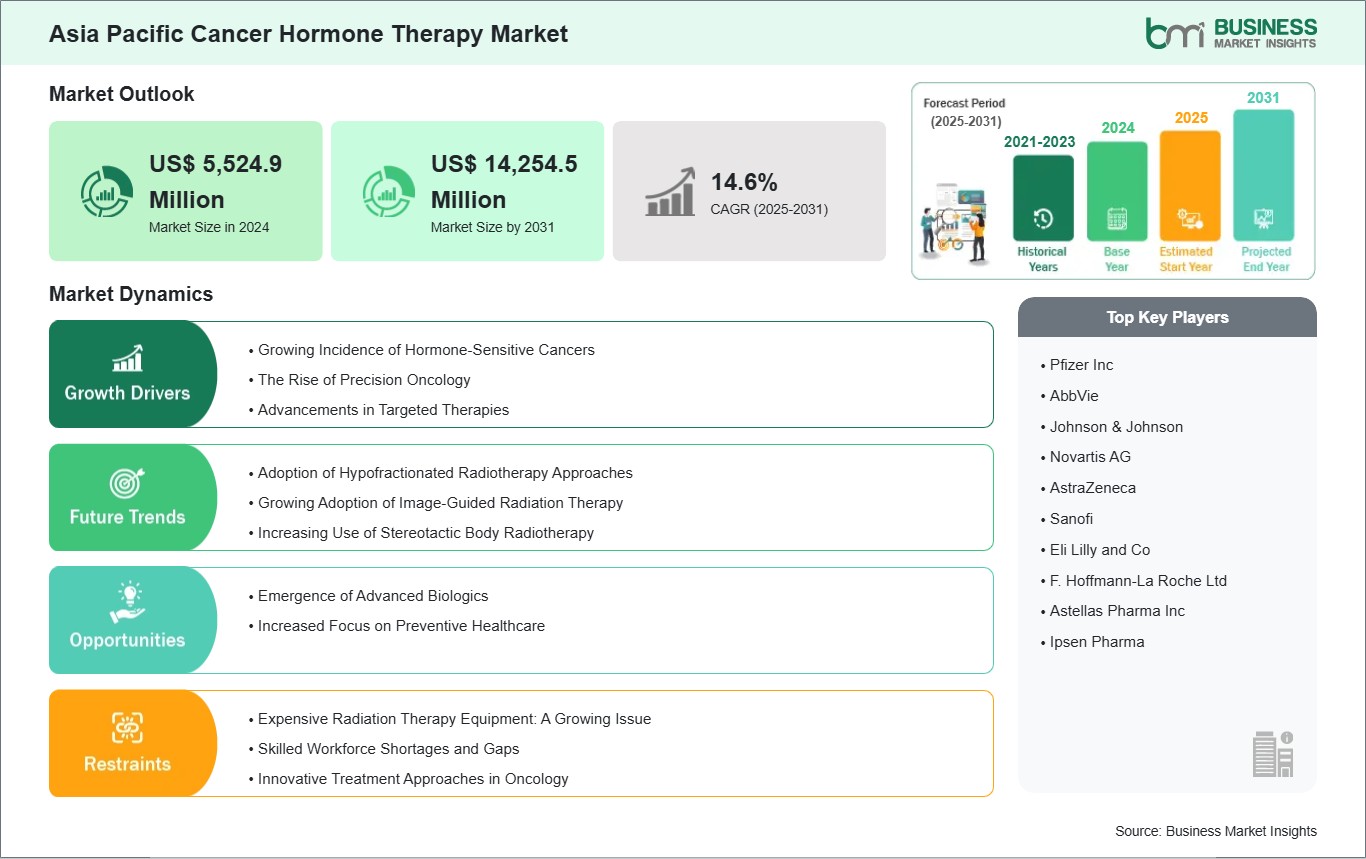
The Asia Pacific cancer hormone therapy market size is expected to reach US$ 14,254.5 million by 2031 from US$ 5,524.9 million in 2024. The market is estimated to record a CAGR of 14.6% from 2025 to 2031.

Executive Summary and Asia Pacific Cancer Hormone Therapy Market Analysis:

Rising awareness of cancer treatment options, coupled with improved healthcare accessibility, is driving the adoption of hormone-based therapies across the region. Personalized medicine and the integration of hormone therapy into combination treatment plans are enhancing its role in comprehensive cancer care. China leads the region, reflecting its commitment to expanding oncology infrastructure, encouraging innovation in treatment protocols, and supporting advanced therapeutic approaches. While the market demonstrates strong growth potential, it faces challenges such as disparities in healthcare access between urban and rural areas and regulatory complexities that can slow the availability of new therapies. Socioeconomic and cultural factors influence patient acceptance and therapy uptake, making uniform penetration across the region difficult. Despite these obstacles, the Asia Pacific market remains dynamic, with continuous advancements in clinical practice, patient education, and treatment delivery. The evolving healthcare landscape and increased emphasis on modern cancer care ensure that hormone therapies will play a central and expanding role in managing hormone-sensitive cancers across APAC, with China at the forefront of these developments.

Asia Pacific Cancer Hormone Therapy Market - Strategic Insights:

global-market-strategic-framework
Get more information on this report

Asia Pacific Cancer Hormone Therapy Market Segmentation Analysis:

Key segments that contributed to the derivation of the Asia Pacific cancer hormone therapy market analysis are drug class, cancer type, route of administration, and sales channel.

  • By drug class, the cancer hormone therapy market is segmented into GnRH analogs, GnRH antagonists, androgen receptor antagonists, aromatase inhibitors, selective estrogen receptor modulators, estrogen receptor antagonists, thyroid hormone therapy, and others. The GnRH analogs segment dominated the market in 2024.
  • By cancer type, the cancer hormone therapy market is segmented into breast cancer, prostate cancer, endometrial cancer, ovarian cancer, thyroid cancer, and others. The breast cancer segment dominated the market in 2024.
  • By route of administration, the cancer hormone therapy is segmented into oral, injectable, and implantable. The oral segment dominated the market in 2024.
  • By sales channel, the cancer hormone therapy market is segmented into hospitals, cancer treatment centers, specialty clinics, and retail pharmacies. The hospitals segment dominated the market in 2024.

Asia Pacific Cancer Hormone Therapy Market Drivers and Opportunities:

Growing Incidence of Hormone-Sensitive Cancers

Across the region, hormone-responsive cancers are rising due to rapid population aging, urbanization, and expanding cancer awareness. Breast cancer is now the leading cancer among women in countries such as China, Japan, South Korea, and Australia, with a growing proportion classified as estrogen or progesterone receptor–positive. Prostate cancer incidence is climbing, particularly in Japan, South Korea, and urban China, reflecting demographic shifts and greater adoption of PSA-based screening. While incidence rates vary widely across the region, longer survival and increased early detection are driving a sustained demand for hormone therapy.

Rising obesity, sedentary behavior, and adoption of Western diets in urban centers of China, South Korea, and Singapore contribute to higher breast cancer risk, while delayed childbirth and reduced breastfeeding rates increase hormone receptor–positive cases. In Japan and Australia, national cancer registries indicate that over 70% of newly diagnosed breast cancers are hormone receptor–positive, highlighting the expanding patient population eligible for endocrine therapy. Similarly, improved prostate cancer detection in China and South Korea is increasing the number of patients starting androgen-deprivation therapy.

High-income countries such as Japan, South Korea, and Australia provide broad access to oral and injectable endocrine agents through public and private systems. Middle-income countries such as China, India, and Indonesia face distribution challenges in rural areas. National cancer control plans are including hormone therapy in essential medicines lists, promoting standardized treatment protocols. As awareness, early detection, and survivorship improve, hormone therapy is becoming a foundational component of cancer management across Asia Pacific.

Growing Adoption of Combination Therapies

In hormone receptor–positive breast cancer, combinations of aromatase inhibitors or fulvestrant with CDK4/6 inhibitors or PI3K/mTOR pathway inhibitors are used in Japan, South Korea, and Australia, supported by reimbursement mechanisms and guideline adoption. These combinations allow earlier initiation in advanced disease, extend therapy duration, and increase per-patient drug consumption.

In prostate cancer, androgen-deprivation therapy combined with next-generation androgen receptor inhibitors or chemotherapy is becoming standard practice in Japan and South Korea for metastatic hormone-sensitive disease. Urban centers in China and Australia are adopting similar strategies, although access is uneven in rural or resource-constrained settings. Sequential hormone therapies play a role in countries with limited access to newer agents, reflecting a gradual shift toward more comprehensive, multi-drug approaches.

Policy frameworks, clinical training, and real-world evidence initiatives are accelerating combination therapy adoption. Japan and South Korea have well-established health technology assessment processes supporting coverage for novel combinations.  Multinational collaborations are expanding clinician expertise and guideline implementation in emerging markets. Pharmaceutical access programs and digital registries enable monitoring of outcomes and adherence to combination protocols. As healthcare infrastructure matures and precision oncology advances, combination hormone therapy is poised to be a major growth driver for the Asia Pacific cancer hormone therapy market.

Asia Pacific Cancer Hormone Therapy Market Size and Share Analysis:

The Asia Pacific cancer hormone therapy market demonstrates steady growth, with size and share analysis highlighting evolving trends and competitive dynamics among key players. The report further examines subsegments categorized within drug class, cancer type, route of administration, and sales channel, highlighting their respective contributions to overall market performance.

By drug class, the GnRH analogs subsegment dominated the market in 2024. Their proven efficacy in hormone-dependent cancers, widespread clinical adoption, established safety profile, and ability to effectively suppress gonadotropin release make them a cornerstone of endocrine-based cancer therapies.

Per cancer type, the breast cancer subsegment dominated the market in 2024, driven by the high global prevalence of breast cancer, increasing awareness and screening programs, strong reliance on hormone-based treatments, and continuous advancements in targeted and combination therapies.

By route of administration, the oral subsegment dominated the market in 2024. Oral therapies are preferred due to their ease of administration, improved patient compliance, convenience for long-term treatment, reduced need for hospital visits, and growing availability of effective oral oncology drugs.

Per sales channel, the hospitals subsegment dominated the market in 2024. Hospitals remain the primary distribution channel as they offer comprehensive cancer care, access to specialized oncology pharmacists, advanced treatment infrastructure, and integrated diagnostic and therapeutic services, ensuring efficient delivery of cancer medications.

Asia Pacific Cancer Hormone Therapy Market Report Highlights:

Report Attribute Details
Market size in 2024 US$ 5,524.9 Million
Market Size by 2031 US$ 14,254.5 Million
CAGR (2025 - 2031)14.6%
Historical Data 2021-2023
Forecast period 2025-2031
Segments Covered By Drug Class
  • GnRH Analogs
  • GnRH Antagonists
  • Androgen Receptor Antagonists
  • Aromatase Inhibitors
  • Selective Estrogen Receptor Modulators
  • Estrogen Receptor Antagonists
  • Thyroid Hormone Therapy
  • Other Drug Classes
By Cancer Type
  • Breast Cancer
  • Prostate Cancer
  • Endometrial Cancer
  • Ovarian Cancer
  • Thyroid Cancer
  • Other Cancer Types
By Route of Administration
  • Oral
  • Injectable
  • Implantable
By Sales Channel
  • Hospitals
  • Cancer Treatment Centers
  • Specialty Clinics
  • Retail Pharmacies
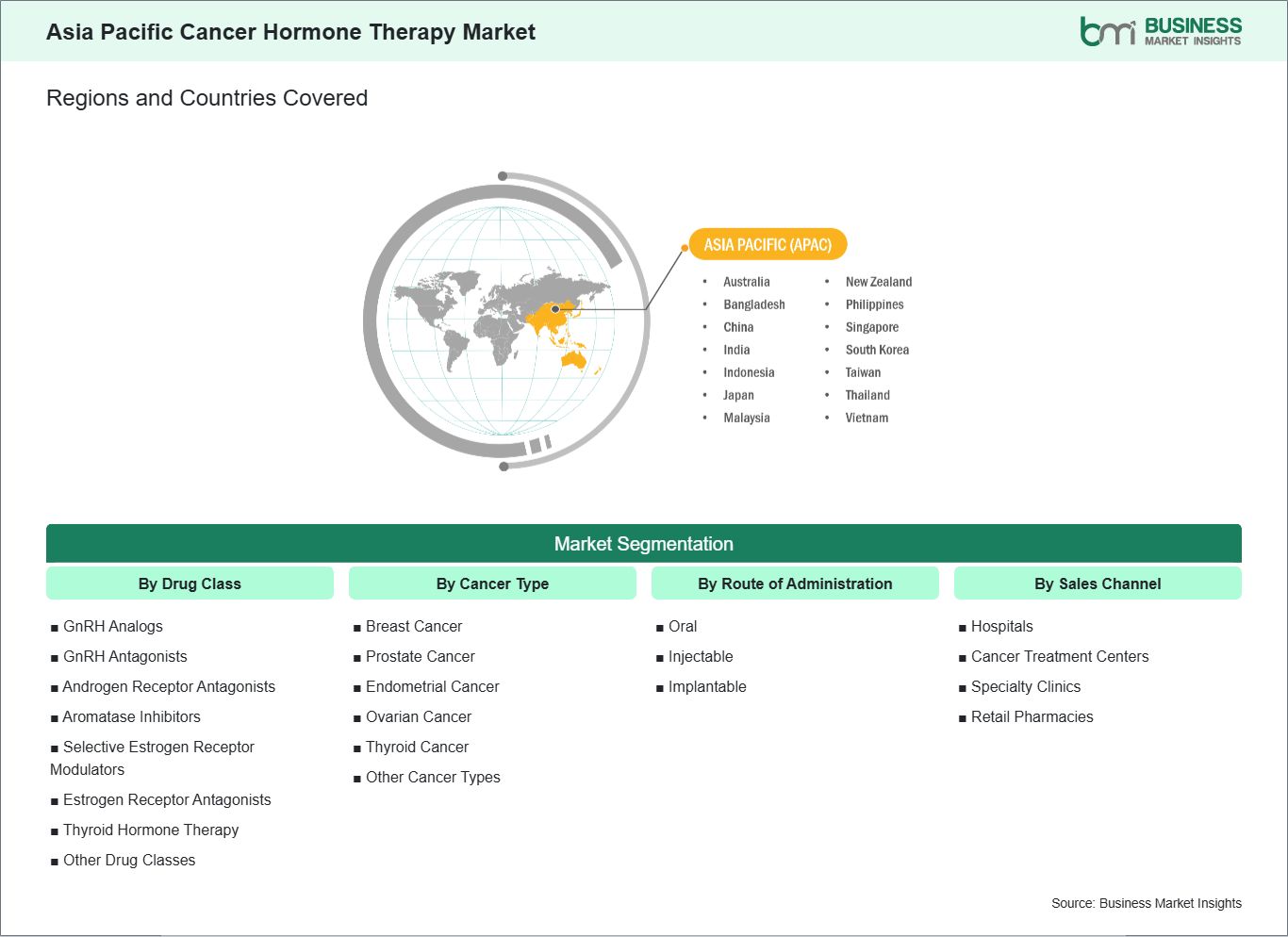
Regions and Countries Covered Asia Pacific
  • China
  • Japan
  • South Korea
  • India
  • Australia
  • New Zealand
  • Indonesia
  • Malaysia
  • Philippines
  • Singapore
  • Thailand
  • Vietnam
  • Taiwan
  • Bangladesh
Market leaders and key company profiles
  • Pfizer Inc
  • AbbVie
  • Johnson & Johnson
  • Novartis AG
  • AstraZeneca
  • Sanofi
  • Eli Lilly and Co
  • F. Hoffmann-La Roche Ltd
  • Astellas Pharma Inc
  • Ipsen Pharma
Get more information on this report

Asia Pacific Cancer Hormone Therapy Market Report Coverage and Deliverables:

The "Asia Pacific Cancer Hormone Therapy Market Size and Forecast (2021–2031)" report provides a detailed analysis of the market covering below areas:

  • Asia Pacific Cancer Hormone Therapy market size and forecast at regional and country levels for all the key market segments covered under the scope
  • Asia Pacific Cancer Hormone Therapy market trends, as well as market dynamics such as drivers, restraints, and key opportunities
  • Asia Pacific Cancer Hormone Therapy market analysis covering key market trends, regional framework, major players, regulations, and recent market developments
  • Industry landscape and competition analysis covering market concentration, heat map analysis, prominent players, and recent developments for the Asia Pacific Cancer Hormone Therapy market
  • Detailed company profiles, including SWOT analysis

Asia Pacific Cancer Hormone Therapy Market Geographic Insights:

The geographical scope of the Asia Pacific Cancer Hormone Therapy market report is divided into: China, Japan, South Korea, India, Australia, New Zealand, Indonesia, Malaysia, the Philippines, Singapore, Thailand, Vietnam, Taiwan, Bangladesh, and Rest of Asia. China held the largest share in 2024.

China dominates the market, largely due to its focus on improving cancer care infrastructure and advancing treatment accessibility. Hormone therapy is adopted for managing breast and prostate cancers, forming a key part of personalized treatment strategies. Urban centers have seen rapid development of oncology services, early detection programs, and specialized treatment facilities, which help streamline therapy delivery. Pharmaceutical companies, domestic and international, actively engage in clinical research, partnerships, and tailored programs to strengthen their presence in the market.  Challenges remain in bridging the gap between major cities and rural regions, where healthcare resources and access to advanced therapies are limited. Policy support, healthcare modernization initiatives, and a growing focus on innovation enhance the reach of hormone therapies across the country. China’s leadership in oncology care, coupled with its large patient base and investment in advanced treatment options, positions it as the driving force behind hormone therapy adoption and development in the region.

global-market-geography
Get more information on this report

Asia Pacific Cancer Hormone Therapy Market Research Report Guidance:

  • The report includes qualitative and quantitative data in the Asia Pacific cancer hormone therapy market across drug class, cancer type, route of administration, sales channel, and geography.
  • The report starts with the key takeaways (chapter 2), highlighting the key trends and outlook of the Asia Pacific Cancer Hormone Therapy market.
  • Chapter 3 includes the research methodology of the study.
  • Chapter 4 further includes ecosystem analysis.
  • Chapter 5 highlights the major industry dynamics in the Asia Pacific Cancer Hormone Therapy market, including factors that are driving the market, prevailing deterrents, potential opportunities, as well as future trends. Impact analysis of these drivers and restraints is also covered in this section.
  • Chapter 6 discusses the Asia Pacific Cancer Hormone Therapy market scenario, in terms of historical market revenues, and forecast till the year 2031.
  • Chapters 7 to 11 cover Asia Pacific Cancer Hormone Therapy market segments by drug class, cancer type, route of administration, sales channel, and geography across China, Japan, South Korea, India, Australia, New Zealand, Indonesia, Malaysia, the Philippines, Singapore, Thailand, Vietnam, Taiwan, Bangladesh, and the Rest of Asia Pacific. They cover the market revenue, forecast, and factors driving the market.
  • Chapter 12 describes the competitive analysis along with the heat map analysis for the key players operating in the market.
  • Chapter 13 describes the industry landscape analysis. It provides detailed descriptions of business activities such as market initiatives, new developments, mergers, and joint ventures globally, along with a competitive landscape.
  • Chapter 14 provides detailed profiles of the major companies operating in the Asia Pacific Cancer Hormone Therapy market. Companies have been profiled on the basis of their key facts, business descriptions, products, financial overview, SWOT analysis, and key developments.
  • Chapter 15, i.e., the appendix, is inclusive of a brief overview of the company, list of abbreviations, and disclaimer.

Asia Pacific Cancer Hormone Therapy Market News and Key Development:

The Asia Pacific Cancer Hormone Therapy market is evaluated by gathering qualitative and quantitative data post primary and secondary research, which includes important corporate publications, association data, and databases. A few of the key developments in the Asia Pacific cancer hormone therapy market are:

  • In August 2025, Daiichi Sankyo announced that its ENHERTU (trastuzumab deruxtecan) was approved in Japan for the treatment of adult patients with hormone receptor (HR)‑positive, HER2‑low or HER2‑ultralow metastatic breast cancer after at least one endocrine therapy, broadening treatment options for HR‑positive breast cancer in the market.
  • In February 2025, Specialised Therapeutics (in partnership with Puma Biotechnology) announced that the Thailand Food and Drug Administration (Thailand FDA) approved NERLYNX (neratinib) for the extended adjuvant treatment of early‑stage HER2‑positive breast cancer and in combination for advanced disease—a therapy that benefits many patients with hormone receptor‑positive, HER2‑overexpressed cancers in the region.

Key Sources Referred:

  • The World Bank
  • World Health Organization (WHO)
  • Center for Disease Control and Prevention (CDC)
  • American Association for Cancer Research (AACR)
  • National Cancer Institute (NCI)
  • American Society of Clinical Oncology (ASCO)
  • European Society for Medical Oncology (ESMO)
  • Company Websites
  • Company Annual Reports
  • Company Investor Presentations

The List of Companies - Asia Pacific Cancer Hormone Therapy Market

  • Pfizer Inc
  • AbbVie
  • Johnson & Johnson
  • Novartis AG
  • AstraZeneca
  • Sanofi
  • Eli Lilly and Co
  • F. Hoffmann-La Roche Ltd
  • Astellas Pharma Inc
  • Ipsen Pharma
Frequently Asked Questions
How big is the Asia Pacific Cancer Hormone Therapy Market?

The Asia Pacific Cancer Hormone Therapy Market is valued at US$ 5,524.9 Million in 2024, it is projected to reach US$ 14,254.5 Million by 2031.

What is the CAGR for Asia Pacific Cancer Hormone Therapy Market by (2025 - 2031)?

As per our report Asia Pacific Cancer Hormone Therapy Market, the market size is valued at US$ 5,524.9 Million in 2024, projecting it to reach US$ 14,254.5 Million by 2031. This translates to a CAGR of approximately 14.6% during the forecast period.

What segments are covered in this report?

The Asia Pacific Cancer Hormone Therapy Market report typically cover these key segments-

  • Drug Class (GnRH Analogs, GnRH Antagonists, Androgen Receptor Antagonists, Aromatase Inhibitors, Selective Estrogen Receptor Modulators, Estrogen Receptor Antagonists, Thyroid Hormone Therapy, Other Drug Classes)
  • Cancer Type (Breast Cancer, Prostate Cancer, Endometrial Cancer, Ovarian Cancer, Thyroid Cancer, Other Cancer Types)
  • Route of Administration (Oral, Injectable, Implantable)
  • Sales Channel (Hospitals, Cancer Treatment Centers, Specialty Clinics, Retail Pharmacies)

What is the historic period, base year, and forecast period taken for Asia Pacific Cancer Hormone Therapy Market?

The historic period, base year, and forecast period can vary slightly depending on the specific market research report. However, for the Asia Pacific Cancer Hormone Therapy Market report:

  • Historic Period : 2021-2023
  • Base Year : 2024
  • Forecast Period : 2025-2031
  • Who are the major players in Asia Pacific Cancer Hormone Therapy Market?

    The Asia Pacific Cancer Hormone Therapy Market is populated by several key players, each contributing to its growth and innovation. Some of the major players include:

  • Pfizer Inc
  • AbbVie
  • Johnson & Johnson
  • Novartis AG
  • AstraZeneca
  • Sanofi
  • Eli Lilly and Co
  • F. Hoffmann-La Roche Ltd
  • Astellas Pharma Inc
  • Ipsen Pharma
  • Who should buy this report?

    The Asia Pacific Cancer Hormone Therapy Market report is valuable for diverse stakeholders, including:

    • Investors: Provides insights for investment decisions pertaining to market growth, companies, or industry insights. Helps assess market attractiveness and potential returns.
    • Industry Players: Offers competitive intelligence, market sizing, and trend analysis to inform strategic planning, product development, and sales strategies.
    • Suppliers and Manufacturers: Helps understand market demand for components, materials, and services related to concerned industry.
    • Researchers and Consultants: Provides data and analysis for academic research, consulting projects, and market studies.
    • Financial Institutions: Helps assess risks and opportunities associated with financing or investing in the concerned market.

    Essentially, anyone involved in or considering involvement in the Asia Pacific Cancer Hormone Therapy Market value chain can benefit from the information contained in a comprehensive market report.

    Available Report Formats

    pdf-format excel-format pptx-format
    Buy Now

    Customization Form

    Please tell us your area of interest
    (Market Segments/ Regions and Countries/ Companies)