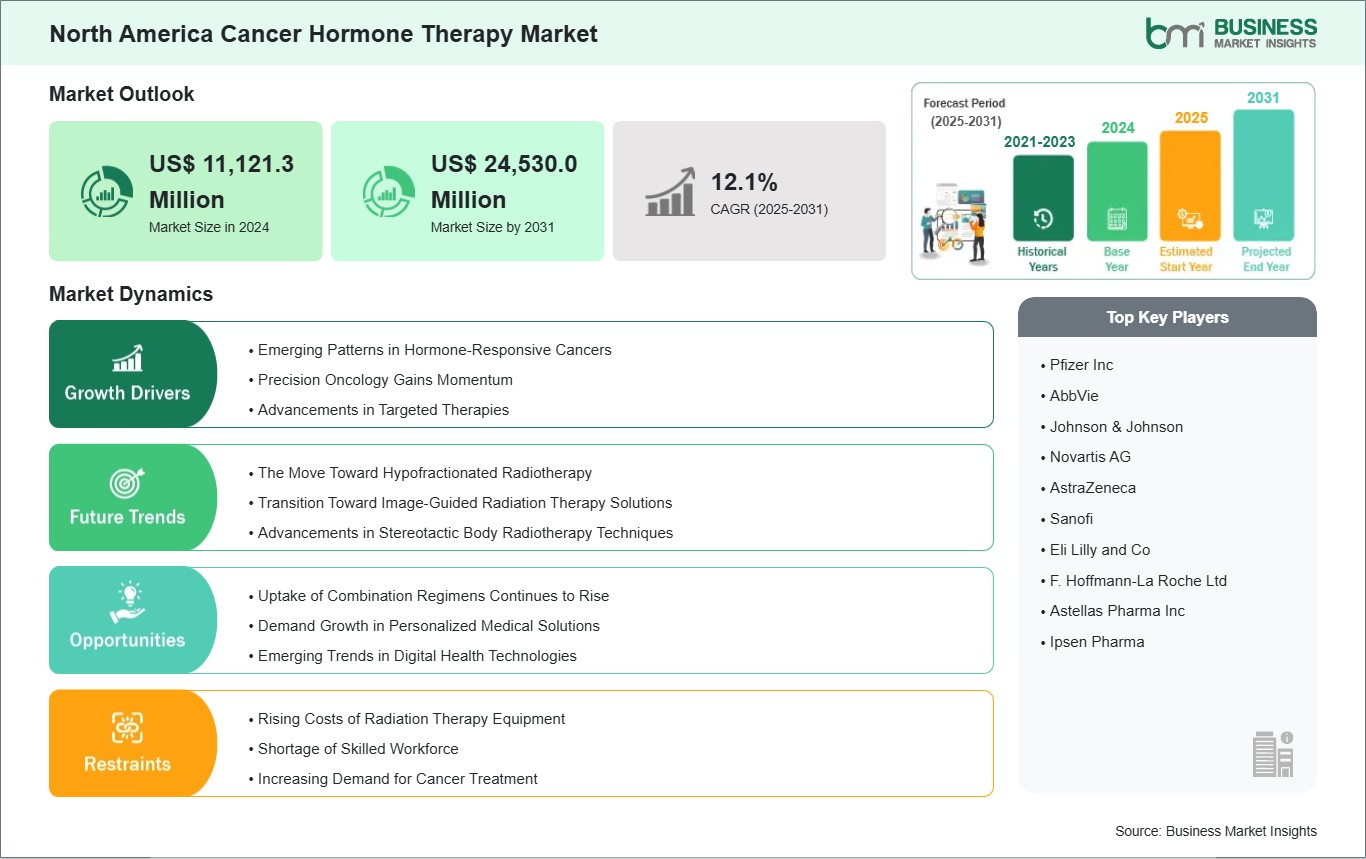
The North America cancer hormone therapy market size is expected to reach US$ 24,530.0 million by 2031 from US$ 11,121.3 million in 2024. The market is estimated to record a CAGR of 12.1% from 2025 to 2031.
Hormone therapies are a cornerstone of managing hormone-sensitive cancers such as breast and prostate cancers, with widespread integration into clinical protocols across hospitals, cancer centers, and outpatient clinics. Market growth is driven by high awareness of cancer prevention and early detection, well-established screening programs, and the increasing emphasis on personalized and precision medicine, which enables clinicians to tailor hormone therapy regimens to individual patient needs. Collaboration between academic institutions, research hospitals, and pharmaceutical companies supports the development and rapid adoption of novel hormone agents and combination therapies.
Advanced hormone therapies are often expensive, which can impact patient access despite insurance coverage, and variations in insurance policies and reimbursement procedures can create barriers for consistent treatment delivery. Additionally, disparities in access between urban and rural regions may limit widespread adoption in some areas. Nevertheless, North America’s leadership in clinical research, advanced healthcare infrastructure, and patient-focused care strategies continues to provide a favorable environment for the innovation of hormone therapies across the region.

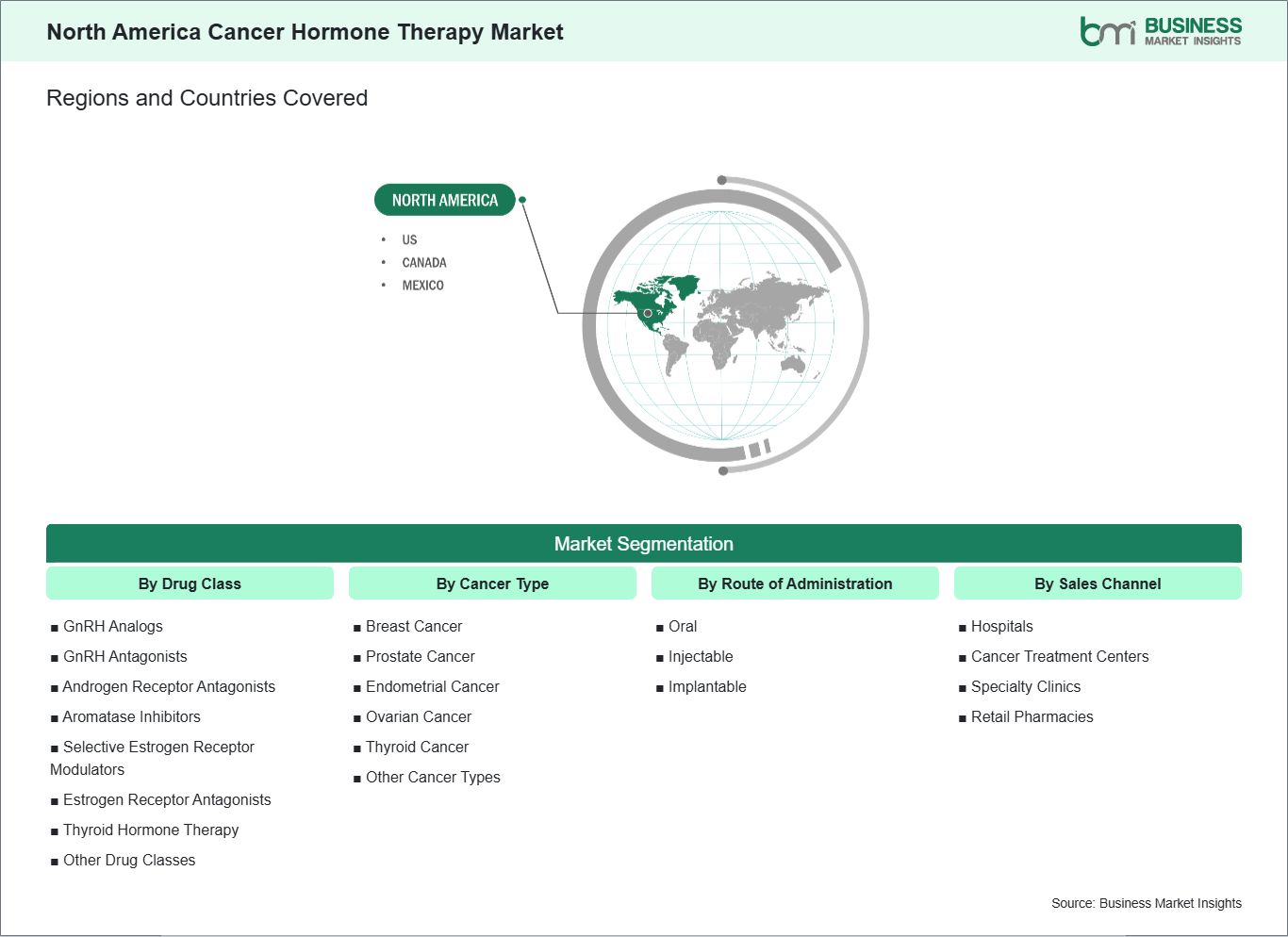
Key segments that contributed to the derivation of the North America cancer hormone therapy market analysis are drug class, cancer type, route of administration, and sales channel.
Hormone-responsive cancers, particularly breast and prostate cancers, continue to be major public health concerns across North America. The US and Canada report significant burdens of breast cancer, often detected at earlier stages due to widespread screening programs, while prostate cancer remains highly prevalent among older men. Lifestyle factors, aging populations, and improved diagnostic awareness are driving sustained demand for hormone-based therapies in both countries.
Healthcare infrastructure is well-developed, with comprehensive oncology networks in major cities such as New York, Toronto, Los Angeles, and Chicago providing broad access to oral and injectable hormone therapies. Academic and community hospitals are equipped for hormone receptor testing, PSA monitoring, and long-term management of hormone-sensitive cancers. While rural regions face challenges in specialist availability, telemedicine and coordinated referral networks are helping ensure timely access to care.
National programs and awareness campaigns support early detection and adherence to hormone therapy. Public initiatives in the US and Canada promote guideline-based screening and treatment access, while patient education emphasizes the importance of completing prescribed endocrine regimens. As more patients enter structured care pathways, the rising prevalence of hormone-responsive cancers continues to drive growth in the market.
The adoption of combination therapy is accelerating in North America, with hormone therapies paired with targeted agents, immunotherapies, or chemotherapy to improve outcomes. In breast cancer, aromatase inhibitors or tamoxifen are often combined with CDK4/6 inhibitors or PI3K-targeted agents, while prostate cancer treatment frequently integrates androgen deprivation therapy with next-generation androgen receptor inhibitors or PARP-targeted approaches. Clinical guidelines and real-world evidence support these strategies, encouraging wider adoption.
Leading oncology centers, including academic and regional hospitals, implement multidisciplinary care models to optimize combination therapy. Genomic profiling, hormone receptor testing, and advanced imaging guide therapy decisions, allowing clinicians to tailor regimens to individual tumor biology. Digital tools and registry-based outcomes monitoring support evidence-based decision-making and treatment personalization.
Policy, reimbursement, and patient preference reinforce the uptake of combination regimens. Public and private insurance programs provide broad access to innovative hormone therapy strategies, while patients favor treatments that enhance survival and quality of life without increasing toxicity.

The North America cancer hormone therapy market demonstrates steady growth, with size and share analysis highlighting evolving trends and competitive dynamics among key players. The report further examines subsegments categorized by drug class, cancer type, route of administration, and sales channel, highlighting their respective contributions to overall market performance.
By drug class, the GnRH analogs subsegment dominated the market in 2024. Their proven efficacy in hormone-dependent cancers, widespread clinical adoption, established safety profile, and ability to suppress gonadotropin release make them a cornerstone of endocrine-based cancer therapies.
Per cancer type, the breast cancer subsegment dominated the market in 2024, driven by the high global prevalence of breast cancer, increasing awareness and screening programs, strong reliance on hormone-based treatments, and continuous advancements in targeted and combination therapies.
By route of administration, the oral subsegment dominated the market in 2024. Oral therapies are preferred due to their ease of administration, improved patient compliance, convenience for long-term treatment, reduced need for hospital visits, and growing availability of effective oral oncology drugs.
Per sales channel, the hospitals subsegment dominated the market in 2024. Hospitals remain the primary distribution channel as they offer comprehensive cancer care, access to specialized oncology pharmacists, advanced treatment infrastructure, and integrated diagnostic and therapeutic services, ensuring efficient delivery of cancer medications.
| Report Attribute | Details |
|---|---|
| Market size in 2024 | US$ 11,121.3 Million |
| Market Size by 2031 | US$ 24,530.0 Million |
| CAGR (2025 - 2031) | 12.1% |
| Historical Data | 2021-2023 |
| Forecast period | 2025-2031 |
| Segments Covered | By Drug Class
|
| Regions and Countries Covered | North America
|
| Market leaders and key company profiles |
|
The "North America Cancer Hormone Therapy Market Size and Forecast (2021–2031)" report provides a detailed analysis of the market covering below areas:
The geographical scope of the North America Cancer Hormone Therapy market report is divided into: The US, Canada, and Mexico. The US held the largest share in 2024.
The US dominates the market due to its cutting-edge healthcare system, strong oncology research ecosystem, and widespread availability of specialized cancer centers. Hormone therapy is routinely incorporated into treatment regimens for hormone-sensitive cancers, with physicians leveraging evidence-based guidelines and personalized approaches to optimize outcomes. Large academic hospitals and research institutions participate in clinical trials, ensuring rapid access to innovative hormone agents and combination therapies, while contributing to continuous improvements in treatment protocols.
The country’s healthcare infrastructure supports broad access to hormone therapies through a mix of private and public insurance coverage, enabling patients in metropolitan and suburban areas to benefit from advanced treatment options. Additionally, extensive patient advocacy and education programs raise awareness of hormone therapy as a viable long-term cancer management strategy. Challenges remain in managing the high costs of advanced therapies and addressing gaps in care for underserved populations. Nonetheless, the nation’s focus on innovation, clinical excellence, and integrated oncology care positions it as the primary driver of the market and a benchmark for the adoption of best practices across the region.

The North America Cancer Hormone Therapy market is evaluated by gathering qualitative and quantitative data post primary and secondary research, which includes important corporate publications, association data, and databases. A few of the key developments in the North America cancer hormone therapy market are:
The North America Cancer Hormone Therapy Market is valued at US$ 11,121.3 Million in 2024, it is projected to reach US$ 24,530.0 Million by 2031.
As per our report North America Cancer Hormone Therapy Market, the market size is valued at US$ 11,121.3 Million in 2024, projecting it to reach US$ 24,530.0 Million by 2031. This translates to a CAGR of approximately 12.1% during the forecast period.
The North America Cancer Hormone Therapy Market report typically cover these key segments-
The historic period, base year, and forecast period can vary slightly depending on the specific market research report. However, for the North America Cancer Hormone Therapy Market report:
The North America Cancer Hormone Therapy Market is populated by several key players, each contributing to its growth and innovation. Some of the major players include:
The North America Cancer Hormone Therapy Market report is valuable for diverse stakeholders, including:
Essentially, anyone involved in or considering involvement in the North America Cancer Hormone Therapy Market value chain can benefit from the information contained in a comprehensive market report.
Please tell us your area of interest
(Market Segments/ Regions and Countries/ Companies)