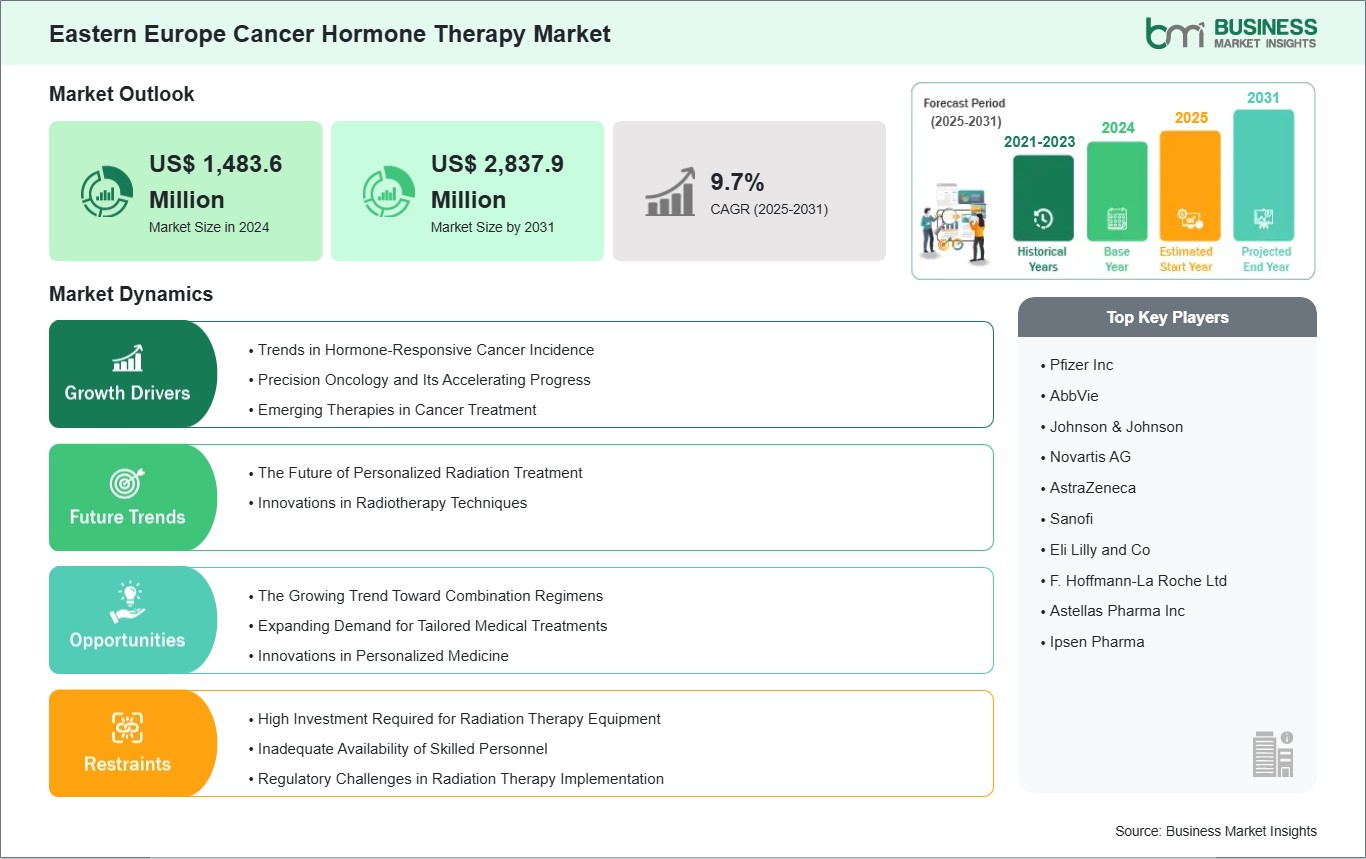
The Eastern Europe cancer hormone therapy market size is expected to reach US$ 2,837.9 million by 2031 from US$ 1,483.6 million in 2024. The market is estimated to record a CAGR of 9.7% from 2025 to 2031.
The Eastern Europe cancer hormone therapy market is shaped by the growing clinical reliance on hormone-based treatments for managing hormone-dependent cancers, particularly breast and prostate cancer. Across the region, hormone therapy is increasingly positioned as a long-term disease management option due to its established efficacy, relatively favorable safety profile, and compatibility with combination treatment approaches. Rising cancer awareness, gradual improvements in diagnostic capabilities, and stronger alignment with international oncology treatment protocols are key factors supporting market development. Eastern European healthcare systems are steadily prioritizing oncology care, leading to better integration of hormone therapies into standard treatment pathways. However, the market faces notable restraints, including uneven access to specialized cancer care across countries and regions, as well as variations in reimbursement policies that affect treatment continuity. Limited availability of advanced hormone therapies in less developed healthcare settings and delays in treatment initiation also pose challenges. Despite these constraints, the region continues to show steady progress as governments and healthcare providers emphasize early intervention and personalized treatment strategies. The Eastern Europe cancer hormone therapy market is evolving, with hormone-based treatments maintaining a vital role in cancer care frameworks across the region.

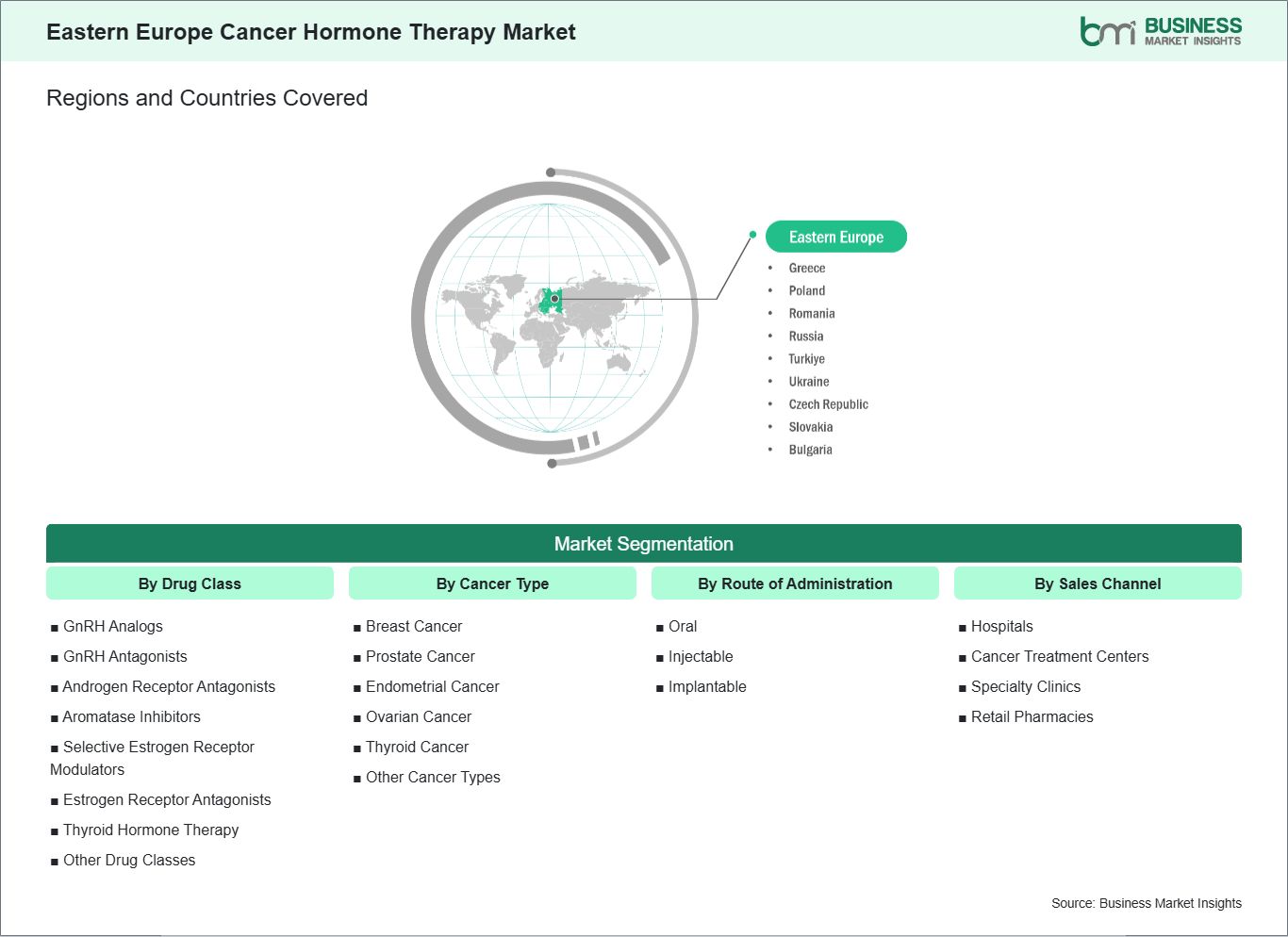
Key segments that contributed to the derivation of the Eastern Europe cancer hormone therapy market analysis are drug class, cancer type, route of administration, and sales channel.
Breast cancer remains the most common malignancy among women, with hormone receptor–positive (HR+) subtypes accounting for the majority of cases. Prostate cancer is prominent in men, particularly in Poland, Romania, and Hungary, where rising life expectancy and screening programs contribute to higher detection rates. These trends have established hormone therapy as a central component of cancer treatment across the region.
In countries such as Ukraine and Bulgaria, limited infrastructure and delayed diagnoses often result in advanced-stage presentation, emphasizing the need for systemic and supportive hormone-based treatments. By contrast, urban centers in Poland, Czechia, and Hungary benefit from well-equipped oncology hospitals and multidisciplinary teams, enabling earlier intervention with endocrine therapies and adherence to guideline-recommended protocols.
Other hormone-sensitive tumors, including select endometrial and ovarian cancers, contribute to the therapeutic landscape. Expansion of pathology and receptor testing services is enhancing patient identification, allowing clinicians to personalize endocrine therapy more effectively.
Combination hormone therapy regimens are becoming standard in Eastern European oncology practice, especially for advanced or high-risk patients. In HR+ breast cancer, aromatase inhibitors or selective estrogen receptor modulators are paired with ovarian suppression or targeted systemic agents to extend disease control and delay resistance. Leading centers in Poland, Czechia, and Hungary are integrating these combinations into routine care, reflecting growing adoption of evidence-based strategies.
Prostate cancer management demonstrates increased use of combination approaches. Androgen deprivation therapy, long the backbone of treatment, is used alongside novel anti-androgens or chemohormonal regimens for patients with advanced or metastatic disease. Multidisciplinary tumor boards in urban centers guide therapy decisions, optimizing outcomes while considering comorbidities, age, and patient preferences.
The regional expansion of combination hormone therapies is supported by improving diagnostic services, clinical guidelines, and oncology education initiatives. Training programs and cross-border collaborations are helping standardize treatment protocols, promote adherence to best practices, and increase clinician familiarity with multi-agent regimens. These developments are shaping hormone therapy as a sophisticated element of cancer care across Eastern Europe.

The Eastern Europe cancer hormone therapy market demonstrates steady growth, with size and share analysis highlighting evolving trends and competitive dynamics among key players. The report further examines subsegments categorized within drug class, cancer type, route of administration, and sales channel, highlighting their respective contributions to overall market performance.
By drug class, the GnRH analogs subsegment dominated the market in 2024. Their proven efficacy in hormone-dependent cancers, widespread clinical adoption, established safety profile, and ability to effectively suppress gonadotropin release make them a cornerstone of endocrine-based cancer therapies.
Per cancer type, the breast cancer subsegment dominated the market in 2024, driven by the high global prevalence of breast cancer, increasing awareness and screening programs, strong reliance on hormone-based treatments, and continuous advancements in targeted and combination therapies.
By route of administration, the oral subsegment dominated the market in 2024. Oral therapies are preferred due to their ease of administration, improved patient compliance, convenience for long-term treatment, reduced need for hospital visits, and growing availability of effective oral oncology drugs.
Per sales channel, the hospitals subsegment dominated the market in 2024. Hospitals remain the primary distribution channel as they offer comprehensive cancer care, access to specialized oncology pharmacists, advanced treatment infrastructure, and integrated diagnostic and therapeutic services, ensuring efficient delivery of cancer medications.
| Report Attribute | Details |
|---|---|
| Market size in 2024 | US$ 1,483.6 Million |
| Market Size by 2031 | US$ 2,837.9 Million |
| CAGR (2025 - 2031) | 9.7% |
| Historical Data | 2021-2023 |
| Forecast period | 2025-2031 |
| Segments Covered | By Drug Class
|
| Regions and Countries Covered | Eastern Europe
|
| Market leaders and key company profiles |
|
The "Eastern Europe Cancer Hormone Therapy Market Size and Forecast (2021–2031)" report provides a detailed analysis of the market covering below areas:
The geographical scope of the Eastern Europe Cancer Hormone Therapy market report is divided into: Russia, Poland, Romania, the Czech Republic, Ukraine, Romania, Greece, Slovakia, and Bulgaria. Russia held the largest share in 2024.
Russia dominates the market due to its advanced oncology infrastructure and focus on comprehensive cancer care. The country has established specialized oncology centers and academic hospitals that implement hormone therapy as a key component of treatment for hormone-responsive cancers. Integration of hormone therapy into standardized clinical protocols has improved outcomes, particularly in urban centers with access to modern diagnostic and treatment facilities.
The Russian pharmaceutical landscape supports this dominance, with domestic manufacturers and multinational companies collaborating to develop and distribute hormone therapy agents locally. Research initiatives emphasize optimizing treatment regimens and investigating combination therapies to enhance efficacy. However, regional disparities remain, with rural areas lacking specialized oncology services and access to advanced hormone treatments. Additionally, navigating regulatory requirements and aligning therapies with reimbursement policies continues to influence treatment adoption. Russia’s focus on early detection, evidence-based protocols, and infrastructure expansion positions it as the key driver of hormone therapy adoption in Eastern Europe.

The Eastern Europe Cancer Hormone Therapy market is evaluated by gathering qualitative and quantitative data post primary and secondary research, which includes important corporate publications, association data, and databases. A few of the key developments in the Eastern Europe cancer hormone therapy market are:
The Eastern Europe Cancer Hormone Therapy Market is valued at US$ 1,483.6 Million in 2024, it is projected to reach US$ 2,837.9 Million by 2031.
As per our report Eastern Europe Cancer Hormone Therapy Market, the market size is valued at US$ 1,483.6 Million in 2024, projecting it to reach US$ 2,837.9 Million by 2031. This translates to a CAGR of approximately 9.7% during the forecast period.
The Eastern Europe Cancer Hormone Therapy Market report typically cover these key segments-
The historic period, base year, and forecast period can vary slightly depending on the specific market research report. However, for the Eastern Europe Cancer Hormone Therapy Market report:
The Eastern Europe Cancer Hormone Therapy Market is populated by several key players, each contributing to its growth and innovation. Some of the major players include:
The Eastern Europe Cancer Hormone Therapy Market report is valuable for diverse stakeholders, including:
Essentially, anyone involved in or considering involvement in the Eastern Europe Cancer Hormone Therapy Market value chain can benefit from the information contained in a comprehensive market report.
Please tell us your area of interest
(Market Segments/ Regions and Countries/ Companies)