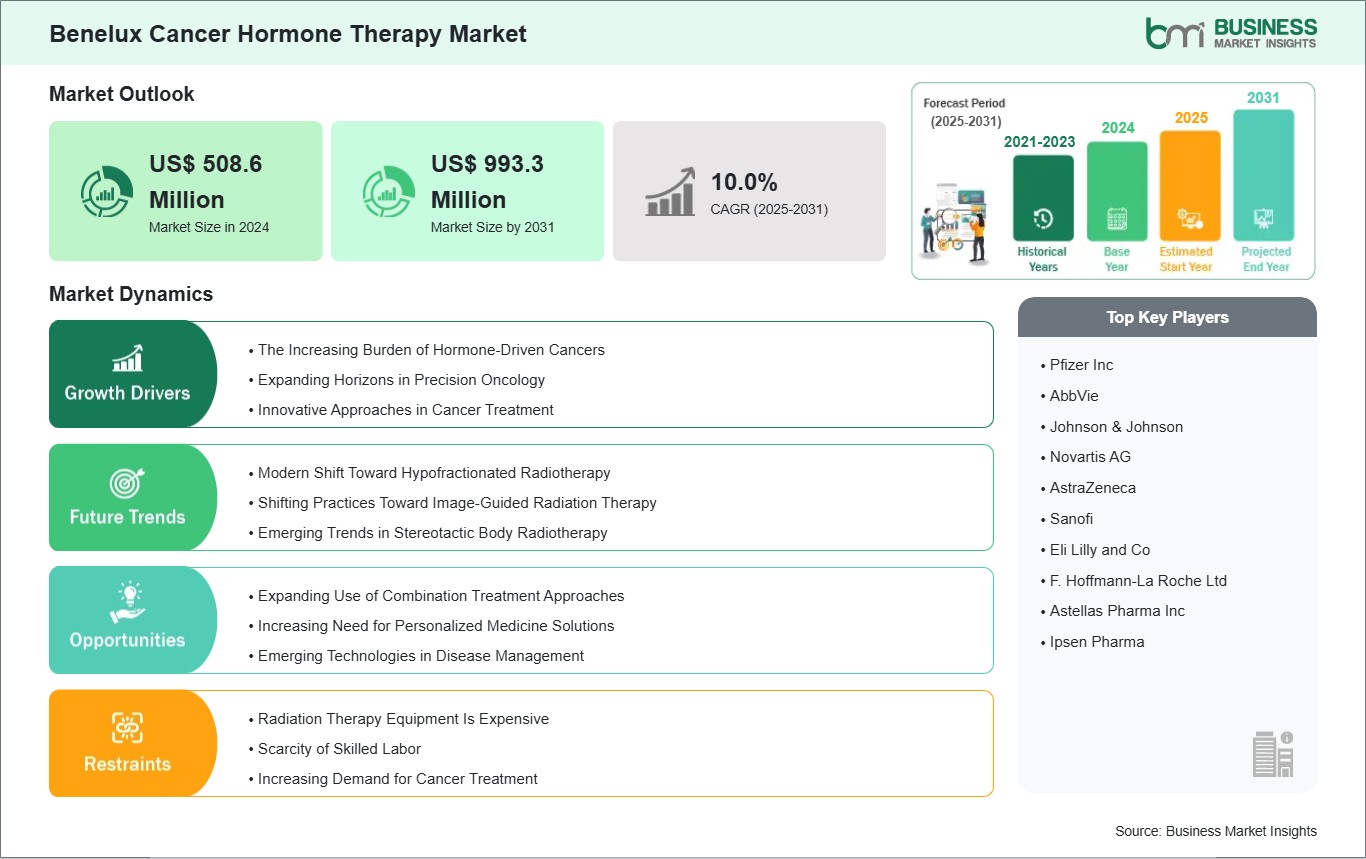
The Benelux cancer hormone therapy market size is expected to reach US$ 993.3 million by 2031 from US$ 508.6 million in 2024. The market is estimated to record a CAGR of 10.0% from 2025 to 2031.
In the Netherlands — the dominant country within the Benelux for hormone therapy adoption — established public healthcare financing and progressive reimbursement policies have increased patient access to hormone‑modulating treatments, particularly in breast and prostate cancer care. Institutional support from cancer research bodies, academic hospitals, and public health programs has accelerated early diagnosis and integration of hormone therapy as a cornerstone in multidisciplinary cancer management. Participation in cross‑national evaluation forums such as the Beneluxa initiative enhances the Netherlands’ ability to negotiate access, optimize treatment pathways, and facilitate quicker clinical adoption of advanced hormone agents compared with other European regions.
The high cost of newer hormone therapies — especially next‑generation androgen receptor antagonists and tailored estrogen receptor modulators — can strain healthcare budgets and create pricing pressures despite broad insurance coverage. Regulatory complexity in drug approval and reimbursement adds another layer of challenge, requiring manufacturers and healthcare stakeholders to align evidence generation with stringent European and national requirements. Nonetheless, the region’s strong biotech ecosystem and culture of clinical research underpin continued innovation and competitive dynamics.

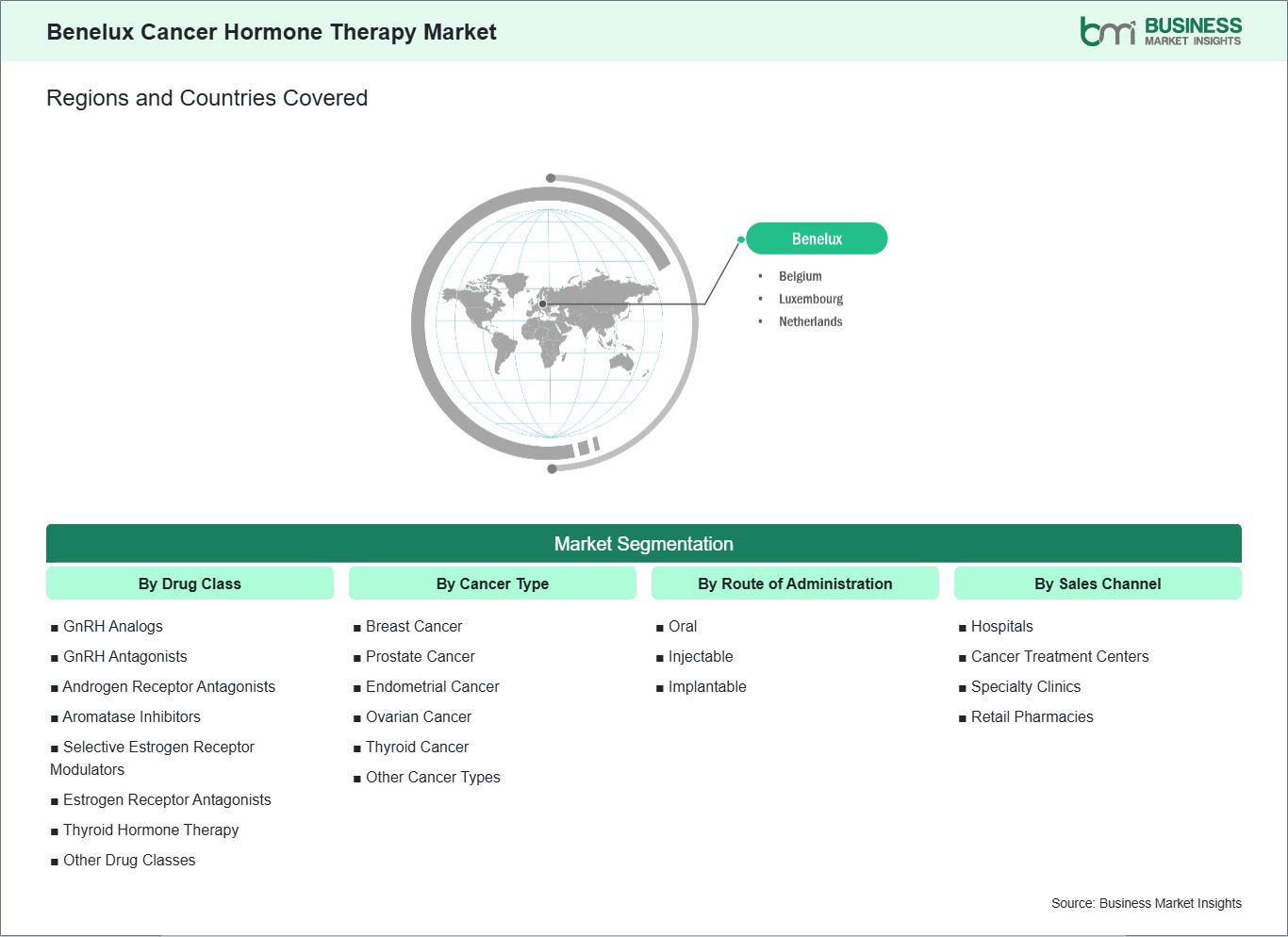
Key segments that contributed to the derivation of the Benelux cancer hormone therapy market analysis are drug class, cancer type, route of administration, and sales channel.
The Benelux region (Belgium, the Netherlands, and Luxembourg) is experiencing a rising incidence of hormone-responsive cancers, particularly breast and prostate cancers, reflecting Western European trends of aging populations combined with improved detection. Breast cancer remains the most commonly diagnosed cancer among women, with hormone receptor–positive (HR+) subtypes accounting for a majority of cases, while prostate cancer continues to dominate male cancer incidence. These patterns create a persistent need for endocrine-based therapies in adjuvant and metastatic settings.
In Belgium, widespread access to screening programs and well-established oncology centers means many breast cancers are diagnosed early, increasing the proportion of patients eligible for hormone therapy. The Netherlands reports high rates of HR+ breast cancer diagnoses, with national guidelines emphasizing long-term adjuvant endocrine therapy. Luxembourg, though smaller, aligns closely with these neighboring practices, ensuring that hormone therapy remains a cornerstone of cancer management across the region.
Beyond breast and prostate cancer, other hormone-sensitive tumors, including certain endometrial and ovarian cancers, contribute to the growing demand for endocrine interventions. Advances in molecular profiling are refining the identification of patients likely to benefit from hormone therapy, helping clinicians tailor treatment and anticipate resistance patterns. The effect is an expanding base of patients requiring hormone-directed care throughout Benelux.
Combination hormone therapy regimens are integrated into clinical practice in the Benelux region, particularly for patients with advanced or high-risk disease. In HR+ breast cancer, clinicians combine aromatase inhibitors or selective estrogen receptor modulators with ovarian suppression or other systemic agents to optimize outcomes. This trend reflects a shift toward more personalized strategies aimed at prolonging disease control while minimizing toxicity.
Prostate cancer management demonstrates growing use of combination approaches. Androgen deprivation therapy, a mainstay for advanced prostate cancer, is paired with other hormonal agents or supportive therapies to enhance efficacy. Clinicians in the Benelux countries leverage multidisciplinary tumor boards to guide these decisions, balancing clinical evidence with patient-specific factors such as age, comorbidities, and treatment goals.
The adoption of combination regimens is supported by robust healthcare infrastructures and close collaboration among oncology centers. Belgian and Dutch hospitals employ standardized protocols, enabling consistent use of multi-agent hormone therapies and facilitating knowledge sharing across the region. This integration ensures that patients benefit from evolving best practices, positioning hormone therapy as a sophisticated component of cancer care in Benelux.

The Benelux cancer hormone therapy market demonstrates steady growth, with size and share analysis highlighting evolving trends and competitive dynamics among key players. The report further examines subsegments categorized within drug class, cancer type, route of administration, and sales channel, highlighting their respective contributions to overall market performance.
By drug class, the GnRH analogs subsegment dominated the market in 2024. Their proven efficacy in hormone-dependent cancers, widespread clinical adoption, established safety profile, and ability to effectively suppress gonadotropin release make them a cornerstone of endocrine-based cancer therapies.
Per cancer type, the breast cancer subsegment dominated the market in 2024, driven by the high global prevalence of breast cancer, increasing awareness and screening programs, strong reliance on hormone-based treatments, and continuous advancements in targeted and combination therapies.
By route of administration, the oral subsegment dominated the market in 2024. Oral therapies are preferred due to their ease of administration, improved patient compliance, convenience for long-term treatment, reduced need for hospital visits, and growing availability of effective oral oncology drugs.
Per sales channel, the hospitals subsegment dominated the market in 2024. Hospitals remain the primary distribution channel as they offer comprehensive cancer care, access to specialized oncology pharmacists, advanced treatment infrastructure, and integrated diagnostic and therapeutic services, ensuring efficient delivery of cancer medications.
| Report Attribute | Details |
|---|---|
| Market size in 2024 | US$ 508.6 Million |
| Market Size by 2031 | US$ 993.3 Million |
| CAGR (2025 - 2031) | 10.0% |
| Historical Data | 2021-2023 |
| Forecast period | 2025-2031 |
| Segments Covered | By Drug Class
|
| Regions and Countries Covered | Benelux
|
| Market leaders and key company profiles |
|
The "Benelux Cancer Hormone Therapy Market Size and Forecast (2021–2031)" report provides a detailed analysis of the market covering below areas:
The geographical scope of the Benelux Cancer Hormone Therapy market report is divided into: Belgium, the Netherlands, and Luxembourg. The Netherlands held the largest share in 2024.
The Netherlands stands out as the most influential player in the Cancer Hormone Therapy segment within the Benelux market, supported by a mature oncology care framework and high levels of R&D investment. Healthcare policy emphasizes evidence‑based adoption of oncology therapeutics, making hormone therapies for estrogen and androgen-receptor-positive cancers widely accessible through universal health coverage. Clinicians integrate hormone therapy early in treatment regimens for eligible patients, backed by strong multidisciplinary tumor board practices and national cancer guidelines that reflect the latest scientific consensus.
Collaborative regional efforts, including joint Health Technology Assessment mechanisms under the Beneluxa agreement, allow the Netherlands to engage in shared clinical evaluations that align regulatory standards across neighboring markets — enhancing bargaining power and streamlining access to innovative hormone treatments. Academic centers contribute to clinical trials involving next‑generation hormone agents and combination strategies with targeted therapies, which reinforces the Netherlands’ position as a hub for hormone therapy innovation within Benelux.
Despite these strengths, access inequities can emerge between urban centers with major oncology facilities and more rural areas where specialist services are less concentrated, prompting ongoing initiatives to standardize service delivery. Balancing cost containment with the adoption of high‑priced therapies continues to influence reimbursement policy discussions among payers and health authorities. Emerging opportunities lie in precision‑medicine approaches that match patients more closely with hormone therapy regimens, enhancing outcomes and long‑term value for payers and patients alike.

The Benelux Cancer Hormone Therapy market is evaluated by gathering qualitative and quantitative data post primary and secondary research, which includes important corporate publications, association data, and databases. A few of the key developments in the Benelux cancer hormone therapy market are:
The Benelux Cancer Hormone Therapy Market is valued at US$ 508.6 Million in 2024, it is projected to reach US$ 993.3 Million by 2031.
As per our report Benelux Cancer Hormone Therapy Market, the market size is valued at US$ 508.6 Million in 2024, projecting it to reach US$ 993.3 Million by 2031. This translates to a CAGR of approximately 10.0% during the forecast period.
The Benelux Cancer Hormone Therapy Market report typically cover these key segments-
The historic period, base year, and forecast period can vary slightly depending on the specific market research report. However, for the Benelux Cancer Hormone Therapy Market report:
The Benelux Cancer Hormone Therapy Market is populated by several key players, each contributing to its growth and innovation. Some of the major players include:
The Benelux Cancer Hormone Therapy Market report is valuable for diverse stakeholders, including:
Essentially, anyone involved in or considering involvement in the Benelux Cancer Hormone Therapy Market value chain can benefit from the information contained in a comprehensive market report.
Please tell us your area of interest
(Market Segments/ Regions and Countries/ Companies)