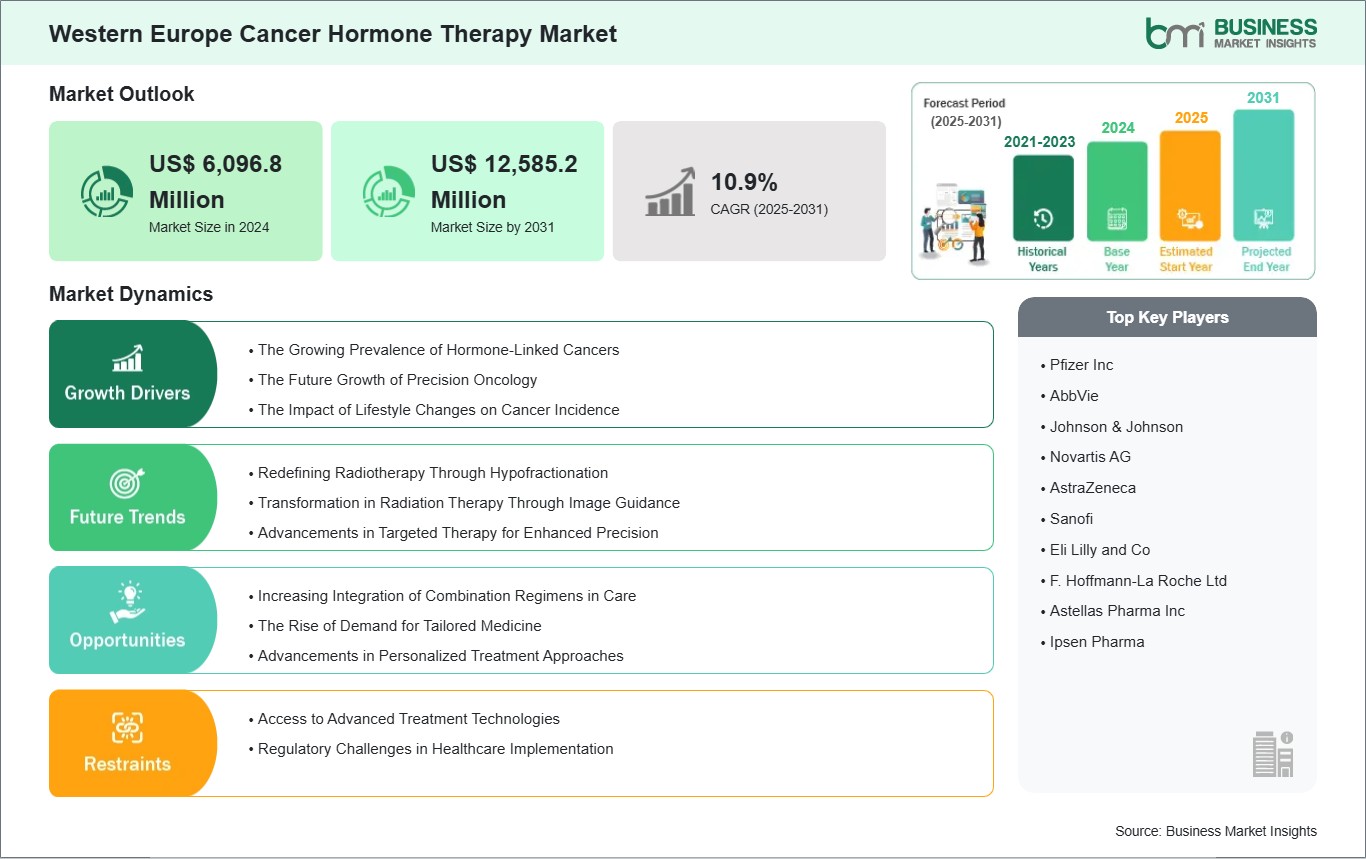
The Western Europe cancer hormone therapy market size is expected to reach US$ 12,585.2 million by 2031 from US$ 6,096.8 million in 2024. The market is estimated to record a CAGR of 10.9% from 2025 to 2031.
Across the region, hormone therapy is deeply embedded within standard treatment pathways, particularly for breast and prostate cancers, where long-term disease management and quality-of-life considerations play a central role in therapy selection. The presence of universal or near-universal healthcare systems supports early diagnosis and continuity of care, allowing hormone therapies to be prescribed across multiple disease stages, including adjuvant, neoadjuvant, and metastatic settings. Western Europe also benefits from a high level of physician familiarity with endocrine treatment options, driven by decades of clinical use and ongoing refinement of treatment protocols.
Germany leads the regional landscape due to its advanced healthcare infrastructure and strong emphasis on evidence-based oncology care. The market is driven by increasing focus on personalized treatment strategies, combination therapies, and long-term disease control rather than short-term outcomes. However, the region faces restraints such as increasing scrutiny on therapy selection within public reimbursement frameworks and evolving clinical recommendations that can influence prescribing behavior. Additionally, treatment-related side effects and patient adherence challenges remain considerations that shape therapy optimization and utilization across Western Europe.

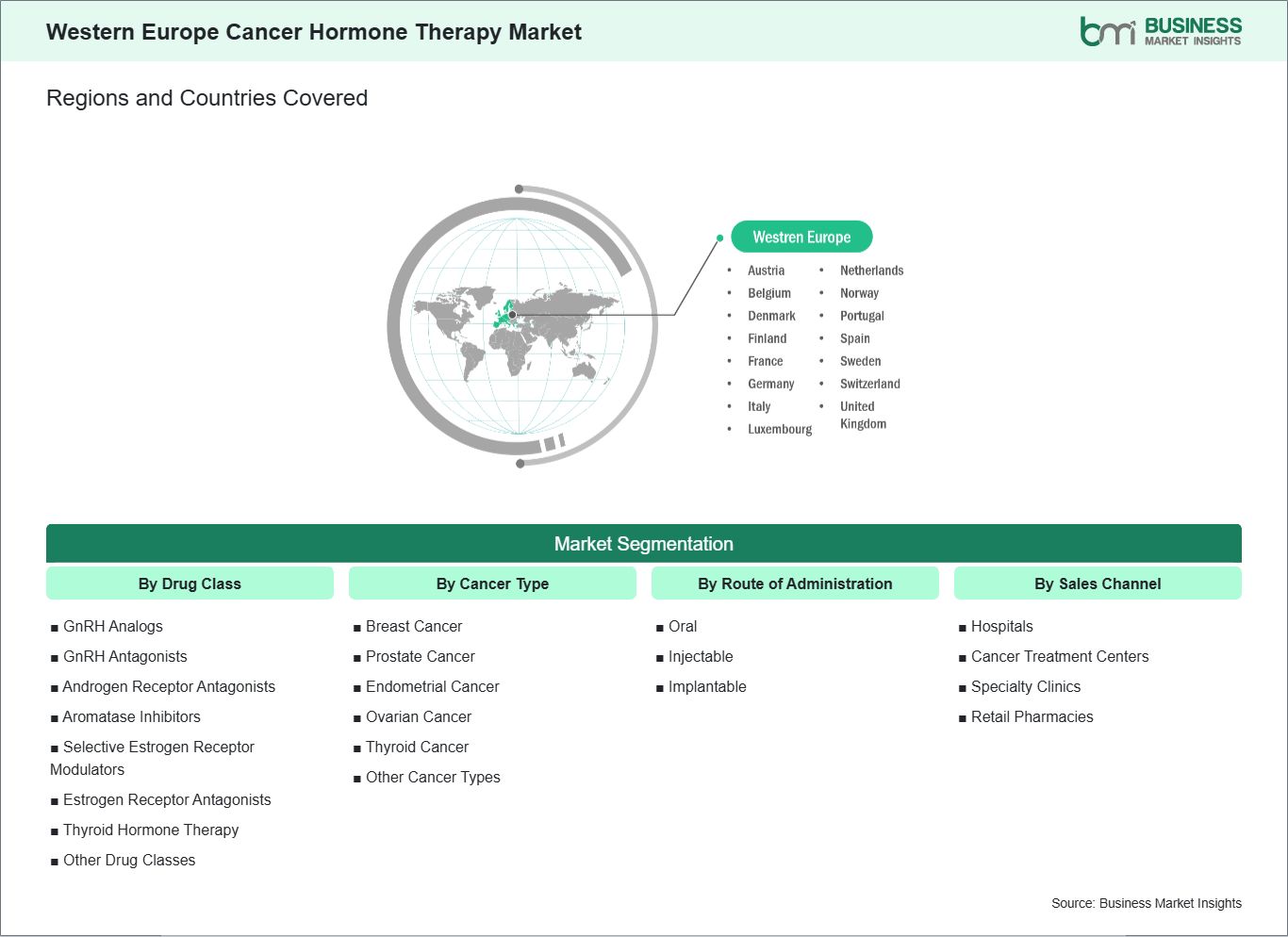
Key segments that contributed to the derivation of the Western Europe cancer hormone therapy market analysis are drug class, cancer type, route of administration, and sales channel.
Western Europe carries one of the world’s highest burdens of hormone-responsive cancers, driven by aging populations, long life expectancy, and mature screening programs. Breast and prostate cancers dominate incidence across Germany, France, the UK, Italy, and Spain, accounting for a substantial share of oncology diagnoses and long-term treatment demand. Widespread mammography and PSA testing have increased early detection, expanding the pool of patients eligible for prolonged hormone therapy in both adjuvant and metastatic settings. As survival improves, prevalence rather than incidence is the primary volume driver for the market.
Later age at first childbirth, lower parity, obesity, and alcohol consumption contribute to estrogen-driven breast cancer risk, particularly in Southern and Western Europe. Rising prostate cancer prevalence in countries such as France and the UK reflects both demographic aging and improved diagnostic intensity. These dynamics translate into extended treatment durations with aromatase inhibitors, SERMs, LHRH agonists, and androgen-deprivation therapies, sustaining steady consumption across hospital and outpatient settings.
Health systems in Western Europe are structurally equipped to manage chronic oncology care, supporting long-term hormone therapy use. Strong primary care referral networks and integrated cancer centers enable consistent initiation and monitoring of endocrine treatments. National cancer strategies in Germany and the Nordics emphasize survivorship care and adherence, reinforcing hormone therapy as a foundational pillar of cancer management. As more patients live longer with controlled disease, the installed base of hormone-treated patients continues to expand, anchoring market growth.
The Western Europe cancer hormone therapy market is increasingly shaped by combination regimens that pair endocrine agents with targeted therapies. In hormone receptor–positive breast cancer, combinations of aromatase inhibitors or fulvestrant with CDK4/6 inhibitors are now the standard of care across the UK, France, and Spain, supported by favorable reimbursement decisions and strong guideline alignment. These regimens have shifted treatment earlier in the disease course, increasing both therapy intensity and per-patient spending.
Prostate cancer management shows a similar evolution. Androgen-deprivation therapy is routinely combined with next-generation androgen receptor inhibitors or chemotherapy in metastatic hormone-sensitive disease, particularly in Germany and Italy. Earlier use of combination approaches has expanded the treated population beyond late-stage patients, while extending the duration of therapy. This shift increases demand for hormone backbones alongside novel agents, reinforcing the central role of endocrine therapy within multimodal regimens.
Western Europe’s regulatory and reimbursement environment accelerates the uptake of combination strategies. Health technology assessment bodies increasingly accept progression-free survival and quality-of-life benefits as sufficient value markers, enabling relatively rapid access compared with other regions. Academic oncology networks and real-world evidence platforms in the Nordics and Benelux countries support adoption by validating outcomes in routine practice. As precision medicine advances and new partners to hormone therapy emerge, combination regimens are set to remain a key growth lever for the Western Europe cancer hormone therapy market.

The Western Europe cancer hormone therapy market demonstrates steady growth, with size and share analysis highlighting evolving trends and competitive dynamics among key players. The report further examines subsegments categorized within drug class, cancer type, route of administration, and sales channel, highlighting their respective contributions to overall market performance.
By drug class, the GnRH analogs subsegment dominated the market in 2024. Their proven efficacy in hormone-dependent cancers, widespread clinical adoption, established safety profile, and ability to effectively suppress gonadotropin release make them a cornerstone of endocrine-based cancer therapies.
Per cancer type, the breast cancer subsegment dominated the market in 2024, driven by the high global prevalence of breast cancer, increasing awareness and screening programs, strong reliance on hormone-based treatments, and continuous advancements in targeted and combination therapies.
By route of administration, the oral subsegment dominated the market in 2024. Oral therapies are preferred due to their ease of administration, improved patient compliance, convenience for long-term treatment, reduced need for hospital visits, and growing availability of effective oral oncology drugs.
Per sales channel, the hospitals subsegment dominated the market in 2024. Hospitals remain the primary distribution channel as they offer comprehensive cancer care, access to specialized oncology pharmacists, advanced treatment infrastructure, and integrated diagnostic and therapeutic services, ensuring efficient delivery of cancer medications.
| Report Attribute | Details |
|---|---|
| Market size in 2024 | US$ 6,096.8 Million |
| Market Size by 2031 | US$ 12,585.2 Million |
| CAGR (2025 - 2031) | 10.9% |
| Historical Data | 2021-2023 |
| Forecast period | 2025-2031 |
| Segments Covered | By Drug Class
|
| Regions and Countries Covered | Western Europe
|
| Market leaders and key company profiles |
|
The "Western Europe Cancer Hormone Therapy Market Size and Forecast (2021–2031)" report provides a detailed analysis of the market covering below areas:
The geographical scope of the Western Europe Cancer Hormone Therapy market report is divided into: Belgium, the Netherlands, Luxembourg, Germany, France, Italy, Spain, Switzerland, Sweden, Austria, the UK, Denmark, Portugal, Norway, and Finland. Germany held the largest share in 2024.
Germany dominates the market due to its highly structured oncology care system, strong clinical leadership, and comprehensive cancer treatment networks. Hormone therapy is recognized as a foundational component of cancer management in Germany, particularly for hormone-dependent malignancies where long-term disease control is prioritized. German oncologists follow standardized treatment guidelines that integrate hormone therapy as a first-line or maintenance option, ensuring consistent adoption across hospital-based and outpatient oncology settings. The country’s emphasis on early detection and multidisciplinary care enables the timely initiation of endocrine therapies, often in combination with other treatment modalities, to enhance clinical outcomes. A key differentiator for Germany is its strong culture of clinical research and physician engagement in therapy optimization. Medical professionals participate in refining treatment strategies based on real-world patient outcomes, which supports continuous improvement in hormone therapy use. Germany’s healthcare system encourages patient education and shared decision-making, contributing to higher acceptance of long-term hormone treatment regimens. Despite its leadership position, Germany navigates challenges related to treatment personalization, managing therapy-related side effects, and aligning evolving clinical recommendations with real-world practice. Overall, Germany’s dominance is sustained by its balance of clinical rigor, patient access, and structured oncology care delivery.

The Western Europe Cancer Hormone Therapy market is evaluated by gathering qualitative and quantitative data post primary and secondary research, which includes important corporate publications, association data, and databases. A few of the key developments in the Western Europe cancer hormone therapy market are:
The Western Europe Cancer Hormone Therapy Market is valued at US$ 6,096.8 Million in 2024, it is projected to reach US$ 12,585.2 Million by 2031.
As per our report Western Europe Cancer Hormone Therapy Market, the market size is valued at US$ 6,096.8 Million in 2024, projecting it to reach US$ 12,585.2 Million by 2031. This translates to a CAGR of approximately 10.9% during the forecast period.
The Western Europe Cancer Hormone Therapy Market report typically cover these key segments-
The historic period, base year, and forecast period can vary slightly depending on the specific market research report. However, for the Western Europe Cancer Hormone Therapy Market report:
The Western Europe Cancer Hormone Therapy Market is populated by several key players, each contributing to its growth and innovation. Some of the major players include:
The Western Europe Cancer Hormone Therapy Market report is valuable for diverse stakeholders, including:
Essentially, anyone involved in or considering involvement in the Western Europe Cancer Hormone Therapy Market value chain can benefit from the information contained in a comprehensive market report.
Please tell us your area of interest
(Market Segments/ Regions and Countries/ Companies)