Market Summary
Executive Summary and Global Market Analysis
Biometric vehicle access system market is witnessing significant growth due to the increasing demand for advanced vehicle security, connected mobility solutions, and seamless user authentication technologies. Biometric vehicle access systems use unique physiological and behavioral characteristics such as fingerprints, facial recognition, iris recognition, and voice authentication to provide secure vehicle entry, ignition control, driver identification, and personalized in-cabin experiences.
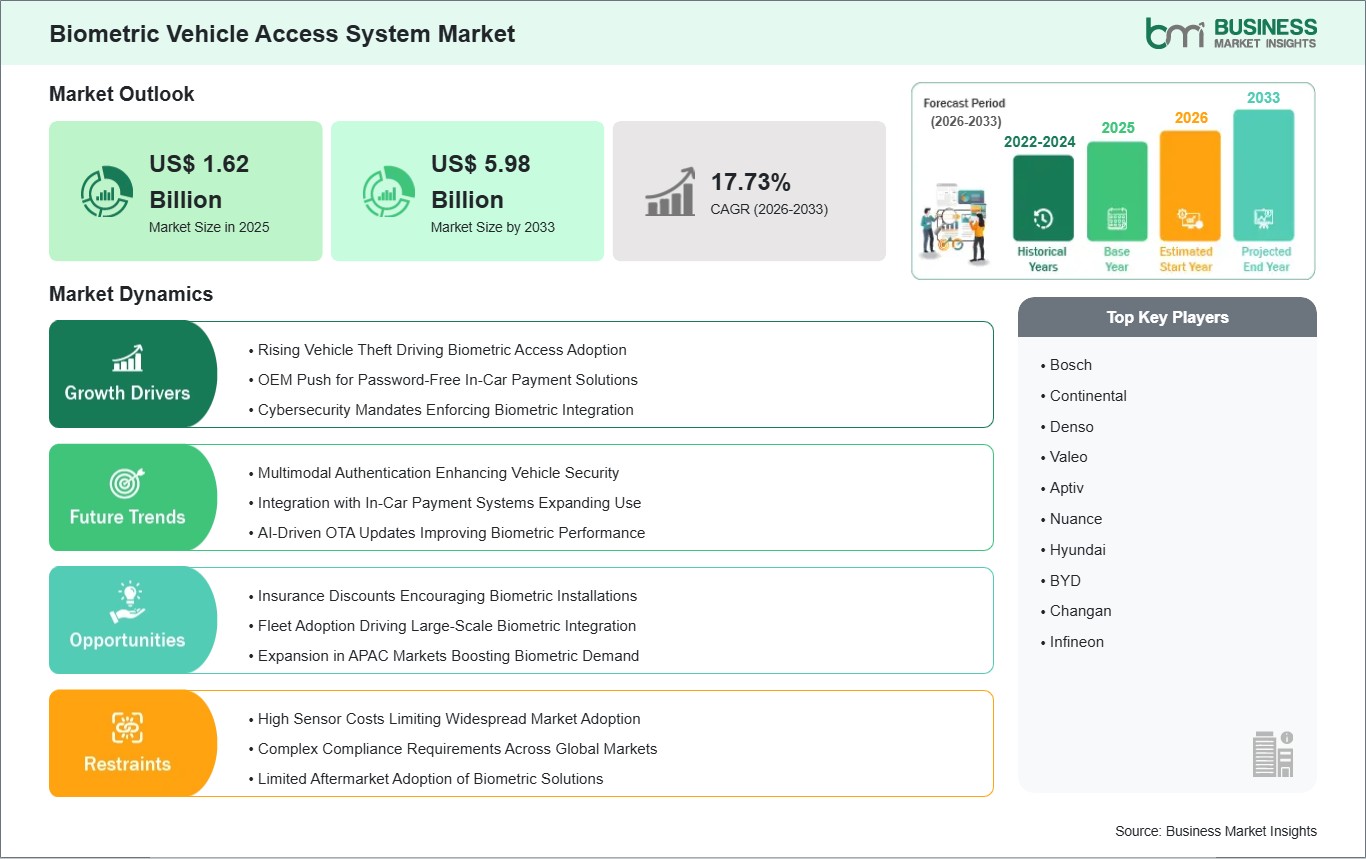
The market is expanding rapidly as rising vehicle theft is driving biometric access adoption across developed and emerging economies. Automotive manufacturers are increasingly integrating biometric technologies into premium and mid-range vehicles to provide secure, password-free access and personalized driving experiences. OEM push for password-free in-car payment solutions is further accelerating adoption, as automakers and mobility providers focus on enabling secure digital transactions directly within connected vehicles.
Technological advancements in artificial intelligence, machine learning, and sensor technologies are further contributing to market growth. Multimodal authentication systems combining fingerprint, facial, iris, and voice recognition are improving authentication accuracy, reducing false acceptance rates, and enhancing overall vehicle security. AI-driven OTA updates are improving biometric performance through continuous algorithm optimization, adaptive learning capabilities, and remote system enhancements. Integration with connected car ecosystems, cloud platforms, and digital payment infrastructures is also creating new opportunities for market expansion.
Despite strong growth potential, the market faces several challenges. High sensor costs limiting widespread market adoption remain a major restraint, particularly in cost-sensitive automotive segments. Advanced biometric systems require sophisticated hardware, software integration, and secure data processing capabilities, increasing overall implementation costs. Complex compliance requirements across global markets also create operational challenges for manufacturers regarding data privacy, cybersecurity, and biometric information management. In addition, limited aftermarket adoption of biometric solutions continues to restrict market penetration beyond OEM-installed systems.
Segment Analysis
Biometric Vehicle Access System Market Segmentation
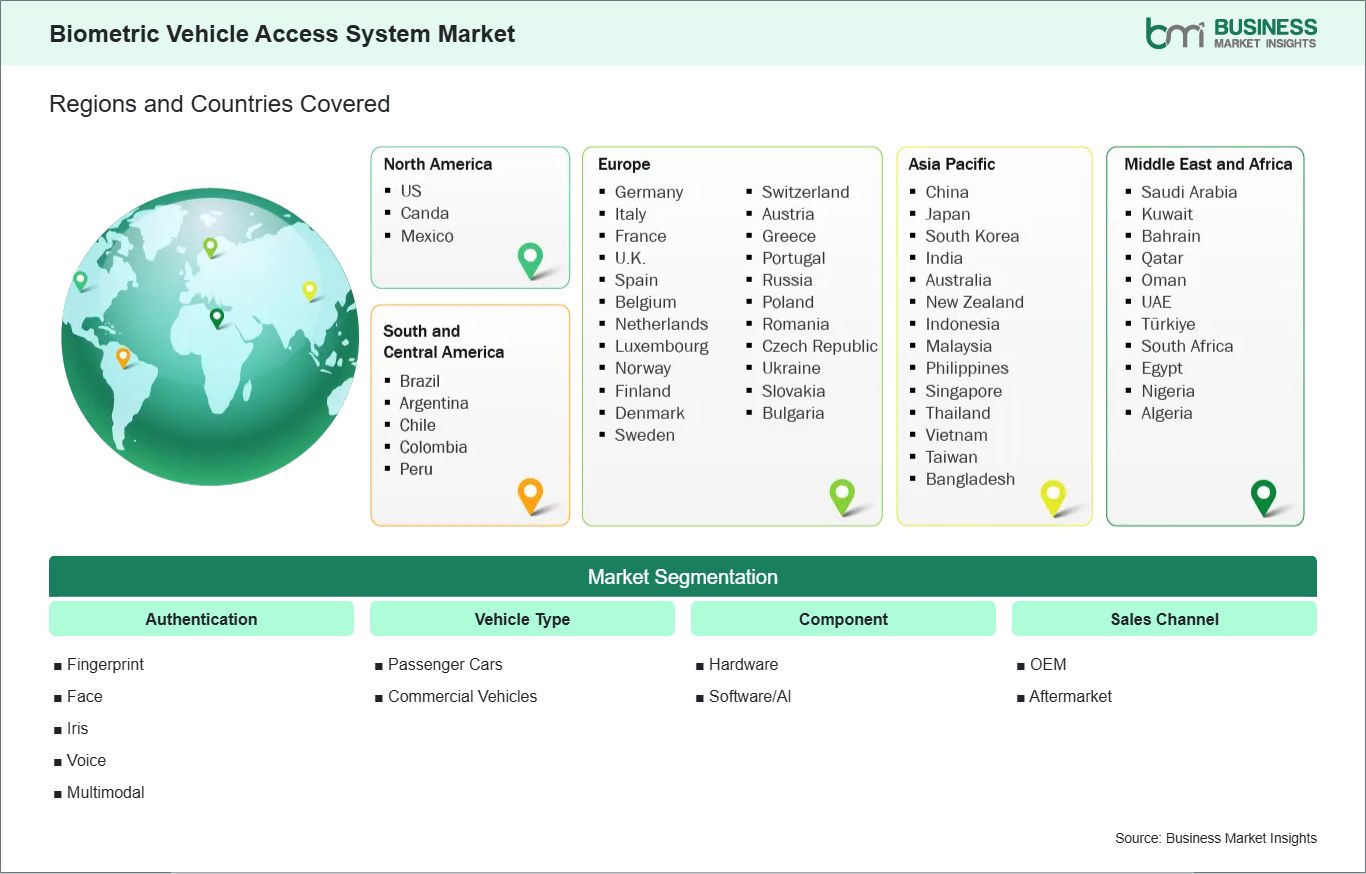
The biometric vehicle access system market is segmented based on authentication, vehicle type, component, and sales channel, reflecting the increasing adoption of advanced automotive security and digital identity verification technologies.
By Authentication
- 2 Fingerprint: Uses fingerprint recognition for secure vehicle entry and ignition access
- Face: Utilizes facial recognition technologies for driver identification and authentication
- Iris: Employs iris scanning systems for highly accurate biometric verification
- Voice: Enables voice-based authentication for secure and contactless vehicle access
- Multimodal: Combines multiple biometric authentication methods for enhanced security and reliability
By Vehicle Type
- Passenger Cars: Widely adopted in premium and connected passenger vehicles for enhanced security and convenience
- Commercial Vehicles: Increasingly integrated into fleet vehicles for driver authentication and operational security
By Component
- Hardware: Includes biometric sensors, cameras, processors, and scanning devices used for authentication
- Software/AI: Comprises biometric algorithms, artificial intelligence platforms, analytics, and authentication management systems
By Sales Channel
- OEM: Factory-installed biometric vehicle access systems integrated directly by automotive manufacturers
- Aftermarket: Third-party biometric access solutions installed after vehicle purchase
Market Forces
Biometric Vehicle Access System Market Drivers and Opportunities
Rising Vehicle Theft Driving Biometric Access Adoption
The demand for biometric vehicle access systems is being driven significantly by increasing the prevalence of vehicle theft globally driving an increased trend on the use of biometric access systems. Standard mechanical key based systems for accessing vehicles are becoming increasingly vulnerable to theft, replication, and cyberattacks, thus increasing the need for automakers and consumers to adopt secure means of authentication in the form of biometrics. Today's more technologically advanced biometrics provide a higher level of protection due to their uniqueness and the challenges associated with replicating and altering physical characteristics.
Increased emphasis by automotive OEMs to incorporate fingerprint, facial recognition, and multimodal authentication into connected vehicles will offer greater vehicle security and enhance convenience for the customer. Automotive OEMs' efforts to provide passwordless in-car payment will contribute positively to the growth of this market segment as the use of biometric authentication will facilitate secure digital transactions and create personalised mobility experiences within the connected vehicle. Cybersecurity mandates that require the integration of biometrics will likely lead more manufacturers to implement advanced systems of authentication to safeguard connected vehicle ecosystems from unauthorised access and cyber threats.
The continued growth in the use of connected vehicles, smart mobility platforms, and autonomous driving technologies will further increase demand for advanced biometric access systems among passenger vehicles and commercial vehicles across the globe.
Insurance Discounts Encouraging Biometric Installations
Biometric vehicle access systems are being increasingly viewed by insurance companies as effective anti-theft devices that can significantly contribute toward reducing vehicle theft exposure and lowering the frequency of insurance claims made for such vehicles. Therefore, consumers and fleet operators will be more inclined to adopt biometric vehicle access technologies in order to reap the benefits of lower insurance premiums and increased security.
Fleet adoption of biometric technologies is leading to increased adoption of biometrics in logistics, transportation and ride sharing; enhancing driver verification, increasing operational control and better fleet security management. The growth of biometric demand in APAC is being fueled by a continued investment by automotive manufacturers and government agencies in connected mobility infrastructure and automotive cyber security technologies.
Automakers are actively exploring multimodal authentication solutions to improve the reliability of vehicle authentication and the convenience to the user. There is an increasing trend in the integration of biometric vehicle access systems with in-vehicle payment systems; which have expanded the use case of biometrics from vehicle access to secure digital commerce and for personalized infotainment services. In addition, the use of artificial intelligence in over-the-air updating of biometric performance will enable continued system optimization, adaptive authentication capabilities, and enhanced user experiences in connection with connected vehicles.
Size and Share Analysis
Biometric Vehicle Access System Market Size and Share Analysis
The Biometric Vehicle Access System Market is projected to grow from US$ 1.62 Billion in 2025 to US$ 5.98 Billion by 2033 , registering a CAGR of 17.73% from 2026 to 2033.
By authentication, fingerprint recognition accounts for a significant market share due to its widespread adoption, ease of use, and cost-effective integration across connected vehicles. Facial recognition technologies are witnessing strong growth with increasing deployment in premium vehicles and intelligent cockpit systems. Iris recognition systems are gaining traction for high-security automotive applications requiring advanced authentication accuracy, while voice authentication solutions are expanding steadily with the growth of connected voice assistant technologies. Multimodal authentication systems are increasingly preferred due to their ability to combine multiple biometric verification methods and enhance overall vehicle security.
By vehicle type, passenger cars dominate the market owing to increasing integration of advanced security and personalization technologies across premium and mid-range vehicles. Commercial vehicles are also witnessing growing adoption as fleet operators increasingly implement biometric authentication systems for driver management, vehicle tracking, and operational security.
By component, hardware solutions hold a notable market share due to rising deployment of biometric sensors, cameras, and embedded processors within vehicles. Software/AI solutions are expected to witness substantial growth driven by advancements in artificial intelligence, machine learning algorithms, cloud-based authentication platforms, and OTA software update capabilities.
By sales channel, OEM installations dominate the market as automakers increasingly integrate biometric access technologies during vehicle manufacturing. The aftermarket segment is growing steadily due to rising consumer awareness regarding vehicle security and increasing availability of third-party biometric access solutions.
Report Coverage
Biometric Vehicle Access System Market Report Coverage and Deliverables
The "Biometric Vehicle Access System Market Size and Forecast (2022 - 2033)" report provides a detailed analysis of the market covering below areas:
- The market size and forecast at global, regional, and country levels for all market segments covered under the scope
- The market trends, as well as drivers, restraints, and opportunities
- The market analysis covering key trends, global and regional framework, major players, regulations, and recent developments
- Industry landscape and competition analysis covering market concentration, heat map analysis, prominent players, and recent developments for the market
- Detailed company profiles, including SWOT analysis
Geographic Insights
Biometric Vehicle Access System Market Geographic Insights
The biometric vehicle access system market is growing steadily across global regions due to increasing demand for connected mobility, automotive cybersecurity, and intelligent vehicle authentication technologies.
The market for a biometric vehicle access system is considerably expanding across all different geographical areas due to the increasing need for connected mobility solutions, automotive cybersecurity solutions and advancements in intelligent vehicle authentication technology.
The North American Market, because of the high number of manufacturers producing connected vehicles, automotive technology providers and developers of cybersecurity solutions, represents the largest market. With both the U.S. and Canada investing heavily into smart mobility, artificial intelligence (AI) enabled automotive systems and advanced vehicle security solutions, connected vehicle adoption (including autonomous vehicles) and digital payment methods will help to drive the biometric authentication supply and demand of passenger and commercial vehicles throughout this entire market.
Rapid growth of the Asia Pacific Market (a result of increased vehicle production), increasing electric vehicle adoption and large investments into digitalisation of automotive technologies, are driving the expansion of the Asia Pacific Region's market of biometric vehicle-access systems. Countries such as China, Japan, South Korea and India are actively implementing biometric vehicle access systems into the design of next generation vehicles with the goal of enhancing the level of vehicle security, improving user convenience, and enhancing vehicle connectivity. The expansion of smart transportation systems, increasing consumer demand for advanced safety solutions and insurance (solutions for connecting devices) and strong government backing of automotive technology are all providing significant support to enhance the growth of the Asia Pacific market.
Europe's market for biometric vehicle access systems is also expected to grow significantly due to the many vehicle cybersecurity requirements that are mandated by regulatory authorities, to the increase in the number of premium vehicles being sold; and to the continued development of many other advanced automotive technologies.
Industry Activity
Recent Developments
The biometric vehicle access system market is evaluated by gathering qualitative and quantitative data post primary and secondary research, which includes important corporate publications, association data, and databases. A few of the key developments in the biometric vehicle access system market are:
- In April 2025, Global automotive Tier-1 supplier Forvia announced a strategic partnership with Smart Eye, a pioneer in Human Insight AI. The collaboration is explicitly aimed at developing next-generation biometric authentication and in-cabin sensing technology. By blending Forvia's vehicle interior integration expertise with Smart Eye’s advanced software, the partnership seeks to deliver seamless, secure biometric vehicle access control and enhanced driver monitoring systems (DMS) directly to major automotive OEMs.
- In October 2025, Biometric testing and assurance firm BixeLab officially inaugurated its dedicated biometric testing center in Canberra, Australia. The specialized facility was launched to thoroughly evaluate, calibrate, and validate the quality of hardware sensors and recognition algorithms.
Trust & Transparency
Research Methodology
The market analysis combines proprietary research with secondary data from government agencies, company disclosures, regulatory filings, industry databases and expert interviews. Market estimates are validated through data triangulation, cross-market benchmarking and analyst
review.
View Full Research Methodology
Key Sources Referred:
International Organization of Motor Vehicle Manufacturers (OICA)
International Electrotechnical Commission (IEC)
Society of Automotive Engineers (SAE International)
International Telecommunication Union (ITU)
European Automobile Manufacturers’ Association (ACEA)
National Highway Traffic Safety Administration (NHTSA)
International Organization for Standardization (ISO)
Automotive Information Sharing and Analysis Center (Auto-ISAC)