Market Summary
Executive Summary and Global Market Analysis
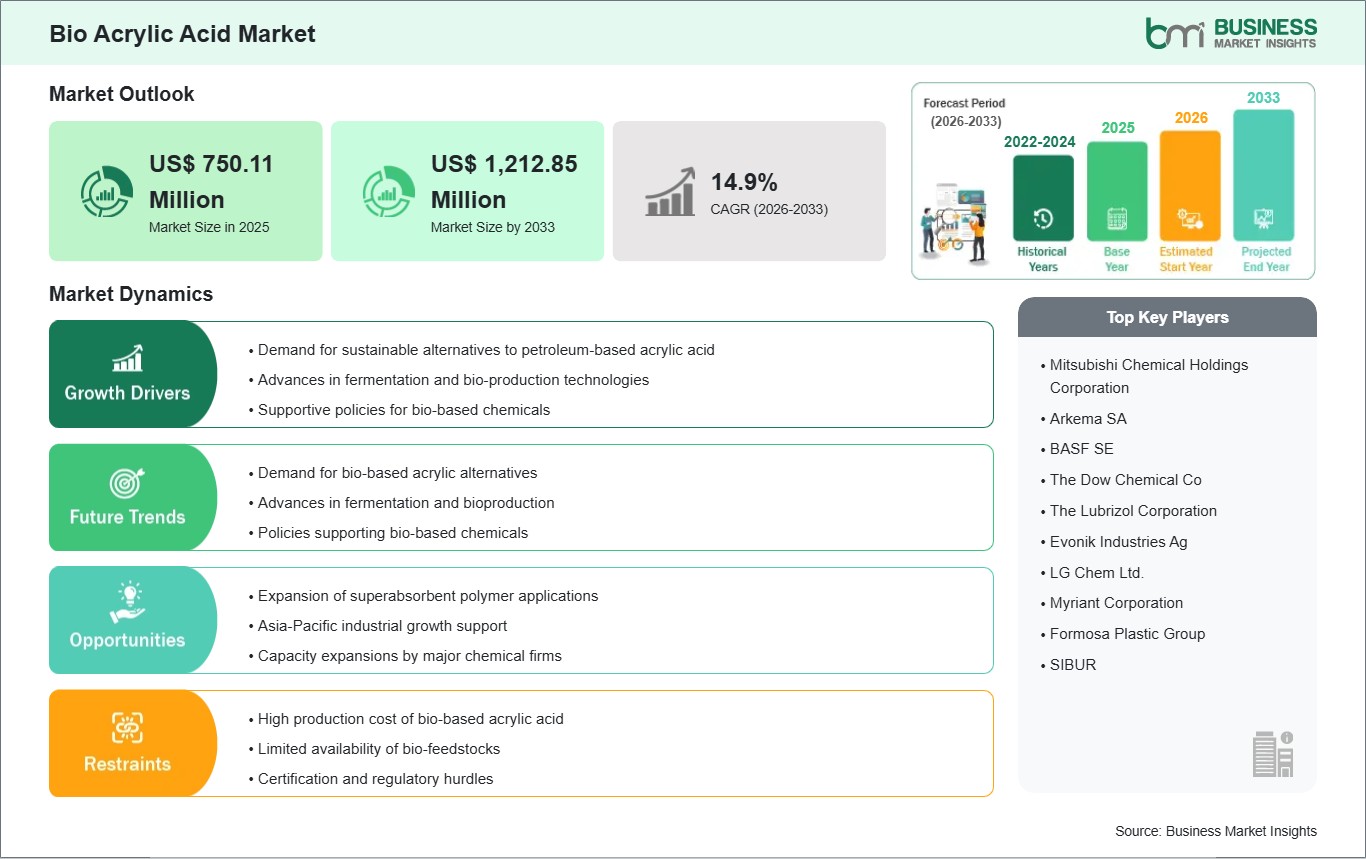
Bio acrylic acid is an important bio-based chemical used to make superabsorbent polymers, coatings, adhesives, textiles, and personal care products. It comes from renewable feedstocks like glycerol, lactic acid, or other biomass sources. This makes it a sustainable alternative to traditional petroleum-based acrylic acid. Bio acrylic acid helps reduce carbon footprints and supports the move towards greener chemical manufacturing. It is commonly used in hygiene products, paints and coatings, water treatment chemicals, and construction materials. This material provides strong adhesion, durability, water absorption, and chemical resistance. It also improves product performance while meeting environmental and regulatory standards. The advantages include less reliance on fossil resources, lower greenhouse gas emissions, compatibility with existing production systems, and a growing consumer preference for sustainable products. Market growth mainly comes from increasing environmental awareness, stricter rules on petrochemical emissions, rising demand for eco-friendly superabsorbent polymers, and the expansion of green packaging and construction sectors. Advances in bio-refining and fermentation processes further speed up market development.
However, the bio acrylic acid market faces several challenges, such as high production costs compared to conventional acrylic acid can limit its widespread use. The availability and price fluctuations of feedstocks may also impact supply stability. Scaling up production while ensuring consistent quality remains a technical challenge for manufacturers. Additionally, competition from established petrochemical alternatives can slow market entry. Despite these hurdles, there are significant opportunities due to advancements in biotechnology, increased investment in sustainable chemical infrastructure, and supportive government policies that promote bio-based products. Future market trends will likely depend on improvements in cost-effective production technologies, the development of high-performance bio-based derivatives, strategic partnerships across the value chain, and the global shift towards circular economy practices.
Segment Analysis
Bio Acrylic Acid Market Segmentation
Key segments that contributed to the derivation of the bio acrylic acid market analysis are type and application.
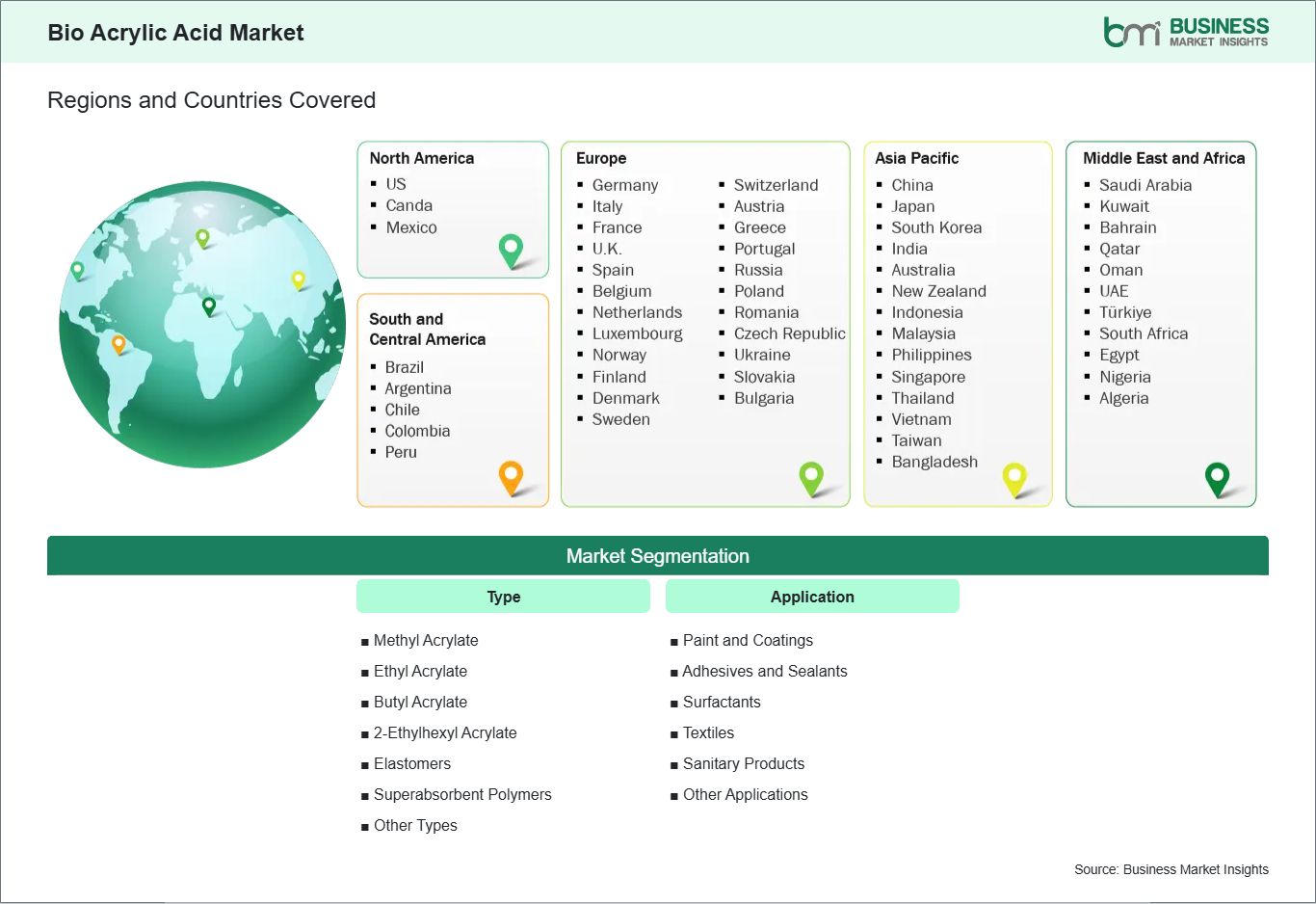
- By type, the bio acrylic acid market is segmented into methyl acrylate, ethyl acrylate, butyl acrylate, 2-ethylhexyl acrylate, elastomers, superabsorbent polymers, and other types. The superabsorbent polymers segment dominated the market in 2025.
- By application, the market is categorized into paint and coatings, adhesives and sealants, surfactants, textiles, sanitary products, and other applications. The sanitary products segment held the largest share of the market in 2025.
Market Forces
Bio Acrylic Acid Market Drivers and Opportunities
Growing Demand for Sustainable and High-Performance Bio Acrylic Acid
Producers and manufacturers are shifting toward bio acrylic acid to meet sustainability goals and reduce reliance on petroleum-based chemicals. Bio acrylic acid performs well in superabsorbent polymers, coatings, adhesives, and textiles while cutting carbon footprints and greenhouse gas emissions. Its use offers a cost-effective way to create eco-friendly polymers, maintain chemical performance, and support current industrial processes without major infrastructure changes. The growing demand for greener personal care products, paints, and construction materials is speeding up the adoption of bio-based acrylic acid. Advances in bio-refining, fermentation, and high-purity production methods ensure consistent quality, efficiency, and versatility, making bio acrylic acid a key part of modern sustainable manufacturing. Market growth benefits from government initiatives, environmental regulations, and rising consumer preference for bio-based materials. The need for high-performance and specialty applications keeps driving research and development and market expansion.
Shift Toward Eco-Friendly and Regulatory-Compliant Chemical Solutions
There is a growing interest in bio-based, low-emission, and biodegradable alternatives to traditional acrylic acid. This trend shows rising environmental awareness, strict global regulations, and the desire for chemical products with smaller environmental impacts. Bio acrylic acid helps produce sustainable superabsorbent polymers and coatings while reducing the use of harmful petrochemicals. Its use improves resource efficiency, cuts carbon emissions, and supports global sustainability goals. Companies are increasingly focusing on products that offer both performance and environmental responsibility. This shift is driving innovation in fermentation technologies, green synthesis methods, and bio-based derivatives. Regulatory compliance, demand for eco-friendly products, and the global move toward circular economy practices are speeding up the adoption of bio acrylic acid across industries, ensuring its ongoing growth and importance in a greener future.
Size and Share Analysis
Bio Acrylic Acid Market Size and Share Analysis
The bio acrylic acid market demonstrates steady growth, with size and share analysis revealing evolving trends and competitive positioning among key players. The report further examines subsegments categorized within type and application, offering insights into their contribution to overall market performance.
Based on within, the superabsorbent polymers subsegment dominates the bio acrylic acid market. Superabsorbent polymers provide excellent water absorption, retention, and gel-forming ability, making them vital for hygiene products, medical uses, and agriculture. They perform well, are stable in chemicals, and are cost-effective. These polymers are commonly found in diapers, adult incontinence products, feminine care items, and soil conditioning. Their dependable absorption, durability, and versatility make them the preferred option for manufacturers and users looking for high-quality, sustainable, and efficient solutions. The increasing demand for eco-friendly and bio-based SAPs further strengthens their top position in the market.
Report Coverage
Bio Acrylic Acid Market Report Coverage and Deliverables
The " Bio Acrylic Acid Market Size and Forecast (2022–2033)" report provides a detailed analysis of the market covering below areas:
- Bio Acrylic Acid market size and forecast at global, regional, and country levels for all the key market segments covered under the scope
- Bio Acrylic Acid market trends, as well as market dynamics such as drivers, restraints, and key opportunities
- Bio Acrylic Acid market analysis covering key market trends, global and regional framework, major players, regulations, and recent market developments
- Industry landscape and competition analysis covering market concentration, heat map analysis, prominent players, and recent developments for the bio acrylic acid market
- Detailed company profiles, including SWOT analysis
Geographic Insights
Bio Acrylic Acid Market Geographic Insights
The geographical scope of the bio acrylic acid market report is divided into five regions: North America, Asia Pacific, Europe, Middle East & Africa, and South & Central America. The Asia Pacific Bio Acrylic Acid Market is segmented into China, Japan, South Korea, India, Australia, New Zealand, Indonesia, Malaysia, the Philippines, Singapore, Thailand, Vietnam, Taiwan, Bangladesh, and the Rest of Asia Pacific. Asia Pacific's fast industrial growth, increasing consumer awareness, and rising demand for eco-friendly chemicals position it as a crucial area for the bio acrylic acid market. The region benefits from growing industries such as hygiene products, paints and coatings, adhesives, and construction materials.
Market growth is also driven by the adoption of bio-based and sustainable solutions, government programs encouraging green manufacturing, and investments in better production technologies. A growing population, urbanization, and a demand for high-performance, environmentally friendly products make the Asia Pacific a top producer and consumer of bio acrylic acid worldwide.
Industry Activity
Recent Developments
The Bio Acrylic Acid market is evaluated by gathering qualitative and quantitative data post-primary and secondary research, which includes important corporate publications, association data, and databases. A few of the key developments in the bio acrylic acid market are:
- In October 2024, Arkema started producing Ethyl Acrylate solely from bioethanol at its Carling, France, facility. This bio-based product boasts a 40% bio-carbon content and can reduce the product's carbon footprint by up to 30%. The bioethanol utilized is derived sustainably from biomass feedstock.
- In March 2025, LG Chem is preparing to commence commercial production of 100% plant-based bio-acrylic acid from vegetable oils in the second quarter of this year, starting with an initial capacity of 100 tons per year. The company aims to increase production in response to rising demand for eco-friendly materials. Bio-acrylic acid can be utilized in various applications, including cosmetics, super absorbent polymers, adhesives, coatings, and eco-friendly paints.
Trust & Transparency
Research Methodology
The market analysis combines proprietary research with secondary data from government agencies, company disclosures, regulatory filings, industry databases and expert interviews. Market estimates are validated through data triangulation, cross-market benchmarking and analyst
review.
View Full Research Methodology
Key Sources Referred:
World Bank – Global Trade IndicatorsEuropean Chemicals AgencyInternational Council of Chemical AssociationsInternational Monetary Fund (IMF)World Trade Organization (WTO)International Trade Administration (ITA)Company WebsitesCompany Annual ReportsCompany Investor Presentations