Bio-based Leather Market Outlook (2022-2033)

Historic Data: 2022-2024   |   Base Year: 2025   |   Forecast Period: 2026-2033
Report Content: Market Scope, Market Segmentation, Market Dynamics, and Competitive Analysis

Report Coverage:
  • Source (Mushroom, Pineapple, Apple, Cactus, Tree Bark, and Leftover Fruits)
  • End-Use Industry (Footwear and Garments and Accessories)

No. of Pages: 400
Report Code: BMIPUB00033324
Category: Chemicals and Materials
Bio-based Leather Market

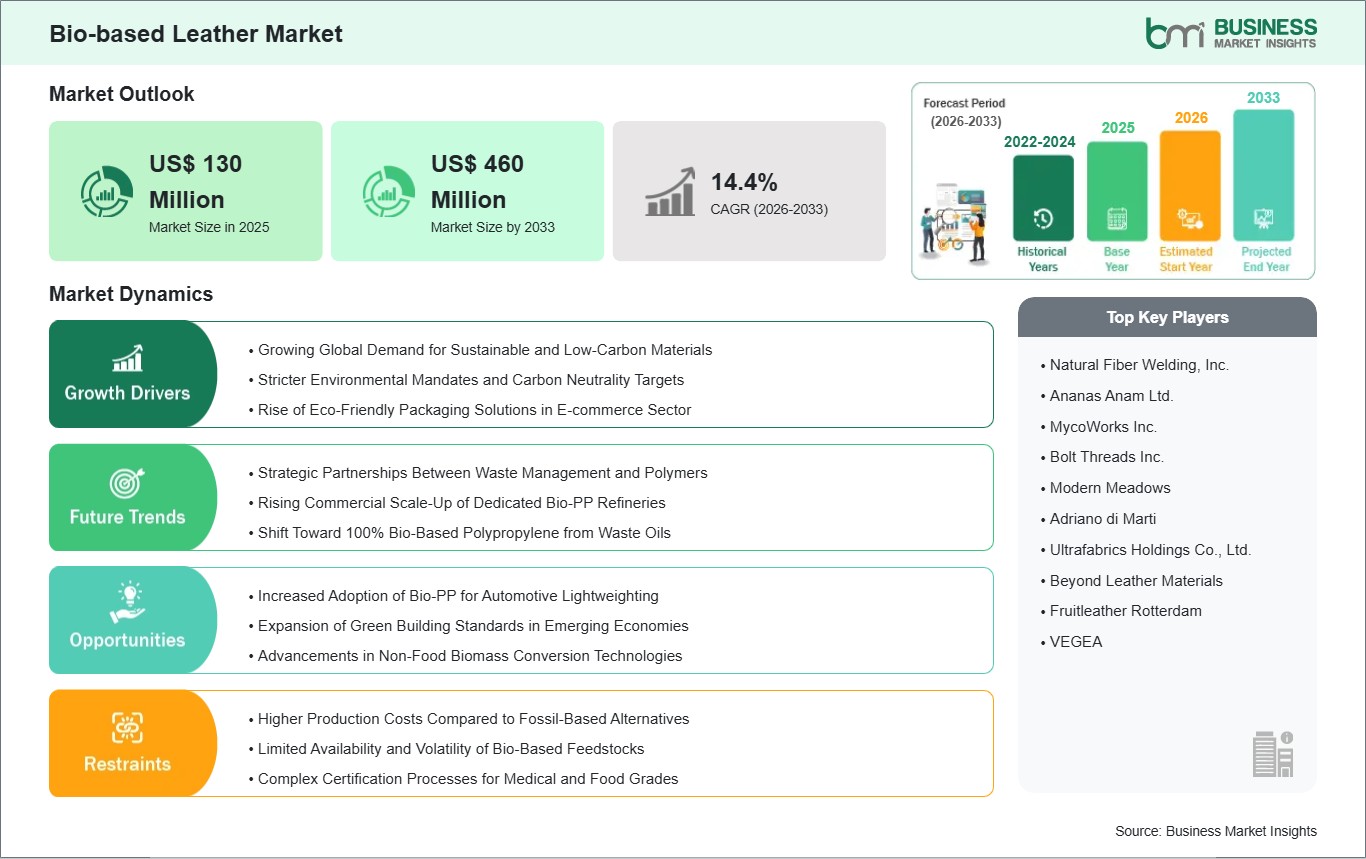
The Bio-based Leather market size is expected to reach US$ 0.46 billion by 2033 from US$ 0.13 billion in 2025. The market is estimated to record a CAGR of 14.43% from 2026 to 2033.

Executive Summary and Global Market Analysis:

Bio-based leather is a sustainable alternative to traditional animal-derived and synthetic leathers, primarily produced from renewable resources such as plant fibers, agricultural waste, and fungal mycelium. It plays an increasingly vital role in sectors like fashion, footwear, and accessories, offering a reduced environmental footprint, lower greenhouse gas emissions, and cruelty-free production. Key advantages include its biodegradability, breathability, and the ability to repurpose waste materials like pineapple leaves, apple pomace, and cactus fibers into high-value textiles. The market is fueled by rising consumer awareness of animal welfare, stringent environmental regulations on chemical tanning processes, and a global shift toward circular economy models. Additionally, advancements in biotechnology, such as microbial fermentation and lab-grown collagen, are significantly improving the material's durability, texture, and scalability.

However, several challenges can restrain market growth, including initial processing costs being too high, the lack of industrial scaling compared to leather, and poor performance in extreme conditions or water resistance. This market will also be influenced by the availability of quality organic materials and the lack of standard certifications of different forms of bio-leathers. Despite these factors, the market will have immense opportunities in the fast-growing sustainable fashion market, in which companies will look for alternatives to leather and plastics. Breakthroughs in green chemistry and regenerative agricultural approaches for feedstocks will provide new market opportunities.

Bio-based Leather Market - Strategic Insights:

global-market-strategic-framework
Get more information on this report

Bio-based Leather Market Segmentation Analysis:

Key segments that contributed to the derivation of the Bio-based Leather market analysis are source and end-use industry.

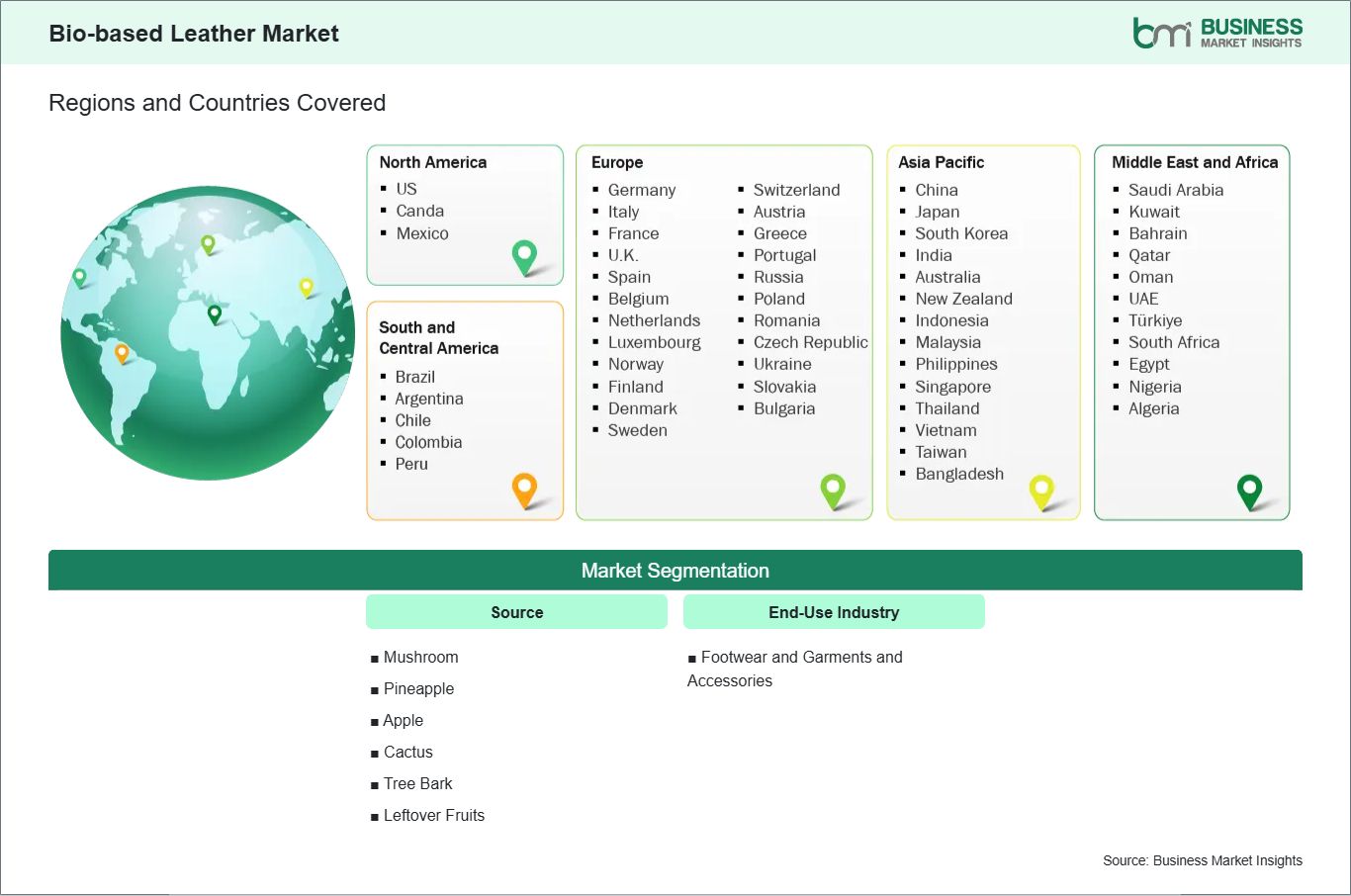
  • By Source, the market is segmented into Mushroom, Pineapple, Apple, Cactus, Tree Bark, and Leftover Fruits.
  • By End-Use Industry, the market is divided into Footwear and Garments and Accessories.

Bio-based Leather Market Drivers and Opportunities:

Growing Consumer Demand for Sustainable and Ethical Fashion

The rapid growth of the global sustainable apparel industry emerged as a pivotal factor positively driving the bio-based leather market. With the digitalization of commerce and the increasing preference for ethical shopping, consumers now expect transparency and cruelty-free options, making bio-based leather a critical component of the modern supply chain.

The significant growth of B2C (business-to-consumer) ecommerce for ethical apparel continues to accelerate. This robust expansion directly supports the growth of the bio-based leather market, as the need for eco-friendly shipping and manufacturing solutions increases to meet consumer expectations worldwide. Leading global fashion brands (such as Adidas, Hermès, and H&M) are expanding their international presence and actively demanding high‑performance, plant‑based alternatives to conventional leather. Their influence is accelerating the shift toward sustainable material solutions across the industry.

Globalization of Trade and Supportive Regulatory Frameworks

As international trade agreements expand and global supply chains become increasingly interconnected, businesses are more reliant than ever on sustainable materials to move goods across borders while complying with new environmental standards. Bio-based leather services, with their ability to reduce carbon footprints, have emerged as a crucial enabler of this global green exchange. The ongoing globalization of trade has led to a powerful growth in the bio-based leather market.

In recent years, trade liberalization policies and the establishment of "Green Deals" in regions like Europe have opened new markets, encouraging the flow of bio-materials between developed and emerging economies. High-value, time-sensitive products such as designer footwear and luxury garments are often manufactured using bio-leather due to the premium appeal and security the material offers. As companies adapt to demand-driven production models and circular inventory practices, the demand for rapid delivery of sustainable raw materials is expected to grow steadily.

Bio-based Leather Market Size and Share Analysis:

The bio-based leather market demonstrates steady growth, with size and share analysis revealing evolving trends and competitive positioning among key players. The report further examines subsegments categorized within the source and end-use industry, offering insights into their contribution to overall market performance.

Based on source, the mushroom subsegment dominates the market. Mushroom-based leather (mycelium) is typically used for high-end fashion applications that require a soft, suede-like feel and rapid production cycles. This source is widely utilized due to its low water usage and ability to be grown in controlled laboratory environments.

In terms of end-use industry, the footwear industry involves the movement of massive volumes of material across country borders and plays a vital role in supporting global retail supply chains. This segment benefits from increasing globalization and the rising demand for vegan athletic and formal shoes.

Bio-based Leather Market Report Highlights:

Report Attribute Details
Market size in 2025 US$ 130 Million
Market Size by 2033 US$ 460 Million
Global CAGR (2026 - 2033)14.4%
Historical Data 2022-2024
Forecast period 2026-2033
Segments Covered By Source
  • Mushroom
  • Pineapple
  • Apple
  • Cactus
  • Tree Bark
  • Leftover Fruits
By End-Use Industry
  • Footwear and Garments and Accessories
Regions and Countries Covered
North America US, Canada, Mexico
Europe Belgium, Austria, Finland, Denmark, Greece, Poland, Romania, Russia, Ukraine, Czech Republic, Slovakia, Bulgaria, Italy, Luxembourg, Germany, Switzerland, France, Netherlands, Norway, Portugal, Spain, Sweden, United Kingdom
Asia-Pacific Australia, China, India, Japan, South Korea, Indonesia, Malaysia, Philippines, Singapore, Thailand, Vietnam, Bangladesh, New Zealand, Taiwan
South and Central America Brazil, Argentina, Peru, Chile, Colombia
Middle East and Africa Bahrain, Kuwait, Oman, Qatar, Saudi Arabia, United Arab Emirates, Turkiye, South Africa, Egypt, Algeria, Nigeria
Market leaders and key company profiles
  • Natural Fiber Welding, Inc.\r\n
  • Ananas Anam Ltd.\r\n
  • MycoWorks Inc.\r\n
  • Bolt Threads Inc.\r\n
  • Modern Meadows\r\n
  • Adriano di Marti\r\n
  • Ultrafabrics Holdings Co., Ltd.\r\n
  • Beyond Leather Materials\r\n
  • Fruitleather Rotterdam\r\n
Get more information on this report

Bio-based Leather Market Report Coverage and Deliverables:

The "Bio-based Leather Market Size and Forecast (2022 - 2033)" report provides a detailed analysis of the market covering below areas:

  • Bio-based Leather market size and forecast at global, regional, and country levels for all the key market segments covered under the scope.
  • Bio-based Leather market trends, as well as market dynamics such as drivers, restraints, and key opportunities.
  • Bio-based Leather market analysis covering key market trends, global and regional framework, major players, regulations, and recent market developments.
  • Industry landscape and competition analysis covering market concentration, heat map analysis, prominent players, and recent developments for the Bio-based Leather market.
  • Detailed company profiles, including SWOT analysis.

Bio-based Leather Market Geographic Insights:

The geographical scope of the Bio-based Leather market report is divided into five regions: North America, Asia Pacific, Europe, Middle East &Africa, and South &Central America.

The Asia-Pacific Bio-based Leather market is segmented into China, Japan, South Korea, India, Australia, New Zealand, Indonesia, Malaysia, the Philippines, Singapore, Thailand, Vietnam, Taiwan, Bangladesh, and the Rest of Asia. The Asia-Pacific bio-leather market is experiencing robust growth, driven by the rapid expansion of sustainable manufacturing, growing international trade volumes, and the rising demand for cruelty-free fashion. Major economies like China and India are leading the way, fueled by increasing industrial output and strategic investments in green textiles.

The region is also witnessing increased adoption of advanced biotechnology, including mycelium fabrication and fruit-waste processing, particularly relevant for sectors like footwear and garments. Bio-based leather production capacity expansion, alongside modernization efforts by regional manufacturers, is enhancing operational efficiency. Additionally, the surge in manufacturing activity and exports, coupled with the growth of eco-conscious consumer networks, is positioning Asia-Pacific as a key hub in the global sustainable materials ecosystem.

The North America bio-based leather market is segmented into the US, Canada, and Mexico. The market in this region is primarily driven by exceptionally high consumer awareness regarding animal welfare and a robust infrastructure that supports rapid technological change in biotechnology. Europe is a leading force in the global market, holding a significant share. The region's growth is fueled by some of the world's most stringent environmental regulations, such as the EU's Sustainable Products Initiative, which compels brands to transition toward circular economy models.

global-market-geography
Get more information on this report

Bio-based Leather Market Research Report Guidance:

  • The report includes qualitative and quantitative data in the Bio-based Leather market across source, end-use industry, and geography.
  • The report starts with the key takeaways (chapter 2), highlighting the key trends and outlook of the Bio-based Leather market.
  • Chapter 3 includes the research methodology of the study.
  • Chapter 4 further includes ecosystem analysis.
  • Chapter 5 highlights the major industry dynamics in the Bio-based Leather market, including factors that are driving the market, prevailing deterrents, potential opportunities, as well as future trends. Impact analysis of these drivers and restraints is also covered in this section.
  • Chapter 6 discusses the Bio-based Leather market scenario, in terms of historical market revenues, and forecast till the year 2033.
  • Chapters 7 to 10 cover Bio-based Leather market segments by source, end-use industry, and geography across North America, Europe, Asia Pacific, Middle East and Africa, and South and Central America. They cover the market revenue, forecast, and factors driving the market.
  • Chapter 11 describes the competitive analysis along with the heat map analysis for the key players operating in the market.
  • Chapter 12 describes the industry landscape analysis. It provides detailed descriptions of business activities such as market initiatives, new developments, mergers, and joint ventures globally, along with a competitive landscape.
  • .Chapter 13 provides detailed profiles of the major companies operating in the Bio-based Leather market. Companies have been profiled on the basis of their key facts, business descriptions, products and services, financial overview, SWOT analysis, and key developments.
  • Chapter 14, i.e., the appendix, is inclusive of a brief overview of the company, list of abbreviations, and disclaimer.

Bio-based Leather Market News and Key Development:

The Bio-based Leather market is evaluated by gathering qualitative and quantitative data post primary and secondary research, which includes important corporate publications, association data, and databases. A few of the key developments in the bio-based leather market are:

  • In March 2025, Modern Meadow announced to showcase its next-generation material, newly branded as INNOVERA™, at the Global Fashion Summit, the leading international event for fashion sustainability. INNOVERA™, formerly known as BIO-VERA®, will be Modern Meadow's primary material product going forward, aligning with the company's focus on offering the premier sustainable leather alternative in the market.
  • In June 2024, Cadillac announced a collaboration with MycoWorks to develop mushroom-based renewable leather for high-performance automotive interiors. This new material, intended to one day have the same applications as leather, incorporates mycelium, which is the renewable root structure of mushrooms, and other bio-based ingredients.

Key Sources Referred:

  • Aerospace Industries Association
  • AFCEA International
  • AIAA
  • International Energy Agency
  • World Bank – Global Trade Indicators
  • World Trade Organization (WTO)
  • International Trade Administration (ITA)
  • Company website
  • Company annual reports
  • Company investor presentations
The List of Companies - Bio-based Leather Market
  • <p>
  • Natural Fiber Welding, Inc.
  • Ananas Anam Ltd.
  • MycoWorks Inc.
  • Bolt Threads Inc.
  • Modern Meadows
  • Adriano di Marti
  • Ultrafabrics Holdings Co., Ltd.
  • Beyond Leather Materials
  • Fruitleather Rotterdam
  • VEGEA</p>
Frequently Asked Questions
How big is the Bio-based Leather Market?

The Bio-based Leather Market is valued at US$ 130 Million in 2025, it is projected to reach US$ 460 Million by 2033.

What is the CAGR for Bio-based Leather Market by (2026 - 2033)?

As per our report Bio-based Leather Market, the market size is valued at US$ 130 Million in 2025, projecting it to reach US$ 460 Million by 2033. This translates to a CAGR of approximately 14.4% during the forecast period.

What segments are covered in this report?

The Bio-based Leather Market report typically cover these key segments-

  • Source (Mushroom, Pineapple, Apple, Cactus, Tree Bark, and Leftover Fruits)
  • End-Use Industry (Footwear and Garments and Accessories)

What is the historic period, base year, and forecast period taken for Bio-based Leather Market?

The historic period, base year, and forecast period can vary slightly depending on the specific market research report. However, for the Bio-based Leather Market report:

  • Historic Period : 2022-2024
  • Base Year : 2025
  • Forecast Period : 2026-2033
  • Who are the major players in Bio-based Leather Market?

    The Bio-based Leather Market is populated by several key players, each contributing to its growth and innovation. Some of the major players include:

  • Natural Fiber Welding, Inc.\r\n
  • Ananas Anam Ltd.\r\n
  • MycoWorks Inc.\r\n
  • Bolt Threads Inc.\r\n
  • Modern Meadows\r\n
  • Adriano di Marti\r\n
  • Ultrafabrics Holdings Co., Ltd.\r\n
  • Beyond Leather Materials\r\n
  • Fruitleather Rotterdam\r\n
  • VEGEA
  • Who should buy this report?

    The Bio-based Leather Market report is valuable for diverse stakeholders, including:

    • Investors: Provides insights for investment decisions pertaining to market growth, companies, or industry insights. Helps assess market attractiveness and potential returns.
    • Industry Players: Offers competitive intelligence, market sizing, and trend analysis to inform strategic planning, product development, and sales strategies.
    • Suppliers and Manufacturers: Helps understand market demand for components, materials, and services related to concerned industry.
    • Researchers and Consultants: Provides data and analysis for academic research, consulting projects, and market studies.
    • Financial Institutions: Helps assess risks and opportunities associated with financing or investing in the concerned market.

    Essentially, anyone involved in or considering involvement in the Bio-based Leather Market value chain can benefit from the information contained in a comprehensive market report.

    Available Report Formats

    pdf-format excel-format pptx-format
    Buy Now
    Sales Assistance
    +1 646 791 7070 (US & UK)
    Customization Form

    Please tell us your area of interest
    (Market Segments/ Regions and Countries/ Companies)