
Beet Pulp Pellets Market Outlook: Size, Share, Trends, Growth Analysis, Competitive Landscape & Forecast, 2026-2033

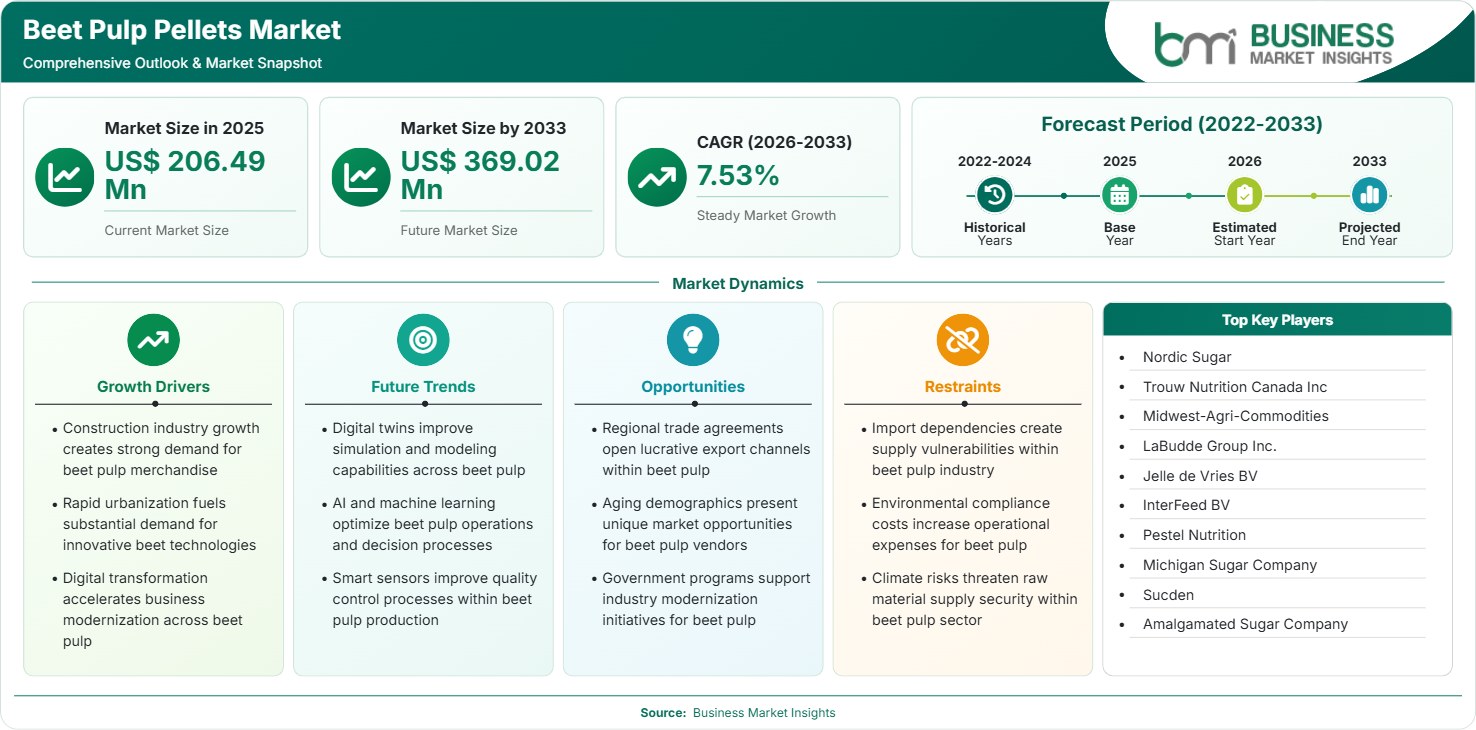
The Beet Pulp Pellets Market size was valued at US$ 206.49 Million in 2025 and is projected to reach US$ 369.02 Million by 2033, growing at a CAGR of 7.53% during 2026–2033. Rising demand for highly digestible livestock feed, expanding dairy and equine nutrition industries, increasing utilization of sugar beet processing by-products, and growing emphasis on sustainable feed ingredients are creating attractive opportunities for manufacturers and feed suppliers.

Report Coverage
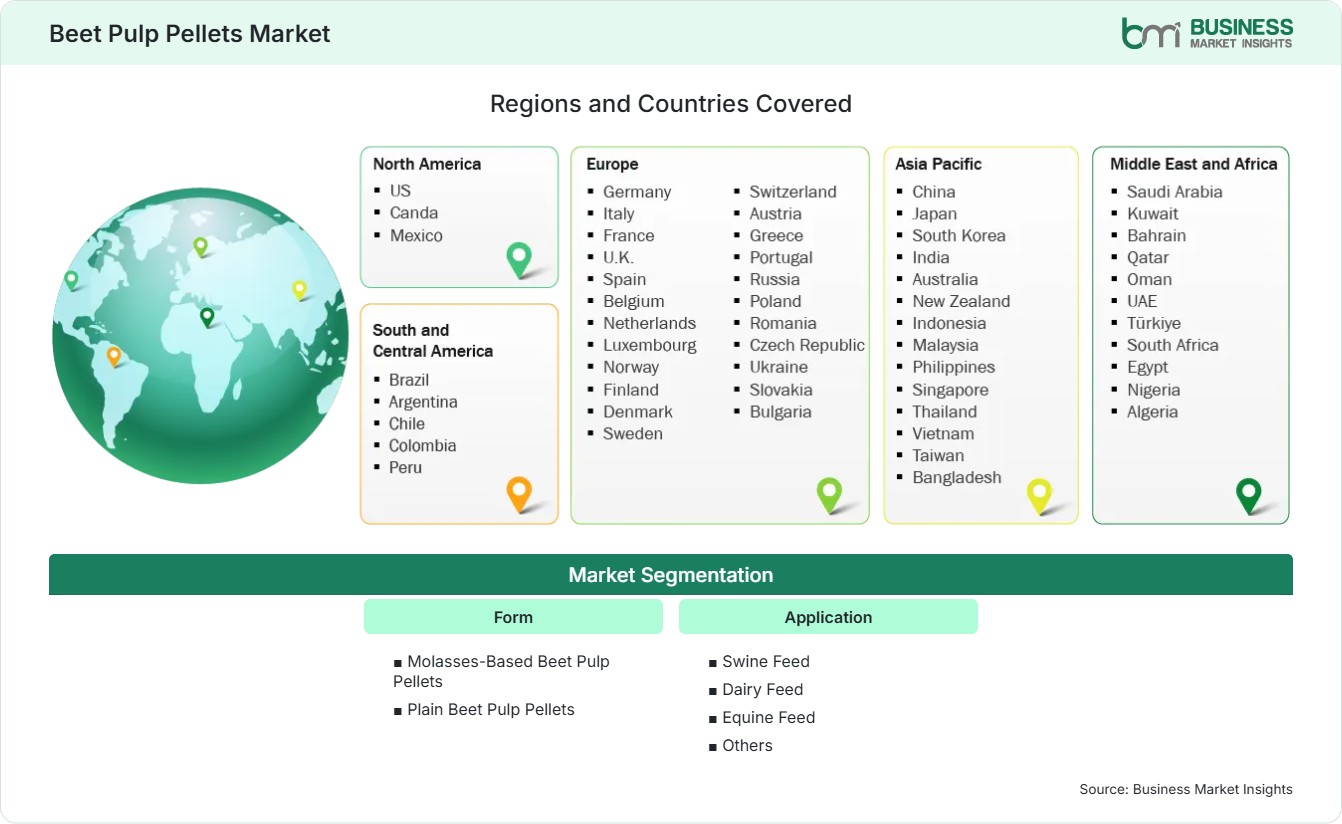
  • Form: Molasses-Based Beet Pulp Pellets, Plain Beet Pulp Pellets
  • Application: Swine Feed, Dairy Feed, Equine Feed, Others
US$ 206.49 Mn Market size in 2025
US$ 369.02 Mn Market Size by 2033
7.53% CAGR, 2026 - 2033
2026-2033 Forecast Period

01 AI Overview

Beet Pulp Pellets Market Summary

  • North America Region: North America holds 34%–37% market share in 2025, growing with a 7.0%–7.4% CAGR during 2026–2033, supported by commercial dairy expansion, advanced feed formulation, sustainable by-product utilization, integrated sugar processing, premium equine nutrition demand, and investments improving livestock productivity across regional feed industries. The United States dominates regional demand through extensive dairy farming, established sugar beet cultivation, and expanding premium livestock nutrition applications, recording a CAGR between 7.1%–7.5%.
  • Fastest Growing Region: Asia Pacific accounts for 22%–25% market share in 2025 and advances at a 9.0%–9.5% CAGR through 2026–2033 as livestock industrialization, commercial dairy investments, imported feed ingredient adoption, expanding animal protein consumption, government productivity initiatives, and feed manufacturing modernization strengthen regional demand.
  • Leading Segment: Plain Beet Pulp Pellets represent 60%–63% market share during 2025 while expanding at a 7.2%–7.6% CAGR through 2026–2033 because nutrition consistency, storage efficiency, affordability, digestibility, compatibility with compound feed formulations, and broad livestock acceptance continue strengthening commercial utilization worldwide.
  • High Growth Segment: Dairy Feed captures 38%–41% market share in 2025 while progressing at a 7.9%–8.4% CAGR between 2026–2033, supported by higher milk productivity objectives, rumen health improvement, balanced fiber requirements, precision feeding practices, commercial herd expansion, and sustainable nutritional strategies.
  • Key Market Opportunity: Expanding premium livestock nutrition, circular bioeconomy initiatives, digital feed formulation technologies, sugar processing modernization, and international feed ingredient trade create profitable opportunities for pellet manufacturers targeting quality-conscious commercial livestock operations worldwide.
  • Major Market Players: Nordic Sugar, Trouw Nutrition Canada Inc., Midwest Agri-Commodities, LaBudde Group Inc., Jelle de Vries BV, InterFeed BV, Pestell Nutrition Inc., Michigan Sugar Company, Sucden, and Amalgamated Sugar Company.
02 Strategic Insights

Beet Pulp Pellets Market: Strategic Insights

Beet Pulp Pellets Market Strategic Framework
FREE PDF
Request your free sample
Request free sample
03 Stakeholder View

Key Takeaways

  • The industry value chain is becoming increasingly integrated as sugar processors, feed manufacturers, distributors, and livestock producers collaborate to improve raw material utilization, logistics efficiency, quality assurance, and year-round pellet availability while reducing processing waste across agricultural ecosystems.
  • Dairy and equine nutrition applications present the strongest commercial expansion opportunities because producers increasingly prioritize digestible fiber sources that improve rumen function, animal health, feed conversion efficiency, and long-term production performance under intensive farming systems.
  • Innovation is shifting toward precision pellet manufacturing, optimized moisture control, enhanced pellet durability, digital quality monitoring, and customized nutritional formulations designed for different livestock categories, improving both feed consistency and commercial competitiveness.
  • Asia Pacific offers an attractive long-term investment destination owing to rapid livestock industrialization, expanding dairy infrastructure, increasing commercial feed production, growing imports of specialty feed ingredients, and supportive government initiatives promoting productivity improvements in animal agriculture.
  • Strategic partnerships between sugar processors, feed ingredient suppliers, and international distributors are increasing cross-border trade while encouraging investments in regional storage infrastructure, product standardization, and premium nutrition solutions for commercial livestock enterprises.
  • Sustainability initiatives centered on circular bioeconomy principles are encouraging greater utilization of sugar beet processing by-products, allowing manufacturers to reduce production waste while creating additional revenue streams through value-added livestock nutrition products.
04 Geographic Outlook

Beet Pulp Pellets Market Regional Highlights

North America Beet Pulp Pellets Market

North America accounts for 34%–37% of the Beet Pulp Pellets Market share in 2025 and is projected to expand at a 7.0%–7.4% CAGR during 2026–2033. Strong sugar beet cultivation across the United States and Canada, combined with highly commercialized dairy production, supports consistent demand for beet pulp pellets. Advanced feed manufacturing capabilities, integrated supply chains, and increasing adoption of sustainable feed ingredients continue strengthening regional consumption across dairy, equine, and livestock nutrition industries.

  • Commercial dairy operations increasingly utilize beet pulp pellets because highly digestible fiber supports rumen function, feed efficiency, and milk yield while reducing dependence on conventional forage during seasonal supply fluctuations.
  • Sugar beet processors continue investing in pelletizing technologies that improve moisture control, product durability, storage performance, and transportation efficiency, enabling wider distribution across commercial livestock production regions.
  • Premium equine nutrition continues expanding as horse owners increasingly prefer consistent fiber ingredients with excellent palatability, supporting steady demand through specialized feed manufacturers and distributors.
  • Sustainability initiatives encourage greater utilization of agricultural processing by-products, helping livestock producers reduce feed waste while supporting circular economy objectives throughout North America's agricultural value chain.
  • Strong research collaborations between universities, feed manufacturers, and livestock nutrition specialists continue improving formulation strategies, increasing confidence among commercial producers adopting advanced fiber-based feeding programs.

US Beet Pulp Pellets Market

The United States represents nearly 78%–81% of North American Beet Pulp Pellets Market demand while advancing at a 7.1%–7.5% CAGR through 2026–2033. Extensive sugar beet cultivation across states including Idaho, Minnesota, Michigan, and North Dakota supports abundant raw material availability. Continuous investments in dairy modernization, precision feeding technologies, and commercial livestock nutrition reinforce long-term demand for high-quality beet pulp pellets throughout the domestic feed industry.

  • Large integrated sugar processors efficiently convert beet processing residues into premium livestock feed products, improving operational profitability while supporting sustainable agricultural resource utilization.
  • Dairy producers increasingly incorporate digestible fiber sources into balanced rations to improve milk production consistency, rumen stability, and feed conversion under intensive farming conditions.
  • The equine industry remains a stable demand contributor owing to rising awareness regarding controlled-energy fiber nutrition, particularly among performance horse owners and specialized breeding operations.
  • Continued investments in automated feed mills and digital formulation technologies improve pellet quality consistency while supporting customized nutrition programs for diverse livestock categories.

Europe Beet Pulp Pellets Market

Europe captures 29%–32% Beet Pulp Pellets Market share during 2025 and is anticipated to record a 7.4%–7.8% CAGR between 2026 and 2033. The region benefits from an established sugar beet processing industry, strong sustainability regulations, and advanced animal nutrition standards. Countries including France, Germany, and the Netherlands remain leading consumers, while Eastern European markets demonstrate faster expansion through commercial livestock modernization and feed manufacturing investments.

  • France maintains regional leadership through extensive sugar beet production, integrated processing infrastructure, and a mature dairy industry supporting stable commercial demand for fiber-rich feed ingredients.
  • The Netherlands demonstrates strong export capabilities through internationally active feed trading companies supplying premium beet pulp pellets to livestock producers across Europe and overseas markets.
  • Poland records one of Europe's faster growth trajectories as dairy modernization, commercial cattle production, and investments in compound feed manufacturing continue accelerating.
  • European sustainability policies encourage higher utilization of agricultural by-products, strengthening circular economy initiatives while improving profitability across sugar processing operations.
  • Feed manufacturers increasingly emphasize traceability, nutritional consistency, and quality certification to satisfy stringent livestock nutrition standards across domestic and export markets.

Asia Pacific Beet Pulp Pellets Market

Asia Pacific represents 22%–25% of the Beet Pulp Pellets Market in 2025 and is forecast to grow at the highest 9.0%–9.5% CAGR through 2026–2033. Rising livestock populations, commercial dairy expansion, increasing imports of specialty feed ingredients, and modernization of compound feed manufacturing support regional demand. China leads overall consumption, while India and Southeast Asian countries continue emerging as attractive growth markets for premium fiber-based livestock nutrition.

  • China remains the largest regional consumer due to rapid dairy modernization, increasing commercial cattle production, and greater adoption of imported high-quality feed ingredients.
  • India exhibits one of the strongest growth prospects as organized dairy farming, productivity improvement initiatives, and compound feed manufacturing continue expanding nationwide.
  • Southeast Asian countries are investing in modern livestock nutrition systems, creating opportunities for imported beet pulp pellets serving dairy and equine applications.
  • Feed manufacturers increasingly develop balanced formulations combining digestible fiber with protein and energy ingredients to improve livestock productivity under intensive production systems.
  • Rising disposable incomes and growing animal protein consumption encourage investments throughout regional dairy and livestock supply chains, supporting long-term market expansion.

Rest of World Beet Pulp Pellets Market

The Rest of World region accounts for 10%–13% Beet Pulp Pellets Market share during 2025 while advancing at a 7.5%–8.0% CAGR throughout 2026–2033. South and Central America continue benefiting from expanding commercial cattle production and feed modernization. Meanwhile, the Middle East and Africa experience growing demand as livestock producers increasingly adopt imported specialty feed ingredients to improve productivity under challenging climatic and forage availability conditions.

Growing commercial dairy investments across Brazil, Argentina, Saudi Arabia, and South Africa continue strengthening demand for digestible fiber ingredients. Rising awareness regarding animal nutrition efficiency, combined with improving feed distribution infrastructure, supports broader adoption across commercial livestock operations.

  • Brazil leads South and Central America through expanding cattle production, commercial dairy operations, and increasing adoption of nutritionally balanced feed formulations.
  • Argentina demonstrates promising demand growth supported by livestock export competitiveness and greater utilization of efficient feed ingredients across commercial cattle farms.
  • Saudi Arabia records strong expansion owing to dairy investments, limited domestic forage availability, and increasing imports of premium livestock feed ingredients.
  • South Africa remains a key African market supported by organized dairy operations, improving feed manufacturing capabilities, and expanding commercial livestock production.
  • Regional distributors continue strengthening international sourcing partnerships to improve product availability, logistics efficiency, and nutritional product portfolios for commercial livestock producers.
Global Market Geography
FREE PDF
Request your free sample
Request free sample
05 Segment Analysis

Beet Pulp Pellets Market Segmentation

Form

The Form segment accounted for 60%–63% of the market in 2025 and is projected to expand at a 7.2%–7.6% CAGR during 2026–2033. Product selection depends on livestock nutritional objectives, storage preferences, feed formulation practices, and transportation efficiency. The Beet Pulp Pellets Market scope continues to widen as feed manufacturers increasingly offer differentiated pellet formulations tailored to commercial dairy, equine, and compound feed applications while emphasizing nutritional consistency and sustainability.

  • Molasses-Based Beet Pulp Pellets: These pellets provide improved palatability and additional energy, making them suitable for dairy cattle, beef cattle, and equine nutrition where enhanced feed intake and energy supplementation are desirable.
  • Plain Beet Pulp Pellets: Widely preferred because of consistent fiber content, excellent digestibility, easy storage, and compatibility with balanced compound feed formulations used across commercial dairy, equine, and livestock production systems.

Application

The Application segment represented 38%–41% market share during 2025 and is anticipated to register a 7.9%–8.4% CAGR through 2026–2033. Expanding commercial livestock farming, precision nutrition strategies, and greater emphasis on feed conversion efficiency continue driving adoption across multiple animal categories. The Beet Pulp Pellets Market trends increasingly reflect demand for specialized nutritional formulations that improve digestive health, productivity, and sustainable livestock management practices.

  • Swine Feed: Producers increasingly incorporate beet pulp pellets to improve digestive efficiency, gut health, and feed utilization while supporting balanced nutritional programs for commercial pig production systems.
  • Dairy Feed: The largest application benefits from superior digestible fiber that enhances rumen function, milk production efficiency, feed intake stability, and overall herd productivity within intensive dairy farming operations.
  • Equine Feed: Horse owners and specialized nutrition providers utilize beet pulp pellets because they offer highly digestible fiber, controlled energy release, excellent palatability, and support digestive health for performance and recreational horses.
06 Market Forces

Beet Pulp Pellets Market Dynamics

Key Market Drivers

Growing demand for digestible fiber in commercial livestock nutrition

Commercial livestock producers are increasingly prioritizing highly digestible fiber ingredients that improve animal performance while supporting efficient feed utilization. Beet pulp pellets provide fermentable fiber that enhances rumen health, stabilizes digestion, and improves nutrient absorption in dairy cattle and horses. According to the Food and Agriculture Organization (FAO), global milk production continues to expand, creating sustained demand for productivity-enhancing feed ingredients. Consequently, there is increased inclusion of fiber-rich feed materials in balanced diets to enhance animal well-being, minimize digestive problems, and improve feed efficiency. Such practices have continually supported their adoption in livestock feed markets globally.

Expansion of circular bioeconomy initiatives in sugar processing

Sugar beet processors are increasingly transforming processing by-products into high-value livestock feed ingredients rather than treating them as waste streams. Circular economy initiatives promoted across Europe and North America encourage greater resource efficiency while reducing industrial waste generation. Investments in advanced drying systems, pellet mills, and storage infrastructure improve product consistency and extend shelf life. In view of the growing significance of sustainable agriculture goals for processors and animal farmers, beet pulp pellets emerge as a viable option that improves both efficiency and environmental performance of the process while ensuring the responsible use of resources.

Modernization of commercial dairy production systems

The commercial dairies are embracing the practice of precision feeding, which is enabled through the use of nutritional software, automatic feeding equipment, and balanced feeds. The growing herd sizes have necessitated the need for a consistent, storage-friendly, and nutritious source of fiber that would boost milk production. International organizations, including the International Dairy Federation, continue highlighting improvements in feed efficiency as a critical driver of sustainable dairy production. These operational changes will promote wider use of beet pulp pellets, especially by large dairy farms that aim to increase their productivity levels while keeping their animals safe.

Key Market Opportunities

Growing international trade of specialty livestock feed ingredients

Growth in international livestock production is generating a need for imports of specialty feed ingredients whose quality does not vary over time of the year. Countries which have little sugar beet production depend on established exporters from Europe and North America. Improving logistics infrastructure, containerized agricultural exports, and specialized feed distribution networks create favorable Beet Pulp Pellets Market Forecasts for manufacturers seeking to expand geographically. Premium feed suppliers capable of maintaining quality certification, traceability, and reliable supply chains are expected to strengthen their competitive positioning across emerging livestock production economies.

Premium equine nutrition creates value-added product opportunities

The global equine industry continues emphasizing scientifically formulated nutrition programs designed to improve digestive health, controlled energy release, and overall animal performance. Beet pulp pellets meet all these criteria, as they deliver high-quality, digestible fiber that is very palatable and low in starch. They can offer a special formula that includes vitamins, minerals, probiotics, or customized nutritional mixes for meeting specific horse feeding needs. It will allow them to have better profit margins while developing solid ties with veterinary nutritionists, breeders, performance horse owners, and premium feed distributors.

Digital feed formulation and precision livestock nutrition

Artificial intelligence, feed formulation software, and precision livestock management systems are transforming commercial animal nutrition. Feed manufacturers have become more interested in analyzing nutritional content, digestive properties, and economic feasibility to determine the best ingredients for the product. Beet pulp pellets can leverage the advantages of their reliable fiber properties, which fit in very well into modern feed optimizing computer systems. The increasing use of intelligent feeding equipment enables producers to enhance milk production while minimizing waste, thereby creating significant business opportunities for pellet manufacturers.

Market Restraints and Challenges

Dependence on seasonal sugar beet production

Factor: Beet pulp pellet availability remains closely linked to sugar beet harvesting cycles and regional sugar processing output.

Impact: Variations in the availability of raw materials may affect stock management, pricing, and export potential. In terms of climatic variations impacting the productivity of sugar beets, it makes purchasing more uncertain for the manufacture of feed products. Businesses have to invest in additional storage capacity and a diversified purchasing approach to ensure their raw material supplies remain uninterrupted throughout the year. Locations without any local sugar beet processing operations are especially reliant on imports.

Competition from alternative fiber feed ingredients

Factor: Livestock producers have access to numerous alternative fiber ingredients, including soybean hulls, alfalfa products, citrus pulp, hay, and various forage supplements.

Impact: The presence of alternative raw materials increases price competition and affects buying decisions depending on the regional economics of feed production. Feed companies regularly alter the composition of their products, taking into account the cost of various raw materials, seasonal availability, and their nutritional targets. It is thus important for producers of beet pulp pellets to stand out by offering a high-quality and reliable product supply among others.

07 Company Analysis

Competitive Landscape

The competitive environment remains moderately consolidated, with established sugar processors, international feed ingredient suppliers, and specialized agricultural commodity companies strengthening their positions through product quality improvements, export expansion, and supply chain integration. The Beet Pulp Pellets Market analysis indicates that companies are focusing on premium feed formulations, sustainable by-product utilization, logistics optimization, and long-term partnerships with feed manufacturers and livestock producers to improve global market penetration and operational efficiency.

Company Name

Overview

Products and Services Relevant to this Market

Nordic Sugar

Nordic Sugar is one of Europe's leading sugar producers, operating integrated sugar beet processing facilities and supplying value-added agricultural co-products across domestic and export markets.

Produces beet pulp pellets, sugar beet co-products, livestock feed ingredients, sustainable agricultural solutions, and integrated sugar processing services for commercial animal nutrition.

Trouw Nutrition Canada Inc.

Trouw Nutrition Canada Inc., part of Nutreco, provides advanced livestock nutrition solutions supported by research, precision feeding expertise, and technical advisory services.

Offers compound feed ingredients, nutritional premixes, specialty livestock nutrition products, feed formulation services, and beet pulp pellet distribution for commercial producers.

Midwest Agri-Commodities

Midwest Agri-Commodities specializes in sourcing, marketing, and distributing agricultural feed ingredients throughout North American and international livestock markets.

Supplies beet pulp pellets, forage products, feed commodities, grain ingredients, logistics management, and customized sourcing solutions for livestock nutrition companies.

LaBudde Group Inc.

LaBudde Group Inc. is an agricultural commodity supplier serving feed manufacturers with diversified ingredient sourcing, storage, and transportation capabilities across North America.

Provides beet pulp pellets, forage ingredients, feed commodities, logistics coordination, commodity marketing, and supply chain support for livestock feed manufacturers.

Jelle de Vries BV

Jelle de Vries BV is an international agricultural trading company specializing in animal feed ingredients and global commodity distribution.

Markets beet pulp pellets, roughage products, feed ingredients, commodity exports, and customized livestock nutrition supply solutions for international customers.

InterFeed BV

InterFeed BV operates globally as an animal feed ingredient trader with strong expertise in sourcing, quality assurance, and international logistics.

Supplies beet pulp pellets, feed raw materials, commodity trading services, logistics management, and quality-certified livestock nutrition ingredients.

Pestell Nutrition Inc.

Pestell Nutrition Inc. is a Canadian supplier of specialty feed ingredients supporting livestock, equine, and companion animal nutrition markets worldwide.

Offers beet pulp pellets, forage products, minerals, feed additives, specialty nutrition ingredients, and customized feed supply programs for livestock producers.

Michigan Sugar Company

Michigan Sugar Company is a major U.S. sugar beet processor producing sugar and value-added agricultural co-products through integrated manufacturing operations.

Manufactures beet pulp pellets, dried beet pulp products, sugar, agricultural co-products, and livestock feed ingredients from sugar beet processing.

Sucden

Sucden is a global commodity trading organization with extensive agricultural supply chain capabilities supporting international food and feed markets.

Provides agricultural commodity trading, feed ingredient sourcing, logistics solutions, beet pulp trading, and international supply chain management services.

Amalgamated Sugar Company

Amalgamated Sugar Company is among the largest sugar beet processors in the United States, supplying sugar and high-quality livestock feed co-products.

Produces beet pulp pellets, dried beet pulp, sugar products, agricultural co-products, feed ingredients, and integrated processing solutions for livestock industries.

10 Trust & Transparency

Research Methodology

The market analysis combines proprietary research with secondary data from government agencies, company disclosures, regulatory filings, industry databases and expert interviews. Market estimates are validated through data triangulation, cross-market benchmarking and analyst review.

View Full Research Methodology

11 Questions Answered

Frequently Asked Questions

Why should businesses invest in the Beet Pulp Pellets Market Report?

The report provides detailed market intelligence covering competitive positioning, regional opportunities, segmentation, technological developments, investment trends, supply chain dynamics, and strategic growth prospects, enabling stakeholders to make informed long-term business decisions.

How does sustainability influence industry development?

The industry benefits from circular economy practices because beet pulp pellets convert sugar processing by-products into valuable livestock nutrition products. This reduces industrial waste, improves resource efficiency, and creates additional revenue opportunities for sugar processors.

Which region is expected to witness the fastest expansion?

Asia Pacific is forecast to record the strongest growth due to expanding commercial livestock farming, rising dairy consumption, modernization of feed manufacturing, increasing imports of specialty feed ingredients, and supportive government initiatives promoting livestock productivity.

Which application segment offers the greatest commercial opportunity?

Dairy feed remains the most attractive application because digestible fiber improves rumen function, feed efficiency, and milk productivity. Increasing commercial dairy investments across developing and developed markets are expected to sustain long-term demand.

What factors are driving demand for the Beet Pulp Pellets Market?

Demand is primarily supported by commercial dairy expansion, increasing adoption of digestible fiber ingredients, sustainable utilization of sugar beet processing by-products, modernization of livestock nutrition practices, and growing emphasis on improving feed conversion efficiency while maintaining animal health.

Access the Full Beet Pulp Pellets Market Report

Get segment-level forecasts, regional estimates, competitive benchmarking, company profiles and downloadable Excel datasets.

Access the full Beet Pulp Pellets Market Report
350 pages PDF & Excel | 2026-08-17