
Alfalfa Pellets Market Outlook: Size, Share, Trends, Growth Analysis, Competitive Landscape & Forecast, 2026-2033

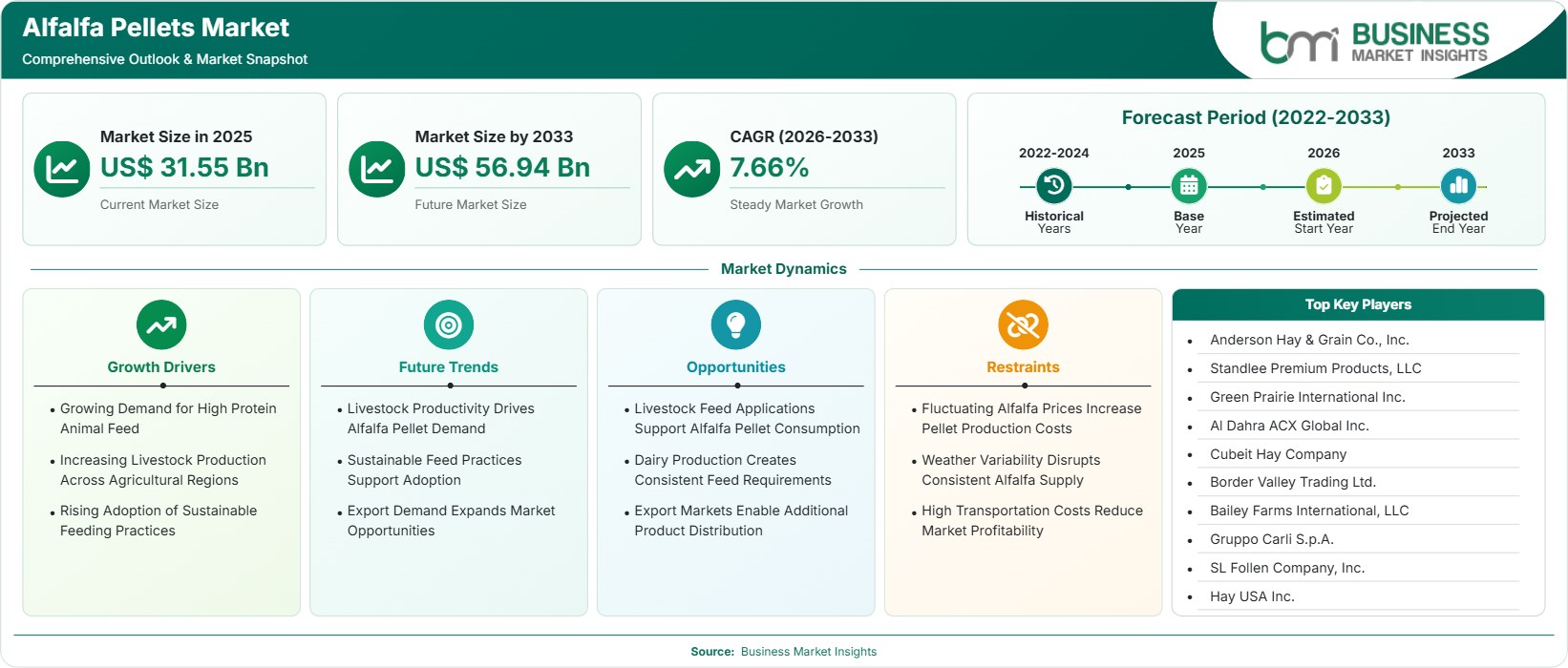
The Alfalfa Pellets Market size was valued at US$ 31.55 Billion in 2025 and is projected to reach US$ 56.94 Billion by 2033, growing at a CAGR of 7.66% during 2026–2033. Rising dairy herd productivity requirements, increasing demand for high-protein forage, expanding commercial livestock farming, and export-led feed trade are creating substantial opportunities across developed and emerging agricultural economies.

Report Coverage
  • Animal Type: Cattle, Horse, Others
  • Feed Type: Hay, Cubes, Pellets
US$ 31.55 Bn Market size in 2025
US$ 56.94 Bn Market Size by 2033
7.66% CAGR, 2026 - 2033
2026-2033 Forecast Period

AI Overview

Alfalfa Pellets Market Summary

  • North America Region: North America holds a market share of 34%–37% in 2025, growing at a CAGR of 6.8%–7.2% during 2026–2033. Strong dairy production, mechanized forage harvesting, export competitiveness, and premium feed demand support expansion. Opportunities arise from sustainable livestock nutrition, processing efficiency, protein-rich feed adoption, and growing equine nutrition requirements worldwide. Brief U.S. analysis: The U.S. dominates regional demand through commercial dairies, export capability, and advanced forage processing, advancing at 6.9%–7.3% CAGR.
  • Fastest Growing Region: Asia Pacific accounts for 27%–30% share in 2025 and advances at 8.6%–9.2% CAGR. Expanding dairy sectors, rising meat consumption, feed modernization, and import dependence fuel demand. Opportunities emerge through large-scale livestock investments, premium feed penetration, and supply-chain development.
  • Leading Segment: Cattle represents 54%–58% share in 2025 and expands at 7.2%–7.8% CAGR. Dairy productivity improvement, protein requirements, feed consistency, nutrition optimization, and commercial herd expansion continue supporting widespread adoption across intensive livestock production systems globally.
  • High Growth Segment: Pellets account for 38%–42% share in 2025 and grow at 8.1%–8.7% CAGR. Superior storage efficiency, reduced feed wastage, transportation advantages, nutritional consistency, and automation compatibility encourage broader utilization within industrial livestock operations.
  • Key Market Opportunity: Development of export-oriented premium forage products serving dairy and beef industries across Asia and Middle Eastern markets enables producers to capture higher value margins through quality differentiation.
  • Major Market Players: Anderson Hay & Grain Co., Inc.; Standlee Premium Products, LLC; Green Prairie International Inc.; Al Dahra ACX Global Inc.; Cubeit Hay Company; Border Valley Trading Ltd.; Bailey Farms International, LLC; Gruppo Carli S.p.A.; SL Follen Company, Inc.; Hay USA Inc.
Strategic Insights

Alfalfa Pellets Market: Strategic Insights

Alfalfa Pellets Market Strategic Framework
FREE PDF
Request your free sample
Request free sample
Stakeholder View

Key Takeaways

  • The value chain remains strongly linked to forage cultivation, drying, processing, storage, logistics, and livestock nutrition industries, making supply security and quality assurance critical competitive factors.
  • Dairy cattle nutrition continues delivering the largest revenue opportunity, while industrial feed operations seeking consistent protein content offer attractive long-term demand expansion.
  • Processing innovations focused on moisture control, nutrient preservation, pellet durability, and digital quality monitoring are improving product performance and operational economics.
  • Asian livestock producers, particularly in China and Southeast Asia, present compelling investment opportunities due to limited domestic forage availability and rising feed requirements.
  • Strategic partnerships between growers, processors, exporters, and feed manufacturers are increasing, supporting geographic expansion and stronger procurement resilience.
  • Sustainability-linked agricultural practices, including efficient water management and carbon-conscious feed sourcing, are becoming important procurement differentiators across international markets.
Geographic Outlook

Alfalfa Pellets Market Regional Highlights

North America Alfalfa Pellets Market

North America maintains leadership with 34%–37% market share in 2025 and a projected CAGR of 6.8%–7.2% through 2033. The region benefits from extensive forage acreage, advanced harvesting technologies, strong dairy and beef industries, and established export infrastructure. The Alfalfa Pellets Market share remains concentrated in the United States and Canada, where producers emphasize premium-quality forage products. Growing demand for efficient feed handling and nutritionally standardized feed ingredients continues supporting commercial-scale consumption across livestock operations.

  • Large dairy farms increasingly integrate processed forage products to improve feed consistency, reduce wastage, and optimize nutrient delivery across production cycles.
  • Export channels serving Asian and Middle Eastern customers remain important revenue contributors for processors operating throughout western production regions.
  • Investment in drying, compression, and storage technologies is improving operational efficiency while enhancing product durability during international transportation.
  • Sustainability initiatives promoting resource-efficient livestock production encourage adoption of nutritionally dense forage solutions across commercial operations.

US Alfalfa Pellets Market

The United States accounts for approximately 78%–82% of North American Alfalfa Pellets Market revenue and advances at 6.9%–7.3% CAGR through 2033. Market expansion is aided by the ability to produce good forage, lead in exports, and advanced livestock feeding systems. The commercial dairy operations are focusing more on standard feed materials to boost their efficiency. Those that are operating in the Western agricultural regions still have considerable sway over international supply.

  • Dairy herd productivity initiatives continue driving adoption of high-protein forage products throughout major milk-producing regions.
  • Advanced mechanization enables efficient harvesting, processing, storage, and distribution across large-scale agricultural operations.
  • Export demand from Asia reinforces processor utilization rates and encourages capacity upgrades within key production states.
  • Premium equine nutrition applications provide additional revenue diversification opportunities for specialized forage suppliers.

Europe Alfalfa Pellets Market

Europe represents 22%–25% Alfalfa Pellets Market share in 2025 and is projected to grow at 7.0%–7.6% CAGR. The demand is fueled by dairy farming, welfare requirements, and the growing preference for quality forage components. France continues to be a key consumer owing to the extensive cultivation of forage crops in the country, whereas Spain has a faster growth rate at a CAGR of 7.7%–8.2%. The feed efficiency projects and sustainability goals promote its adoption in ruminant diets.

  • Regulatory emphasis on traceability and feed quality supports adoption of standardized forage products across livestock industries.
  • France leads regional consumption through strong dairy and beef production supported by established forage supply chains.
  • Spain exhibits faster expansion due to export opportunities and growing commercial livestock feed requirements.
  • Demand for premium equine nutrition products supports specialized market niches across several European countries.
  • Modern pelletizing facilities are improving production efficiency and supporting value-added product development.

Asia Pacific Alfalfa Pellets Market

Asia Pacific holds 27%–30% market share in 2025 and delivers the fastest CAGR of 8.6%–9.2% through 2033. Despite China being the largest regional consumer owing to its intensive expansion of dairy products, India and Southeast Asia continue to register rapid growth in their demand. Higher income levels, higher protein consumption, and the commercialization of livestock have contributed immensely towards adoption rates. The ongoing development in the feed industry and increased reliance on foreign forage enhance the potential for further growth.

  • China dominates regional demand because domestic forage availability remains insufficient for expanding dairy requirements.
  • India records strong growth through dairy sector modernization and increasing feed optimization initiatives.
  • Southeast Asian livestock investments support broader adoption of processed forage products across commercial operations.
  • Rising meat and milk consumption drives procurement of nutrient-rich feed ingredients throughout developing economies.
  • Strategic import agreements strengthen supply security and support expanding livestock production systems.

Rest of World Alfalfa Pellets Market

The Rest of World region captures 12%–15% share and advances at 7.5%–8.1% CAGR. The advantages of the South and Central American regions are the growing cattle sector and the improvement of feed management. The Middle East and African countries make use of imported forages for developing the dairy sector and achieving their food security goals. Brazil is the largest regional consumer of forages in Latin America; however, the UAE shows a higher growth rate.

  • Brazil benefits from large cattle populations and growing interest in nutritionally optimized feeding approaches.
  • Gulf countries increasingly rely on imported forage solutions because of land and water constraints.
  • Commercial dairy expansion across selected Middle Eastern markets supports sustained import demand.
  • Feed security programs encourage strategic sourcing agreements between importers and international suppliers.
  • Infrastructure improvements enhance logistics efficiency and strengthen access to premium animal nutrition products.
Segment Analysis

Alfalfa Pellets Market Segmentation

Animal Type

Animal Type accounted for a significant revenue contribution, with cattle representing the dominant demand base. This segment held approximately 54%–58% share in 2025 and is projected to expand at 7.2%–7.8% CAGR. The Alfalfa Pellets Market scope within livestock nutrition continues broadening as producers prioritize feed efficiency, protein quality, and productivity improvements across commercial operations.

  • Cattle: High protein content and digestible fiber characteristics make pelletized forage suitable for dairy and beef nutrition programs focused on productivity and feed utilization efficiency.
  • Horse: Equine nutrition applications benefit from consistent nutrient profiles, convenient storage, reduced dust generation, and improved feeding management across recreational and professional segments.

Feed Type

Feed Type remains central to market development, with pellets emerging as the most dynamic category. The Alfalfa Pellets Market trends indicate increasing preference for processed forage formats. Pellets held 38%–42% share in 2025 and are expected to register 8.1%–8.7% CAGR because of transportation efficiency, reduced wastage, and storage advantages.

  • Hay: Traditional forage format continues serving large livestock operations where local availability, bulk feeding practices, and cost considerations remain primary purchasing factors.
  • Cubes: Compressed forage cubes provide handling convenience, nutritional consistency, and improved storage benefits while maintaining acceptance across multiple livestock feeding applications.
  • Pellets: Pelletized products support automated feeding systems, lower transportation expenses, and improved nutrient uniformity, making them increasingly attractive for commercial-scale operations.
Market Forces

Alfalfa Pellets Market Dynamics

Key Market Drivers

Expansion of Commercial Dairy Production

Growing milk demand continues to encourage dairy farm consolidation and productivity-focused feeding strategies. Dairy companies worldwide are more inclined towards finding dependable forage suppliers who can help them boost milk output and enhance herd efficiency. Processed alfalfa contains proteins, easily digestible fiber, and other qualities that meet the needs of intensive dairy farming. With the increasing size of herds, the need for nutritionally standardized feed becomes even greater. High demand for dairy products in Asia and the Middle East fuels import growth, while modern agriculture in North America and Europe keeps developing. These changes ensure the basis for future growth of the industry.

Rising Focus on Feed Efficiency and Nutrition

Feed prices are an essential part of livestock production costs, underscoring the need for formulations that enhance nutrient absorption and minimize losses. Processed alfalfa helps optimize the feeding process due to its uniform composition and ease of handling. Commercial feed makers have started incorporating high-nutrient content forage in the feeding programs. The Alfalfa Pellets Market is growing due to the ongoing shift towards performance-based livestock nutrition. The demand for increased weight gain, milk productivity, and health results motivates producers to assess ways of improving feed conversion efficiency. Increased awareness concerning balanced nutrition among livestock farmers will further ensure steady demand across various animals.

Growth of International Forage Trade

Globalization of the livestock supply chain has boosted international forage demand. Countries that lack sufficient water, arable land, or forage lands rely on importing feed material. Countries that specialize in feed exports have advantages in terms of large-scale production and well-developed logistics. Rising containerized trade and supply-chain optimization continue to enhance market accessibility. The Alfalfa Pellets Market trends continue to be influenced by demands that originate from dairy and animal protein industries relying on imports. High-quality processed products become increasingly appealing as they ensure efficient transport and preservation of the quality of goods transported long distances.

Key Market Opportunities

Premium Export Products for Import-Dependent Markets

Livestock economies that depend on imports in Asia and the Gulf regions provide great opportunities for companies that are able to maintain quality and reliability in supply chain operations. Value-added forages with nutritional predictability are preferred by commercial dairies. Export companies can compete in terms of quality certifications, logistics, and feed tailored to regional livestock needs. The Alfalfa Pellets Market Forecasts show continued demand for better feed security and increased productivity in the market. Investments in processing equipment, storage facilities, and distribution systems will help in creating value while building solid customer relationships within growing sectors of animal nutrition.

Integration with Precision Livestock Nutrition

With the advancement of digital technology platforms for managing livestock, there is an opportunity for nutritionally uniform feed materials to facilitate performance monitoring systems. Forage materials in pellet form fit well with the concept of precision feeding since the nutritional content is more uniform compared to their bulk counterparts. With the rising trend towards productivity-oriented farm management systems, there is a need for quality feeds that can be easily quantified. Feed producers can meet this need by producing certified feeds compatible with advanced feeding methods.

Expansion in Equine and Specialty Feed Applications

Beyond the growth potential in dairy and beef feeds, equine care and specialty animal feed products present other areas where manufacturers could realize potential gains. There is increasing demand among horse owners for specialized forage products that are reliable in nutritional value and low in dust content. Specialty livestock farming enterprises need high-quality feed products to support health-based feeding programs. Manufacturers who wish to serve these sectors can produce customized feed formulas and brands. Higher margins are available due to the trend of premiumization in animal feeds.

Market Restraints and Challenges

Water Availability Constraints in Production Regions

Factor: Alfalfa cultivation requires substantial water resources, particularly in major growing regions vulnerable to drought conditions and regulatory restrictions. Impact: Reduced irrigation availability can limit production volumes, increase cultivation costs, and create supply volatility. Water management policies in agricultural areas continue influencing crop planning and long-term investment decisions. Producers facing resource constraints may encounter lower yields or higher operational expenditures. These pressures can affect processor margins and product availability for export markets. Climate variability further complicates planning, requiring greater emphasis on efficiency improvements, geographic diversification, and sustainable cultivation practices throughout the supply chain.

Exposure to Transportation and Commodity Cost Volatility

Factor: International trade relies heavily on freight availability, fuel costs, storage capacity, and broader agricultural commodity market conditions. Impact: Elevated logistics expenses can reduce competitiveness and influence purchasing decisions among importers. Shipping disruptions, container shortages, or fuel price increases may affect profitability across supply chains. Producers exporting long distances remain particularly exposed to transportation market fluctuations. Changes in broader feed ingredient pricing can also alter purchasing patterns among livestock operators. Maintaining cost competitiveness therefore requires efficient logistics management, procurement discipline, and diversified customer portfolios capable of absorbing temporary market disruptions.

Company Analysis

Competitive Landscape

The competitive environment reflects strong participation from forage growers, processors, exporters, and feed specialists. This Alfalfa Pellets Market analysis highlights companies focused on quality assurance, supply-chain efficiency, export expansion, and value-added forage solutions.

Company Name

Overview

Products and Services relevant to this market

Anderson Hay & Grain Co., Inc.

Major U.S. forage exporter serving international livestock markets through extensive sourcing and distribution networks.

Alfalfa hay, pellets, forage products, export logistics, animal feed solutions.

Standlee Premium Products, LLC

Premium forage producer known for branded livestock and equine nutrition products.

Alfalfa pellets, cubes, hay products, equine feed and forage solutions.

Green Prairie International Inc.

Canadian supplier specializing in compressed forage products for export markets.

Alfalfa products, timothy forage, feed ingredients, compressed bale solutions.

Al Dahra ACX Global Inc.

International agribusiness company with extensive forage production and distribution capabilities.

Alfalfa feed products, forage sourcing, export supply-chain services.

Cubeit Hay Company

Producer focused on compressed and processed forage products for livestock feeding.

Alfalfa cubes, pellets, hay products, forage packaging solutions.

Border Valley Trading Ltd.

Agricultural supplier supporting livestock nutrition programs across export markets.

Alfalfa products, forage ingredients, feed supply and logistics services.

Bailey Farms International, LLC

U.S.-based forage exporter serving commercial animal nutrition customers globally.

Alfalfa hay, pellets, forage exports, livestock feed products.

Gruppo Carli S.p.A.

European forage specialist active in dehydrated feed and animal nutrition markets.

Dehydrated alfalfa, pellets, forage ingredients, feed nutrition products.

SL Follen Company, Inc.

Forage trading and export company serving global agricultural clients.

Alfalfa products, hay exports, feed ingredient sourcing solutions.

Hay USA Inc.

Supplier focused on premium forage and export-oriented animal nutrition products.

Alfalfa pellets, hay products, forage exports, livestock feed services.

Trust & Transparency

Research Methodology

The market analysis combines proprietary research with secondary data from government agencies, company disclosures, regulatory filings, industry databases and expert interviews. Market estimates are validated through data triangulation, cross-market benchmarking and analyst review.

View Full Research Methodology

Questions Answered

Frequently Asked Questions

What insights does an Alfalfa Pellets Market Report provide?

An Alfalfa Pellets Market Report typically evaluates demand drivers, regional opportunities, competition, trade flows, technological developments, segment performance, and future investment prospects.

How does export trade influence industry performance?

International demand from water-constrained and forage-deficient countries strengthens utilization rates, supports processor investments, and encourages development of premium value-added feed products.

Why are pellets preferred over some traditional forage formats?

Pellets provide easier storage, lower transport costs, compatibility with automated feeding systems, consistent nutrient delivery, and reduced handling losses across large livestock operations.

Which region presents the strongest expansion potential?

Asia Pacific offers the strongest growth outlook due to rising dairy investments, feed modernization programs, increasing protein consumption, and dependence on imported forage supplies.

What factors are driving demand for pelletized alfalfa products?

Demand is supported by dairy productivity goals, efficient feed handling requirements, nutrient consistency, reduced wastage, and increasing adoption of commercial livestock production systems worldwide.

Access the Full Alfalfa Pellets Market Report

Get segment-level forecasts, regional estimates, competitive benchmarking, company profiles and downloadable Excel datasets.

Access the full Alfalfa Pellets Market Report
350 pages PDF & Excel | 2026-09-08