
Autonomous Cars Market Outlook: Size, Share, Trends, Growth Analysis, Competitive Landscape & Forecast, 2026-2033

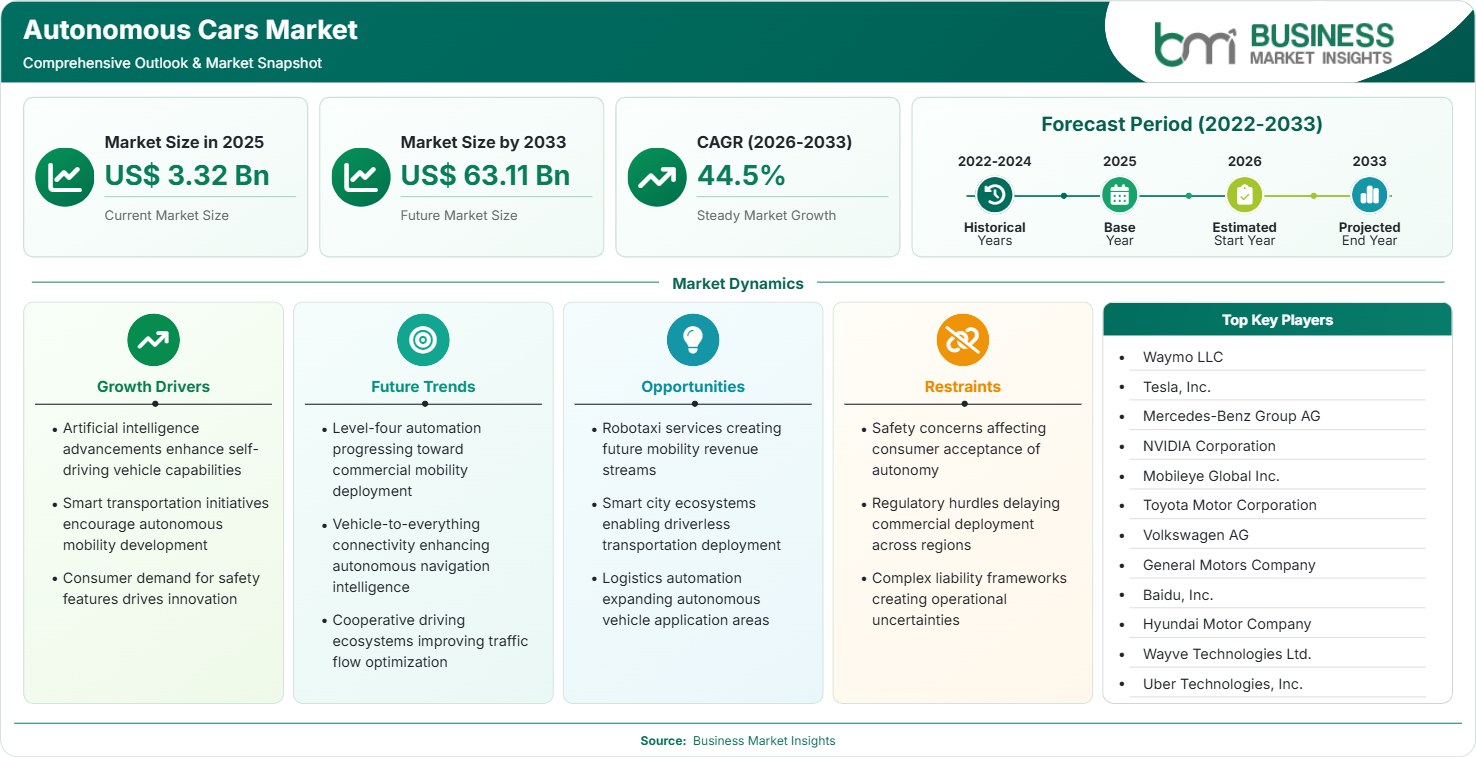
The Autonomous Cars Market size was valued at US$ 3.32 Billion in 2025 and is projected to reach US$ 63.11 Billion by 2033, growing at a CAGR of 44.50% during 2026–2033, driven by AI advances, sensor integration, fleet digitization, robotaxi deployment, regulatory progress, and expanding autonomous mobility investments.

Report Coverage
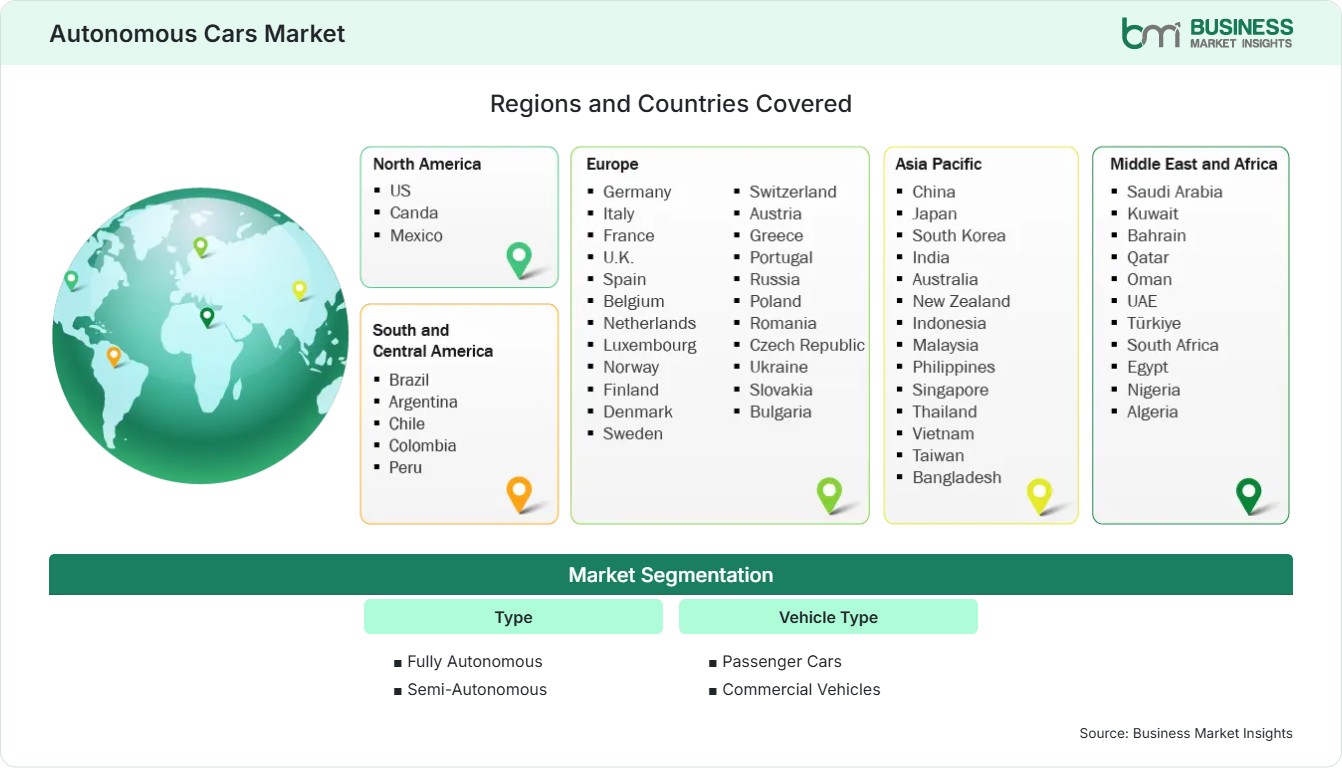
  • Type: Fully Autonomous, Semi-Autonomous
  • Vehicle Type: Passenger Cars, Commercial Vehicles
US$ 3.32 Bn Market size in 2025
US$ 63.11 Bn Market Size by 2033
44.5% CAGR, 2026 - 2033
2026-2033 Forecast Period

AI Overview

Autonomous Cars Market Summary

  • North America Region: North America holds an Autonomous Cars Market share of 34%–38% in 2025, growing at a CAGR of 42%–46%, influenced by robotaxi commercialization, AI investment, advanced testing ecosystems, regulatory pilots, and strong technology partnerships across automakers and mobility providers. The US remains the principal contributor, supported by commercial robotaxi deployment, autonomous testing programs, high AI investment, and technology partnerships, with a CAGR of 43%–47%.
  • Fastest Growing Region: Asia Pacific holds market share of 28%–32% in 2025, expanding at a CAGR of 46%–50%, supported by Chinese autonomous-driving investment, electric-vehicle integration, smart-city programs, high technology adoption, manufacturing scale, and accelerating regulatory experimentation.
  • Leading Segment: Fully Autonomous holds market share of 55%–59% in 2025, advancing at a CAGR of 46%–50%, supported by robotaxi fleets, autonomous logistics, purpose-built vehicle architectures, sensor fusion, high-performance computing, and increasing commercial deployment.
  • High Growth Segment: Commercial Vehicles hold Autonomous Cars Market share of 18%–22% in 2025, expanding at a CAGR of 49%–53%, supported by freight automation, labor constraints, predictable operating routes, utilization economics, autonomous delivery applications, and fleet-management integration.
  • Key Market Opportunity: Commercial robotaxi networks, autonomous freight, software-defined vehicles, AI foundation models, and fleet-as-a-service platforms create monetization opportunities beyond vehicle sales while accelerating recurring software, data, mapping, and mobility revenues.
  • Major Market Players: Waymo LLC, Tesla, Inc., Mercedes-Benz Group AG, NVIDIA Corporation, Mobileye Global Inc., Toyota Motor Corporation, Volkswagen AG, General Motors Company, Baidu, Inc., Hyundai Motor Company, Wayve Technologies Ltd., and Uber Technologies, Inc.
Strategic Insights

Autonomous Cars Market: Strategic Insights

Autonomous Cars Market Strategic Framework
FREE PDF
Request your free sample
Request free sample
Stakeholder View

Key Takeaways

  • Value creation is migrating across the automotive ecosystem from mechanical components toward AI compute, perception software, simulation, cybersecurity, sensor systems, fleet operations, and autonomous mobility platforms. Suppliers able to integrate several layers can participate in multiple vehicle programs rather than relying on individual component cycles.
  • Fully autonomous passenger mobility has the clearest commercialization pathway where vehicles operate repeatedly within defined service areas, while commercial vehicles provide an expanding opportunity because utilization, route predictability, and driver-related operating costs can strengthen automation economics.
  • Autonomous systems are moving toward centralized compute and end-to-end AI architectures. NVIDIA's Hyperion platform combines compute, operating software, and sensor architecture, while emerging systems increasingly use foundation models and simulation to improve performance across diverse driving environments.
  • Asia Pacific combines electric-vehicle manufacturing scale, software investment, dense urban mobility demand, and rapid intelligent-vehicle adoption. China, Japan, South Korea, and Singapore provide distinct opportunities across passenger vehicles, robotaxis, connected infrastructure, and autonomous fleet services.
  • Capital is increasingly directed toward partnerships rather than standalone development. The Wayve ecosystem illustrates this shift through relationships with automakers and mobility platforms, while NVIDIA's expanding partner network demonstrates growing dependence on shared compute and software architectures.
  • Recurring revenue models based on autonomous ride services, software licensing, fleet management, mapping, and data services can complement vehicle sales, creating a broader addressable value pool as autonomy moves from optional features toward operational mobility services.
Geographic Outlook

Autonomous Cars Market Regional Highlights

North America Autonomous Cars Market

North America accounts for a modelled 34%–38% Autonomous Cars Market share in 2025 and is projected to expand at 42%–46% CAGR through 2033. The region benefits from mature AI ecosystems, established autonomous testing programs, venture funding, robotaxi operations, and technology partnerships. The United States represents most regional demand, while Canada contributes through AI research, connected-vehicle development, and autonomous testing. California's regulatory reporting framework continues to provide structured operational visibility, with Waymo, Zoox, Aurora, WeRide, Nuro, and others participating in 2026 reporting.

  • Robotaxi commercialization is expanding beyond established markets, with Waymo extending public autonomous rides to Denver, San Diego, and Tampa during September 2026, taking its operating footprint to 14 cities.
  • AI infrastructure remains strategically important because autonomous vehicles require substantial edge computing, simulation, model training, and validation capabilities before deployment.
  • Automakers increasingly combine internal vehicle engineering with external autonomy software, enabling faster technology integration while retaining control over vehicle platforms and customer interfaces.
  • North American commercial opportunity is broadening from passenger robotaxis toward autonomous trucking, delivery vehicles, and fleet services where utilization rates can support higher technology investment.

US Autonomous Cars Market

The US represents a modelled 70%–75% Autonomous Cars Market share of North American revenue in 2025 and is estimated to grow at 43%–47% CAGR through 2033. Its position reflects strong AI investment, extensive testing activity, established technology companies, and early robotaxi commercialization. State-level regulatory structures create different operating environments, requiring developers to adapt deployment strategies to local permitting, safety reporting, and operational requirements. Commercial autonomous mobility is therefore developing through geographically concentrated launches before broader market expansion.

  • Waymo's September 2026 launches in Denver, San Diego, and Tampa expanded public autonomous service coverage, demonstrating continued movement from controlled testing toward commercial ride operations.
  • California's quarterly reporting framework provides operational data from autonomous carriers, supporting structured oversight of testing and deployment activity across multiple technology developers.
  • Tesla, Waymo, Zoox, and other operators are expanding service footprints, increasing competitive pressure around fleet scale, software performance, operating cost, and rider experience.

Europe Autonomous Cars Market

Europe is projected to have an Autonomous Cars Market Share of 27%-31 % in 2025 and is expected to grow at a 41%-45% CAGR by 2033. Some European countries, such as Germany, the United Kingdom, France, Sweden, and the Netherlands, have established themselves as centers for technology and testing, while Germany and the United Kingdom are becoming hotspots for commercialization. European adoption of the market is influenced by the need for functional safety, privacy laws, the Type Approval process, and government participation.

  • Germany is positioned as a leading automotive autonomy hub, with Mercedes-Benz combining internal development with external technology partnerships to accelerate software-defined driving capabilities.
  • The United Kingdom recorded a major commercialization milestone in September 2026 when Wayve and Uber launched supervised autonomous rides in London using electric Ford Mustang Mach-E vehicles.
  • France and Sweden offer opportunities in autonomous mobility, connected infrastructure, and commercial vehicle automation, supported by strong automotive engineering and technology supplier ecosystems.
  • European manufacturers are increasingly using partnerships to access advanced AI capabilities while maintaining control over vehicle integration, safety engineering, and production platforms.

Asia Pacific Autonomous Cars Market

Asia Pacific is estimated to have a 28%-32% market share in the Autonomous Cars market in 2025 and is also likely to see the fastest CAGR of 46%-50% through 2033. China dominates the region in terms of deployment, but Japan, South Korea, Singapore, and India offer additional growth opportunities. Scale in electric vehicle manufacturing, semiconductor investments, smart city initiatives, and consumer acceptance of intelligent vehicle capabilities are key elements for the adoption of autonomous cars.

  • China remains a major development center for autonomous passenger vehicles, robotaxis, AI-assisted driving, vehicle computing, and sensor technologies, supported by large domestic automotive and technology ecosystems.
  • Singapore's planned Waymo commercial service in 2028 illustrates how compact, infrastructure-rich cities can provide controlled environments for autonomous mobility commercialization.
  • Japan and South Korea combine advanced automotive manufacturing with robotics, semiconductor, AI, and connected-vehicle capabilities, supporting development of higher automation functions.
  • Regional automakers are expanding relationships with compute and AI providers, reinforcing a technology architecture centered on software-defined vehicles and centralized processing.

Rest of World Autonomous Cars Market

Rest of World contributes to a modelled 7% - 11% Autonomous Cars market share in 2025 and is expected to grow at a 38% - 42% CAGR. South America and Central America offer distinct opportunities in connected mobility, logistics automation, and controlled fleet operations. Countries such as Brazil and Mexico are well supported by industrial infrastructure, owing to the automotive industry, urbanization, and a growing technology ecosystem. Adoption is expected to be more focused on commercial fleets and a controlled operating environment.

The Middle East and Africa offer opportunities in smart city initiatives, premium mobility services, logistics automation, and government-driven technology initiatives. Countries such as the United Arab Emirates and Saudi Arabia are innovation hubs for the region, and South Africa offers opportunities in mining- and logistics-related automation.

  • Mexico can leverage its established automotive manufacturing base to integrate advanced driving systems into globally produced vehicle platforms.
  • Brazil offers opportunities in urban mobility, logistics, and connected fleets where autonomous functions can address operating efficiency and route management requirements.
  • Gulf markets can support premium autonomous mobility deployments through smart-city programs, controlled infrastructure, and high technology investment.
  • South Africa provides potential commercial applications in mining, logistics, ports, and industrial environments where structured routes can simplify autonomous deployment.
Global Market Geography
FREE PDF
Request your free sample
Request free sample
Segment Analysis

Autonomous Cars Market Segmentation

Type

The Fully Autonomous systems segment is modelled at 55% - 59% of the Autonomous Cars Market in 2025 and is forecast to grow at a 46% - 50% CAGR through 2033. Robotaxis, autonomous logistics, and fleets have driven market growth through focused operations in limited-service zones and increased fleet utilization.

  • Fully Autonomous: Driverless operation depends on redundant perception, high-performance computing, localization, fail-operational systems, and continuous validation. Robotaxis and controlled logistics fleets provide the strongest deployment pathways as service operators manage operating domains.
  • Semi-Autonomous: Advanced assistance remains relevant because regulatory readiness, consumer familiarity, and lower system complexity enable broader deployment. Highway assistance, automated parking, lane management, and supervised urban driving provide transitional pathways toward higher automation.

Vehicle Type

Passenger Cars account for the largest deployment base; Commercial Vehicles have the highest growth trajectory, with a modeled 18%-22% share of the Autonomous Cars market in 2025 and a 49%-53% CAGR through 2033.

  • Passenger Cars: Consumer vehicles increasingly integrate automated driving, parking, monitoring, and connected functions. Adoption depends on affordability, regulatory approval, perceived safety, software reliability, and manufacturers' ability to deliver useful functions across vehicle classes.
  • Commercial Vehicles: Autonomous trucks, delivery vehicles, shuttles, and fleet vehicles benefit from route predictability, high utilization, labor availability constraints, and centralized fleet management, supporting stronger economic incentives for automation.
Market Forces

Autonomous Cars Market Dynamics

Key Market Drivers

Centralized AI Computing and Software-Defined Vehicle Architectures

Autonomous Cars Market growth is increasingly linked to centralized computing because perception, planning, vehicle control, infotainment, and monitoring require coordinated processing. The Hyperion architecture is demonstrated in NVIDIA's Hyperion platform, which comprises computing, DriveOS, sensors, and autonomous driving features, while NVIDIA's 2025 platform announcement included safety and cybersecurity analysis of its products. Thus, the automakers are moving from fragmented electronic control units to centralized systems with higher performance that can be updated with new software. Such a shift helps minimize hardware fragmentation while enabling developers to enhance driving features without redesigning all subsystems. The computing requirements of AI also drive partnerships among semiconductor vendors, automakers, cloud providers, and software developers.

Expansion of Commercial Robotaxi and Autonomous Mobility Services

Autonomous Cars Market trends increasingly center on recurring mobility services because commercial fleets can generate continuous operating data and utilize vehicles more intensively than private ownership models. Waymo reported a total of 20 million rides in its driverless fleet and 300 million self-driving miles by September 2026, when it entered more U.S. cities and prepared to launch in Singapore. Such an endeavor will create a learning loop throughout the process, from route planning to safety testing. In addition, the business model will encourage collaboration between automakers, AI creators, and ride-hailing companies. Uber's partnership with Wayve and Stellantis is one example of how mobility platforms can become distributors of autonomous cars. Business revenues from this kind of operation will be used to monetize software while collecting data.

Growing Integration of AI With Advanced Vehicle Sensor Systems

Autonomous driving performance depends on combining cameras, radar, lidar, ultrasonic sensing, localization, and AI perception rather than relying on a single technology. The NVIDIA Hyperion 10 platform is equipped with 14 cameras, 9 radars, 1 lidar, and 12 ultrasonic sensors, demonstrating how complex level 4 systems intended for manufacturing can be. The use of sensor fusion ensures that the car retains its environmental awareness across varying lighting, weather, traffic, and road conditions. At the same time, AI models are becoming increasingly capable of understanding multimodal data and making autonomous driving decisions through end-to-end architectural designs. As a result, there is a need for better quality data, simulated environments, edge computing, and safety validation. Sensors still matter, yet system integration drives the value of solutions.

Key Market Opportunities

Robotaxi Networks in Dense Urban Mobility Corridors

The deployment of urban robotaxis is a scalable venture due to repeated routes, higher passenger volumes, centralized fleet management, and data from ongoing operations, which will help optimize asset utilization. Wayve and Uber have already started their pilot project for supervised self-driving rides in London since September 2026, while Waymo has announced plans for its future commercial self-driving rides in Singapore starting in 2028. The examples show that a company could employ various commercialization strategies based on regulatory conditions, vehicle availability, software architecture, and mobility platforms. Possible investment opportunities extend far beyond vehicles and include fleet management, remote assistance, charging stations, maintenance, maps, user interfaces, insurance, and data services. Cities with developed public transport systems, high ride-hailing popularity, and supportive policies towards technology will be preferable deployment locations.

Autonomous Freight and Fleet Automation

Commercial freight is a potential application for autonomous technology that will benefit from high vehicle usage, predictable routes and operating hours, and driver availability. Autonomous truck manufacturers are becoming increasingly collaborative with vehicle makers and computing providers, and NVIDIA sees long-haul freight as one of the biggest Level 4 autonomous applications. Autonomous freight will also be able to run in hubs, ports, distribution centers, mining sites, and dedicated lanes before running on more complex roads. The multi-phase process will bring about benefits such as reduced operational complexity and clearer productivity metrics. Fleet operators will gain from reduced dependence on drivers, higher efficiency, improved maintenance planning, and better dispatch control. Software companies will be able to earn money from hardware, software, simulation, safety, and fleet management solutions. The growth of commercial autonomy may lead to a distinction between special and ordinary vehicles due to differing economic incentives.

Cloud-Enhanced Mapping, Simulation, and Autonomous Driving Data

Autonomous Cars Market Forecasts increasingly depend on data infrastructure because large-scale deployment requires continuous model training, scenario generation, simulation, mapping, validation, and fleet monitoring. Mobileye's REM system shows how valuable crowdsourced road intelligence is, with the company stating that it has covered more than 95% of public roads in the United States and Europe and data from millions of cars. Cloud intelligence will enhance localization, road understanding, and feature availability, and reduce the need for hand-made maps. It is also possible to use simulations to test rare and dangerous situations without having to replicate everything in physical reality. This opens up new opportunities for cloud companies, mapping firms, AI infrastructure vendors, data labeling firms, cybersecurity providers, and simulation experts. The commercial model includes subscription and data licensing as well as SaaS and per-vehicle platform fee models.

Market Restraints and Challenges

Regulatory Fragmentation and Deployment Approval Complexity

Factor: The criteria for autonomous deployment will differ between jurisdictions, leading to differences in the issuance of test permits, safety reports, car approvals, design operating domains, liability regimes, and the need for human oversight. Impact: The developer will need to localize the validation process, documentation, software behavior, and procedures, thereby increasing deployment costs and delaying commercialization. The reporting regime for autonomous vehicles in California shows that there will always be structured regulatory reporting requirements for operators, whereas other markets like Europe and Asia have different regulatory methods for approval and safety. Fragmentation may also slow the adoption of proven autonomous systems by other cities and countries. While collaboration with authorities and mobility service providers can reduce deployment friction, it will not eliminate differences in regulatory expectations. Companies will need regulatory engineering capabilities alongside AI and vehicle engineering.

High Validation, Safety, and System Integration Costs

Factor: Autonomous vehicles require significant sensor redundancy, high computing capabilities, cybersecurity, functional safety, simulation, road testing, and operational testing. Impact: The cost of development may remain relatively high even after the driving software reaches maturity, especially since manufacturers must validate the product across multiple vehicles and geographic locations. Increased requirements for integrating hardware and software are expected for companies such as semiconductor producers, sensor producers, software developers, car engineering design specialists, and fleet managers. Edge cases that occur infrequently but may have a substantial impact will need to be included in the safety validation process, meaning that continuous testing will not be sufficient. This is illustrated by NVIDIA's case, which emphasizes safety-certified computing and cybersecurity.

Company Analysis

Competitive Landscape

The competitive environment is becoming more ecosystem-oriented, with automakers, AI developers, semiconductor companies, autonomous mobility operators, and software specialists combining capabilities. Current Autonomous Cars Market analysis therefore requires consideration of both vehicle manufacturing scale and control over computing, autonomy software, data, and deployment platforms. NVIDIA's expanding partner ecosystem and the partnerships formed by Wayve, Stellantis, Uber, Nissan, and Mercedes-Benz demonstrate the industry's movement toward collaborative technology stacks.

Company Name

Overview

Products and Services relevant to this market

Waymo LLC

Alphabet-backed autonomous mobility company focused on commercial driverless transportation and autonomous driving technology.

Waymo Driver, Waymo One robotaxi services, autonomous vehicle platforms, fleet operations, mapping, and safety validation.

Tesla, Inc.

Electric vehicle and technology manufacturer developing automated driving software and vehicle computing capabilities across its fleet.

Full Self-Driving capabilities, Autopilot, vehicle AI computing, autonomous driving software, fleet data, and robotaxi initiatives.

Mercedes-Benz Group AG

Premium automaker developing advanced driving systems through internal engineering and technology partnerships.

DRIVE PILOT, automated driving systems, sensor integration, vehicle computing, software-defined vehicle technologies, and autonomous mobility development.

NVIDIA Corporation

Computing and AI infrastructure company supplying platforms for advanced driver assistance and autonomous vehicle development.

NVIDIA DRIVE, Hyperion, DRIVE AGX Thor, DriveOS, AI training infrastructure, simulation, and autonomous-driving software.

Mobileye Global Inc.

Autonomous driving technology specialist providing computer vision, mapping, and automated-driving platforms to global automakers.

EyeQ systems, SuperVision, Chauffeur, REM mapping, ADAS software, autonomous-driving technology, and road intelligence.

Toyota Motor Corporation

Global automaker developing advanced automated driving through internal research and strategic technology relationships.

Advanced driver assistance, autonomous driving research, vehicle computing, automated mobility services, and safety technologies.

Volkswagen AG

Global automotive group investing in software-defined vehicles, automated driving, and mobility technologies.

Automated driving systems, vehicle software, connected platforms, autonomous mobility partnerships, and advanced vehicle electronics.

General Motors Company

Automotive manufacturer with experience in advanced driver assistance and autonomous mobility development.

Super Cruise, autonomous driving technology, connected vehicle platforms, driver monitoring, and mobility technology development.

Baidu, Inc.

Chinese technology company with major capabilities in AI, mapping, intelligent transportation, and autonomous mobility.

Apollo autonomous driving platform, robotaxi technology, mapping, AI systems, vehicle integration, and autonomous mobility services.

Hyundai Motor Company

Global automaker expanding software-defined vehicle and autonomous-driving capabilities through AI and technology partnerships.

Advanced driver assistance, autonomous driving systems, connected vehicles, AI platforms, robotics, and automated mobility technologies.

Wayve Technologies Ltd.

UK autonomous driving company developing end-to-end embodied AI for scalable automated driving.

Wayve AI Driver, foundation models, autonomous driving software, fleet data systems, simulation, and mobility partnerships.

Uber Technologies, Inc.

Global mobility platform integrating autonomous vehicles into ride-hailing and transportation services.

Autonomous mobility platform integration, robotaxi deployment, fleet orchestration, rider services, and mobility marketplace technology.

Trust & Transparency

Research Methodology

The market analysis combines proprietary research with secondary data from government agencies, company disclosures, regulatory filings, industry databases and expert interviews. Market estimates are validated through data triangulation, cross-market benchmarking and analyst review.

View Full Research Methodology

Questions Answered

Frequently Asked Questions

How are automakers approaching autonomous driving partnerships?

Automakers increasingly combine internal vehicle engineering with external AI, computing, mapping, and autonomous-driving specialists. Partnerships can shorten development cycles while allowing manufacturers to retain control over vehicle architecture, production, branding, and customer relationships.

What role does simulation play in autonomous driving?

Simulation allows developers to evaluate large numbers of driving scenarios, including rare edge cases, without reproducing every situation on public roads. It supports model training, validation, safety testing, and software iteration.

Why are commercial fleets important for autonomy?

Commercial fleets can operate for longer periods and on predictable routes, creating stronger utilization economics. Fleet operators can also centralize maintenance, charging, monitoring, software updates, and operational oversight.

How does autonomous driving create recurring revenue?

As per the Autonomous Cars Market report, revenue can come from autonomous ride services, software licensing, subscriptions, mapping, fleet-management platforms, data services, maintenance, and technology licensing. This expands monetization beyond the initial vehicle sale.

What technologies are most important for autonomous vehicles?

High-performance AI computing, sensor fusion, perception software, localization, simulation, cybersecurity, functional safety, and continuous software validation are core technologies. Commercial deployment also requires fleet management, mapping, remote assistance, and vehicle connectivity.

Access the Full Autonomous Cars Market Report

Get segment-level forecasts, regional estimates, competitive benchmarking, company profiles and downloadable Excel datasets.

Access the full Autonomous Cars Market Report
350 pages PDF & Excel | 2026-10-12
Similar Research

Related Market Reports