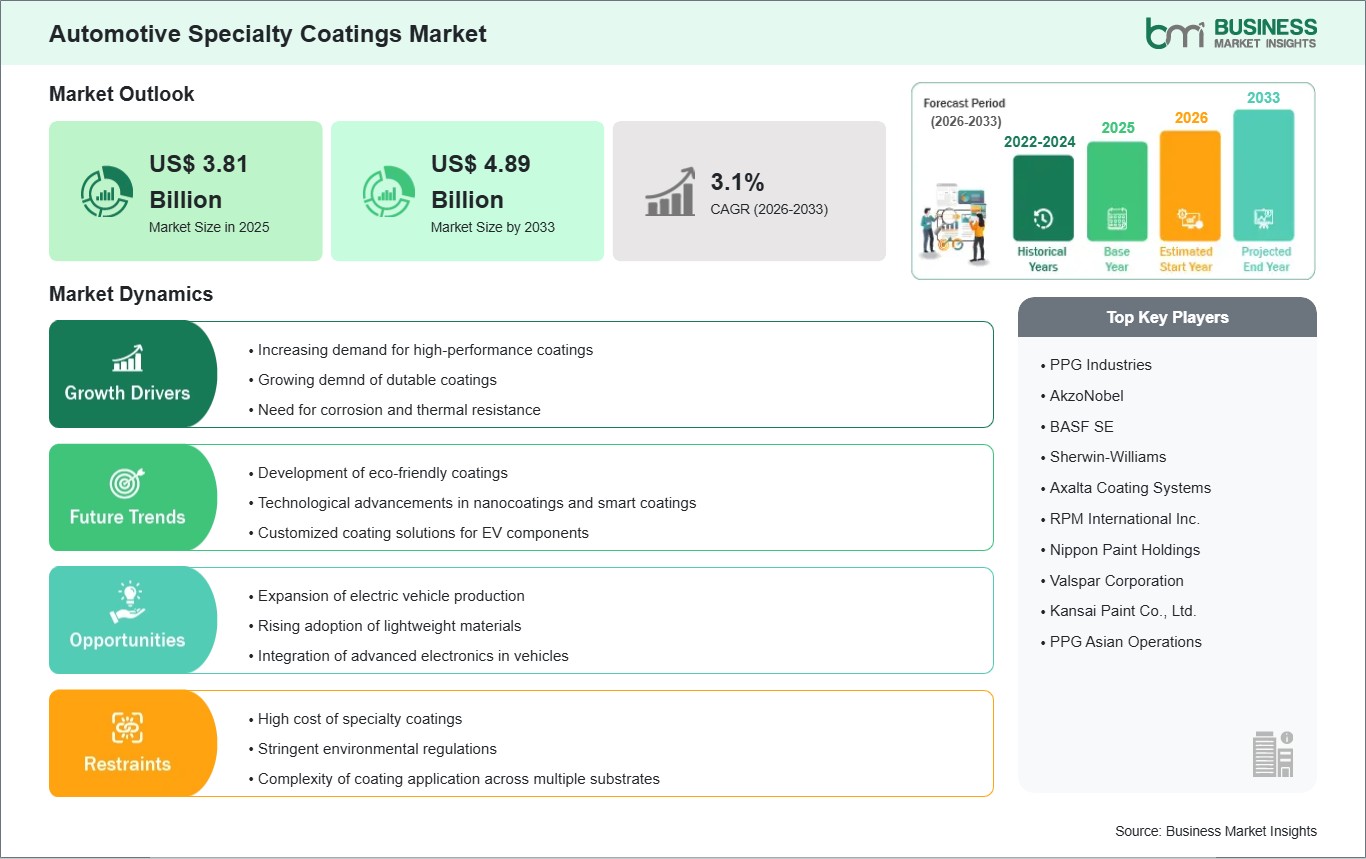
The Automotive Specialty Coatings Market size is expected to reach US$ 4.89 Billion by 2033 from US$ 3.81 Billion in 2025 .The market is estimated to record a CAGR of 3.1% from 2026 to 2033.
The global automotive specialty coatings market is defined by the increasing demand for high-performance coatings that enhance durability, protection, and aesthetics of automotive components. Specialty coatings are engineered to provide resistance against corrosion, heat, chemicals, and wear, making them essential for both functional and decorative applications across vehicles. These coatings are widely used in critical areas such as engines, exhaust systems, interiors, and advanced electronic components.
The market is witnessing robust growth driven by advancements in automotive design, increasing vehicle production, and the rising adoption of electric and hybrid vehicles. Specialty coatings are playing a crucial role in improving vehicle longevity and performance, particularly in harsh operating environments. Additionally, the growing integration of lightweight materials and advanced electronics in vehicles is driving demand for coatings with enhanced adhesion, thermal stability, and protective properties.
Competitive dynamics are centered on innovation in coating technologies, sustainability, and regulatory compliance. Manufacturers are focusing on developing low-VOC and environmentally friendly coatings, including water-borne and powder-based solutions. Technological advancements in nanocoatings and smart coatings are further enhancing product performance. Strategic collaborations with automotive OEMs and component manufacturers are enabling customized solutions and strengthening market positioning.

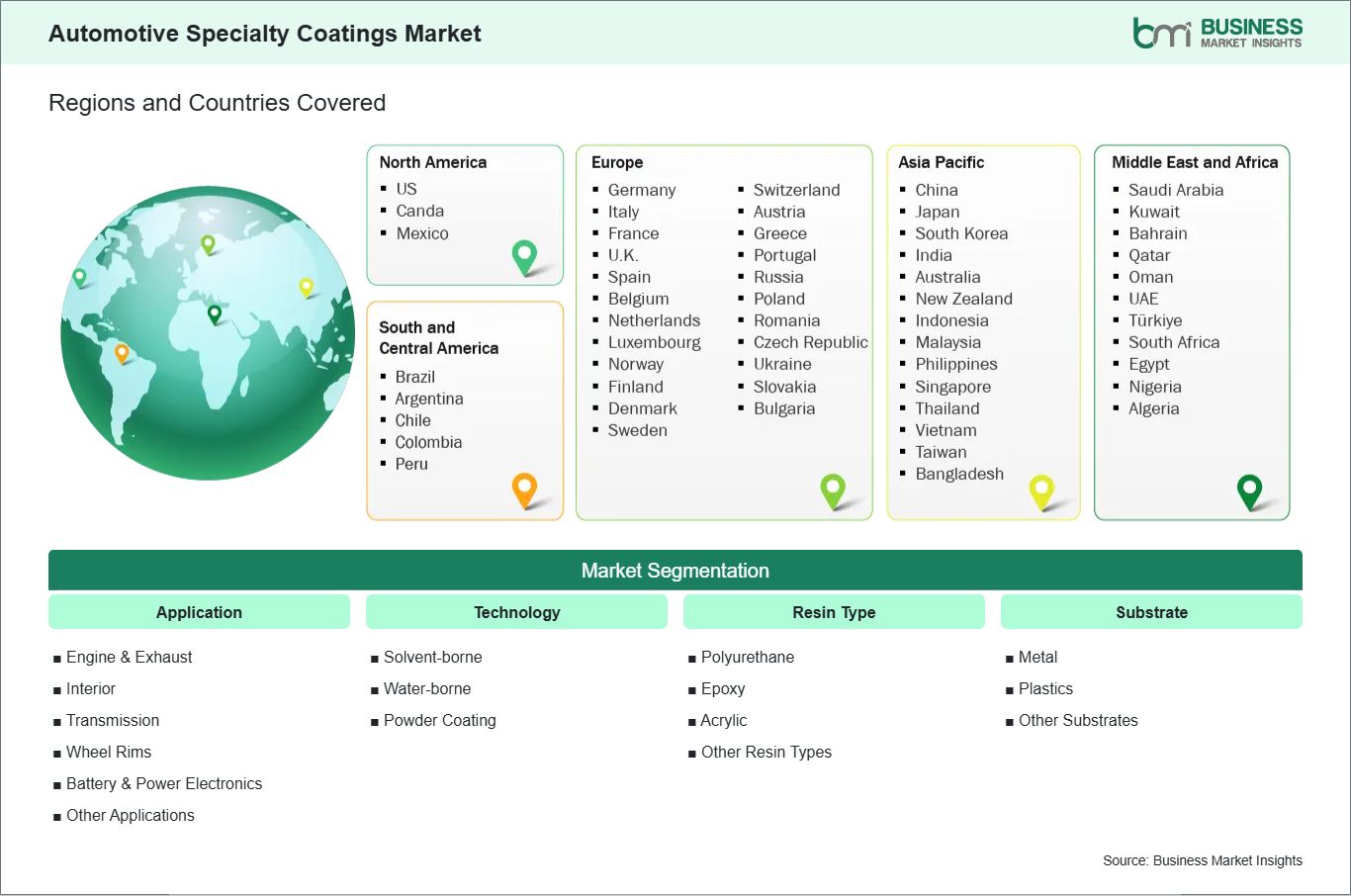
Key segments that contributed to the derivation of the automotive specialty coatings market analysis are application, technology, resin type, substrate, vehicle type, and electric & hybrid vehicle type.
The growing need for high-performance coatings within the automotive industry is a major factor driving growth in the automotive specialty coatings market. Vehicles are subjected to harsh environmental conditions including extreme temperature, high humidity, chemicals, and mechanical stresses, leading to corrosion or degradation. Coatings specializing in protecting against all of these factors increase the life and durability of automotive components.
Applying coatings on engine and exhaust systems or transmission components means that the coating must withstand both a high temperature and exposure to chemicals. It is essential that specialty coatings have both superior thermal resistance and corrosion resistant properties.
In addition, applying coatings on both interior and exterior parts of the vehicle improves the visual aspect of the vehicle while protecting the parts against wear and UV exposure.
Furthermore, advances in technology for creating coating formulations is leading to coatings with significantly better performance characteristics, such as adhesion, flexibility, and resistance to environmental conditions than conventional coatings. The increased use of lightweight materials, such as plastics and composites, must also be paired with specialty coatings that provide an adequate bond between the substrate and the coating. As automotive manufacturers place greater emphasis on maintaining the durability and performance of their vehicles, demand for specialty coatings will continue to grow.
The rapid upsurge in both electric and hybrid vehicles is providing exciting opportunities for many companies on this specialty coatings market. Electric or hybrid vehicles require special coatings for their battery systems, power electronic devices and thermal management systems. Therefore, specialty coatings fulfil an important role in terms of providing the very necessary safety, effectiveness and durability necessary in order for these underlying systems to perform well.
The coatings used on the battery packs and electronic components within electric vehicles must achieve a number of very stringent performance specifications, including the requirement for electrical insulation, thermal conductivity, moisture barrier capabilities, and chemical barrier properties. In addition, there is a growing demand from vehicle manufacturers for specialty coatings that deliver enhanced dielectric performance, due to advanced electronics increasingly being used in vehicle production.
Finally, the movement towards sustainable transportation is leading to the introduction of eco-coating technologies, such as water-based and powder coatings, which minimise impacts to the environment. There is considerable investment being made by manufacturers to develop innovative specialty coatings designed specifically for use in electric/hybrid vehicles. Therefore, as the global automotive industry continues to migrate towards electrified transport solutions, there will be an increasing amount of demand for specialty coatings, thus providing extraordinary growth prospects for the players within the specialty coatings industry.

The Automotive Specialty Coatings Market demonstrates steady growth, with size and share analysis highlighting evolving trends and competitive dynamics among key players. The report examines subsegments categorized within application, technology, resin type, substrate, vehicle type, and electric & hybrid vehicle type, offering insights into their contribution to overall market performance.
By application, the engine & exhaust subsegment dominated the market in 2025, driven by high demand for heat-resistant and corrosion-resistant coatings.
Based on technology, the water-borne subsegment dominated the market in 2025, driven by increasing environmental regulations and demand for low-VOC solutions.
In terms of resin type, the polyurethane (PU) subsegment dominated the market in 2025, driven by its superior durability and flexibility.
By substrate, the metal subsegment dominated the market in 2025, driven by extensive use in automotive structures and components.
Based on vehicle type, the passenger cars subsegment dominated the market in 2025, driven by high production volumes.
By electric & hybrid vehicle type, the battery electric vehicles (BEV) subsegment dominated the market in 2025, driven by rapid growth in electric mobility.
| Report Attribute | Details |
|---|---|
| Market size in 2025 | US$ 3.81 Billion |
| Market Size by 2033 | US$ 4.89 Billion |
| Global CAGR (2026 - 2033) | 3.1% |
| Historical Data | 2022-2024 |
| Forecast period | 2026-2033 |
| Segments Covered | By Application
|
|
Regions and Countries Covered
| |
| North America | US, Canada, Mexico |
| Europe | Belgium, Austria, Finland, Denmark, Greece, Poland, Romania, Russia, Ukraine, Czech Republic, Slovakia, Bulgaria, Italy, Luxembourg, Germany, Switzerland, France, Netherlands, Norway, Portugal, Spain, Sweden, United Kingdom |
| Asia-Pacific | Australia, China, India, Japan, South Korea, Indonesia, Malaysia, Philippines, Singapore, Thailand, Vietnam, Bangladesh, New Zealand, Taiwan |
| South and Central America | Brazil, Argentina, Peru, Chile, Colombia |
| Middle East and Africa | Bahrain, Kuwait, Oman, Qatar, Saudi Arabia, United Arab Emirates, Turkiye, South Africa, Egypt, Algeria, Nigeria |
| Market leaders and key company profiles |
|
The "Automotive Specialty Coatings Market Size and Forecast (2022 - 2033)" report provides a detailed analysis of the market covering below areas:
The geographical scope of the Automotive Specialty Coatings Market report is divided into North America, Asia Pacific, Europe, Middle East & Africa, and South & Central America. North America held the largest share in 2025.
The adoption and demand for automotive specialty coatings vary across regions, influenced by automotive production, regulatory standards, and technological advancements. In North America, the market is driven by strong automotive manufacturing capabilities and increasing adoption of advanced coating technologies.
In Europe, stringent environmental regulations and a strong focus on sustainability are encouraging the use of eco-friendly coating solutions. The region is also witnessing significant growth in electric vehicle adoption, further boosting demand for specialty coatings.
Asia Pacific is the fastest-growing region, supported by large-scale automotive production and rising demand for passenger vehicles. Countries such as China, India, and Japan are key contributors to market growth.
The Middle East & Africa and South & Central America are experiencing moderate growth, driven by increasing vehicle demand and industrial development. Across all regions, evolving automotive technologies and regulatory frameworks continue to shape market dynamics.

The Automotive Specialty Coatings Market is evaluated by gathering qualitative and quantitative data post primary and secondary research, which includes important corporate publications, association data, and databases. A few of the key developments in the automotive specialty coatings market are:
The Automotive Specialty Coatings Market is valued at US$ 3.81 Billion in 2025, it is projected to reach US$ 4.89 Billion by 2033.
As per our report Automotive Specialty Coatings Market, the market size is valued at US$ 3.81 Billion in 2025, projecting it to reach US$ 4.89 Billion by 2033. This translates to a CAGR of approximately 3.1% during the forecast period.
The Automotive Specialty Coatings Market report typically cover these key segments-
The historic period, base year, and forecast period can vary slightly depending on the specific market research report. However, for the Automotive Specialty Coatings Market report:
The Automotive Specialty Coatings Market is populated by several key players, each contributing to its growth and innovation. Some of the major players include:
The Automotive Specialty Coatings Market report is valuable for diverse stakeholders, including:
Essentially, anyone involved in or considering involvement in the Automotive Specialty Coatings Market value chain can benefit from the information contained in a comprehensive market report.
Please tell us your area of interest
(Market Segments/ Regions and Countries/ Companies)