Market Summary
Executive Summary and Global Market Analysis
Arc flash protection refers to safety solutions designed to detect, reduce, and protect people from high-energy electrical arc faults in industrial and utility settings. These systems use sensing technologies, protective relays, and specialized gear to lower thermal and pressure risks during electrical faults. Their use is increasingly linked to modern electrical infrastructure design.
The growth of electrification in industrial sectors has increased the need for better electrical safety measures. The expansion of high-voltage networks and aging grid infrastructure has put more focus on preventive protection systems. Safety regulations also support the use of arc mitigation technologies in important facilities.
Different areas within this industry show various needs for detection systems and protective equipment. Utilities and manufacturing plants are key adopters due to their constant high-load operations. Installation choices differ based on voltage levels, with medium and high-voltage systems needing more sensitive detection.
Technological progress is changing how quickly systems respond by using faster detection relays and digital monitoring interfaces. Connections to smart grid infrastructure and predictive diagnostics are improving the ability to prevent incidents. Better sensor accuracy and real-time fault isolation are becoming standard in modern designs.
The competitive landscape is marked by ongoing product innovation and system integration. Manufacturers are focused on speeding up response times, ensuring reliability, and meeting changing safety standards. Partnerships and bundled solutions are influencing buying patterns among industrial customers.
Segment Analysis
Arc Flash Protection Market Segmentation
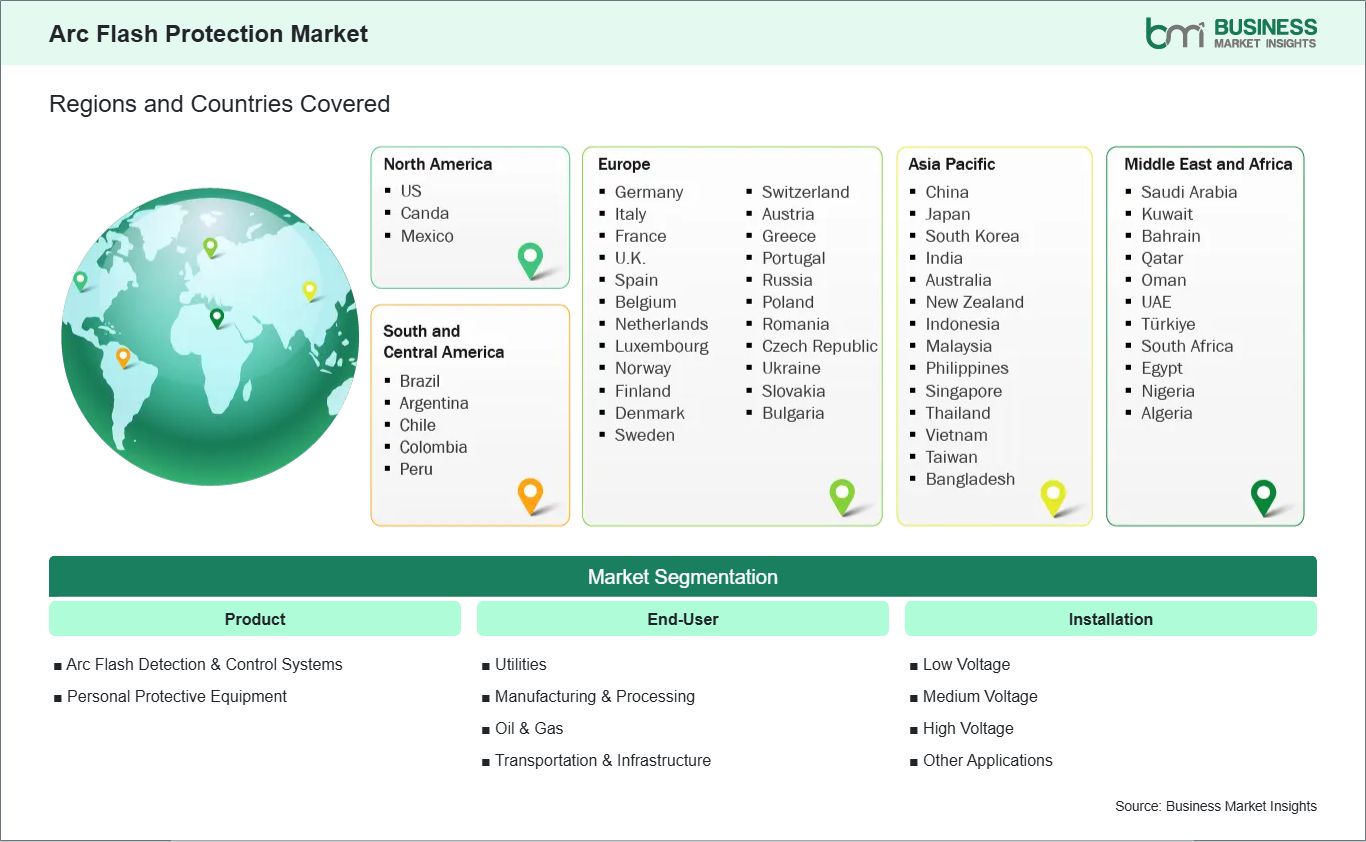
The market is segmented based on product, end-user, and installation.
By Product
- Arc Flash Detection & Control Systems - real-time fault isolation and rapid response mechanisms
- Personal Protective Equipment - insulated clothing and gear for worker safety compliance
By End-User
- Utilities - grid safety improvement and outage risk reduction focus
- Manufacturing & Processing - continuous operation safety in heavy machinery environments
- Oil & Gas - high-risk electrical zones requiring strict arc containment
- Transportation & Infrastructure - electrified systems requiring fault protection layers
By Installation
- Low Voltage - residential and light industrial protection setups
- Medium Voltage - industrial distribution network safety integration
- High Voltage - critical infrastructure and utility-scale protection systems
- Other Applications - specialized or hybrid electrical environments
Market Forces
Arc Flash Protection Market Drivers and Opportunities
Rising Industrial Electrification and Safety Compliance
As industrial electrification grows, exposure to electrical fault risks in work environments has increased. Facilities that manage continuous power loads need better protection systems to prevent thermal and pressure-related hazards.
This demand has led to more companies adopting integrated arc flash detection and mitigation solutions in utilities and manufacturing. Regulatory standards for workplace electrical safety have pushed organizations to invest in protective infrastructure. Many are updating old systems to meet compliance and lower operational risks. This shift has made arc flash protection an essential part of industrial safety in high-load areas.
Smart Grid Integration and Predictive Protection Systems
Improvements in smart grid infrastructure are creating more responsive electrical protection systems with real-time monitoring. Digital relays and sensor-based technologies are making fault detection more accurate and quicker. These advancements are changing traditional protection setups into smart safety networks.
Looking ahead, we expect growth in predictive fault analytics and automated isolation systems in power networks. Integration with industrial IoT platforms allows for early detection of unusual electrical behavior. This change boosts operational resilience and expands deployment options in modern electrical infrastructure systems.
Size and Share Analysis
Arc Flash Protection Market Size and Share Analysis
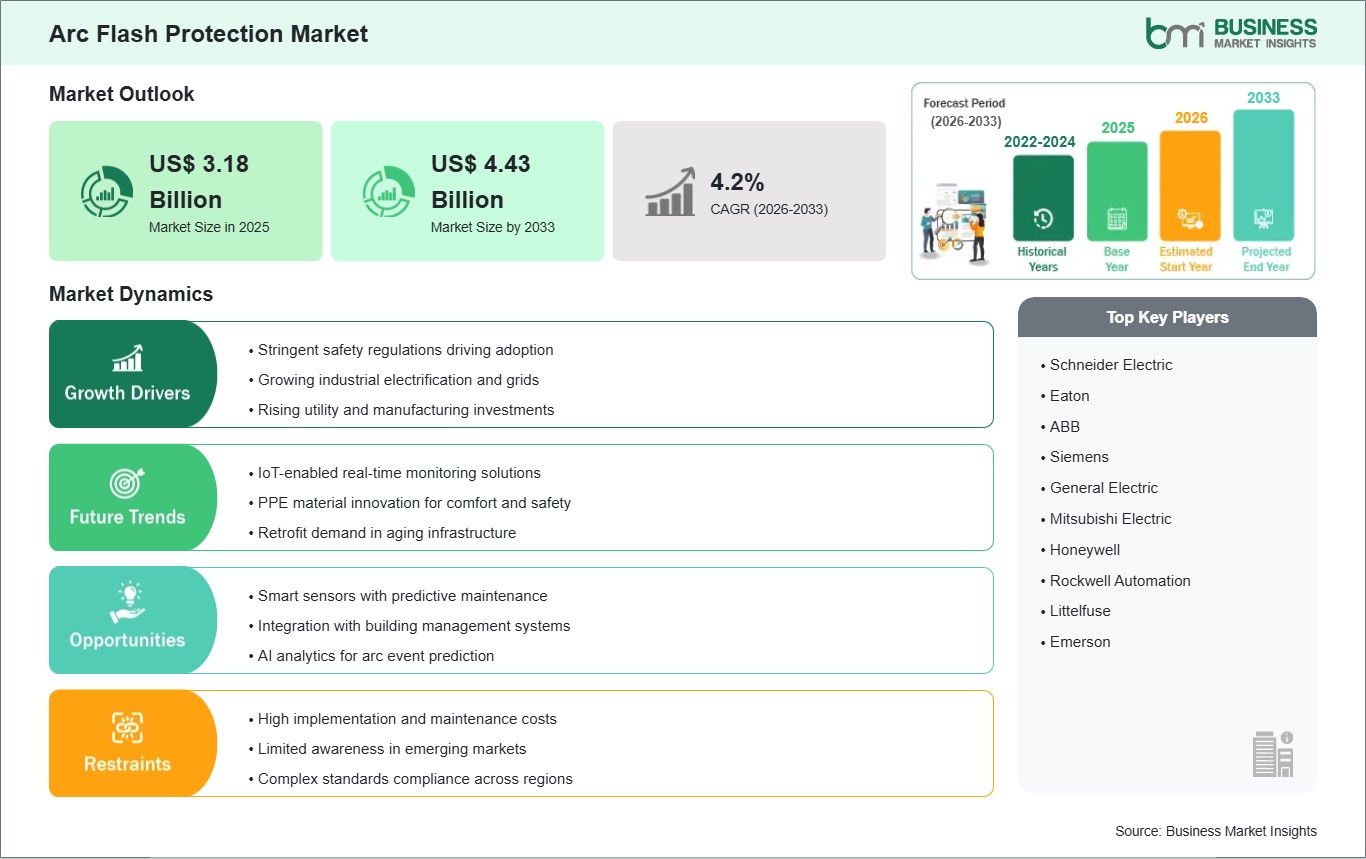
The arc flash protection market size is expected to reach US$ 4.43 billion by 2033, up from US$ 3.18 billion in 2025. The market is projected to grow at a CAGR of 4.2% from 2026 to 2033.
This growth shows steady improvement, driven by updates in industrial safety and electrical infrastructure across various sectors.
Product segmentation reveals a strong focus on detection and control systems because of their role in actively reducing faults. There is consistent demand for protective equipment in environments that prioritize compliance. More companies are also focusing on system-level integration instead of just standalone safety components.
Utility and manufacturing applications lead usage trends because of ongoing electrical load exposure and intense operational risks. Industrial settings that need constant power distribution continue to consider arc mitigation solutions essential for their safety infrastructure.
Report Coverage
Arc Flash Protection Market Report Coverage and Deliverables
The "Arc Flash Protection Market Size and Forecast (2022-2033)" report provides a detailed analysis of the market covering below areas:
- The market size and forecast at global, regional, and country levels for all market segments covered under the scope
- The market trends, as well as drivers, restraints, and opportunities
- The market analysis covering key trends, global and regional framework, major players, regulations, and recent developments
- Industry landscape and competition analysis covering market concentration, heat map analysis, prominent players, and recent developments for the market
- Detailed company profiles, including SWOT analysis
Geographic Insights
Arc Flash Protection Market Geographic Insights
The Arc Flash Protection market shows different patterns of adoption across regions. These patterns are affected by the level of industrial electrification and the maturity of safety regulations. Differences in infrastructure updates also determine deployment priorities in both developed and emerging economies.
North America shows strong use of modern electrical safety systems in utilities and industrial plants. Focus on upgrades driven by compliance supports the widespread use of arc mitigation technologies in critical infrastructure settings.
Asia Pacific is seeing increased deployment due to rapid industrial growth and large-scale power distribution development. The expansion of manufacturing and the growth of grid capacity continue to create steady demand for protective electrical systems across various sectors.
Europe has a well-structured adoption process, backed by strict occupational safety rules and updates to aging electrical networks. Emerging markets in the Middle East and South America are gradually adopting these systems, influenced by infrastructure growth and investments in the energy sector.
Industry Activity
Recent Developments
The arc flash protection market is evaluated by gathering qualitative and quantitative data post primary and secondary research, which includes important corporate publications, association data, and databases. Recent developments and news in the market include:
- In April 2026, Siemens launched a new direct current (DC) technology portfolio with semiconductor-based circuit breakers and ultra-fast switching systems. This innovation speeds up fault interruption, improves electrical system safety, and supports strong infrastructure for data centers, renewable energy, and advanced industrial power networks.
- In March 2026, ABB announced a US$75 million investment in India to expand manufacturing and research and development in electrification, automation, and critical infrastructure areas. This expansion boosts local production, supports engineering development, and improves solutions for grid upgrades, rail, data centers, and industrial electrification needs.
Trust & Transparency
Research Methodology
The market analysis combines proprietary research with secondary data from government agencies, company disclosures, regulatory filings, industry databases and expert interviews. Market estimates are validated through data triangulation, cross-market benchmarking and analyst
review.
View Full Research Methodology
Key Sources Referred:
International Electrotechnical Commission (IEC)National Fire Protection Association (NFPA)Institute of Electrical and Electronics Engineers (IEEE)Occupational Safety and Health Administration (OSHA)Company WebsitesCompany Annual ReportsCompany Investor Presentations