
Application Security Market Outlook: Size, Share, Trends, Growth Analysis, Competitive Landscape & Forecast, 2026-2033

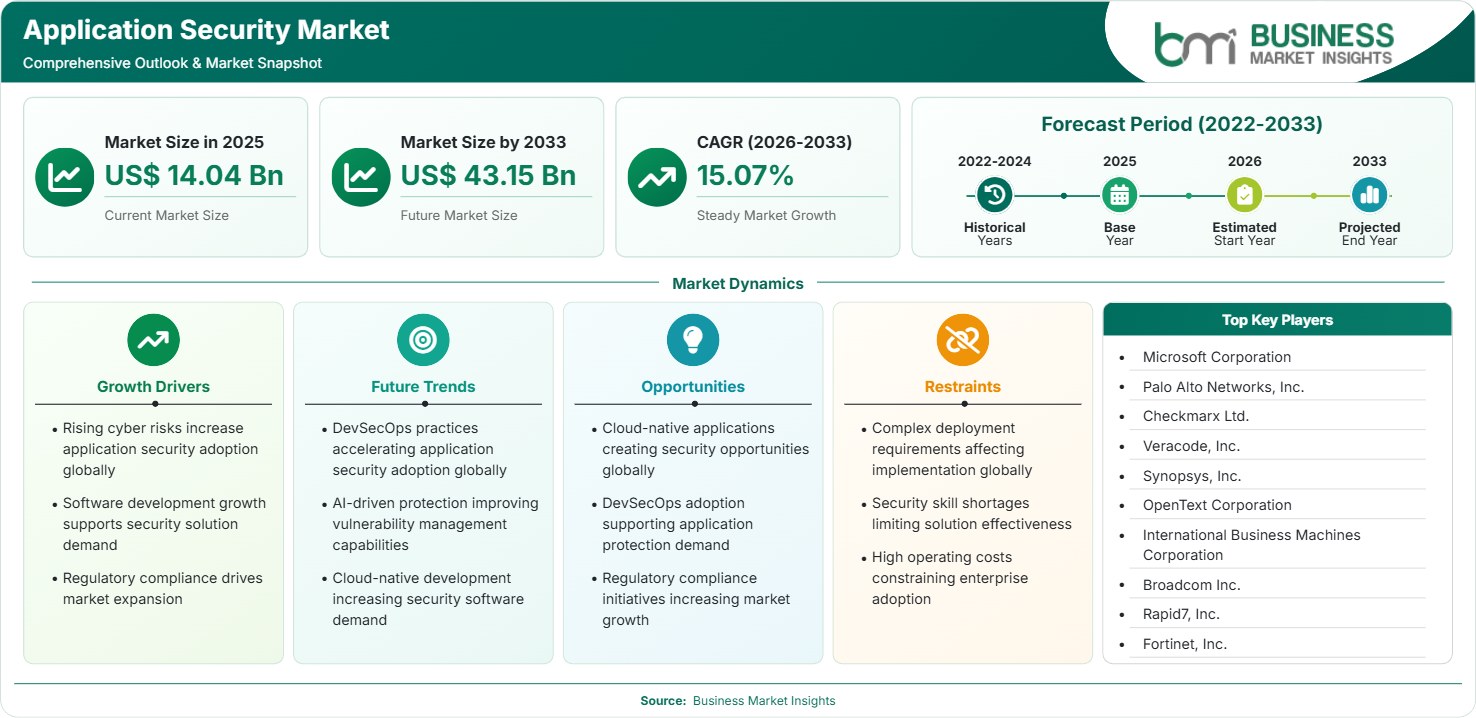
The Application Security Market size was valued at US$ 14.04 Billion in 2025 and is projected to reach US$ 43.15 Billion by 2033, growing at a CAGR of 15.07% during 2026–2033, driven by cloud adoption, software supply-chain risks, AI-assisted development, API exposure, and regulatory pressure.

Report Coverage
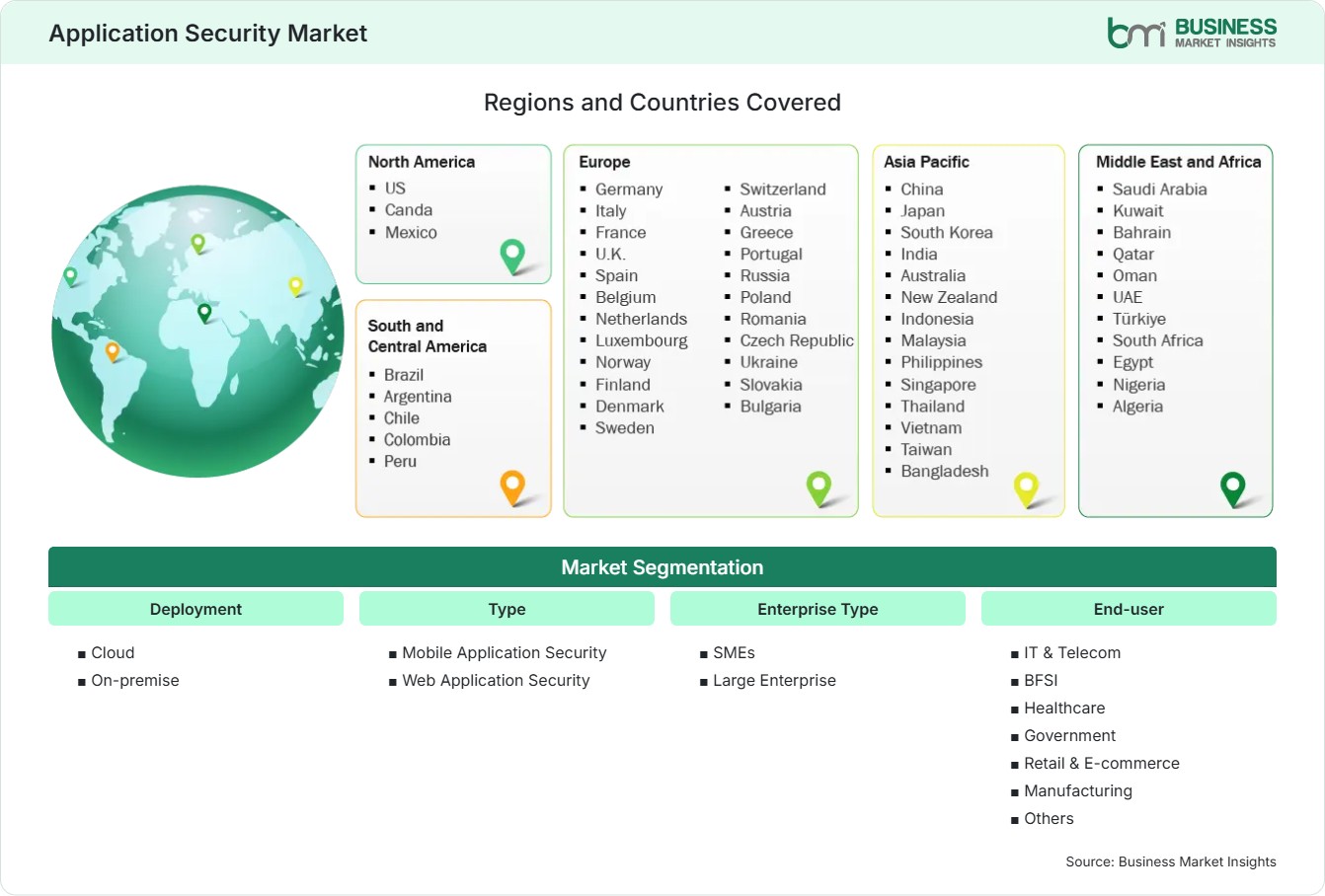
  • Deployment: Cloud, On-premise
  • Type: Mobile Application Security, Web Application Security
  • Enterprise Type: SMEs, Large Enterprise
  • End-user: IT & Telecom, BFSI, Healthcare, Government, Retail & E-commerce, Manufacturing, Others
US$ 14.04 Bn Market size in 2025
US$ 43.15 Bn Market Size by 2033
15.07% CAGR, 2026 - 2033
2026-2033 Forecast Period

AI Overview

Application Security Market Summary

  • North America Region: North America holds a 39%–42% share in 2025, growing with a CAGR of 13.8%–14.8%, influenced by cloud migration, DevSecOps adoption, software supply-chain controls, and sustained enterprise cybersecurity investment. The US accounts for most regional demand, supported by mature security programs, federal cyber requirements, and extensive SaaS adoption, with application security spending expanding at approximately 14.0%–15.0% CAGR through 2033.
  • Fastest Growing Region: Asia Pacific holds a 25%–28% Application Security Market share in 2025, expanding at a CAGR of 17.2%–18.5%, supported by rapid digitization, mobile-first applications, cloud migration, expanding software development ecosystems, cybersecurity regulations, and rising enterprise investment across India, China, Japan, South Korea, Singapore, and Australia.
  • Leading Segment: Web Application Security holds a 58%–62% share in 2025 and expands at a CAGR of 14.8%–16.0%, supported by API exposure, cloud applications, ecommerce transactions, identity risks, regulatory requirements, continuous testing, and increasing integration of security throughout software development workflows.
  • High Growth Segment: Cloud deployment holds a 55%–59% share in 2025 and expands at a CAGR of 17.0%–18.2%, driven by SaaS adoption, cloud-native development, distributed workloads, automated security controls, scalable deployment models, and integrated DevSecOps platforms across enterprises.
  • Key Market Opportunity: Integration of application security with AI-assisted coding, cloud-native protection, API discovery, software supply-chain controls, and automated remediation creates recurring revenue opportunities as enterprises consolidate fragmented security tools.
  • Major Market Players: Microsoft Corporation, Palo Alto Networks, Inc., Checkmarx Ltd., Veracode, Inc., Synopsys, Inc., OpenText Corporation, International Business Machines Corporation, Broadcom Inc., Rapid7, Inc., and Fortinet, Inc.
Strategic Insights

Application Security Market: Strategic Insights

Application Security Market Strategic Framework
FREE PDF
Request your free sample
Request free sample
Stakeholder View

Key Takeaways

  • Application security value chains are now heading in the direction of integrated platforms that link together developers, security teams, cloud operations, vulnerability management, and runtime monitoring, thus eliminating redundant controls and reducing the fragmentation of remediation workflows.
  • Cloud deployment has great potential when it comes to expansion, since nowadays application environments tend to rely on containers, APIs, serverless functions, managed services, and on infrastructure that is constantly changing and therefore needs automated security validation.
  • The economics of security are being altered by AI-assisted coding since it speeds up software production at the same time as it raises the demand for automated code analysis, dependency validation, secret detection, contextual prioritization, and machine-assisted remediation.
  • There is a significant Application Security Market opportunity for regional growth in Asia Pacific since India, China, Japan, South Korea, Singapore, and Australia are all pursuing digital transformation, together with greater cybersecurity needs and increased cloud adoption.
  • Investment activity is now focusing more and more on platform convergence, artificial intelligence, the management of application security posture, and autonomous remediation; the fact that Checkmarx acquired Tromzo in December 2025 is an example of this trend towards consolidation.
  • Because application vulnerabilities can have a direct effect on regulated information, payment systems, citizen services, and customer trust, the need for specialized controls in the financial services, healthcare, government, and e-commerce sectors is growing.
Geographic Outlook

Application Security Market Regional Highlights

North America Application Security Market

North America held 39%–42% Application Security Market share in 2025 and is projected to expand at a 13.8%–14.8% CAGR through 2033. The region benefits from mature DevSecOps practices, high cloud penetration, large cybersecurity budgets, extensive SaaS adoption, and stringent enterprise security governance.

  • Increasingly, large enterprises in the United States are incorporating code scanning, dependency analysis, secrets protection, and cloud workload security into their unified development workflows.
  • The federal cybersecurity requirements and the expectations regarding software security have led to a demand for automated controls that enable continuous visibility for both internally developed and third-party applications.
  • Financial institutions are still the principal purchasers since APIs, mobile banking applications, payment interfaces, and customer identity systems all need continuous security testing.
  • Canada is currently extending its programs for cloud and software modernization, which is leading to greater demand for application testing, vulnerability management, and secure development services.
  • Because of platform consolidation, companies are now considering their purchases, aiming to use fewer tools that offer a longer lifecycle and have better integration across their developer environments.

US Application Security Market

The US represented approximately 31%–34% of the global Application Security Market demand in 2025 and is projected to grow at a 14.0%–15.0% CAGR through 2033. Strong enterprise cloud adoption, federal software security initiatives, financial technology development, healthcare digitization, and mature DevSecOps practices underpin demand.

  • The federal government's efforts to improve software security promote more rigorous controls relating to software development, provenance, the disclosure of vulnerabilities, and the integrity of the supply chain throughout its technology ecosystems.
  • Technology companies are incorporating AI to assist with coding and are embedding security checks into the developer workflows so as to keep the speed of delivery without having to increase the number of manual security reviews in proportion.
  • Financial institutions and healthcare organizations place a high priority on testing applications since digital services make sensitive financial, personal, payment, and medical information available through constantly changing interfaces.
  • Increasingly, businesses that are buying are preferring consolidated platforms that connect code, cloud services, identity, dependencies, and runtime context so that priorities can be established and remedial action taken more quickly.

Europe Application Security Market

Europe accounted for 23%–26% Application Security Market share in 2025 and is expected to grow at a 14.5%–15.7% CAGR through 2033. The region benefits from privacy requirements, software governance, financial-sector controls, cloud modernization, and increasing attention to software supply-chain resilience.

  • Germany has a substantial industrial software base and, at the same time, imposes strict enterprise security requirements, which enable application testing in the areas of manufacturing, the automotive sector, healthcare, and financial applications.
  • The United Kingdom has a well-developed level of adoption of financial technology, makes extensive use of cloud services, and has in place well-established procedures for acquiring cybersecurity across both public and private organizations.
  • France is extending its digital infrastructure and cloud services in order to meet the demand for secure software development, vulnerability assessment, and application lifecycle governance.
  • In the Nordic markets, there is a strong focus on digital public services and on the use of advanced cloud technologies, which in turn leads to a greater need for automated security validation and for software supply-chain controls.
  • Instead, European companies are now assessing the security of their applications through the lenses of governance, risk, compliance, and the software development lifecycle rather than relying just on vulnerability scanning.

Asia Pacific Application Security Market

Asia Pacific held 25%–28% Application Security Market share in 2025 and is projected to record the fastest 17.2%–18.5% CAGR through 2033. Rapid digitalization, mobile application adoption, cloud migration, e-commerce expansion, and growing cybersecurity investment support regional acceleration.

  • As India continues to expand its adoption of application security, it is doing so in conjunction with its developments in software exports, digital public infrastructure, financial technology, e-commerce, and cloud-native enterprise applications.
  • Because of its large-scale digital platforms and widespread use of mobile devices, China has greater demands for secure APIs, application testing, identity controls, and protection of the supply chain.
  • Japan has a high demand for enterprise security in its manufacturing, financial services, telecommunications, and government modernization projects, all of which require reliable application assurance.
  • Australia enjoys the benefits of advanced cloud adoption and well-developed cybersecurity governance, which in turn enables continuous application testing in both public-sector and regulated enterprise environments.
  • Digital banking, e-commerce, super-app ecosystems, and cloud services are all expanding in Indonesia, Singapore, Malaysia, Thailand, and Vietnam, so that the region of Southeast Asia is developing rapidly.

Rest of World Application Security Market

The rest of the world represented 8%–11% Application Security Market share in 2025 and is projected to grow at a 15.5%–17.0% CAGR through 2033. South and Central America are expanding application security adoption through fintech, ecommerce, telecommunications, and government digitization.

  • The financial technology ecosystem in Brazil has a constant need for secure mobile applications, APIs, identity controls, payment security, and regular vulnerability testing.
  • Mexico enjoys the advantages of digitizing its manufacturing sector, modernizing its financial services, adopting e-commerce, and seeing greater use of cloud-based applications by businesses.
  • The economies of the Gulf are putting their money into digital government and cloud infrastructure, which in turn is leading to a greater demand for secure applications in such sectors as citizen services, banking, energy, and telecommunications.
  • South Africa has a well-developed financial services sector alongside growing use of cloud services, which in turn leads to a demand for secure software development and for the continuous assessment of applications.
  • Regional buyers now tend to prefer managed security services since there are few internal application security specialists, and the development teams need scalable testing expertise.
Global Market Geography
FREE PDF
Request your free sample
Request free sample
Segment Analysis

Application Security Market Segmentation

Deployment

Deployment determines how organizations integrate security capabilities into development and production environments. Cloud solutions represented 55%–59% Application Security Market share in 2025, while on-premise deployments retain relevance among regulated enterprises. Cloud adoption is expanding faster through centralized management, scalable scanning, automated updates, and easier integration with distributed DevSecOps workflows.

  • Cloud: Cloud deployment supports elastic scanning, centralized policy management, rapid integration, and distributed development. Its adoption benefits from SaaS applications, containers, APIs, continuous delivery, and reduced infrastructure administration requirements.
  • On-premise: On-premise environments remain important where data residency, legacy systems, operational control, or specialized compliance requirements restrict cloud migration. Demand persists across government, banking, manufacturing, and sensitive enterprise workloads.

Type

Type segmentation is led by Web Application Security, representing 58%–62% Application Security Market share in 2025. Web applications remain broad attack surfaces because businesses depend on APIs, customer portals, e-commerce interfaces, cloud applications, and interconnected backend services. Mobile security is expanding as organizations distribute more transactions through smartphones and application ecosystems.

  • Mobile Application Security: Mobile security addresses insecure authentication, application tampering, data leakage, API exposure, and device-level threats. Growth is supported by mobile banking, digital commerce, healthcare applications, and consumer platforms.
  • Web Application Security: Web security covers dynamic testing, static analysis, API protection, vulnerability assessment, runtime monitoring, and secure development. Adoption rises as enterprises modernize applications and expose more digital services.

Enterprise Type

Enterprise type influences application security spending through application complexity, regulatory exposure, internal development capacity, and security maturity. Large enterprises maintain the largest installed base because they operate extensive application portfolios, while SMEs increasingly adopt managed and cloud-delivered security solutions to overcome resource limitations.

  • SMEs: SMEs increasingly use cloud-delivered application security because subscription models reduce infrastructure costs and provide access to scanning, vulnerability management, and automated remediation without large specialist teams.
  • Large Enterprise: Large enterprises require comprehensive controls across distributed applications, development teams, third-party dependencies, cloud workloads, and regulatory environments, supporting demand for integrated platforms and centralized security governance.

End-user

End-user demand varies with regulatory sensitivity, transaction intensity, application complexity, and digital transformation. IT and telecommunications remain major users, while BFSI, healthcare, government, retail, and manufacturing expand adoption. The Application Security Market scope increasingly includes organizations integrating application protection directly into development governance.

  • IT & Telecom: High application volumes, APIs, cloud platforms, and network services create continuous requirements for vulnerability detection, code security, dependency monitoring, and secure software delivery.
  • BFSI: Digital banking, payments, fintech platforms, and customer identity systems require continuous application testing because security failures can expose financial information and disrupt critical transactions.
  • Healthcare: Electronic health records, telehealth platforms, connected devices, and patient portals require stronger application controls to protect sensitive information and maintain reliable digital services.
  • Government: Government applications support citizen services, taxation, identity, benefits, and public administration, increasing requirements for secure development, vulnerability management, and software supply-chain assurance.
  • Retail & e-commerce: Online storefronts, payment interfaces, loyalty platforms, and mobile applications expand attack surfaces, creating demand for continuous testing and protection across customer-facing applications.
  • Manufacturing: Connected production systems, industrial applications, supplier platforms, and digital engineering tools increase requirements for application security as manufacturers adopt cloud and connected technologies.
Market Forces

Application Security Market Dynamics

Key Market Drivers

Cloud-Native Software Expansion

Cloud-native development is increasing the number of applications, APIs, containers, identities, and infrastructure configurations that require continuous security validation. Gartner's 2025 research describes cloud-native application protection as covering application and infrastructure protection throughout the lifecycle, from development through production. This architecture shift supports Application Security Market growth because traditional periodic testing cannot efficiently address continuously changing workloads. Organizations increasingly integrate static testing, dynamic testing, dependency analysis, infrastructure-as-code checks, secrets detection, and runtime signals into automated pipelines. The resulting security model moves controls closer to developers while maintaining operational visibility.

Software Supply-Chain Risk

Software increasingly depends on open-source packages, commercial components, container images, build systems, and third-party services, expanding risk beyond internally written code. OWASP's 2025 framework explicitly introduces Software Supply Chain Failures as a Top 10 category, reflecting the broader security implications of compromised dependencies and development infrastructure. This creates sustained demand for software composition analysis, dependency monitoring, SBOM management, provenance controls, and automated vulnerability prioritization. Enterprises increasingly require visibility into which components reach production and whether vulnerable packages are actively exploitable. Application Security Market growth, therefore, extends beyond conventional source-code scanning into supply-chain governance.

AI-Assisted Software Development

Generative AI is speeding up the process of creating software and bringing about changes in the economics of security testing. Because development teams can now produce code, tests, documentation, and configuration files more quickly, there is a greater volume of artifacts that need to be validated. Gartner has named AI-driven development as one of the factors expected to reshape application and data security by 2026. As a result, AI is contributing to various application security trends such as the use of secure coding assistants, automated vulnerability explanations, contextual prioritization, and machine-assisted remediation. There is an increasing need for security platforms to be able to tell the difference between exploitable weaknesses and those with a low impact so that developers can take action without having to put in excessive review effort. At the same time, AI is introducing new risks relating to insecurely generated code, excessive permissions, exposure of secrets, dependency selection, and insufficient validation.

Key Market Opportunities

Application Security Posture Management

Managing an application's security posture allows for the consolidation of the various security signals coming from source repositories, applications, dependencies, cloud environments, and the development pipelines. Since enterprises nowadays need a single, unified view of application risk, this is because separate scanning tools tend to generate overlapping findings without having enough context. By linking together factors such as ownership, deployment status, runtime exposure, exploitability, and business criticality, platforms can enhance the prioritization of issues and decrease the friction involved in carrying out remediation. This Application Security Market opportunity is especially pertinent to large enterprises that manage thousands of repositories and applications. Vendor solutions that combine posture management with automated remediation are able to create ongoing subscription value at the same time as reducing operational overhead.

Automated Remediation and Developer Security

Automated remediation is a significant investment opportunity since security teams are dealing with a growing number of vulnerabilities, but developers are still required to deliver software quickly. By explaining security findings in language that is relevant to developers, providing suggested fixes, verifying that the remediation has been carried out, and integrating with current repositories, the time between when a problem is identified and when it is corrected can be reduced. The fact that Checkmarx acquired Tromzo in December 2025 shows that there is commercial interest in autonomous application security agents and in automated triage. The potential of such solutions goes beyond simply correcting code to include dependency upgrades, changes to configurations, management of secrets, and the enforcement of policies. Vendors can distinguish their offerings by focusing on accuracy, contextual reasoning, the range of integrations available, and governance controls.

Emerging-Market Digital Security Programs

Digital transformation across Asia Pacific, Latin America, the Middle East, and Africa creates an opportunity to establish application security earlier in the technology lifecycle. New financial platforms, government portals, ecommerce systems, mobile applications, and cloud services can adopt modern security controls without extensive legacy constraints. Vendors can address these markets through managed services, cloud-delivered testing, regional security expertise, and simplified deployment models. Application Security Market Forecasts should therefore consider not only enterprise software budgets but also the expansion of digitally enabled services in countries where application estates are still developing.

Market Restraints and Challenges

Complexity of Security Tool Integration

Fact: companies often use separate tools for static testing, dynamic testing, software composition analysis, API security, secrets detection, cloud security, and vulnerability management. Impact: This can lead to duplicated alerts, inconsistent policies, fragmented ownership, and high integration costs, all of which may hinder the uptake of more comprehensive application security platforms. In large organizations, extensive customization may be necessary before a new solution can be made to fit within the existing development pipelines and governance procedures.

Shortage of Specialized Security Skills

The areas involved in application security include secure coding, cloud architecture, software dependencies, APIs, identity controls, threat modeling, vulnerability management, and development workflows. Organizations that have a limited number of specialists will find it difficult to understand the findings, decide what to prioritize in terms of remediation, and keep up their ongoing security activities. This situation grows more complicated as application environments move towards the use of microservices, containers, serverless architectures, and AI-assisted development. Although automation can lessen the amount of manual work, security teams will still need governance expertise in order to verify the automated suggestions and handle exceptions.

Company Analysis

Competitive Landscape

The Application Security Market analysis indicates a competitive environment combining broad cybersecurity platforms, specialist application security providers, software development ecosystems, and cloud security vendors. Competitive differentiation increasingly centers on lifecycle coverage, AI-assisted remediation, developer integration, cloud-native protection, software supply-chain visibility, and consolidation of testing capabilities.

Company Name

Overview

Products and Services relevant to this market

Microsoft Corporation

Global technology provider with extensive enterprise software, cloud, developer, and cybersecurity capabilities serving organizations across industries.

GitHub Advanced Security, code scanning, secret protection, dependency security, Microsoft Defender for Cloud, and developer security integrations.

Palo Alto Networks, Inc.

Cybersecurity provider expanding application protection through cloud-native security, application posture management, and integrated security operations.

Cortex Cloud, cloud-native application protection, application security posture management, vulnerability prioritization, and code-to-cloud security.

Checkmarx Ltd.

Specialist application security provider focused on securing software development processes and enterprise application portfolios.

Checkmarx One offers static analysis, dynamic analysis, software composition analysis, API security, supply-chain security, and AI-assisted remediation.

Veracode, Inc.

Application security specialist providing testing, risk management, developer education, and automated remediation capabilities.

Static analysis, dynamic analysis, software composition analysis, penetration testing, application risk management, and developer security services.

Synopsys, Inc.

Technology provider with broad software integrity capabilities spanning application security and software development assurance.

Static analysis, software composition analysis, fuzz testing, interactive analysis, binary analysis, and software supply-chain security.

OpenText Corporation

Enterprise software provider operating Fortify application security capabilities across development and application testing environments.

Fortify SAST, DAST, software composition analysis, application security testing, vulnerability intelligence, and security lifecycle management.

International Business Machines Corporation

Global technology company combining software, cloud, consulting, automation, and cybersecurity capabilities for enterprise customers.

Application security testing, DevSecOps services, software security consulting, vulnerability management, and cloud security capabilities.

Broadcom Inc.

Technology company serving enterprises through software and infrastructure solutions, including application and development security capabilities.

Software security, application security testing, development security integrations, identity controls, and enterprise cybersecurity solutions.

Rapid7, Inc.

Cybersecurity provider offering application security testing alongside broader exposure management and security operations capabilities.

InsightAppSec, dynamic application testing, vulnerability assessment, application exposure management, scanning, and remediation workflows.

Fortinet, Inc.

Cybersecurity company providing integrated security technologies across networks, applications, cloud environments, and enterprise infrastructure.

Web application security, application control, cloud security, API protection, secure access, and integrated cybersecurity management.

Trust & Transparency

Research Methodology

The market analysis combines proprietary research with secondary data from government agencies, company disclosures, regulatory filings, industry databases and expert interviews. Market estimates are validated through data triangulation, cross-market benchmarking and analyst review.

View Full Research Methodology

Questions Answered

Frequently Asked Questions

How should enterprises evaluate application security platforms?

Enterprises can assess lifecycle coverage, integration with development tools, vulnerability prioritization, remediation automation, cloud compatibility, reporting, governance, scalability, and total operating effort. Evaluation should also consider whether security findings can be connected to application ownership and production exposure.

What application security capabilities are increasingly integrated into DevSecOps?

Static analysis, dependency scanning, secret detection, dynamic testing, API testing, infrastructure-as-code analysis, software supply-chain controls, and automated remediation are increasingly integrated directly into development pipelines and repository workflows.

Why is cloud deployment gaining importance?

Cloud deployment enables centralized policy management, scalable testing, rapid updates, and integration with distributed development environments. It also supports security across containers, APIs, serverless workloads, and continuously changing infrastructure without requiring organizations to maintain extensive security tool infrastructure.

How is AI changing application security?

AI is being applied to vulnerability prioritization, secure coding assistance, remediation recommendations, threat analysis, and security workflow automation. At the same time, AI-generated code introduces additional validation requirements because automatically produced software can contain insecure patterns or unsuitable dependencies.

What is driving application security adoption across enterprises?

Cloud migration, API exposure, software supply-chain risks, AI-assisted development, regulatory requirements, and increasing software release velocity are major adoption factors. Organizations are moving security controls into development pipelines to identify and remediate vulnerabilities earlier.

Access the Full Application Security Market Report

Get segment-level forecasts, regional estimates, competitive benchmarking, company profiles and downloadable Excel datasets.

Access the full Application Security Market Report
350 pages PDF & Excel | 2026-10-28
Similar Research

Related Market Reports