
Antimicrobial Catheters Market Outlook: Size, Share, Trends, Growth Analysis, Competitive Landscape & Forecast, 2026–2033

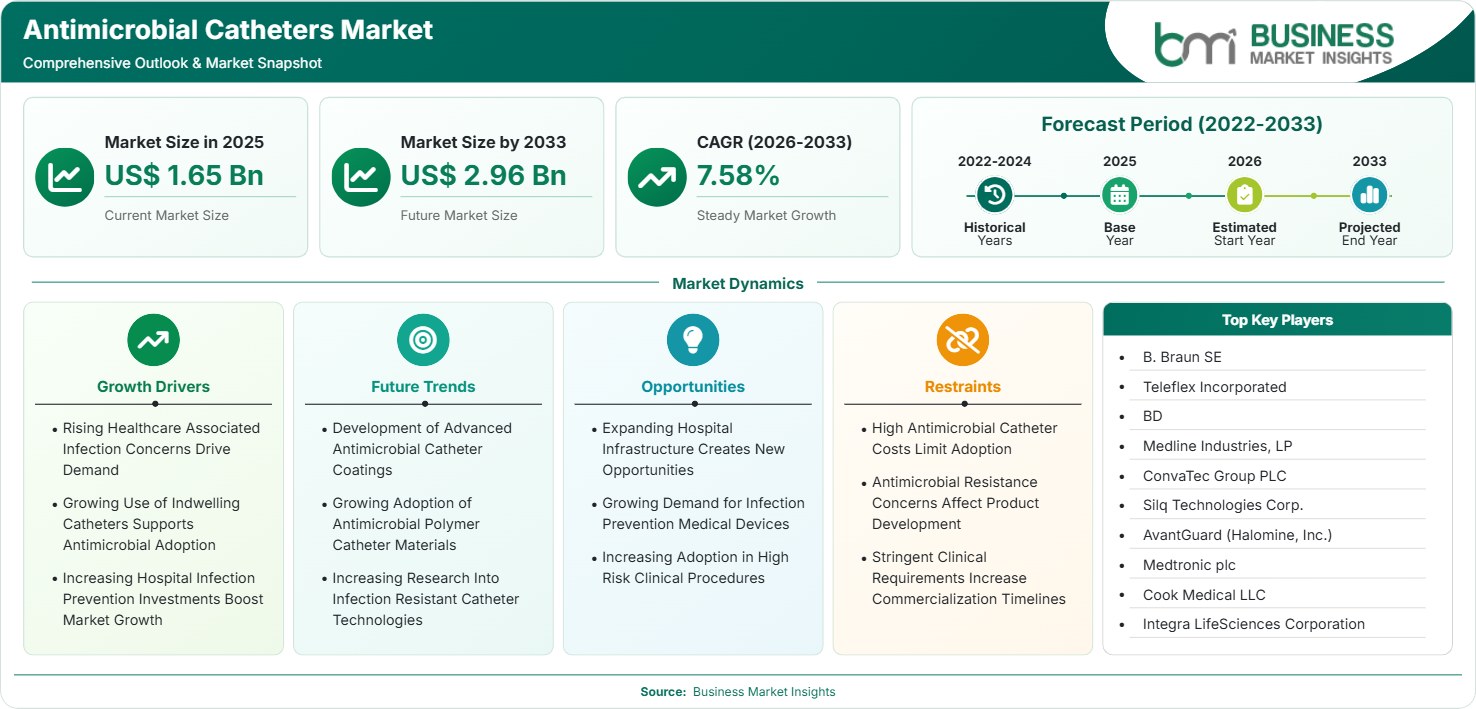
The Antimicrobial Catheters Market size was valued at US$ 1.65 Billion in 2025 and is projected to reach US$ 2.96 Billion by 2033, growing at a CAGR of 7.58% during 2026–2033, driven by infection prevention priorities, catheter utilization, hospital quality initiatives, and demand for safer indwelling devices.

Report Coverage
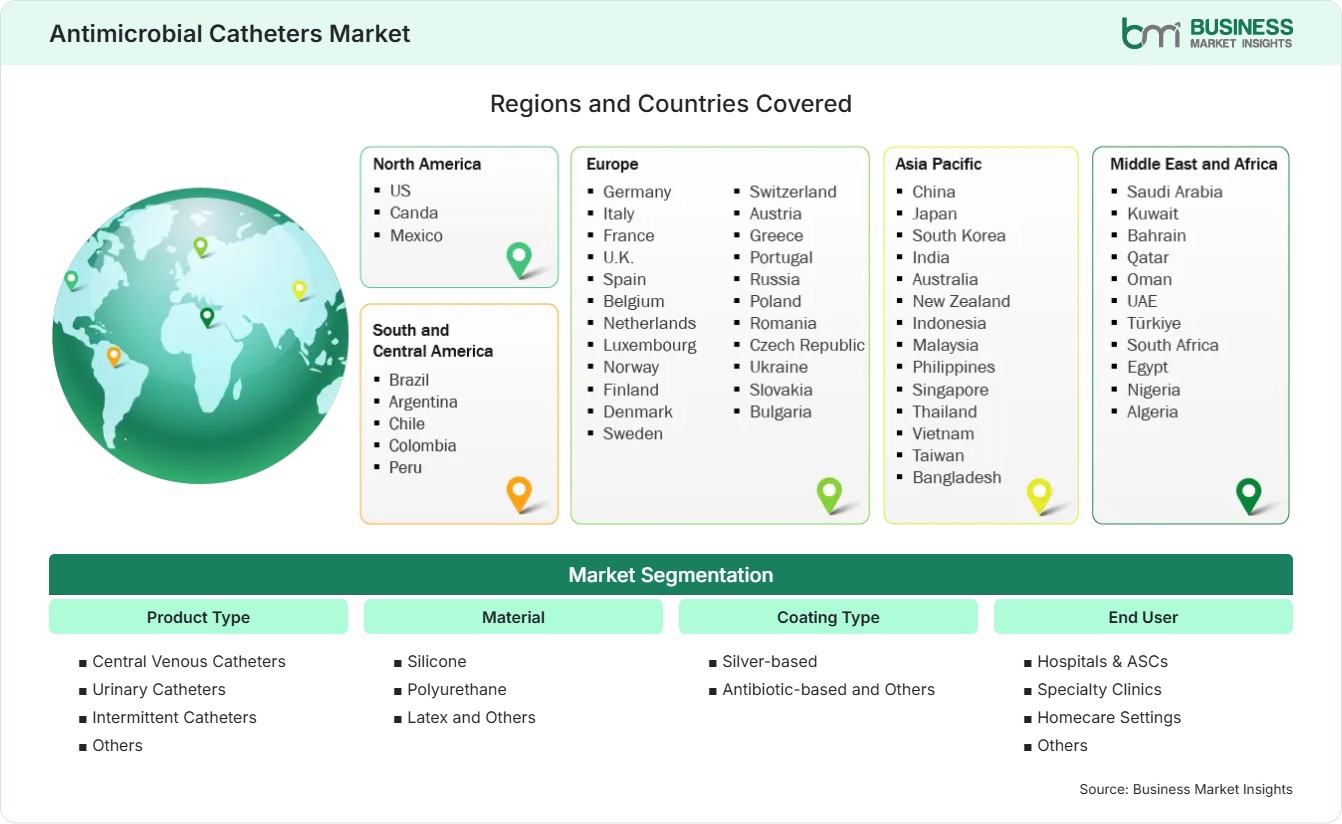
  • Product Type: Central Venous Catheters, Urinary Catheters, Intermittent Catheters, Others
  • Material: Silicone, Polyurethane, Latex and Others
  • Coating Type: Silver-based, Antibiotic-based and Others
  • End User: Hospitals & ASCs, Specialty Clinics, Homecare Settings, Others
US$ 1.65 Bn Market size in 2025
US$ 2.96 Bn Market Size by 2033
7.58% CAGR, 2026 - 2033
2026-2033 Forecast Period

AI Overview

Antimicrobial Catheters Market Summary

  • North America: North America holds a 34%–38% share in 2025 and is advancing at a 6.9%–7.7% CAGR through 2033, supported by established infection-control programs, high catheter utilization, hospital quality requirements, advanced healthcare infrastructure, and demand for coated medical devices. The US Antimicrobial Catheters Market accounts for a 29%–33% of the North American share and is advancing at a 7.0%–7.8% CAGR, supported by hospital infection prevention, catheter-associated infection reduction initiatives, and advanced clinical procurement.
  • Fastest Growing Region: Asia Pacific holds a 25%–29% share in 2025 and is advancing at an 8.4%–9.3% CAGR, supported by expanding hospital capacity, improving infection-control practices, rising procedural volumes, healthcare modernization, and increasing adoption of advanced catheter technologies.
  • Leading Segment: Central Venous Catheters account for a 38%–42% share in 2025 and are advancing at a 7.1%–7.9% CAGR, supported by intensive-care utilization, oncology procedures, long-term intravenous therapy, infection prevention priorities, and demand for antimicrobial catheter technologies.
  • High Growth Segment: Antibiotic-based coatings represent a 20%–24% share in 2025 and are advancing at an 8.5%–9.4% CAGR, supported by infection-risk reduction strategies, high-risk vascular access procedures, coating innovation, and increasing clinical attention to catheter-related infections.
  • Key Market Opportunity: Expanding hospital infrastructure, infection-control investment, homecare catheterization, and high-risk procedures create opportunities for antimicrobial coatings, advanced materials, improved catheter design, and differentiated clinical solutions.
  • Major Market Players: B. Braun SE, Teleflex Incorporated, BD, Medline Industries, LP, ConvaTec Group PLC, Silq Technologies Corp., AvantGuard (Halomine, Inc.), Medtronic plc, Cook Medical LLC, Integra LifeSciences Corporation
Strategic Insights

Antimicrobial Catheters Market: Strategic Insights

Antimicrobial Catheters Market Strategic Framework
FREE PDF
Request your free sample
Request free sample
Stakeholder View

Key Takeaways

  • Catheter manufacturers increasingly compete through infection-prevention performance, material engineering, coating durability, insertion characteristics, and compatibility with clinical workflows.
  • Central venous and urinary applications provide substantial commercial opportunity because prolonged catheter use creates persistent requirements for infection-risk management.
  • Coating technologies are becoming more differentiated, with manufacturers evaluating antimicrobial agents, coating stability, surface properties, and compatibility with catheter materials.
  • Asia Pacific offers strong expansion potential as hospitals modernize clinical infrastructure and infection-prevention practices become more integrated into procurement decisions.
  • Clinical evidence is becoming an important competitive differentiator because healthcare providers must balance acquisition costs against infection prevention, patient outcomes, and total treatment economics.
  • Future competitive positioning will depend on combining antimicrobial performance with catheter flexibility, ease of placement, biocompatibility, manufacturing consistency, and regulatory readiness.
Geographic Outlook

Antimicrobial Catheters Market Regional Highlights

North America Antimicrobial Catheters Market

North America holds a 34%–38% share in 2025 and is projected to advance at a 6.9%–7.7% CAGR through 2033. Established hospitals, infection-control protocols, and advanced catheter procurement support sustained regional demand.

  • Hospitals are now considering the evaluation of antimicrobial catheters in tandem with insertion bundles, maintenance practices, surveillance programs, and catheter utilization controls while tackling the issue of bloodstream infections and urinary tract infections.
  • The United States continues to be the major regional market due to well-established hospitals, sophisticated vascular access procedures, and purchasing channels of infection control devices.
  • Specialty hospitals and ambulatory surgery centers are further areas of opportunity where procedure volumes are rising, and physicians are looking for products appropriate for their procedures.
  • Canada provides a stable demand in the form of the modernization of hospitals and the introduction of advanced medical devices into existing facilities.

US Antimicrobial Catheters Market

The US represents a 29%–33% of the North American share in 2025 and is advancing at a 7.0%–7.8% CAGR through 2033. Demand reflects extensive catheter utilization, infection-prevention priorities, and established medical-device procurement.

  • Applications for vascular access will continue to be crucial since healthcare institutions need technology to work with sterile insertion, skin antisepsis, securement, and maintenance of the procedure.
  • The need for urinary catheters will depend on the reduction of unnecessary catheterization, improved maintenance, and issues of catheter-associated urinary tract infections.
  • Antimicrobial and antiseptic-impregnated catheters are recommended only if the application of prevention measures does not decrease the infection rate.

Europe Antimicrobial Catheters Market

Europe accounts for a 27%–31% share in 2025 and is advancing at a 6.6%–7.4% CAGR. Germany, the UK, France, Italy, and Spain represent leading demand centers, with Germany and the UK offering strong growth potential.

  • Infection prevention within European hospitals is an ongoing process since healthcare-associated infections pose a great challenge in terms of patient safety.
  • Germany has opportunities due to the developed hospital infrastructure and procedures, as well as demand for specialized vascular and urinary catheters.
  • The UK and France present opportunities through infection surveillance, hospital quality programs, and greater emphasis on evidence-based device choice.

Asia Pacific Antimicrobial Catheters Market

Asia Pacific represents a 25%–29% share in 2025 and records the fastest growth at an 8.4%–9.3% CAGR. China, Japan, India, South Korea, and Australia provide diverse opportunities.

  • China provides great opportunities because of the hospital expansions, increased number of procedures, and modernization of the infection control infrastructure.
  • India can be considered due to the adoption of more advanced devices in the private and public hospitals, as well as improved infection prevention.
  • Japan and South Korea represent mature markets due to the presence of highly developed hospitals and procurement processes for clinical devices.
  • Australia provides great opportunities due to the high standards of healthcare and infection prevention technologies.

Rest of World Antimicrobial Catheters Market

Rest of World holds a 10%–14% share in 2025 and is projected to grow at a 7.0%–8.1% CAGR. Latin America, the Middle East, and Africa provide selective expansion opportunities.

Latin America is driven by hospital upgrading, increased procedures, and infection control. The Middle East is benefiting from investments in high-end hospitals and specialty care, while Africa is offering long-term prospects with improvement in clinical infrastructure and availability of specialty devices.

  • Brazil can be considered an opportunity country in Latin America owing to its sizeable health care system and usage of high-end medical devices.
  • Mexico is another opportunity owing to investments being made in private hospitals and advanced infection control systems.
  • The Gulf countries are opportunity countries owing to their demand for high-end hospitals, surgical centers, and intensive care units.
  • South Africa can be used as an entry point for specialized catheters.
Global Market Geography
FREE PDF
Request your free sample
Request free sample
Segment Analysis

Antimicrobial Catheters Market Segmentation

Product Type

Central Venous Catheters lead the product structure with a 38%–42% share in 2025 and a 7.1%–7.9% CAGR through 2033. Their importance reflects intensive-care, oncology, infusion, and long-duration vascular access requirements.

  • Central Venous Catheters: Provide intensive care, oncology, infusion, and extended vascular access with antimicrobial coating for dealing with the infection concerns associated with long-term catheterization.
  • Urinary Catheters: Perform bladder drainage in both acute and extended care with antimicrobial catheters for the selected individuals, where preventing infection is an important issue.
  • Intermittent Catheters: Allow bladder drainage at selected intervals, with benefits from improvements in materials and surfaces for ease in handling and minimizing infections.
  • Others: Include specialized forms of catheters to provide certain vascular, drainage, and procedural functions.

Material

Silicone represents a 30%–34% share in 2025 and is advancing at a 7.4%–8.2% CAGR. Its biocompatibility, flexibility, and suitability for selected long-duration applications support continued clinical adoption.

  • Silicone: Ensures flexibility and biocompatibility in applications where prolonged tissue interaction and catheter performance are needed.
  • Polyurethane: Facilitates vascular catheter applications by virtue of its flexibility, strength, thin wall, and compatibility with sophisticated catheters.
  • Latex: Ensures cost-effective flexibility in certain applications, though material sensitivity issues make it necessary to explore alternative materials for catheters.
  • Others: materials are made up of different polymers or combinations that aim at better durability and functionality.

Coating Type

Antibiotic-based coatings account for a 20%–24% Antimicrobial Catheters Market share in 2025 and are advancing at an 8.5%–9.4% CAGR. Demand is supported by selected high-risk applications and infection-prevention requirements.

  • Silvery-based: Utilize antimicrobial properties of silver to minimize colonization by microorganisms and to aid infection control efforts through the use of catheters.
  • Antibiotic-based: Use antimicrobial agents on the catheter surface to minimize the risk of infection in certain catheter applications.
  • Others: Includes antiseptic and new surface technologies meant to minimize bacterial attachment to the catheter surface.

End User

Hospitals & ASCs hold a 70%–74% share in 2025 and are advancing at a 7.3%–8.0% CAGR. Their dominance reflects high catheter utilization and stronger infection-prevention requirements.

  • Hospitals and ASCs: Serve as the main source of demand due to various catheters that are needed for vascular access, urinary drainage, critical care, and surgery.
  • Specialty Clinics: Are sources of demand for catheters for oncology, dialysis, urology, and other procedure-based treatments.
  • HomeCare Settings: Serve as an increasing opportunity area since the chronic care paradigm moves certain catheter procedures out of hospitals into home-based care under supervision.
  • Others: Long-term care and specialty clinics where infection prevention using catheter management remains a priority.
Market Forces

Antimicrobial Catheters Market Dynamics

Key Market Drivers

Rising Healthcare Associated Infection Concerns Drive Demand

There has been an increasing focus on technological means of minimizing microbial colonization on catheter surfaces. There are several benefits that can be gained from using antimicrobial catheters, as they would act as an added protective mechanism to the already known ways of controlling infections. The hospitals are looking at different kinds of catheter materials and coatings based on their antimicrobial capacity, biocompatibility, durability, and adaptability to clinical processes. The Antimicrobial Catheters Market growth is driven by healthcare professionals who seek to implement effective infection control strategies to be used alongside catheter care techniques. An increased focus on minimizing any preventable complications will also stimulate the adoption of catheters across hospitals, specialty centers, and other clinical settings.

Growing Use of Indwelling Catheters Supports Antimicrobial Adoption

The significance of indwelling catheters in numerous medical operations ensures there will be a constant need for products that can provide solutions to the issues arising from infections due to long-term usage of these catheters. The use of indwelling catheters in intensive care, post-operative, chronic treatments, and other medical operations makes medical professionals come up with catheters that can offer more protection. Antimicrobial properties and special materials will assist manufacturers in product differentiation, as well as the solution of the problem of microorganism attachment to the catheters. With the aim of improving catheter management in hospitals, antimicrobial solutions may come under consideration when infection prevention is an important factor in the purchase decision. This particular Antimicrobial Catheters Market trend drives further innovations in terms of designing more versatile catheters.

Increasing Hospital Infection Prevention Investments Boost Market Growth

There have been a lot of efforts in making the infection prevention programs stronger in the hospital sector, which have included surveillance, staff policies, sterilization processes, and choice of devices. There have been more catheters being used in these infection prevention programs due to the occurrence of infections from the devices. The use of antibacterial catheters can therefore be considered another advantage of the infection prevention program because of the antibacterial nature of the devices. The procurement departments are now considering such devices based on their clinical efficacy, material safety, coating efficacy, usability, and conformity to the infection control process. Investments made in hospital infrastructure will also enhance the availability of advanced medical devices and the replacement of existing inferior products. Such manufacturers who show antimicrobial activity in addition to retaining the catheter’s performance can gain an advantage from this market situation.

Key Market Opportunities

Expanding Hospital Infrastructure Creates New Opportunities

As the construction of more hospitals continues, it results in new opportunities in the catheter industry owing to the increasing needs for medical equipment in various hospital departments. The ICU, surgery department, emergency, and other specialty treatment units have an increased need for catheters and thus provide an opportunity for catheters that are able to address the problem of infection in addition to their normal operations. This opens up a chance for health care providers to assess the effectiveness of antimicrobial catheters during the procurement process and the upgrading of medical devices. Consequently, the Antimicrobial Catheters Market Forecast will be determined by the ability of manufacturers to match product development with the needs of hospitals in terms of procurement, workflow, patient safety, and infection control in increasing healthcare facilities.

Growing Demand for Infection Prevention Medical Devices

The medical devices are becoming more popular with health professionals who are looking for equipment that would aid them in infection prevention without having to make major modifications to their already existing clinical protocols. In this way, antimicrobial catheters become relevant as protective capabilities could be integrated via special coating or material properties while still fulfilling the basic function of the catheter. Antimicrobial capability could be considered in tandem with biocompatibility, flexibility, ease of insertion, dwell properties, and general product reliability. The opportunity exists within hospitals, ambulatory centers, specialist clinics, and any other medical facilities where infection prevention through catheters is significant. Market positioning can be enhanced through the development of products that have reliable performance and compatibility with the regular process of catheterization.

Increasing Adoption in High Risk Clinical Procedures

High-risk clinical procedures provide an important opportunity for antimicrobial catheter adoption because patients undergoing intensive or prolonged treatment may require closer infection-control attention. Critical care, complex surgery, oncology treatment, dialysis-related procedures, and other specialized interventions can involve catheter use under conditions where infection prevention is particularly important. Healthcare facilities may therefore consider antimicrobial technologies when selecting products for patients or procedures with elevated clinical risks. Manufacturers can address this opportunity through catheter designs tailored to specific procedures, anatomical requirements, dwell periods, and clinical workflows. Product development can also focus on minimizing insertion difficulty while maintaining antimicrobial performance and material compatibility.

Market Restraints and Challenges

High Antimicrobial Catheter Costs Limit Adoption

Factor: Antimicrobial catheters generally involve additional material, coating, manufacturing, testing, and quality-control requirements compared with conventional catheter products. Specialized antimicrobial technologies can therefore increase procurement prices and create challenges for healthcare facilities operating under strict medical-device budgets. Impact: Higher acquisition costs may discourage hospitals and clinics from replacing conventional catheters when they are uncertain about the incremental clinical or economic value of antimicrobial products. Budget-conscious healthcare systems may prioritize established products, particularly where reimbursement structures do not fully recognize additional device costs. Manufacturers can address this restraint by demonstrating clinical value, improving manufacturing efficiency, and developing cost-effective antimicrobial technologies.

Antimicrobial Resistance Concerns Affect Product Development

Factor: Concerns about antimicrobial resistance can influence the development of catheter technologies that rely on antimicrobial agents. Healthcare stakeholders increasingly require careful consideration of antimicrobial selection, release characteristics, duration of activity, and potential effects on microbial populations. Impact: These concerns can increase research, testing, regulatory, and product-development requirements for manufacturers seeking to commercialize antimicrobial catheter technologies. Developers may need to demonstrate that antimicrobial functionality provides useful protection without creating undesirable resistance-related outcomes. This can encourage greater interest in non-antibiotic approaches, advanced surface technologies, and carefully engineered antimicrobial coatings. Regulatory scrutiny and clinical evaluation may also extend development timelines.

Company Analysis

Competitive Landscape

The Antimicrobial Catheters Market analysis indicates competition among diversified medical-device manufacturers, vascular-access specialists, catheter developers, and infection-prevention technology companies. Differentiation centers on coating performance, catheter materials, clinical evidence, insertion characteristics, infection-control compatibility, product breadth, and hospital relationships.

Company Name

Overview

Products and Services relevant to this market

B. Braun SE

Global medical technology company with broad vascular access and infusion capabilities serving hospitals and clinical facilities.

Central venous catheters, vascular access products, infusion systems, catheter technologies, and infection-prevention solutions.

Teleflex Incorporated

Medical technology company with established vascular access and interventional product capabilities.

Arrow central venous catheters, antimicrobial catheter technologies, vascular access devices, and related clinical products.

BD

Global medical technology company with extensive catheter, vascular access, and infection-prevention capabilities.

Vascular catheters, antimicrobial technologies, urinary catheter products, vascular access systems, and related solutions.

Medline Industries, LP

Healthcare manufacturer and distributor supplying hospitals and post-acute facilities with broad medical-device portfolios.

Urinary catheters, vascular access products, catheter-care supplies, infection-prevention products, and clinical solutions.

ConvaTec Group PLC

Medical products company focused on advanced wound care, ostomy, continence, and infusion-related healthcare solutions.

Urinary catheter products, intermittent catheter technologies, continence solutions, and supporting clinical products.

Silq Technologies Corp.

Medical technology company focused on silicone catheter technologies and surface-engineering approaches.

Silicone catheter technologies, vascular access products, surface treatments, and specialized catheter solutions.

AvantGuard (Halomine, Inc.)

Technology company developing antimicrobial surface treatments designed to provide durable protection across medical applications.

Antimicrobial surface technology, catheter coating solutions, antimicrobial materials, and device-focused infection-control technologies.

Medtronic plc

Diversified medical technology company serving cardiovascular, surgical, and hospital markets globally.

Catheter-based technologies, vascular access products, cardiovascular devices, and related clinical systems.

Cook Medical LLC

Medical-device manufacturer with extensive catheter and minimally invasive product capabilities.

Central venous access products, urinary catheter technologies, drainage products, and interventional catheter systems.

Integra LifeSciences Corporation

Medical technology company serving surgical and specialty healthcare markets through advanced device portfolios.

Catheter-related products, surgical technologies, specialty medical devices, and infection-conscious clinical solutions.

Trust & Transparency

Research Methodology

The market analysis combines proprietary research with secondary data from government agencies, company disclosures, regulatory filings, industry databases and expert interviews. Market estimates are validated through data triangulation, cross-market benchmarking and analyst review.

View Full Research Methodology

Questions Answered

Frequently Asked Questions

What does the Antimicrobial Catheters Market report indicate about future competition?

The report indicates that competition will focus on antimicrobial efficacy, clinical evidence, catheter materials, coating durability, product breadth, ease of use, and total treatment economics. Companies able to combine infection-prevention performance with reliable catheter functionality should strengthen their market positioning.

Why are infection prevention programs creating new opportunities for catheter manufacturers?

Hospitals are increasingly integrating device management into broader infection-control programs. This encourages manufacturers to develop catheters that complement established clinical protocols while offering improvements in materials, coatings, insertion performance, and infection-risk management.

How are antimicrobial coatings influencing catheter adoption?

Antimicrobial coatings can provide an additional infection-prevention measure when appropriately selected alongside sterile insertion, maintenance, surveillance, and catheter-removal practices. Coating technologies are therefore increasingly evaluated according to clinical evidence, durability, material compatibility, and patient-specific requirements.

Which applications present the strongest opportunity in the market?

Central venous access, urinary catheterization, intensive-care procedures, oncology treatment, and other prolonged catheter applications present strong opportunities. High-risk clinical environments are particularly relevant where infection prevention is a major component of device-selection decisions.

What factors are improving Antimicrobial Catheters Market return on investment?

Infection-prevention priorities, higher catheter utilization, intensive-care procedures, prolonged vascular access, and hospital quality initiatives can improve commercial returns. Products that demonstrate clinical value while integrating smoothly with existing insertion and maintenance protocols can strengthen procurement acceptance.

Access the Full Antimicrobial Catheters Market Report

Get segment-level forecasts, regional estimates, competitive benchmarking, company profiles and downloadable Excel datasets.

Access the full Antimicrobial Catheters Market Report
350 pages PDF & Excel | 2026-09-22
Similar Research

Related Market Reports