
Antidepressants Market Outlook: Size, Share, Trends, Growth Analysis, Competitive Landscape & Forecast, 2026–2033

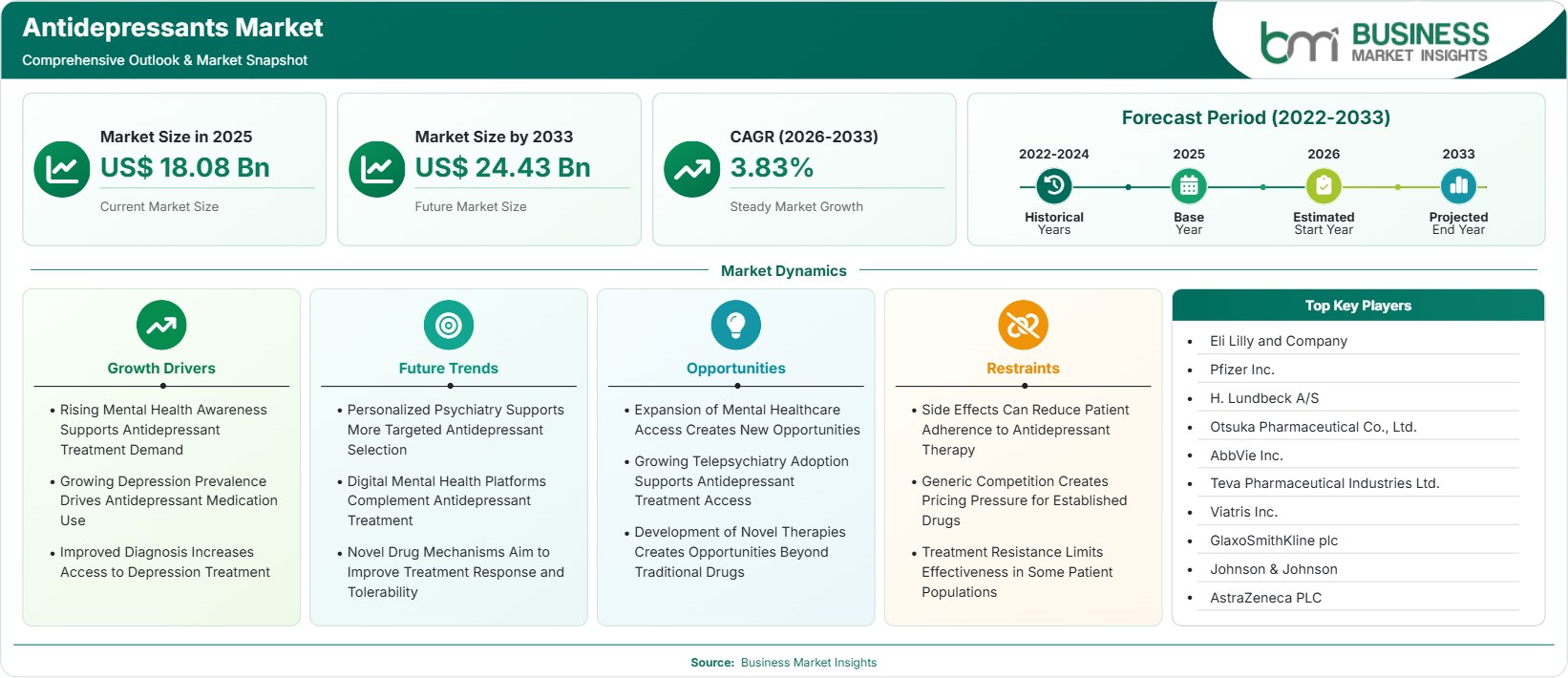
The Antidepressants Market size was valued at US$ 18.08 Billion in 2025 and is projected to reach US$ 24.43 Billion by 2033, growing at a CAGR of 3.83% during 2026–2033, supported by rising diagnosis, broader mental healthcare access, improved treatment awareness, telepsychiatry, and continued development of differentiated therapies.

Report Coverage
  • Drug Class: Selective Serotonin Reuptake Inhibitors, Serotonin & Norepinephrine Reuptake Inhibitors, Atypical Antidepressants, Tricyclic Antidepressants
  • Disorder: Major Depressive Disorder, Obsessive-Compulsive Disorder, Generalized Anxiety Disorder
  • Distribution Channel: Hospital Pharmacy, Retail Pharmacy
US$ 18.08 Bn Market size in 2025
US$ 24.43 Bn Market Size by 2033
3.83% CAGR, 2026 - 2033
2026-2033 Forecast Period

01 AI Overview

Antidepressants Market Summary

  • North America: holds 38%–42% Antidepressants Market share in 2025, growing at a CAGR of 3.5%–4.1% during 2026–2033, supported by established mental healthcare infrastructure, high treatment awareness, prescription access, expanding telepsychiatry, and improving diagnosis. The US represents 88%–92% of regional demand and is projected to grow at 3.6%–4.2% CAGR through 2033, supported by broad prescribing access, diagnosis, telepsychiatry, and treatment continuity.
  • Fastest Growing Region: Asia Pacific holds 20%–24% share in 2025, expanding at a CAGR of 4.6%–5.3% during 2026–2033, supported by increasing mental health awareness, improving diagnosis, expanding healthcare infrastructure, greater pharmaceutical access, urbanization, and growing acceptance of professional mental healthcare.
  • Leading Segment: Selective Serotonin Reuptake Inhibitors hold 42%–46% share in 2025, growing at a CAGR of 3.6%–4.2% during 2026–2033, supported by established clinical use, broad prescribing familiarity, treatment accessibility, and continued demand for commonly prescribed pharmacological options.
  • High Growth Segment: Serotonin & Norepinephrine Reuptake Inhibitors hold 17%–21% share in 2025, growing at a CAGR of 4.2%–4.9% during 2026–2033, supported by broader therapeutic use, treatment diversification, physician familiarity, and demand for differentiated pharmacological approaches.
  • Key Market Opportunity: Expanding mental healthcare access, telepsychiatry, digital treatment pathways, improved diagnosis, and differentiated therapies can widen treatment reach and support pharmaceutical innovation.
  • Major Market Players: Eli Lilly and Company; Pfizer Inc.; H. Lundbeck A/S; Otsuka Pharmaceutical Co., Ltd.; AbbVie Inc.; Teva Pharmaceutical Industries Ltd.; Viatris Inc.; GlaxoSmithKline plc; Johnson & Johnson; AstraZeneca PLC.
02 Strategic Insights

Antidepressants Market: Strategic Insights

Antidepressants Market Strategic Framework
FREE PDF
Request your free sample
Request free sample
03 Stakeholder View

Key Takeaways

  • Value chain extends from pharmaceutical discovery to API production, formulation, approvals, manufacturing, marketing, prescription, dispensation, and post-therapy activities, thereby generating several differentiation opportunities.
  • Selective Serotonin Reuptake Inhibitors continue to represent the largest class opportunity due to existing familiarity, clinical usage and availability of these drugs.
  • Innovation in treatment is now moving towards differentiation in mechanisms of action, increased tolerability, rapid onset of therapy and treatment for those not getting enough from existing drugs.
  • Asia Pacific represents the significant potential for regional growth because the awareness, diagnoses, medical infrastructure, and mental health service access in major economies are getting better.
  • The competitive landscape is increasingly defined by generic competition, IP positioning, formulation differentiation, clinical data, safety, production capacity, and drug distribution capability.
  • Digital health can enhance the ability to get prescriptions and follow-up treatment, but ongoing treatment requires diagnosis, adherence, physicians' interest, affordability, and continuity.
04 Geographic Outlook

Antidepressants Market Regional Highlights

North America Antidepressants Market

North America holds 38%–42% share in 2025 and North America Antidepressants Market forecast to grow at 3.5%–4.1% CAGR through 2033. The US accounts for 88%–92% of regional demand, supported by extensive healthcare infrastructure, established prescribing practices, broad pharmaceutical distribution, and high awareness of mental health conditions. Canada contributes through public healthcare coverage and expanding mental health services.

  • The existing drug-prescribing system facilitates ongoing use through primary care and specialty physicians, whereas pharmacy networks enable ongoing access to medication.
  • Telepsychiatry increases patient access to consultations where geographic or mobility issues or scheduling conflicts are obstacles to beginning treatment and follow-up.
  • Generic drugs increase accessibility of established therapies, although the pricing competition poses pressures on mature drug portfolios.
  • Growing recognition of treatment-resistant depression fosters demand for differentiated products and psychiatric approaches to treatment.

US Antidepressants Market

The US represents 88%–92% of North American demand in 2025 and is projected to grow at 3.6%–4.2% CAGR through 2033. The market benefits from extensive healthcare infrastructure, broad prescription availability, established psychiatric services, and widespread pharmacy access. Digital consultation and remote follow-up have expanded treatment pathways, while primary care remains important for identifying patients.

  • Strong pharmaceutical distribution infrastructure supports widespread access through hospital and retail pharmacy channels.
  • Telepsychiatry provides additional routes for consultation and treatment follow-up, particularly for patients facing provider shortages or geographic barriers.
  • Generic competition remains intense across established medicines, encouraging manufacturers to focus on differentiated therapies and commercial positioning.

Europe Antidepressants Market

Europe Antidepressants Market holds 28%–32% share in 2025 and is projected to grow at 3.2%–3.9% CAGR through 2033. Germany, UK, France, Italy, and Spain account for the key markets driven by mature healthcare systems and prescription processes. Spain is expected to show comparatively higher growth at 4.0% to 4.7% CAGR. The focus of the European healthcare systems remains on availability of mental health services, early diagnosis, holistic care, and evidence-based treatment. Reimbursement policies, prescription procedures, generics availability, and the strength of the healthcare systems differ considerably between countries.

  • Germany provides substantial demand through broad healthcare coverage, established physician networks, pharmacy infrastructure, and increasing attention to mental healthcare.
  • France, Italy, and the UK maintain established treatment markets supported by specialist services, primary-care involvement, and extensive pharmaceutical distribution.
  • Generic adoption creates affordability benefits while increasing competitive pressure on manufacturers of established antidepressant products.

Asia Pacific Antidepressants Market

Asia Pacific Antidepressants Market holds 20%–24% share in 2025 and is projected to grow at 4.6%–5.3% CAGR through 2033. China, Japan, India, South Korea, and Australia are key markets, and India is expected to expand by 5.2%-6.0% CAGR. Rising mental health awareness, better diagnosis, higher healthcare spending, and enhanced drug distribution contribute to the adoption of therapy.

  • China provides significant demand through its large population, expanding healthcare infrastructure, improving awareness, and gradual strengthening of mental healthcare services.
  • India offers the strongest regional growth at 5.2%–6.0% CAGR as diagnosis, digital healthcare, pharmaceutical access, and mental health awareness expand.
  • Japan and South Korea maintain established pharmaceutical markets supported by developed healthcare systems and growing attention to mental health treatment.
  • Southeast Asia offers additional opportunities as healthcare infrastructure, professional services, awareness, and access to prescription medicines improve.

Rest of World Antidepressants Market

Rest of World holds 16%–20% share in 2025 and is projected to grow at 3.8%–4.6% CAGR through 2033. South and Central America are considered emerging markets for treatment, where increased mental health awareness, better healthcare facilities, and availability of drugs aid in meeting demands. Brazil and Mexico rank as leading consumers in the region, whereas Colombia and Chile have more to offer. The integration of mental health services within primary health care will benefit diagnosis and early treatment. Middle East and Africa remain smaller markets but provide expansion opportunities through healthcare infrastructure development, increasing awareness, and improving access to psychiatric services.

  • Brazil provides substantial demand through its large healthcare system, established pharmaceutical distribution, and growing focus on mental health treatment.
  • Mexico supports expansion through improving healthcare access, growing awareness, and increasing availability of prescription-based mental health services.
  • Gulf markets are expanding specialist healthcare capacity, creating opportunities for improved psychiatric diagnosis and treatment access.
  • South Africa represents an important African market as healthcare providers strengthen mental health services and pharmaceutical distribution capabilities.
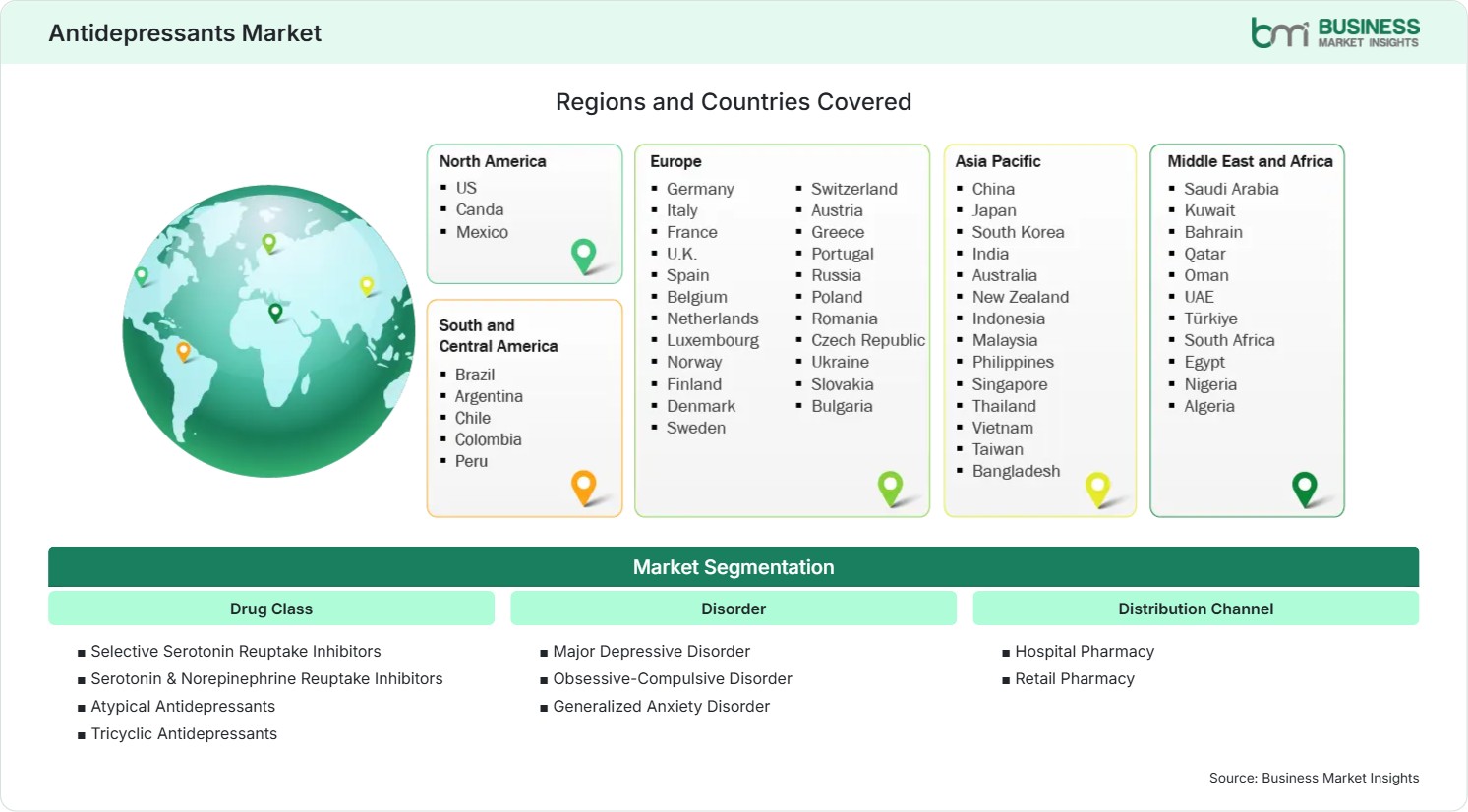
Global Market Geography
FREE PDF
Request your free sample
Request free sample
05 Segment Analysis

Antidepressants Market Segmentation

Drug Class

Selective Serotonin Reuptake Inhibitors hold 42%–46% share in 2025 and are projected to grow at a CAGR of 3.6%–4.2% through 2033. Their established clinical role, prescribing familiarity, broad availability, and use across multiple depressive and anxiety-related conditions support continued demand.

  • Selective Serotonin Reuptake Inhibitors: Clinical experience in prescribing, widespread clinical usage, availability, and accessibility have been proven to maintain demand in treating depression and other related psychiatric disorders.
  • Serotonin & Norepinephrine Reuptake Inhibitors: Dual effect on neurotransmitters encourages use in selective cases of depression and anxiety disorders.
  • Atypical Antidepressants: Distinct pharmacological mechanisms support use where conventional approaches provide inadequate response or specific tolerability considerations influence treatment selection.
  • Tricyclic Antidepressants: Established efficacy maintains clinical relevance in selected treatment settings, although tolerability, safety considerations, and newer alternatives influence broader utilization.

Disorder

Major Depressive Disorder holds 56%–60% share in 2025 and remains the principal treatment category because of its large diagnosed population and recurring pharmacological management requirements. Obsessive-Compulsive Disorder and Generalized Anxiety Disorder contribute additional demand.

  • Major Depressive Disorder: Large patient prevalence, recurring treatment requirements, diagnosis expansion, and continued pharmacological management make this the primary disorder category for antidepressant demand.
  • Obsessive-Compulsive Disorder: Treatment demand is supported by increasing recognition, specialist diagnosis, and long-term pharmacological management for patients requiring sustained symptom control.
  • Generalized Anxiety Disorder: Growing diagnosis and mental health awareness support treatment access, while antidepressants remain relevant for long-term pharmacological management.

Distribution Channel

Retail pharmacies hold 62%–66% share in 2025 and remain the dominant distribution route because long-term antidepressant treatment frequently requires recurring outpatient prescriptions. Hospital pharmacies hold 34%–38% share and remain important for inpatient psychiatric care, treatment initiation, specialist management, and complex cases.

  • Hospital Pharmacy: Hospital pharmacies support treatment initiation, inpatient psychiatric care, specialist prescribing, medication management, and access for patients receiving intensive healthcare services.
  • Retail Pharmacy: Retail pharmacies provide broad geographic access and recurring prescription fulfillment, making them central to long-term outpatient antidepressant treatment.
06 Market Forces

Antidepressants Market Dynamics

Key Market Drivers

Rising Mental Health Awareness Supports Antidepressant Treatment Demand

Mental health awareness is improving recognition of depressive disorders and encouraging individuals to seek professional care. Public health campaigns, workplace initiatives, educational programs, and broader discussion of mental wellbeing can also reduce barriers associated with seeking care. Awareness alone does not guarantee medication utilization, because treatment depends on clinical assessment, severity, patient preference, access, and treatment response. However, higher recognition expands the potential pool of diagnosed patients. Antidepressants Market growth therefore benefits when awareness is accompanied by accessible psychiatric services, primary-care screening, prescription availability, and follow-up.

Growing Depression Prevalence Drives Antidepressant Medication Use

Depression represents a major global mental health burden and remains a core demand foundation for antidepressant medicines. The commercial effect depends on how many patients receive diagnosis and pharmacological care because treatment coverage remains uneven across countries. Major depressive disorder generates recurring demand because treatment may require sustained medication use and periodic clinical reassessment. Antidepressants Market trends are consequently shaped by patient volumes, diagnosis rates, prescribing patterns, treatment persistence, and availability of alternative interventions. Continued attention to mental healthcare capacity can convert unmet need into formal treatment demand.

Improved Diagnosis Increases Access to Depression Treatment

Improved diagnosis creates a direct pathway between underlying mental health burden and pharmaceutical treatment. Depression can remain undiagnosed because symptoms may overlap with other conditions, patients may delay seeking care, or healthcare systems may lack adequate screening and specialist capacity. Antidepressants Market growth is therefore linked to healthcare-system capability as well as disease prevalence. Improved recognition can increase prescription volumes, while structured follow-up supports treatment persistence. However, diagnosis expansion must be accompanied by affordability, professional availability, medicine access, and evidence-based prescribing to generate sustained commercial demand.

Key Market Opportunities

Expansion of Mental Healthcare Access Creates New Opportunities

Expansion of mental healthcare access can address a large treatment gap by integrating psychiatric support into primary care, community services, hospitals, and digital platforms. Increasing healthcare workforce capacity, improving reimbursement, strengthening referral networks, and expanding medicine availability can move patients into formal treatment pathways. The opportunity is especially relevant in emerging economies where treatment penetration remains below potential demand. Sustainable expansion requires coordinated investment across diagnosis, prescribing, pharmacy access, and long-term patient support.

Growing Telepsychiatry Adoption Supports Antidepressant Treatment Access

Telepsychiatry can reduce geographic and scheduling barriers that limit access to mental healthcare, particularly where specialist availability is concentrated in urban centers. Remote consultations can support assessment, medication management, follow-up, and treatment monitoring when appropriate clinical and regulatory requirements are satisfied. Digital pathways can also improve continuity for patients who find conventional appointments difficult to maintain. The opportunity is strongest when telepsychiatry is integrated with prescription services, electronic health records, pharmacy distribution, and referral networks rather than operating as an isolated consultation channel.

Development of Novel Therapies Creates Opportunities Beyond Traditional Drugs

Novel therapies provide an opportunity to address patients who obtain inadequate benefit, experience tolerability problems, or require different therapeutic approaches. Conventional antidepressants can involve delayed response and variable effectiveness, creating demand for differentiated mechanisms and treatment strategies. Research increasingly emphasizes faster action, treatment-resistant depression, personalized treatment, and improved tolerability. Innovation can therefore create new commercial categories rather than simply replacing existing products.

Market Restraints and Challenges

Side Effects Can Reduce Patient Adherence to Antidepressant Therapy

Factor: Antidepressant therapy can produce adverse effects that vary according to drug class, patient characteristics, dose, treatment duration, and individual sensitivity. Impact: Unwanted effects can reduce adherence, cause treatment discontinuation, delay dose optimization, or prompt switching between therapies. Patients may discontinue treatment before achieving full therapeutic benefit when adverse effects are perceived as burdensome or when improvement is slower than expected.

Generic Competition Creates Pricing Pressure for Established Drugs

Factor: Patent expirations and broad availability of generic antidepressants increase competition among manufacturers offering therapeutically established medicines. Impact: Pricing pressure can reduce revenue potential for mature products and encourage manufacturers to differentiate through new formulations, delivery approaches, clinical evidence, or novel mechanisms. Manufacturers may face declining prices as multiple suppliers enter established therapeutic categories.

07 Company Analysis

Competitive Landscape

The Antidepressants Market analysis indicates a competitive environment spanning diversified pharmaceutical companies, psychiatric specialists, generic manufacturers, and organizations with research capabilities across central nervous system therapies. Competitive positioning depends on therapeutic efficacy, safety, tolerability, intellectual-property protection, clinical evidence, manufacturing scale, geographic reach, and access to established prescription and pharmacy channels.

Company Name

Overview

Products and Services relevant to this market

Eli Lilly and Company

Global pharmaceutical company with substantial research capabilities and an established presence across major therapeutic areas.

Neuroscience medicines, clinical research, pharmaceutical development, manufacturing, and global commercial distribution.

Pfizer Inc.

Diversified pharmaceutical company with broad international operations and established central nervous system capabilities.

Antidepressant medicines, pharmaceutical research, manufacturing, clinical development, and global distribution.

H. Lundbeck A/S

Specialist pharmaceutical company focused strongly on brain diseases and psychiatric treatment areas.

Antidepressant therapies, neuroscience research, clinical development, manufacturing, and specialist healthcare support.

Otsuka Pharmaceutical Co., Ltd.

Global healthcare company with significant neuroscience and psychiatric medicine development capabilities.

Psychiatric medicines, neuroscience research, clinical development, manufacturing, and global pharmaceutical distribution.

AbbVie Inc.

Research-driven biopharmaceutical company with diversified therapeutic capabilities and global commercial infrastructure.

Neuroscience therapies, pharmaceutical research, clinical development, manufacturing, and healthcare solutions.

Teva Pharmaceutical Industries Ltd.

Major pharmaceutical manufacturer with broad generic and specialty medicine capabilities.

Generic antidepressants, specialty medicines, manufacturing, pharmaceutical distribution, and affordable treatment options.

Viatris Inc.

Global healthcare company combining branded and generic pharmaceutical capabilities across numerous markets.

Generic antidepressants, branded medicines, manufacturing, supply, distribution, and patient access solutions.

GlaxoSmithKline plc

Global biopharmaceutical company with broad research and commercial capabilities across multiple therapeutic areas.

Central nervous system medicines, clinical research, pharmaceutical manufacturing, and global distribution capabilities.

Johnson & Johnson

Diversified healthcare company with pharmaceutical operations and established research capabilities.

Neuroscience medicines, clinical development, pharmaceutical manufacturing, and global healthcare distribution.

AstraZeneca PLC

Global biopharmaceutical company with extensive research capabilities and a broad specialty medicines portfolio.

Neuroscience-related medicines, pharmaceutical research, clinical development, manufacturing, and international distribution.

10 Trust & Transparency

Research Methodology

The market analysis combines proprietary research with secondary data from government agencies, company disclosures, regulatory filings, industry databases and expert interviews. Market estimates are validated through data triangulation, cross-market benchmarking and analyst review.

View Full Research Methodology

11 Questions Answered

Frequently Asked Questions

What is driving antidepressant demand in emerging economies?

Improving mental health awareness, diagnosis, healthcare infrastructure, pharmaceutical distribution, digital consultation, and integration of mental healthcare into primary care are expanding access.

Why is treatment-resistant depression important for pharmaceutical innovation?

Treatment-resistant depression represents an important unmet need because some patients obtain insufficient benefit from established therapies.

What role does telepsychiatry play in Antidepressants Market report?

Telepsychiatry can improve access to psychiatric assessment, medication management, and follow-up, particularly where specialist availability is limited.

How does generic competition affect antidepressant manufacturers?

Generic competition lowers prices and improves affordability but can reduce revenue from mature products. Manufacturers increasingly rely on differentiated therapies, novel mechanisms, and lifecycle strategies to maintain commercial value.

What is the largest drug class in the antidepressants market?

Selective Serotonin Reuptake Inhibitors represent the largest drug-class category because of established clinical use, and application across depressive and anxiety-related disorders.

Access the Full Antidepressants Market Report

Get segment-level forecasts, regional estimates, competitive benchmarking, company profiles and downloadable Excel datasets.

Access the full Antidepressants Market Report
350 pages PDF & Excel | 2026-08-20