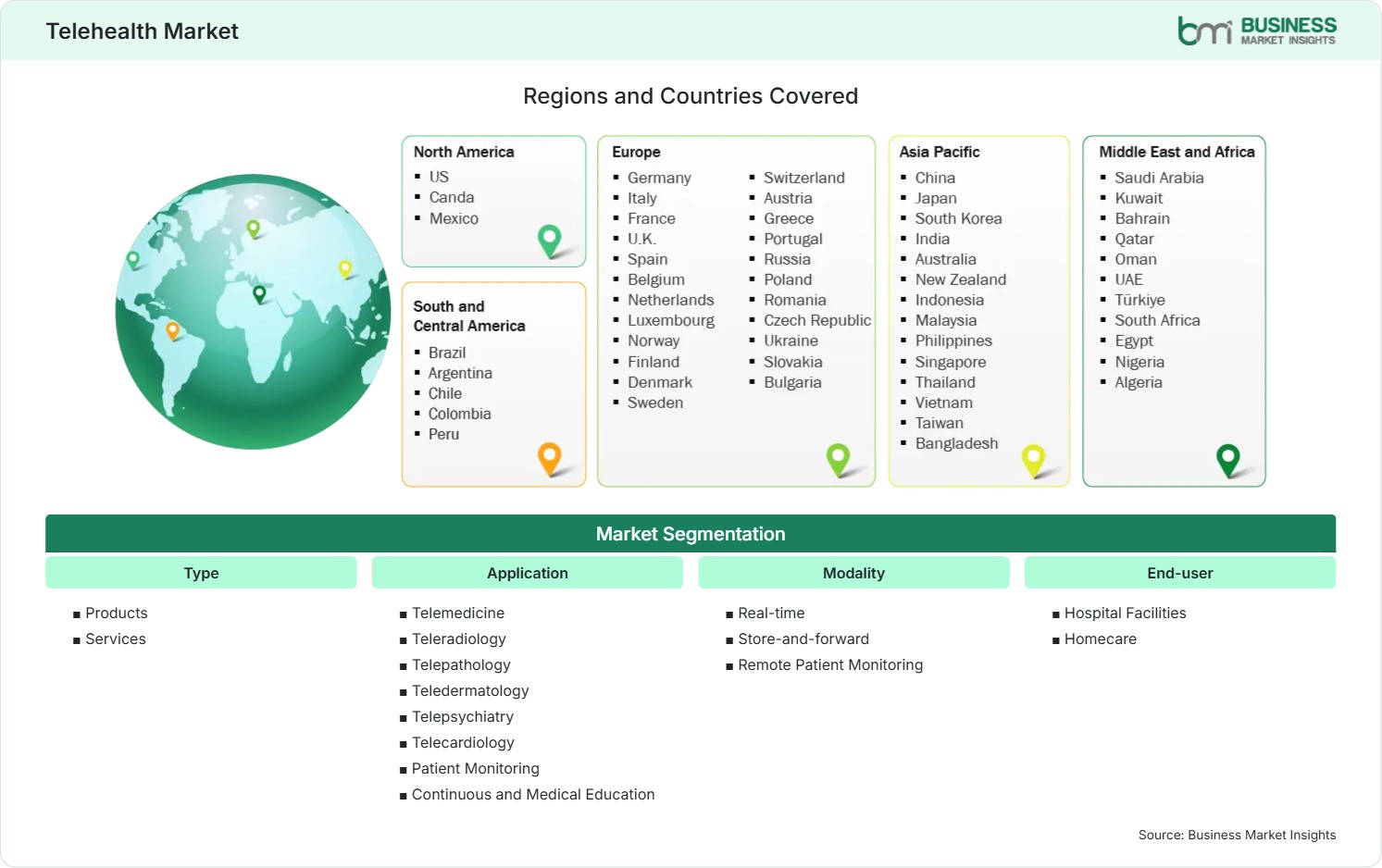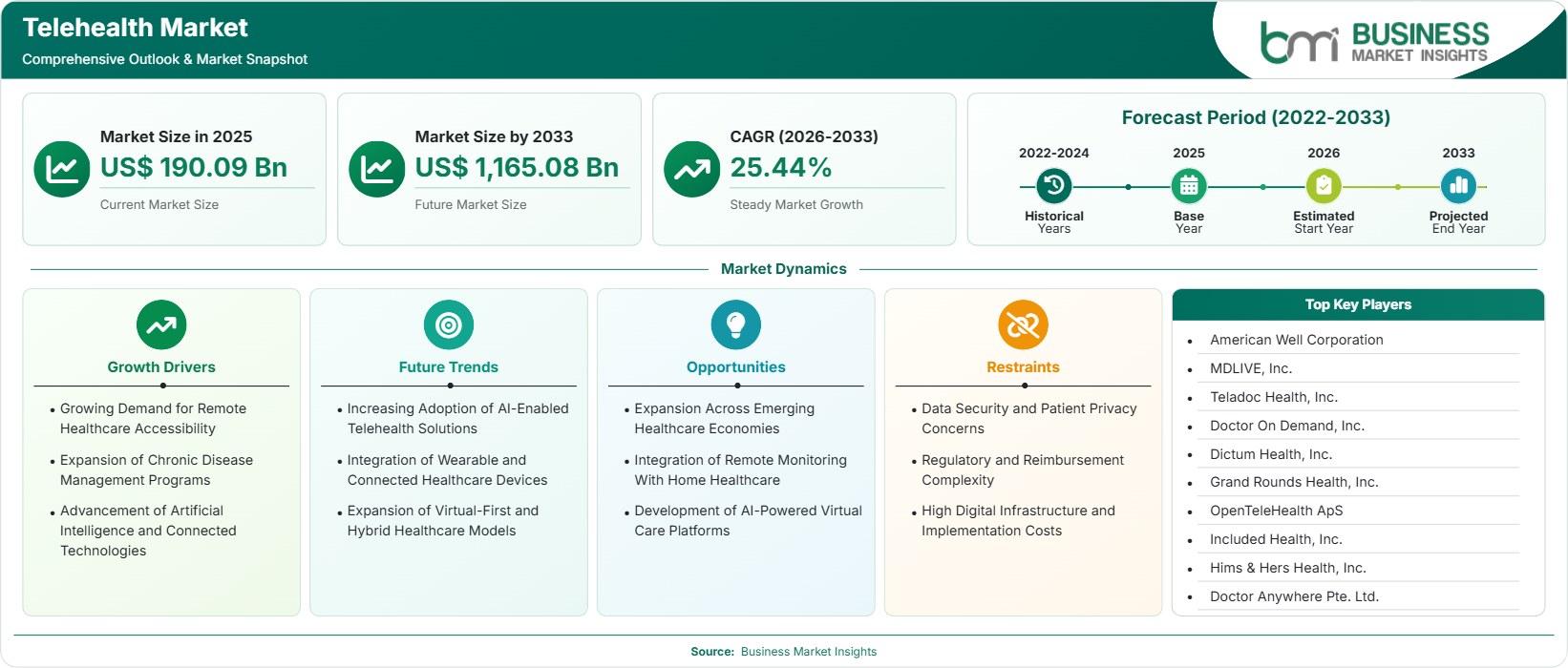
Telehealth Market Regional Highlights
North America Telehealth Market
North America accounts for approximately 42%–45% Telehealth Market share in 2025 and is projected to register a 23%–25% CAGR during 2026–2033. Leadership is sustained within the region through established health care infrastructure, favorable reimbursement structures, digital health technology, and connectivity networks. Health care facilities will continue integrating their virtual care platforms into the electronic health record systems and remote monitoring systems.
- Healthcare providers increasingly deploy hybrid care models combining in-person services with virtual consultations to optimize resource utilization, enhance patient satisfaction, and improve continuity of care throughout treatment journeys.
- AI-enabled documentation, predictive analytics, and clinical workflow automation are helping reduce administrative burdens while improving clinician efficiency and patient engagement across large healthcare delivery systems.
- Remote patient monitoring programs are expanding rapidly among aging populations, supporting proactive disease management and lowering hospital readmission rates through continuous health tracking and intervention.
- Supportive reimbursement policies and payer participation continue strengthening provider confidence, encouraging long-term investments in virtual care platforms, connected devices, and integrated healthcare services.
US Telehealth Market
The United States contributes approximately 78%–82% of North American revenue and is expected to expand at a 23%–25% CAGR through 2033. Strong healthcare spending, broad payer participation, and extensive technology investment have positioned the country as the largest digital healthcare market globally. Healthcare organizations increasingly implement virtual-first strategies integrating telemedicine, remote monitoring, digital therapeutics, and AI-enabled care pathways to improve healthcare accessibility and operational efficiency.
- Large integrated delivery networks continue scaling virtual care programs to enhance patient access while reducing unnecessary emergency department visits and healthcare system costs.
- Mental health and behavioral healthcare applications remain among the most frequently utilized virtual healthcare services due to growing demand and provider shortages.
- Healthcare insurers increasingly promote virtual consultations as cost-effective alternatives for non-emergency care, improving accessibility while managing healthcare expenditures.
- Technology vendors continue introducing interoperability solutions that improve data exchange between telemedicine platforms, care providers, payers, and pharmacy networks.
Europe Telehealth Market
Europe accounted for approximately 24%–27% share in 2025 and is expected to grow at a 24%–26% CAGR during 2026–2033. The Telehealth Market trends in Europe are driven by increasing healthcare digitization, an aging population, favorable regulatory developments, and mounting pressure on healthcare delivery systems. Telehealth adoption through reimbursement models for digital health in some European countries has been stimulated among healthcare organizations as well as patients. Germany is still the leading market of country because of the presence of digital health ecosystem in it. Central and Eastern Europe are also experiencing a fast-growing market of remote healthcare solutions because of healthcare modernization initiatives in the region.
- Germany leads regional adoption with strong reimbursement support for digital health services and continued investment in healthcare technology infrastructure that improves physician access and patient engagement across multiple care settings.
- The United Kingdom continues expanding virtual primary care initiatives and digitally enabled disease management programs, strengthening healthcare efficiency while reducing pressure on traditional care delivery systems.
- France and the Nordic countries continue advancing integrated care models combining telemedicine platforms, chronic disease management solutions, and remote patient monitoring technologies.
- Poland and several Central European healthcare markets are among the fastest-growing national opportunities, supported by healthcare modernization programs and expanding digital infrastructure capabilities.
Asia Pacific Telehealth Market
Asia Pacific represents approximately 22%–25% Telehealth Market share in 2025 and is projected to record the highest regional CAGR of 28%–31% through 2033. The large population base, rising health-care costs, greater access to the Internet, and high rates of smartphone penetration are helping speed up the adoption of telemedicine in the region. Increasingly, governments are supporting digital delivery of health-care to increase access to health-care services in areas that are distant and difficult to reach. China is by far the biggest market in the region, but there are huge growth opportunities in India and Southeast Asia.
- China continues investing heavily in AI-enabled healthcare infrastructure, telemedicine platforms, and connected healthcare ecosystems, supporting large-scale deployment across both urban and rural healthcare networks.
- India benefits from national digital health initiatives, growing internet penetration, and increasing adoption of virtual consultations among patients seeking accessible and cost-effective healthcare services.
- Southeast Asian markets including Singapore, Indonesia, Vietnam, and the Philippines are expanding telehealth ecosystems through partnerships between insurers, providers, and technology companies.
- Japan remains an important market due to demographic aging trends and increasing utilization of remote patient monitoring technologies for long-term chronic disease management.
Rest of World Telehealth Market
The Rest of World region holds approximately 10%–13% Telehealth Market share in 2025 and is expected to expand at a 25%–28% CAGR during 2026–2033. Growth is also being fueled by efforts toward healthcare access, broadening of broadband connections, and digitalization of healthcare. South and Central American countries are also embracing virtual healthcare services to address physician shortages and accessibility issues. Countries across the Middle East and Africa are also investing in modernizing their healthcare facilities through adoption of telemedicine and other digital healthcare practices.
- Brazil represents the leading South American market due to increasing digital health investment, healthcare infrastructure modernization, and expanding adoption of telemedicine consultations.
- Mexico demonstrates growing demand for virtual healthcare platforms driven by healthcare accessibility requirements and increasing penetration of connected technologies.
- Saudi Arabia and the United Arab Emirates continue investing in national healthcare transformation programs that prioritize digital healthcare delivery and smart healthcare infrastructure.
- South Africa is among the fastest-growing African markets, supported by increasing mobile connectivity and efforts to improve healthcare accessibility across underserved populations.