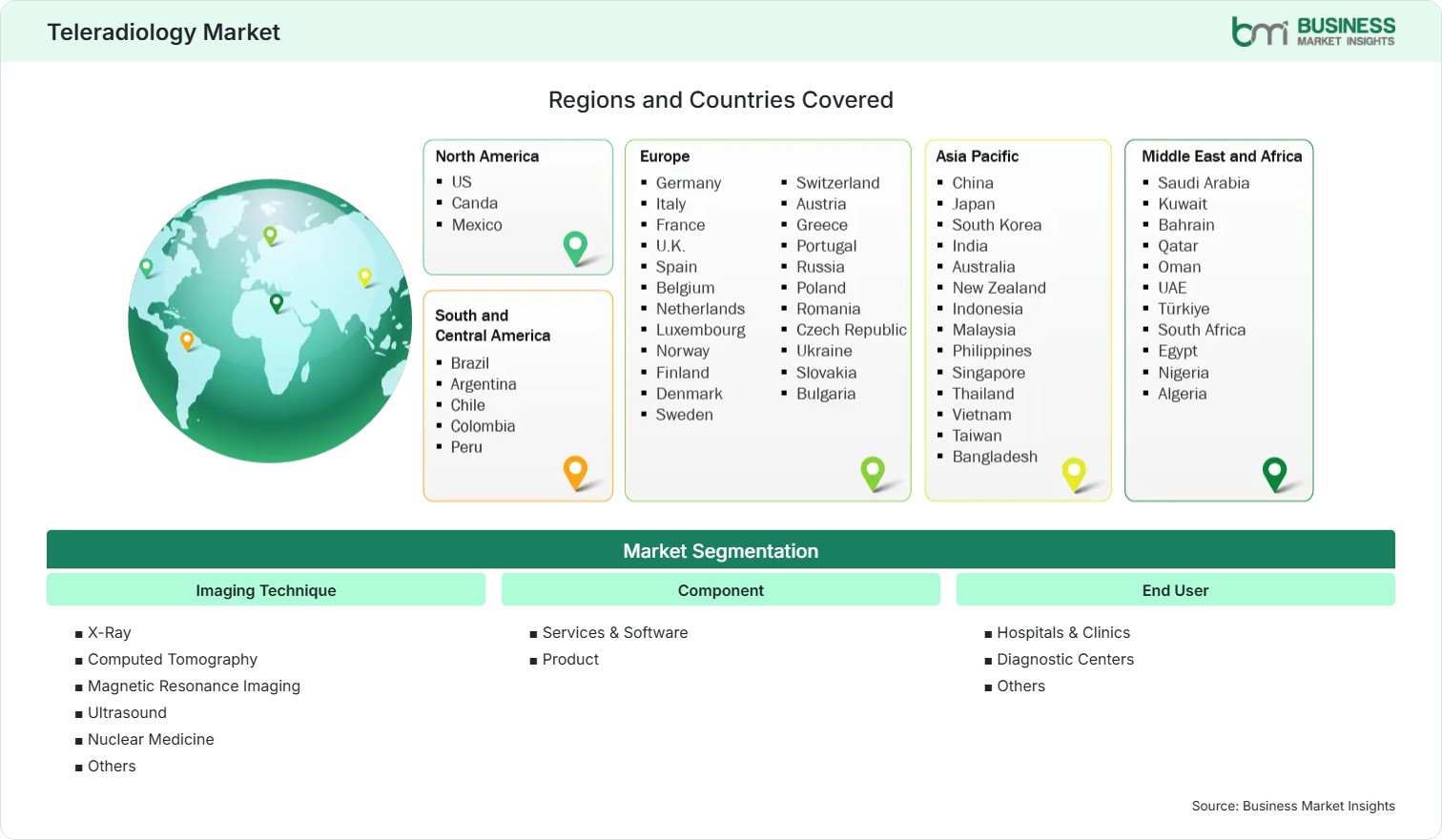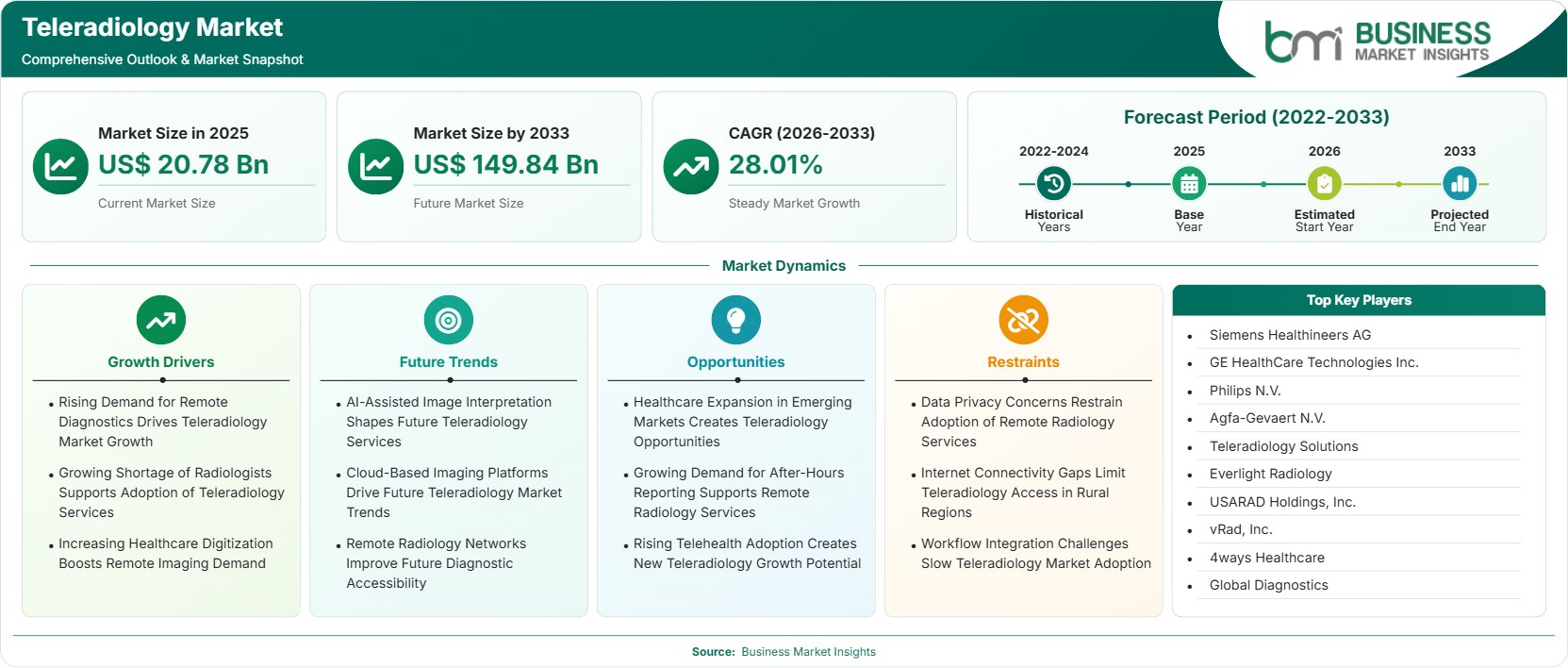
Teleradiology Market Regional Highlights
North America Teleradiology Market
North America accounts for 36%–40% share in 2025 and is projected to grow at a CAGR of 26.50%–27.50% through 2033. The region benefits from mature digital imaging infrastructure, high diagnostic volumes, and persistent radiologist staffing pressures. Teleradiology Market share remains concentrated in the US, where hospitals increasingly use distributed reporting models.
- Healthcare providers increasingly use remote radiology networks to address workforce shortages and maintain continuous coverage, particularly during nights, weekends, holidays, and periods of elevated imaging demand.
- Cloud-based imaging infrastructure is improving collaboration between hospitals, diagnostic centers, and specialist radiologists while reducing geographic barriers to subspecialty interpretation and second opinions.
- Large healthcare systems are consolidating imaging operations and using centralized reporting models to improve resource utilization, standardize workflows, and expand access to specialist expertise.
US Teleradiology Market
The US represents approximately 32%–36% of global demand and 88%–92% of North American activity in 2025, with a CAGR of 26.80%–27.80% through 2033. High imaging utilization, radiologist shortages, established electronic health records, and widespread digital image exchange support adoption.
- Hospitals increasingly outsource overnight and emergency interpretation to specialized networks, enabling continuous coverage while reducing the need for permanent onsite staffing across every shift.
- Teleradiology providers are expanding subspecialty access, allowing smaller hospitals and regional facilities to connect with experts in areas such as neuroradiology, musculoskeletal imaging, and cardiac radiology.
Europe Teleradiology Market
Europe Teleradiology Market holds 27%–31% share in 2025 and is expected to grow at a CAGR of 27.00%–28.00%. Germany, the United Kingdom, France, and the Nordic countries represent leading markets, while Eastern Europe provides high-growth opportunities. The United Kingdom is estimated at 28.00%–29.00% CAGR, supported by radiologist workforce pressures and demand for remote reporting. Poland is positioned at 30.00%–31.00% CAGR as healthcare digitization, imaging expansion, and specialist shortages encourage distributed reporting models.
- European healthcare systems are increasingly exploring remote reporting to manage radiologist shortages and improve access to specialist interpretation across geographically dispersed facilities.
- Cross-border services require careful compliance with privacy, professional licensing, data governance, and clinical responsibility requirements, creating both barriers and opportunities for specialized providers.
- Eastern European markets offer growth opportunities as diagnostic infrastructure expands and healthcare providers seek specialist expertise without establishing large onsite radiology teams.
Asia Pacific Teleradiology Market
Asia Pacific Teleradiology Market accounts for 23%–27% share in 2025 and is projected to record the fastest regional CAGR of 31.00%–32.50%. China, Japan, India, South Korea, and Australia are leading markets, while Southeast Asia provides high-growth opportunities. India is estimated at 32.00%–33.00% CAGR, supported by uneven radiologist distribution and expanding diagnostic capacity.
- India offers substantial opportunities because large geographic disparities in specialist availability encourage remote reporting models connecting diagnostic facilities with radiologists in major urban centers.
- China is expanding digital healthcare capabilities and imaging infrastructure, creating opportunities for remote interpretation, AI-assisted workflows, and centralized radiology services.
- Southeast Asian healthcare systems are increasingly adopting telehealth and cloud technologies, supporting remote imaging services where specialist availability remains uneven across islands and rural areas.
- Australia benefits from geographic dispersion and remote communities, creating sustained demand for digital imaging and remote specialist interpretation across facilities outside major metropolitan centers.
Rest of World Teleradiology Market
South and Central America account for 5%–7% share in 2025 and are projected to expand at 25.00%–26.50% CAGR. Brazil and Mexico lead regional demand as diagnostic imaging expands and specialist distribution remains uneven. Brazil is estimated at 26.00%–27.00% CAGR, supported by healthcare digitization and centralized reporting opportunities. The Middle East and Africa represent 5%–7% share in 2025, with a CAGR of 28.00%–30.00%. The UAE, Saudi Arabia, and South Africa lead adoption, while Gulf healthcare systems provide high-value opportunities.
- Brazil's geographically dispersed healthcare system creates opportunities for remote reporting networks that connect regional diagnostic facilities with radiologists and subspecialists located in larger cities.
- Mexico is expanding digital healthcare capabilities, supporting remote imaging interpretation for hospitals and diagnostic centers facing specialist availability constraints outside major urban areas.
- Gulf countries are investing heavily in healthcare modernization and digital infrastructure, creating opportunities for advanced teleradiology platforms integrated with AI, cloud imaging, and specialist networks.
- South Africa's uneven distribution of healthcare specialists creates demand for remote interpretation services, particularly for facilities serving rural and underserved populations.