Antifreeze Protein Market Regional Highlights
North America Antifreeze Protein Market
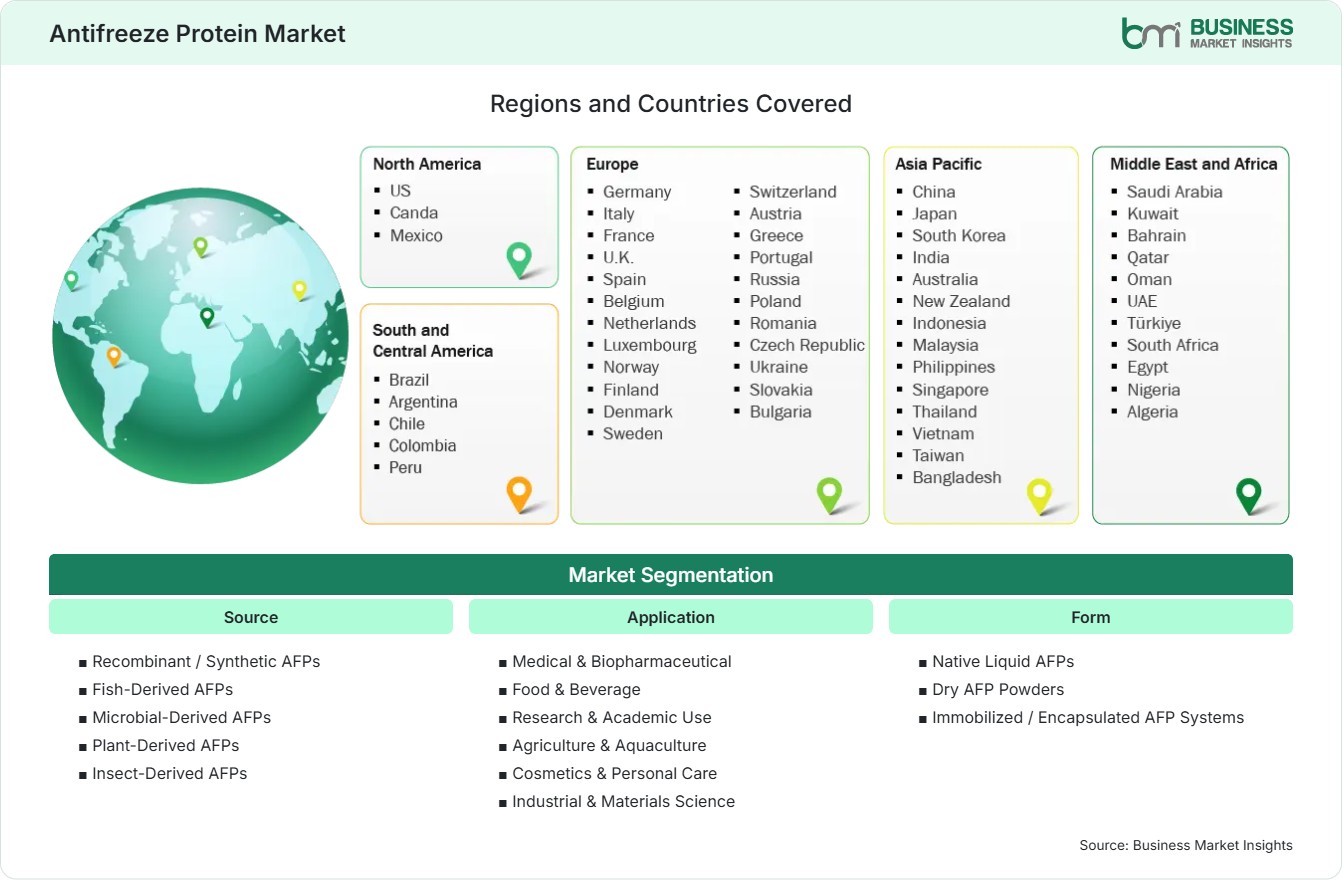
North America accounted for a 32%–36% Antifreeze Protein Market share in 2025 and is projected to grow at an 11.5%–12.5% CAGR during 2026–2033. The region benefits from advanced biotechnology infrastructure, strong academic research, biopharmaceutical investment, and established cryopreservation capabilities. The US represents the dominant regional market, supported by cell therapy development, regenerative medicine research, organ preservation initiatives, and food technology innovation. Canada provides additional opportunities through biotechnology and life sciences research.
- Strong research institutions and biotechnology companies are advancing recombinant protein engineering, creating opportunities for engineered antifreeze proteins with improved activity, stability, purity, and application-specific characteristics.
- Cell therapy, tissue engineering, and regenerative medicine programs are increasing demand for advanced preservation technologies capable of maintaining biological viability during freezing and storage.
- Food manufacturers and researchers are investigating ice recrystallization control technologies to improve frozen product texture, stability, and quality throughout storage and distribution.
US Antifreeze Protein Market
The United States accounted for 28%-32% of global demand in 2025 and is projected to grow at a CAGR of 11.5%- 12.5% through 2033. The antifreeze protein market benefits from extensive research capabilities across universities, biotechnology companies, and healthcare institutions, while food technology and agricultural research provide additional commercialization pathways for antifreeze protein applications.
- Cell therapy, regenerative medicine, and advanced biological research are creating demand for preservation technologies that can improve viability and functional recovery following cryogenic storage.
- Increasing research into transplantation logistics and organ preservation creates opportunities for antifreeze proteins that could complement existing preservation solutions and extend viable storage conditions.
- US biotechnology companies and research institutions are developing engineered proteins with improved performance characteristics, potentially reducing dependence on naturally sourced proteins and enabling more consistent manufacturing.
Europe Antifreeze Protein Market
Europe represented 24%–28% in 2025 and will see a CAGR of 11.0%–12.0% through 2033. Germany dominates the regional market on account of its strengths in biotechnology, food science, and research capacity; the UK has strengthened its strengths in academia and biopharmaceuticals; and France offers excellent growth potential at a 12.0%–13.0% CAGR through applications in biotechnology and food technology.
- Germany offers strong opportunities in biotechnology research, food technology, pharmaceutical manufacturing, and academic expertise in protein science and cryobiology.
- The UK benefits from established life sciences research infrastructure, which supports the development of advanced preservation technologies for cell therapy, regenerative medicine, and biopharmaceutical applications.
- France offers higher-growth opportunities through pharmaceutical research, food innovation, biotechnology investment, and increasing interest in advanced protein-based preservation technologies.
Asia Pacific Antifreeze Protein Market
Asia Pacific captured a 27%–31% share in 2025 and is APAC Antifreeze Protein Market forecast to achieve a 13.5%–14.5% CAGR through 2033, making it the fastest-growing region. Japan and China represent leading markets, supported by advanced biotechnology and food research. India is projected to grow at 15.0%–16.0% CAGR as biotechnology capabilities expand. Aquaculture, frozen food production, pharmaceutical manufacturing, and academic research provide multiple avenues for commercialization.
- China combines extensive food processing and aquaculture industries with expanding biotechnology investment, creating demand for preservation technologies across food, research, and biological applications.
- Japan maintains advanced capabilities in biotechnology, food science, and specialty chemical manufacturing, supporting development and commercialization of sophisticated protein-based preservation technologies.
- India's growing biotechnology sector and expanding research infrastructure provide opportunities for recombinant protein development, pharmaceutical applications, and emerging cryopreservation technologies.
Rest of World Antifreeze Protein Market
South and Central America represented a 7%–10% share in 2025 and is expected to grow at a 10.5%–11.5% CAGR through 2033, supported by food processing, aquaculture, and agricultural research. Brazil leads regional demand. Middle East and Africa represented a 5%–8% share, growing at a 9.5%–10.5% CAGR, with opportunities emerging in food technology, biotechnology research, and specialized agricultural applications.
- Brazil provides the strongest regional opportunity through its large food processing, agriculture, aquaculture, and biotechnology ecosystems, creating multiple potential application pathways for antifreeze proteins.
- South American aquaculture growth creates opportunities for technologies supporting biological preservation, breeding research, cold-chain management, and improved resilience of aquatic biological materials.
- Gulf markets provide opportunities in advanced food processing and frozen food quality enhancement as producers seek technologies that improve texture and stability during cold storage.
- Expanding biotechnology research capabilities and agricultural innovation programs can create longer-term opportunities for antifreeze protein applications in biological preservation and crop-related research.