Market Summary
Executive Summary and Global Market Analysis
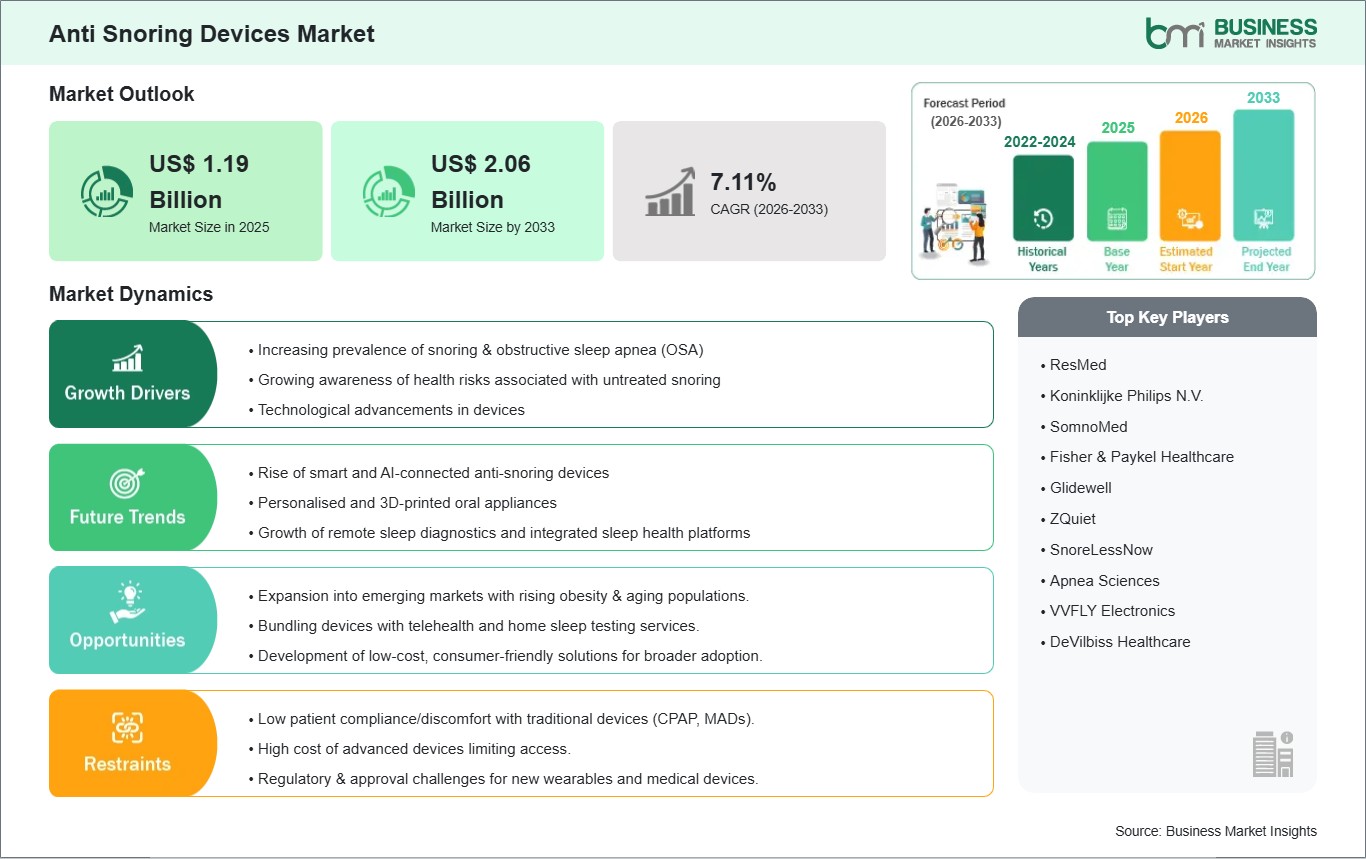
Anti-snoring devices function as essential components for current sleep health treatments because their design specifically targets snoring reduction by creating better airflow which decreases airway blockages during sleeping hours. Homecare and clinical environments utilize these solutions which include mandibular advancement devices tongue stabilizing devices nasal dilators chin straps and smart anti-snoring wearables to treat patients who experience mild to moderate snoring problems and sleep-related breathing disorders. The use of anti-snoring devices leads to improved sleep patterns which benefits overall health while decreasing the chances of developing health issues that result from prolonged snoring.
The global anti-snoring devices market is experiencing continuous expansion because more people develop sleep disorders which stem from obesity and the increasing number of elderly individuals and rising stress levels and shifting dietary patterns. The market growth receives additional support from two factors first customers become more aware about sleep health and second people increasingly choose to treat snoring and obstructive sleep apnea through non-invasive methods instead of surgical solutions. The market faces obstacles which include insufficient reimbursement options and varying patient treatment adherence and unawareness among patients in some areas despite the market having strong potential for growth. The period between now and the future will bring about major business expansion because sleep clinics will become more accessible and people will have better financial ability and home solutions will become more popular and products will continuously improve.
Segment Analysis
Anti Snoring Devices Market Segmentation
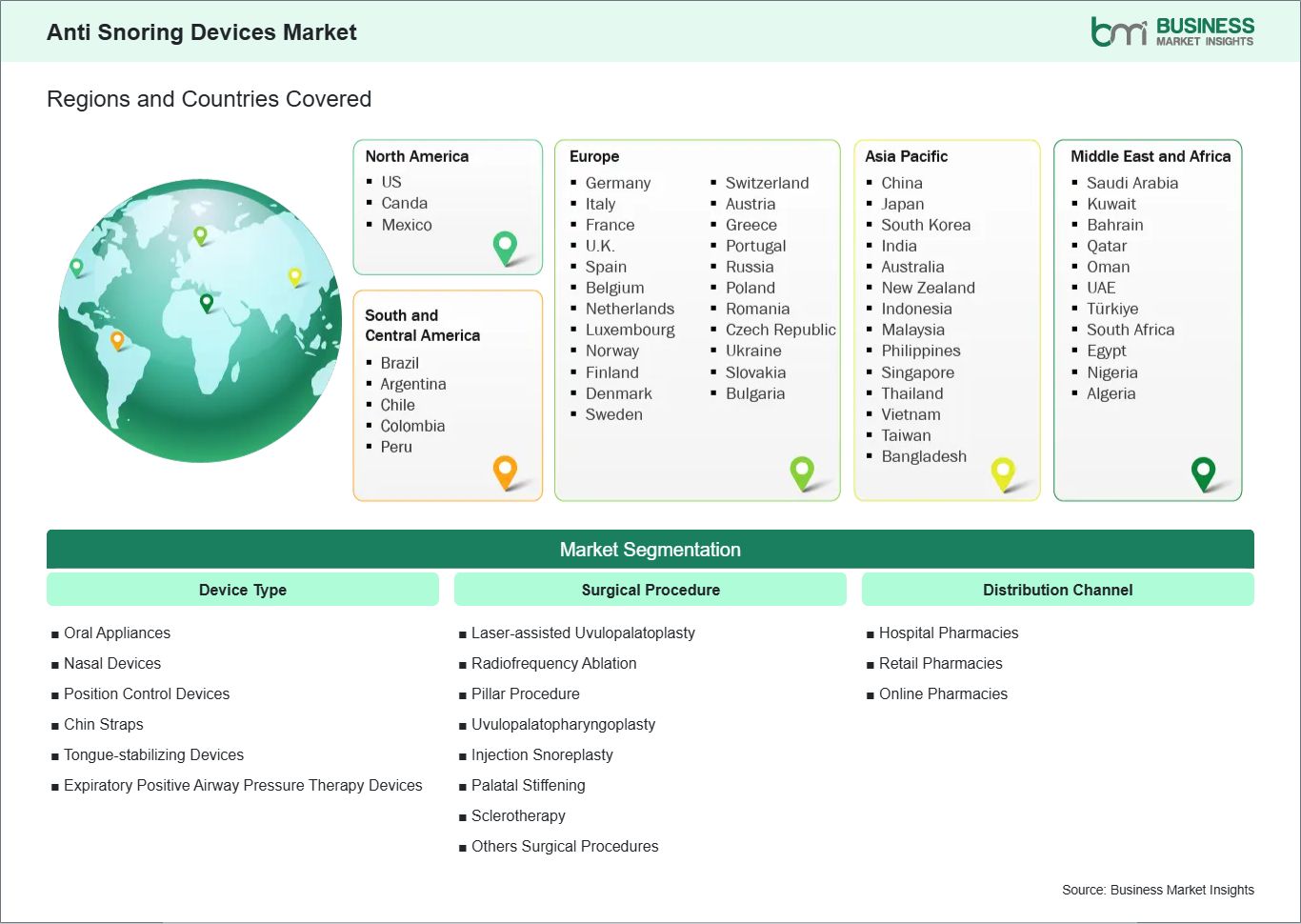
Key segments that contributed to the derivation of the anti snoring devices market analysis are device type, surgical procedure, and distribution channel.
- By device type, the anti snoring devices market is segmented into oral appliances, nasal devices, position control devices, chin straps, tongue-stabilizing devices, and expiratory positive airway pressure (EPAP) therapy devices. The oral appliances segment dominated the market in 2025.
- By surgical procedure, the market is segmented into laser-assisted uvulopalatoplasty, radiofrequency ablation, pillar procedure, uvulopalatopharyngoplasty (UPPP), injection snoreplasty, palatal stiffening, sclerotherapy, and others surgical procedures. The uvulopalatopharyngoplasty (UPPP) segment held the largest market share in 2025.
- By distribution channel, the anti snoring devices market is segmented into hospital pharmacies, retail pharmacies, online pharmacies. The retail pharmacies segment dominated the market in 2025.
Market Forces
Anti Snoring Devices Market Drivers and Opportunities
Rising Prevalence of Sleep Disorders
The market for anti-snoring devices keeps growing because more people around the world develop sleep-related breathing disorders. The combination of obesity and smoking and alcohol consumption and nasal congestion and aging results in more people developing persistent snoring problems. People now choose anti-snoring devices because these devices cost less and are simple to operate and create no discomfort for users when compared to traditional surgical or CPAP-based treatments.
Middle-aged people and older adults experience more snoring because of the global increase in obesity and inactive lifestyles. The growing recognition that snoring causes hypertension and cardiovascular disease and daytime fatigue has increased the need for effective snoring solutions which results in overall market expansion.
Technological Advancements and Expanding Consumer Applications
The ongoing development of anti-snoring technology results in better user experience through increased device use and wider range of applications. The development of adjustable oral appliances and ergonomic nasal devices and smart wearables with vibration-based feedback technology have brought improvements to treatment success rates and user comfort. The present consumer market shows a preference for modern devices which allow personal customizations and work together with mobile apps to monitor their sleep and track their performance.
The adoption of smart anti-snoring devices, digital sleep monitoring tools and data-driven sleep assessment technologies is rising because these innovations enable personalized therapy which leads to better treatment results. The combination of strong clinical evidence and increasing consumer trust has led product manufacturers to develop new products which they can sell to larger customer bases. The global anti-snoring devices market will continue to grow because healthcare spending increases and people become more aware of sleep wellness.
The development of technology has brought major improvements to how devices function. The development of adjustable mandibular advancement devices and smart nasal dilators and vibration-based wearables and comfort-focused materials has brought about improved treatment efficiency and decreased patient discomfort while boosting patient compliance. Anti-snoring devices have gained broader acceptance for use in homecare facilities and sleep clinics and wellness centers due to these technological advancements.
Size and Share Analysis
Anti Snoring Devices Market Size and Share Analysis
By device type, the anti snoring devices market is segmented into oral appliances, nasal devices, position control devices, chin straps, tongue-stabilizing devices, and expiratory positive airway pressure (EPAP) therapy devices. The oral appliances segment dominated the market in 2025. This is driven by their proven efficacy, ease of use, and strong preference as first-line, non-surgical treatment for snoring. These devices are widely recommended by sleep specialists for their ability to reposition the jaw and tongue, effectively reducing airway obstruction. The increasing availability of customized and adjustable oral devices compatible with smart monitoring apps further boosts demand.
By surgical procedure, the market is segmented into laser-assisted uvulopalatoplasty, radiofrequency ablation, pillar procedure, uvulopalatopharyngoplasty (UPPP), injection snoreplasty, palatal stiffening, sclerotherapy, and others surgical procedures. The uvulopalatopharyngoplasty (UPPP) segment held the largest market share in 2025. Due to its high success rate in reducing snoring severity and treating obstructive sleep apnea. UPPP is preferred by ENT specialists for its effectiveness in removing excess tissue and widening the airway, particularly in patients with moderate to severe snoring.
By distribution channel, the anti snoring devices market is segmented into hospital pharmacies, retail pharmacies, online pharmacies. The retail pharmacies segment dominated the market in 2025. Due to the rising number of retail pharmacies worldwide, further increasing the availability and accessibility of anti-snoring devices.
Report Coverage
Anti Snoring Devices Market Report Coverage and Deliverables
The "Anti Snoring Devices Market Size and Forecast (2022&2033)" report provides a detailed analysis of the market covering below areas:
- Anti Snoring Devices market size and forecast at global, regional, and country levels for all the key market segments covered under the scope
- Anti Snoring Devices market trends, as well as market dynamics such as drivers, restraints, and key opportunities
- Anti Snoring Devices market analysis covering key market trends, global and regional framework, major players, regulations, and recent market developments
- Industry landscape and competition analysis covering market concentration, heat map analysis, prominent players, and recent developments for the Anti Snoring Devices market
- Detailed company profiles, including SWOT analysis
Geographic Insights
Anti Snoring Devices Market Geographic Insights
The geographical scope of the anti snoring devices market report is divided into five regions: North America, Asia Pacific, Europe, Middle East & Africa, and South & Central America. The Anti Snoring Devices market in Asia Pacific is expected to grow significantly during the forecast period.
The Asia-Pacific Anti Snoring Devices market is segmented into China, Japan, South Korea, India, Australia, New Zealand, Indonesia, Malaysia, the Philippines, Singapore, Thailand, Vietnam, Taiwan, Bangladesh, and the Rest of Asia. The anti-snoring devices market in the Asia-Pacific region is growing rapidly because more people develop sleep disorders and cities expand their populations and public awareness of sleep health increases. The market development receives backing from better healthcare facilities and the growing use of digital health solutions which countries like China and Japan and India and South Korea and Australia are currently implementing.
The large populations of China and Japan and India create excellent growth opportunities because their citizens face rising obesity rates and demand low-cost sleep solutions that do not require invasive procedures. The regional increase in anti-snoring device usage results from government programs that promote preventive medical practices and develop better diagnostic methods and provide residents with enhanced access to sleep medicine facilities.
The market development received a boost from major technological progress that introduced smart wearable devices and application-based oral devices which operate through Bluetooth connections. The increasing customer demand for sleep management solutions at home drives the market growth which medical providers deliver through telemedicine services and urban wellness centers and online retail platforms. Throughout the forecast period the second-fastest-growing anti-snoring devices market will remain in the Asia-Pacific region according to current projections.
Industry Activity
Recent Developments
The Anti Snoring Devices market is evaluated by gathering qualitative and quantitative data post primary and secondary research, which includes important corporate publications, association data, and databases. A few of the key developments in the Anti Snoring Devices market are:
- In December 2024, a new app-controlled device was introduced in the UK to treat sleep apnea. This implant stimulates the tongue's nerves to help sufferers breathe better overnight, offering a novel approach to managing sleep apnea
- In September 2024, dental sleep apnea treatments introduced NightLase, a non-invasive laser therapy that uses laser energy to tighten and firm the tissues in the throat, reducing airway obstruction. This procedure offers a painless alternative to traditional surgical methods, aiming to alleviate snoring and improve sleep quality.
Trust & Transparency
Research Methodology
The market analysis combines proprietary research with secondary data from government agencies, company disclosures, regulatory filings, industry databases and expert interviews. Market estimates are validated through data triangulation, cross-market benchmarking and analyst
review.
View Full Research Methodology
Key Sources Referred:
World Bank - Global Trade IndicatorsAmerican Medical Association (AMA)National Center for Biotechnology Information (NCBI)National Library of Medicine (NLM)Centers for Disease Control and Prevention (CDC)Company websiteNational Institutes of Health (NIH)International Hospital Federation (IHF)Company annual reportsCompany investor presentations