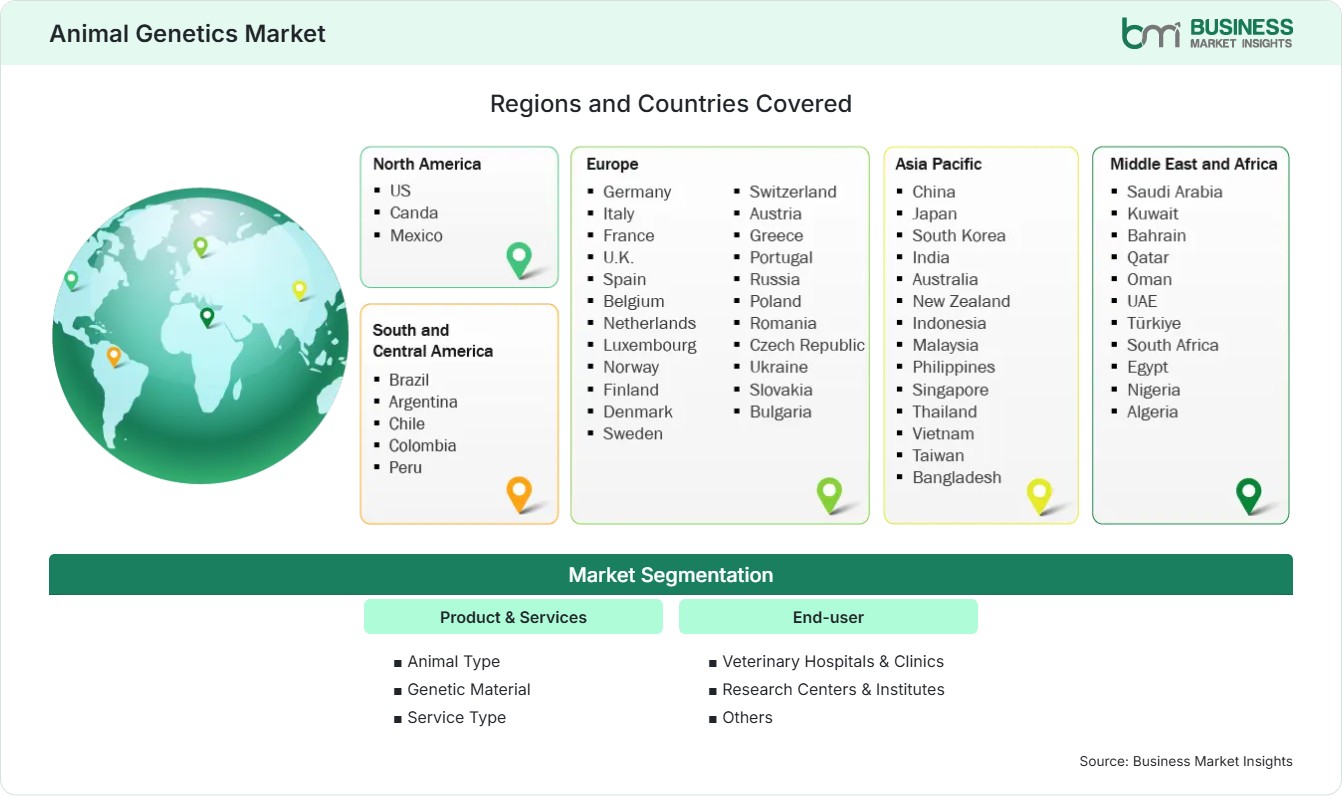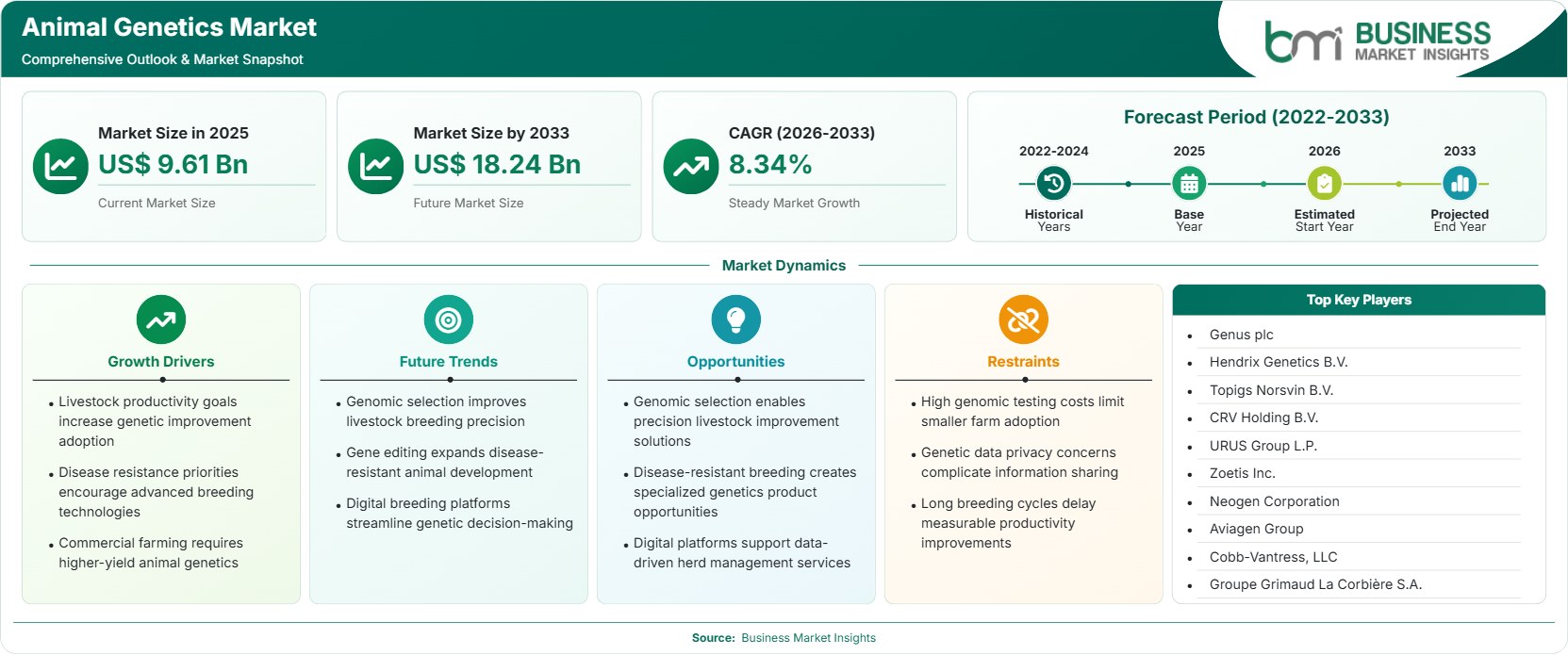
Animal Genetics Market Regional Highlights
North America Animal Genetics Market
North America Animal Genetics market represents 34%–37% of global revenue in 2025 and grows at a 7.4%–8.1% CAGR through 2033. Mature dairy, beef, swine, and poultry systems support advanced artificial insemination, genomic databases, and veterinary infrastructure. The US remains the principal demand center, while Canada maintains strength in dairy genetics and reproductive services. Producers increasingly evaluate genetics against fertility, resilience, feed efficiency, animal health, lifetime productivity, and production consistency. This supports growing adoption of integrated breeding technologies.
- Genomic testing is increasingly incorporated into herd-management workflows, enabling earlier replacement selection and more accurate breeding decisions.
- Disease-resistance programs are attracting investment as producers seek genetic approaches that complement vaccination, biosecurity, nutrition, and veterinary intervention.
- Reproductive technologies accelerate dissemination of elite genetics while improving breeding-program efficiency and herd-level productivity.
- Digital platforms connect genomic information with health, fertility, production, and environmental measurements, increasing the value of integrated services.
US Animal Genetics Market
The US Animal Genetics market represents 27%–30% of global revenue and 79%–82% of North American demand in 2025, expanding at a 7.5%–8.2% CAGR through 2033. Large dairy, beef, swine, and poultry operations support scalable genomic and reproductive technology adoption. University research, veterinary infrastructure, commercial breeding databases, and sophisticated livestock systems reinforce technological uptake. Regulatory developments remain particularly important for gene-edited traits because approval affects commercialization, producer access, and investment returns.
- Dairy producers increasingly use genomic evaluations for replacement selection, fertility, longevity, production efficiency, and economically important lifetime traits.
- Gene-editing commercialization creates opportunities where regulatory approval determines intellectual-property value, market access, and commercialization timing.
- Consolidated livestock production supports scalable deployment of genomic testing, reproductive technologies, analytics, and precision herd-management services.
Europe Animal Genetics Market
Europe Animal Genetics market holds a 23%–26% share in 2025 and expands at a 7.0%–7.8% CAGR through 2033. Germany, France, the Netherlands, Denmark, and the United Kingdom are leading markets, while Poland and Spain provide additional growth opportunities. Breeding strategies increasingly balance productivity with fertility, robustness, welfare, environmental efficiency, and disease resilience. Traceability and sustainability requirements encourage broader selection indices and greater use of genomic information in commercial breeding decisions.
- The Netherlands remains influential in dairy breeding through established organizations, genomic programs, international germplasm distribution, and producer-oriented services.
- Denmark remains important for swine genetics, with an emphasis on feed efficiency, reproductive performance, robustness, and production economics.
- France and Germany provide diversified demand across cattle, poultry, and swine, supported by established research and breeding ecosystems.
- Sustainability-focused selection increasingly incorporates longevity, fertility, resilience, welfare, and environmental characteristics.
Asia Pacific Animal Genetics Market
Asia Pacific Animal Genetics market accounts for 25%–28% of global revenue in 2025 and expands at a 9.2%–10.1% CAGR through 2033. China leads regional demand, while India, Japan, Australia, South Korea, Vietnam, and Southeast Asia provide distinct opportunities. Commercial livestock expansion, domestic breeding programs, disease-control requirements, and protein demand support investment. Producers increasingly seek genetics suited to local climates, feed availability, disease exposure, and production systems rather than standardized imported traits.
- China is strengthening domestic breeding capacity through nucleus farms, high-health facilities, partnerships, and localized breeding infrastructure.
- India offers substantial potential across cattle, buffalo, poultry, and small ruminants as organized production and productivity-focused breeding expand.
- Australia remains important for cattle and sheep genetics, particularly breeding programs suited to extensive production and climatic variability.
- Southeast Asia provides high-growth opportunities as commercial poultry and swine systems become increasingly technology-intensive.
Rest of World Animal Genetics Market
South and Central America Animal Genetics market provides a major production base led by Brazil and Argentina, with demand concentrated in cattle, poultry, swine, and reproductive technologies. Brazil benefits from extensive livestock production and export orientation, while Argentina provides specialized beef-genetics opportunities. Heat tolerance, fertility, disease resilience, growth, and feed utilization remain important selection priorities across pasture-based and mixed systems.
Middle East and Africa remain smaller markets but offer strategic opportunities. Saudi Arabia, the United Arab Emirates, South Africa, and selected North African countries are developing adoption around heat resilience, reproductive performance, feed efficiency, and improved breeding infrastructure. The RoW region represents 11%–15% of global revenue in 2025 and grows at a 6.5%–7.4% CAGR through 2033.
- Brazil provides strong cattle-genetics potential because large production systems can monetize improvements in fertility, growth, carcass characteristics, and environmental adaptability.
- Argentina offers specialized demand for beef genetics emphasizing reproductive performance, growth, carcass quality, and pasture adaptation.
- Middle Eastern producers increasingly seek genetics capable of maintaining reproductive and productive performance under heat and resource constraints.
- South Africa provides an established livestock technology base with potential to support wider African adoption.