
Anaerobic Digestion Market Outlook: Size, Share, Trends, Growth Analysis, Competitive Landscape & Forecast, 2026-2033

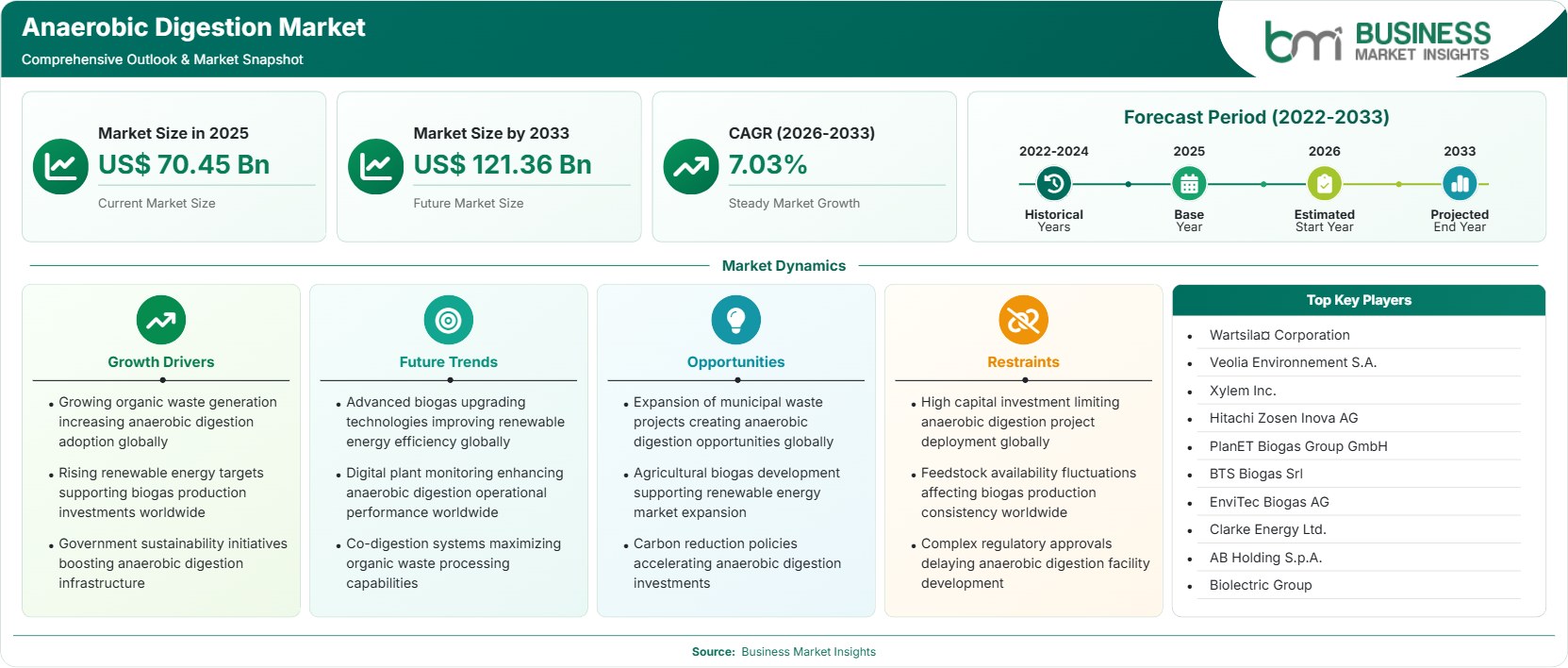
The Anaerobic Digestion Market size was valued at US$ 70.45 billion in 2025 and is projected to reach US$ 121.36 billion by 2033, growing at a CAGR of 7.03% during 2026–2033. The market is expanding steadily due to increasing organic waste generation, rising renewable energy demand, supportive government sustainability policies, and growing investments in circular economy infrastructure. The integration of biogas production with waste management strategies continues strengthening long-term industry growth across developed and emerging economies.

Report Coverage
  • Feedstock: Organic Residue and Waste, Energy Crops
  • Application: Electricity Generation, Heating, Combined Heat and Power , Others
US$ 70.45 Bn Market size in 2025
US$ 121.36 Bn Market Size by 2033
7.03% CAGR, 2026 - 2033
2026-2033 Forecast Period

01 AI Overview

Anaerobic Digestion Market Summary

  • North America Region: North America accounts for 27%–30% share in 2025 and is projected to grow at a CAGR of 6.70%–7.10% during 2026–2033. Strong renewable energy policies, expanding municipal waste management projects, and increasing adoption of biogas technologies continue supporting regional demand. The US market is projected to register a CAGR of 6.80%–7.20% throughout the forecast period.
  • Fastest Growing Region: Europe holds 34%–37% share in 2025 and is forecast to expand at a CAGR of 7.20%–7.70% during 2026–2033. Supportive carbon reduction regulations, advanced waste management infrastructure, and widespread deployment of agricultural biogas facilities continue driving regional leadership.
  • Leading Segment: Organic Residue and Waste account for 67%–70% share in 2025 and are projected to grow at a CAGR of 7.00%–7.40%, supported by increasing utilization of municipal waste, food waste, sewage sludge, and industrial organic residues for renewable energy generation.
  • High Growth Segment: Combined Heat and Power (CHP) is projected to register a CAGR of 7.50%–8.00%, driven by increasing demand for efficient energy recovery systems that simultaneously generate electricity and useful heat.
  • Key Market Opportunity: Municipal waste processing, agricultural biogas projects, renewable natural gas production, carbon reduction initiatives, and circular economy investments continue creating attractive long-term opportunities across global markets.
  • Major Market Players: Wärtsilä Corporation, Veolia Environnement S.A., Xylem Inc., Hitachi Zosen Inova AG, PlanET Biogas Group GmbH, BTS Biogas Srl, EnviTec Biogas AG, Clarke Energy Ltd., AB Holding S.p.A., Biolectric Group
02 Strategic Insights

Anaerobic Digestion Market: Strategic Insights

Anaerobic Digestion Market Strategic Framework
FREE PDF
Request your free sample
Request free sample
03 Stakeholder View

Key Takeaways

  • The market value chain integrates feedstock suppliers, technology providers, engineering companies, project developers, utilities, waste management organizations, and energy consumers to support efficient renewable energy production.
  • Organic Residue and Waste remain the dominant feedstock category, while Combined Heat and Power (CHP) represents the fastest-growing application because of its superior energy utilization efficiency.
  • Product innovation continues focusing on advanced digester technologies, biogas upgrading systems, automation, feedstock optimization, and digital monitoring solutions.
  • Europe offers the strongest long-term investment opportunities because of ambitious renewable energy policies, established waste management infrastructure, and expanding agricultural biogas deployment.
  • Strategic partnerships, technological innovation, infrastructure modernization, and government policy support continue strengthening competitiveness across the global anaerobic digestion industry.
04 Geographic Outlook

Anaerobic Digestion Market Regional Highlights

North America Anaerobic Digestion Market

North America accounts for 27%–30% share in 2025 and is projected to grow at a CAGR of 6.70%–7.10% during 2026–2033. Increasing investments in renewable energy, municipal solid waste management, wastewater treatment modernization, and agricultural biogas production continue supporting regional expansion. The Anaerobic Digestion Market share remains strong as governments and private developers increasingly utilize organic waste to produce renewable electricity, biomethane, and low-carbon fuels while reducing landfill dependence.

  • The US leads regional demand through expanding municipal biogas facilities and agricultural renewable energy projects.
  • Canada continues investing in organic waste diversion and renewable natural gas production.
  • Food processing industries increasingly adopt anaerobic digestion to recover energy from organic by-products.
  • Utilities continue integrating biogas into renewable energy and decarbonization strategies.

US Anaerobic Digestion Market

The US represents 84%–87% of the North American market in 2025 and is projected to expand at a CAGR of 6.80%–7.20% during 2026–2033. Federal and state renewable energy incentives, landfill diversion initiatives, and growing investments in renewable natural gas continue supporting market growth.

  • Agricultural biogas projects continue expanding across livestock-intensive regions.
  • Municipal wastewater treatment plants increasingly incorporate anaerobic digestion systems.
  • Renewable natural gas production supports transportation and industrial decarbonization.
  • Public-private partnerships continue accelerating commercial-scale project deployment.

Europe Anaerobic Digestion Market

Europe accounts for 34%–37% share in 2025 and is projected to register a CAGR of 7.20%–7.70% during 2026–2033. Germany, the UK, France, Italy, and Denmark continue leading regional adoption through strong environmental regulations, carbon reduction targets, and advanced waste management infrastructure.

  • Germany remains the largest regional market because of its mature agricultural biogas sector.
  • The UK expands municipal waste-to-energy and renewable gas infrastructure.
  • France continues investing in agricultural digesters and renewable energy diversification.
  • European decarbonization policies encourage wider deployment of anaerobic digestion technologies.

Asia Pacific Anaerobic Digestion Market

Asia Pacific accounts for 24%–27% share in 2025 and is forecast to grow at a CAGR of 7.30%–7.80% during 2026–2033. China, India, Japan, and South Korea continue driving regional expansion through increasing organic waste generation, renewable energy investments, and government initiatives promoting sustainable waste management.

  • China continues expanding municipal and industrial biogas infrastructure.
  • India records strong growth through agricultural waste utilization and rural biogas programs.
  • Japan strengthens adoption of food waste recycling and renewable energy technologies.
  • South Korea increases investment in advanced waste treatment and resource recovery facilities.
  • Urbanization continues creating additional demand for integrated organic waste management systems.

Rest of World Anaerobic Digestion Market

Rest of World accounts for 10%–12% share in 2025 and is projected to grow at a CAGR of 6.80%–7.20% during 2026–2033. Latin America, the Middle East, and Africa continue investing in renewable energy, agricultural modernization, and waste management infrastructure to improve environmental sustainability.

  • Brazil expands agricultural biogas production using livestock and crop residues.
  • Mexico strengthens municipal organic waste treatment initiatives.
  • Gulf countries invest in sustainable waste-to-energy infrastructure.
  • South Africa continues developing renewable energy projects utilizing organic waste.
  • International financing supports new anaerobic digestion project development across emerging markets.
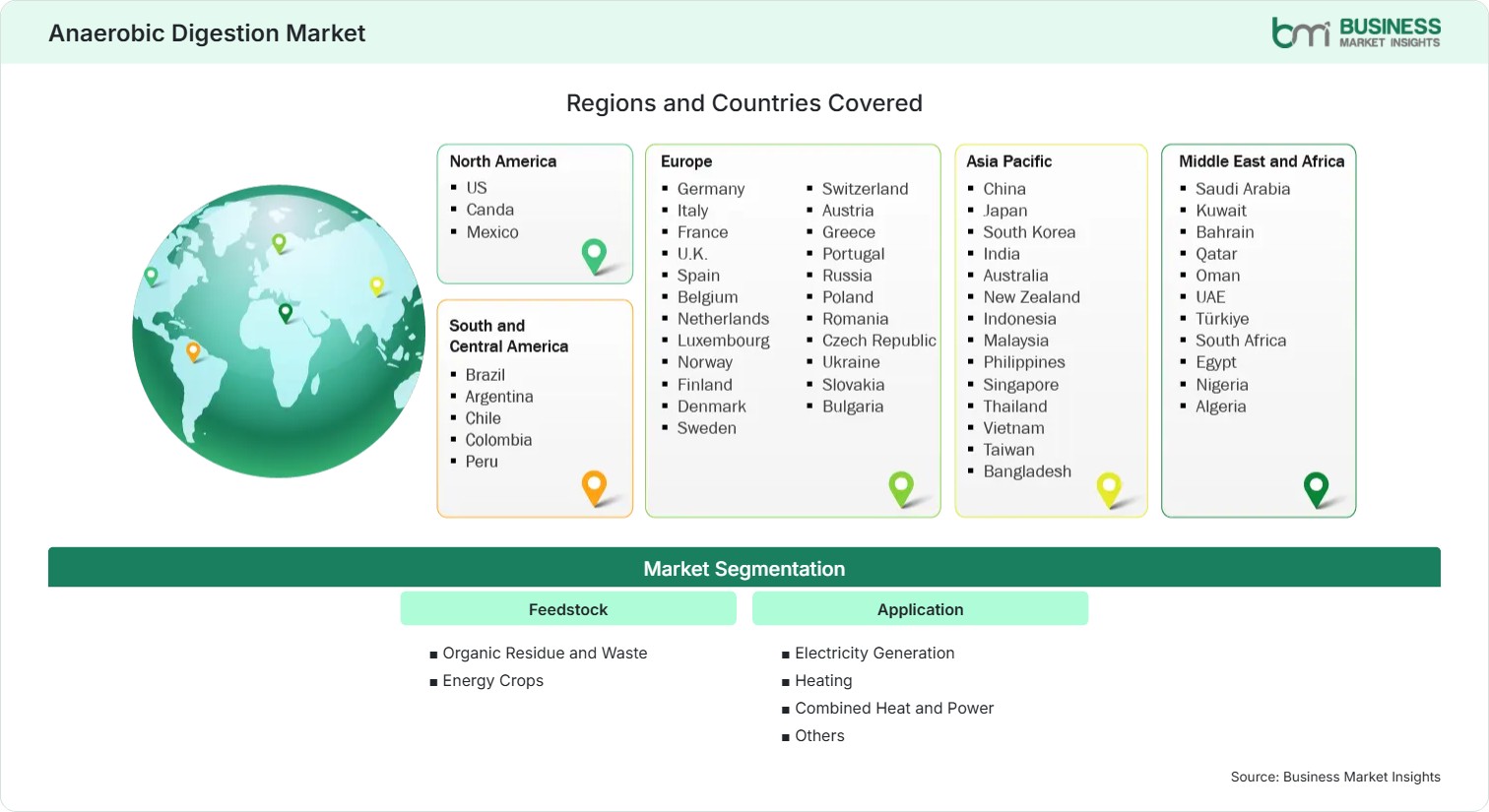
Global Market Geography
FREE PDF
Request your free sample
Request free sample
05 Segment Analysis

Anaerobic Digestion Market Segmentation

Feedstock

The Feedstock segment defines the Anaerobic Digestion Market scope by utilizing various biodegradable materials for biogas generation and resource recovery. The segment accounted for 100% of the market in 2025 and is projected to grow at a CAGR of 7.03% during 2026–2033. Increasing emphasis on sustainable waste management, renewable energy generation, and circular economy practices continues supporting feedstock diversification across municipal, agricultural, and industrial applications.

  • Organic Residue and Waste: Organic Residue and Waste represent the largest segment because municipal solid waste, food waste, sewage sludge, industrial organic residues, and biodegradable materials provide abundant and consistent feedstock for commercial anaerobic digestion facilities.
  • Agriculture Waste: Agriculture Waste continues recording strong growth as livestock manure, crop residues, and agricultural by-products are increasingly converted into biogas and nutrient-rich digestate, supporting sustainable farming and renewable energy production.
  • Energy Crops: Energy Crops remain an important feedstock source in regions with dedicated renewable energy programs, providing predictable biomass supply for high-efficiency anaerobic digestion facilities.
  • Others: Other feedstocks include industrial organic by-products, commercial food processing waste, brewery residues, dairy waste, and other biodegradable materials suitable for anaerobic digestion.

Application

Electricity Generation accounts for the largest market share because biogas-powered electricity production remains the primary commercial application across municipal, industrial, and agricultural facilities. Combined Heat and Power (CHP) represents the fastest-growing application due to higher energy efficiency achieved through simultaneous production of electricity and thermal energy. The Anaerobic Digestion Market trends increasingly emphasize renewable natural gas production, integrated energy recovery, carbon emission reduction, and efficient utilization of organic waste resources.

  • Electricity Generation: Electricity Generation remains the leading application as utilities, industries, and municipalities increasingly convert biogas into renewable electrical power to reduce dependence on fossil fuels.
  • Heating: Heating applications continue expanding because recovered biogas provides a reliable renewable fuel source for industrial facilities, commercial buildings, and district heating systems.
  • Combined Heat and Power (CHP): Combined Heat and Power (CHP) records the fastest growth by maximizing energy recovery efficiency while reducing operational costs and greenhouse gas emissions.
  • Others: Other applications include renewable natural gas upgrading, vehicle fuel production, industrial process energy, and decentralized renewable energy systems supporting sustainable infrastructure development.
06 Market Forces

Anaerobic Digestion Market Dynamics

Market Drivers

Growing organic waste generation increasing anaerobic digestion adoption globally

Increasing urbanization, population growth, industrial expansion, and rising consumption patterns are contributing to significant growth in organic waste generation worldwide. Municipalities, agricultural operators, food processing companies, and wastewater treatment facilities are increasingly adopting anaerobic digestion technologies to manage organic waste efficiently while producing renewable energy. The technology enables conversion of biodegradable materials into biogas and nutrient-rich digestate, supporting waste reduction and resource recovery objectives. Anaerobic Digestion Market growth is further supported by increasing adoption of circular economy models, while Market trends increasingly focus on advanced digestion systems, biogas upgrading, renewable natural gas production, and sustainable waste management solutions.

Rising renewable energy targets supporting biogas production investments worldwide

Governments in leading economies are setting higher targets for renewable energy in order to lower their dependency on fossil fuels and increase efforts towards decarbonization. Anaerobic digestion offers an ideal method for obtaining renewable energy through the production of electricity, heat, and biomethane from organic materials. The government policy, renewable energy incentive schemes, and carbon emission reduction initiatives are motivating power and energy providers, industries, and farmers to construct biogas facilities and initiate large scale projects. Growing focus on circular economy principles is also increasing the use of agricultural waste, food waste, sewage sludge, and organic waste from industries for generating biogas. Energy companies are considering the development of biomethane as a clean fuel in replacement of natural gas, and hence the integration in energy grids. Innovation in digestion technology, purification systems, and overall process is also enhancing efficiency and financial feasibility of biogas projects. Demand for low carbon energy sources and investments in renewable fuel infrastructure will continue to boost growth of global biogas market in coming years.

Government sustainability initiatives boosting anaerobic digestion infrastructure

Government policies relating to waste minimization, landfills avoidance, emission reduction, and renewable energy generation keep reinforcing implementation of anaerobic digestion technologies around the world. Various public funding and environmental programs as well as sustainability targets are motivating governments and businesses to build sophisticated organic waste processing plants. They help to improve infrastructure development and increase adoption in various applications. Governments worldwide are introducing stringent waste management policies and resource recovery programs in order to decrease environmental pollution and enhance efficiency of waste utilization. Building of municipal waste treatment plants, agricultural biogas production facilities, and industrial wastewater management facilities is creating new opportunities for the anaerobic digestion technology providers. Financial incentives like renewable fuels credits, carbon reduction projects, and financing of clean energy projects are helping in making projects more feasible. Enhanced cooperation between governments, utilities, and technology providers will contribute towards faster adoption of anaerobic digestion technologies.

Market Opportunities

Expansion of municipal waste projects creating anaerobic digestion opportunities globally

The expansion of municipal waste management projects creates significant opportunities for anaerobic digestion technology providers. Cities worldwide are investing in organic waste collection, landfill reduction programs, and waste-to-energy infrastructure to improve environmental sustainability. Anaerobic Digestion Market Forecasts indicate continued growth opportunities as municipalities increasingly adopt integrated waste processing solutions that generate renewable energy while reducing emissions.

Agricultural biogas development supporting renewable energy market expansion

Agricultural biogas projects still present numerous chances for both farmers and livestock producers to generate extra income using their sources of organic waste. With anaerobic digestion technology, manure and other agricultural waste products can be transformed into renewable energy. The increase in electrification programs and sustainable agriculture practices is also helping to boost the market.

Carbon reduction policies accelerating anaerobic digestion investments

Carbon reduction goals in the global scenario are inspiring businesses, energy producers, and governments to make investments in low-carbon energy production. Anaerobic digestion helps to reduce greenhouse gases because of the production of methane gas from organic materials and conversion into energy. Emphasis on net zero, carbon credits, and sustainable infrastructure is further encouraging investment in biogas.

Market Restraints and Challenges

High capital investment limiting anaerobic digestion project deployment globally

Factor: Anaerobic digestion facilities require significant upfront investment for equipment installation, feedstock processing systems, storage infrastructure, gas upgrading units, and operational management technologies. Impact: High project development costs can limit adoption among small-scale operators and municipalities with restricted budgets, slowing deployment in price-sensitive markets despite long-term environmental and energy benefits.

Feedstock availability fluctuations affecting biogas production consistency worldwide

Factor: Anaerobic digestion performance depends on reliable availability, quality, and composition of organic feedstock. Seasonal variations, inconsistent waste collection systems, agricultural production cycles, and changing waste streams can affect feedstock supply. Impact: Fluctuating feedstock availability creates operational challenges, impacts energy output consistency, and requires advanced feedstock management strategies to maintain efficient facility performance.

07 Company Analysis

Competitive Landscape

The Anaerobic Digestion Market analysis is highly competitive, with companies focusing on advanced biogas technologies, waste-to-energy solutions, renewable natural gas production, and integrated digestion systems. Market participants are investing in research and development, project partnerships, technology upgrades, and global expansion strategies to strengthen their presence across municipal, agricultural, industrial, and wastewater applications. Increasing demand for sustainable energy solutions is encouraging companies to develop efficient digesters, biogas upgrading technologies, and digital monitoring systems.

Company Name

Overview

Products and Services relevant to this market

Wärtsilä Corporation

Wärtsilä Corporation provides energy solutions and technologies supporting renewable energy integration and sustainable power generation.

Offers biogas upgrading systems, renewable gas solutions, energy management technologies, and anaerobic digestion-related infrastructure solutions.

Veolia Environnement S.A.

Veolia Environnement S.A. is a global environmental services company providing waste management, water treatment, and energy recovery solutions.

Provides organic waste treatment, wastewater anaerobic digestion, biogas recovery systems, resource recovery solutions, and renewable energy services.

Xylem Inc.

Xylem Inc. develops water and wastewater technologies supporting sustainable resource management.

Offers wastewater treatment technologies, monitoring solutions, pumps, process equipment, and systems supporting anaerobic digestion operations.

Hitachi Zosen Inova AG

Hitachi Zosen Inova AG specializes in environmental technology and waste-to-energy solutions.

Provides anaerobic digestion systems, biogas plants, waste treatment technologies, renewable gas solutions, and energy recovery systems.

PlanET Biogas Group GmbH

PlanET Biogas Group GmbH develops customized biogas plants and renewable energy solutions.

Offers agricultural biogas plants, industrial digestion systems, feedstock processing technologies, and biogas optimization solutions.

BTS Biogas Srl

BTS Biogas Srl provides anaerobic digestion technologies for agricultural, industrial, and waste management applications.

Supplies biogas plants, organic waste treatment systems, renewable energy production solutions, and plant management services.

EnviTec Biogas AG

EnviTec Biogas AG develops and operates biogas plants across agricultural and industrial sectors.

Provides biogas plant construction, operation services, biomethane upgrading systems, and renewable energy solutions.

Clarke Energy Ltd.

Clarke Energy Ltd. specializes in distributed energy solutions and gas engine technologies.

Offers biogas engines, combined heat and power systems, energy generation equipment, and renewable power solutions.

AB Holding S.p.A.

AB Holding S.p.A. develops cogeneration and renewable energy technologies for efficient energy production.

Provides biogas cogeneration systems, CHP solutions, biomethane technologies, and energy efficiency solutions.

Biolectric Group

Biolectric Group focuses on small-scale agricultural biogas solutions for farms and livestock operations.

Offers farm-based anaerobic digestion systems, methane capture technologies, and renewable energy solutions.

10 Trust & Transparency

Research Methodology

The market analysis combines proprietary research with secondary data from government agencies, company disclosures, regulatory filings, industry databases and expert interviews. Market estimates are validated through data triangulation, cross-market benchmarking and analyst review.

View Full Research Methodology

11 Questions Answered

Frequently Asked Questions

What does the market report include?

The Anaerobic Digestion Market Report provides detailed insights into market size, segmentation, regional analysis, competitive landscape, growth opportunities, industry trends, technological developments, and future market outlook.

Why is anaerobic digestion important for renewable energy generation?

Anaerobic digestion converts organic waste into biogas and renewable energy while reducing landfill waste, lowering greenhouse gas emissions, and supporting circular economy objectives.

Which feedstock segment holds the largest market share?

Organic Residue and Waste account for the largest share because of abundant availability of municipal waste, food waste, sewage sludge, and industrial organic materials.

Which region dominates the market?

Europe leads the market because of strong renewable energy policies, advanced waste management infrastructure, established agricultural biogas systems, and supportive carbon reduction initiatives.

What is driving the Anaerobic Digestion Market?

Growing organic waste generation, increasing renewable energy targets, government sustainability initiatives, and rising investments in waste-to-energy infrastructure are driving market growth.

Access the Full Anaerobic Digestion Market Report

Get segment-level forecasts, regional estimates, competitive benchmarking, company profiles and downloadable Excel datasets.

Access the full Anaerobic Digestion Market Report
350 pages PDF & Excel | 2026-08-12