
Ammonium Hydroxide Market Outlook: Size, Share, Trends, Growth Analysis, Competitive Landscape & Forecast, 2026-2033

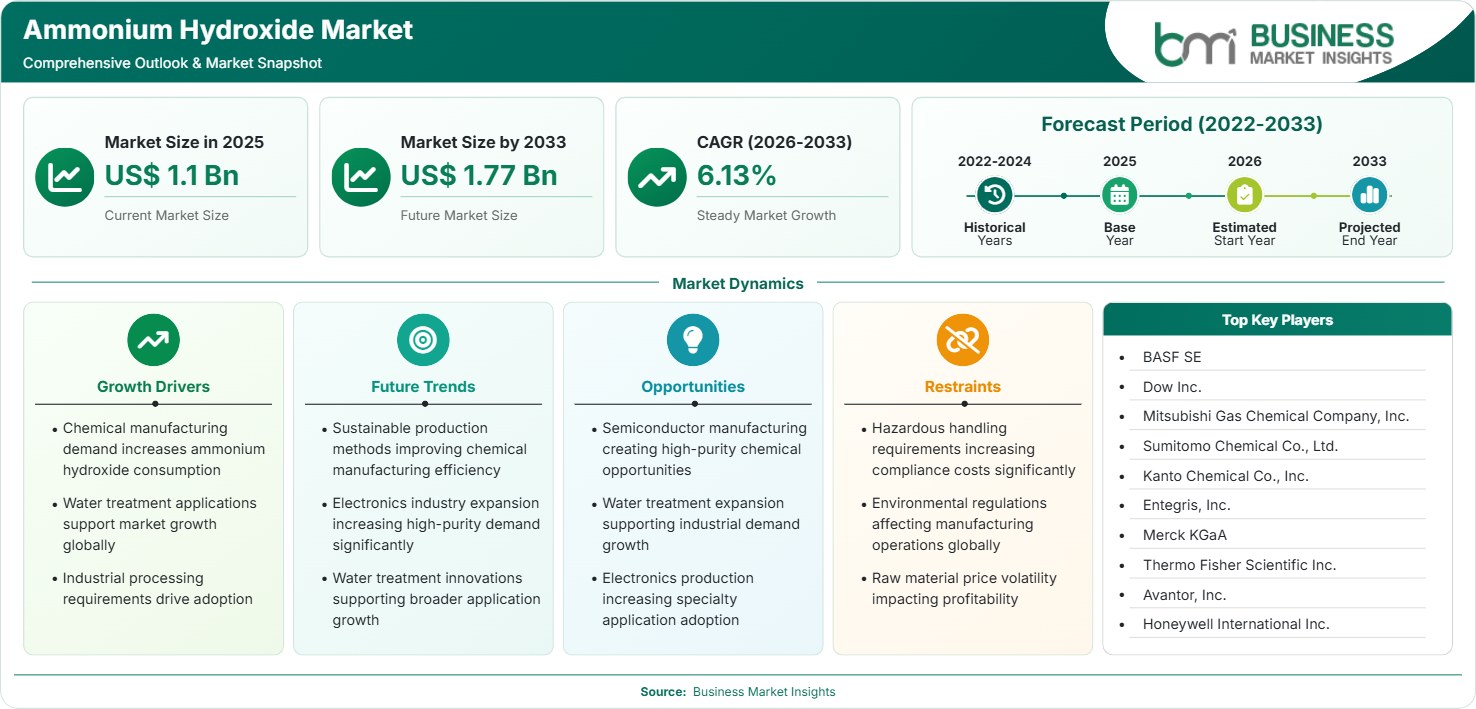
The Ammonium Hydroxide Market size was valued at US$ 1.1 Billion in 2025 and is projected to reach US$ 1.77 Billion by 2033, growing at a CAGR of 6.13% during 2026–2033, driven by chemical processing, semiconductor manufacturing, pharmaceutical production, and expanding water treatment requirements.

Report Coverage
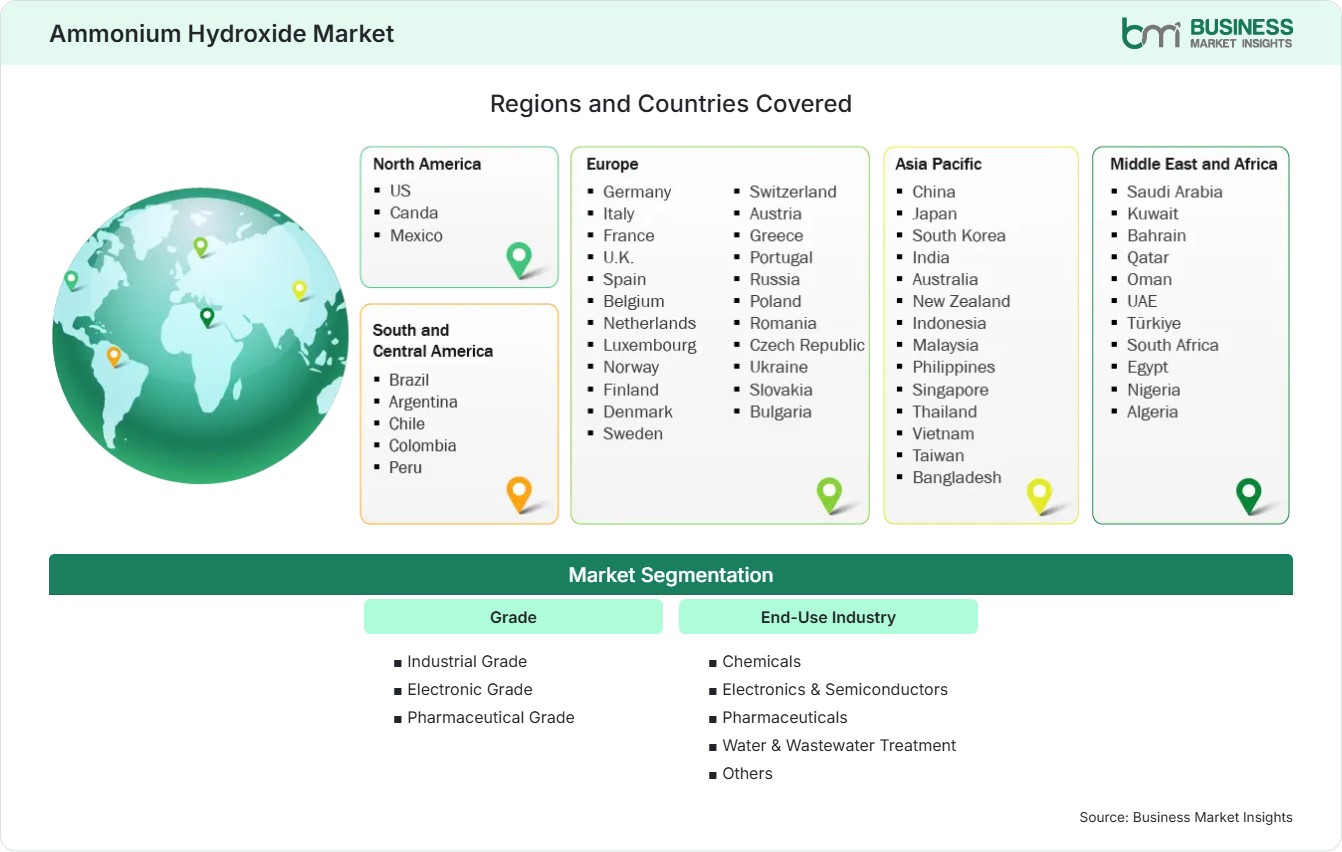
  • Grade: Industrial Grade, Electronic Grade, Pharmaceutical Grade
  • End-Use Industry: Chemicals, Electronics & Semiconductors, Pharmaceuticals, Water & Wastewater Treatment, Others
US$ 1.1 Bn Market size in 2025
US$ 1.77 Bn Market Size by 2033
6.13% CAGR, 2026 - 2033
2026-2033 Forecast Period

AI Overview

Ammonium Hydroxide Market Summary

  • North America Region: North America holds an estimated 24%–28% share in 2025, with a CAGR of 5.0%–6.0% during 2026–2033. Demand is supported by chemical processing, industrial water treatment, pharmaceutical manufacturing, and investments in domestic semiconductor capacity. The United States benefits from established chemical supply chains, advanced manufacturing, and demand for high-purity process chemicals.
  • Fastest Growing Region: Asia Pacific accounts for an estimated 35%–39% Ammonium Hydroxide Market share in 2025, with a CAGR of 6.5%–7.5% during 2026–2033. Expanding semiconductor fabrication, electronics manufacturing, chemical production, and infrastructure investment support regional consumption, particularly in China, India, Japan, South Korea, and Taiwan.
  • Leading Segment: Industrial Grade accounts for an estimated 58%–64% share in 2025, with a CAGR of 5.0%–6.0% during 2026–2033. Broad adoption in chemical manufacturing, pH adjustment, industrial cleaning, and wastewater treatment sustains demand across established manufacturing industries and large-volume procurement networks.
  • High Growth Segment: Electronics and Semiconductors represent an estimated 19%–24% share in 2025, with a CAGR of 7.0%–9.0% during 2026–2033. Semiconductor capacity additions, wafer-cleaning requirements, and demand for contamination-controlled chemicals create opportunities for suppliers investing in electronic-grade purification and reliable local distribution.
  • Key Market Opportunity: Investment in high-purity production, semiconductor-grade chemical supply, and automated dispensing systems offers suppliers opportunities to secure long-term customer relationships, improve product consistency, and serve increasingly demanding manufacturing processes.
  • Major Market Players: BASF SE, Dow Inc., Mitsubishi Gas Chemical Company, Inc., Sumitomo Chemical Co., Ltd., Kanto Chemical Co., Inc., Entegris, Inc., Merck KGaA, Thermo Fisher Scientific Inc., Avantor, Inc., and Honeywell International Inc.
Strategic Insights

Ammonium Hydroxide Market: Strategic Insights

Ammonium Hydroxide Market Strategic Framework
FREE PDF
Request your free sample
Request free sample
Stakeholder View

Key Takeaways

  • Competitiveness depends on more than ammonia availability. Producers need reliable water quality, concentration control, storage capacity, transport arrangements, and packaging suitable for the customer's application. Partnerships between bulk chemical producers and specialty distributors can connect large-volume supply with demanding end-user specifications.
  • The ability to differentiate lies in the purity, traceability, and quality assurance offered by electronic-grade and pharmaceutical-grade products. Although industrial-grade quantities remain important, specialized products can strengthen customer relationships, as their qualification requirements and process consistency influence customers' purchase decisions.
  • The focus of investment should be on better filtration, monitoring for contamination, using closed transfer systems, automating the dosing process, and packaging, which reduce exposure during storage and delivery. Suppliers of electronic-grade materials must ensure that their purification and analytical methods meet the requirements of advanced semiconductor manufacturing.
  • The Asia Pacific region provides a highly attractive mix of large-scale chemical manufacturing and demand for electronics, whereas Europe has opportunities in the area of locally producing high-purity chemicals, and the United States has potential due to its investments in semiconductors, its existing pharmaceutical production, and its industrial water treatment.
  • When making investment decisions, one should focus on contracted demand, the level of facility utilization, proximity to customers, and the cost of qualifying new products; long-term supply agreements and technical partnerships are capable of reducing commercial uncertainty in cases where customers require a great deal of testing before switching suppliers.
  • The ammonia price fluctuations, as well as the costs of energy and water, the transport needs, the requirements relating to the environment, and the degree of concentration of customers should all be taken into account together. Protection of continuous operations is possible through diversified sourcing and the preparation of contingency plans when production is based on a small number of qualified chemical suppliers.
Geographic Outlook

Ammonium Hydroxide Market Regional Highlights

North America Ammonium Hydroxide Market

North America represents an estimated 24%–28% Ammonium Hydroxide Market share of global revenue in 2025, with a CAGR of 5.0%–6.0% during 2026–2033. Demand reflects established chemical manufacturing, industrial cleaning, pharmaceutical production, and wastewater treatment. Semiconductor investment adds a higher-purity demand stream, although industrial applications continue to support substantial volumes.

  • Expert chemical manufacturers use aqueous ammonia for purposes such as adjusting the pH, neutralizing substances, and preparing formulations. The amount required is determined by the plant's operating rates, the economic aspects of production, and the availability of ammonia-based materials within the industrial supply chains.
  • Alkaline chemicals are used by municipal and industrial facilities to regulate process conditions. The process of procuring these chemicals is based on the treatment design, the requirements relating to water chemistry, safety considerations, and the need for reliable deliveries to facilities that cannot easily stop their operations.
  • The creation of new manufacturing capacity offers opportunities to electronic-grade suppliers who are capable of meeting strict impurity specifications. The qualification processes, the use of special containers, and the reliability of delivery all affect the choice of supplier and the economic aspects of local production.
  • Pharmaceutical plants need to have strict specifications and must keep records of the quality of each batch. Suppliers that provide traceability, a consistent concentration, and reliable technical support are able to win over repeated orders for use in both manufacturing and laboratory activities.

US Ammonium Hydroxide Market

The United States is estimated to account for 82%–88% of North American Ammonium Hydroxide Market revenue in 2025, with a CAGR of 5.0%–6.0% during 2026–2033. Its position reflects a broad industrial customer base, established chemical production, and semiconductor and pharmaceutical investment.

  • Investment in semiconductor manufacturing leads to a demand for electronically graded chemicals that are of a suitable quality. Chemical suppliers have to demonstrate that their products maintain stable purity, have effective contamination control, are reliably replenished, and are compatible with cleanroom operating procedures.
  • Alkaline reagents are used in wastewater treatment and for process control, and the demand for them is determined by the characteristics of the wastewater, the volume of wastewater treated, the need for continuous operation, and the cost of safely handling the chemicals.
  • Pharmaceutical and laboratory customers place importance on having documented specifications, being able to trace batches, and gaining consistent reagent performance. Specialty distributors can reinforce their standing by combining the availability of their products with technical documentation and customer support.
  • The advantages of domestic supply are based on regional storage, the use of appropriate containers, and the presence of skilled handling teams. It is especially important to have a reliable distribution system when customers run continuous processes and keep only small inventories of essential chemicals.

Europe Ammonium Hydroxide Market

Europe is estimated to represent 20%–24% of global Ammonium Hydroxide Market revenue in 2025, with a CAGR of 5.0%–6.0% during 2026–2033. Germany is a leading market because of its chemical manufacturing base and semiconductor-related investments.

  • The demand for industrial and high-purity products is supported by investments in chemical manufacturing and in semiconductors. The fact that BASF is planning to build an electronic-grade ammonium hydroxide plant in Ludwigshafen is an example of steps being taken to secure local supplies for the production of advanced chips.
  • Industrial processing, the pharmaceutical industry, and the production of specialty chemicals help to meet continuous consumption. Since customers place importance on consistent product specifications and well-established quality procedures, this presents opportunities for suppliers with a wide range of chemicals and technical services.
  • The infrastructure for advanced manufacturing, chemical distribution, and regional logistics helps customers to access the products. To meet the needs of customers who require smaller, more frequent shipments or have special product documentation, suppliers can use existing distribution networks.
  • European chemical suppliers have to meet the relevant requirements regarding classification, labeling, workplace safety, and the environment. While investments in safer storage, traceability, and process controls can help to gain access to the market, they also increase the complexity of operations.
  • The expansion of semiconductor capacity presents a clear opportunity for electronic-grade solutions; Germany is well-placed to achieve growth through investment, while other manufacturing centers can take advantage of customer qualification programs and the demand for a reliable local supply.

Asia Pacific Ammonium Hydroxide Market

Asia Pacific is estimated to account for 35%–39% of global Ammonium Hydroxide Market revenue in 2025, with a CAGR of 6.5%–7.5% during 2026–2033. China, Japan, South Korea, Taiwan, and India contribute through chemical manufacturing, electronics, pharmaceuticals, and industrial water treatment.

  • The large-scale production of chemicals and the manufacture of electronics give rise to extensive demand. Opportunities arise for suppliers who can provide reliable quantities and meet the specific requirements of various applications because of domestic sourcing, the demands of industrial processes, and the investment made in semiconductor capabilities.
  • The ability to carry out advanced semiconductor processing together with existing expertise in specialty chemicals enables the production of high-purity products, and customers place great importance on analytical consistency, on preventing contamination, and on the supplier's long-term performance.
  • The production of semiconductors and the manufacturing of electronic equipment involve a special kind of chemical demand. Suppliers have to match their quality systems, packaging, and delivery schedules with the production needs of their customers and with the strict process-control requirements.
  • The development of pharmaceutical manufacturing, chemical processing, and water infrastructure provides opportunities for the production of industrial and pharmaceutical-grade products. It is still important to have broad distribution and to maintain reliable records of product quality to serve customers in different areas.

Rest of World Ammonium Hydroxide Market

South and Central America are estimated to account for 5%–8% of global Ammonium Hydroxide Market revenue in 2025, with demand linked to chemical processing, industrial cleaning, pharmaceutical production, and water treatment.

  • The demand for chemical manufacturing and industrial water treatment is continuous. Having the ability to distribute locally, ensuring a reliable supply, and using appropriate packaging all help in gaining access to industrial customers who are located outside of the main production areas.
  • The manufacturing supply chains and pharmaceutical operations are designed to meet demand; being close to North America's industrial networks provides distributors with the chance to keep reliable stocks and meet customers' documentation requirements.
  • Industrial development and the facilities for the use of water meet the demand for chemicals. Before increasing its distribution capacity, each supplier has to assess the storage conditions, the transport requirements, the concentration of customers, and the local compliance regulations.
  • People who deal in chemicals have the chance to get involved in industrial processing and the management of water. It is important to offer reliable delivery, technical support, and the correct handling procedures when customers are at risk of experiencing supply interruptions or long lead times for imports.
  • Customers who are dependent on imports could get advantages from having goods stored regionally and by using smaller shipment sizes. Forming partnerships with suppliers can increase the availability of products while at the same time reducing the amount of capital needed to set up local manufacturing operations.
Global Market Geography
FREE PDF
Request your free sample
Request free sample
Segment Analysis

Ammonium Hydroxide Market Segmentation

Grade

Grade determines purity requirements, quality controls, pricing structures, and the types of customers a supplier can serve. Industrial Grade is estimated to hold 58%–64% share in 2025, with a CAGR of 5.0%–6.0% during 2026–2033. These distinctions shape manufacturing investments, customer qualification, analytical testing, and distribution requirements across the Ammonium Hydroxide Market.

  • Industrial Grade: Industrial-grade solutions support chemical processing, pH control, cleaning, and wastewater treatment. Buyers prioritize consistent concentration, cost-effective delivery, process compatibility, and dependable supply for recurring high-volume applications.
  • Electronic Grade: Electronic-grade products require rigorous impurity control and contamination prevention. Semiconductor manufacturers use them in wafer cleaning and related precision processes, creating demand for specialized packaging, analytical testing, and qualified supply chains.
  • Pharmaceutical Grade: Pharmaceutical-grade solutions serve regulated manufacturing and laboratory applications requiring defined specifications, traceability, and documented quality. Demand depends on process suitability, customer validation, supplier qualification, and applicable pharmacopeial or internal standards.

End-Use Industry

End-use requirements determine purchasing volumes, purity specifications, handling procedures, and supplier qualification. Chemicals are estimated to remain the largest end-use category, with a 34%–40% Ammonium Hydroxide Market share in 2025 and a CAGR of 5.0%–6.0% during 2026–2033.

  • Chemicals: Chemical manufacturers use ammonium hydroxide in formulation, neutralization, pH adjustment, and process control. Consumption follows production volumes, plant utilization, input costs, and the technical requirements of individual chemical processes.
  • Electronics and Semiconductors: Semiconductor manufacturers use high-purity solutions in wafer cleaning and related fabrication steps. Demand depends on fab capacity, process complexity, supplier qualification, contamination controls, and dependable delivery to specialized manufacturing environments.
  • Pharmaceuticals: Pharmaceutical producers and laboratories use specified grades for suitable processing and analytical applications. Buyers emphasize consistent composition, batch documentation, traceability, and supplier quality systems aligned with intended use.
  • Water and Wastewater Treatment: Municipal and industrial facilities use alkaline solutions for process adjustment and treatment operations. Demand depends on flow volumes, water chemistry, treatment design, environmental obligations, and operational continuity.
Market Forces

Ammonium Hydroxide Market Dynamics

Key Market Drivers

Growing Demand for Chemical Processing and Industrial pH Control

Ammonium hydroxide is used in chemical formulation, neutralization, cleaning, and pH adjustment, supporting recurring industrial consumption. Its suitability for aqueous processing allows manufacturers to incorporate it into established production systems without requiring a dry reagent in every application. The Ammonium Hydroxide Market growth therefore depends on manufacturing activity, chemical plant utilization, and the cost competitiveness of ammonia-based inputs.

Semiconductor Manufacturing and High-Purity Chemical Requirements

Semiconductor manufacturing creates demand for electronic-grade solutions used in wafer cleaning and precision processing. As chip production becomes more complex, manufacturers pay closer attention to trace-metal impurities, particle contamination, packaging integrity, and batch consistency. These requirements distinguish electronic-grade products from conventional industrial solutions and create opportunities for suppliers with specialized purification and analytical capabilities. The Ammonium Hydroxide Market trends in this application include local sourcing, supplier qualification, and closer technical coordination between chemical producers and fabrication facilities.

Industrial Water Treatment and Process Efficiency

Water and wastewater treatment facilities require reliable chemicals to manage process conditions and support treatment performance. Ammonium hydroxide can serve as an alkaline reagent where the treatment design and water chemistry make it suitable. Industrial sites also use chemical dosing to maintain operating conditions and manage process streams. Ammonium Hydroxide Market Demand is influenced by facility throughput, treatment technology, water quality, and environmental discharge requirements rather than infrastructure spending alone.

Key Market Opportunities

Expansion of Electronic-Grade Production Near Semiconductor Hubs

Setting up electronic-grade production capacity near areas with a high concentration of semiconductor companies can reduce delivery time and enhance supply chain continuity. When making investment decisions, one should take into account the announced fabrication projects, the schedules for customer qualification, the local utilities, the quality of the water, and the availability of specialized analytical equipment. The fact that BASF is planning a facility in Ludwigshafen shows how producers are linking their investments in high-purity chemicals with the demand for chips in Europe. Suppliers can make the business case for their investments stronger by entering into long-term agreements with customers and by carrying out coordinated qualification programs.

Specialty Grades for Pharmaceutical and Laboratory Applications

Suppliers can target pharmaceutical and laboratory customers by providing consistent specifications, traceable batches, and documentation suitable for the intended purpose. Growth should be directed towards applications which have definite quality requirements rather than supposing that every pharmaceutical process needs the same grade. Companies and distributors can distinguish themselves by offering analytical certificates, using controlled packaging, implementing effective inventory management, and providing responsive technical support.

Integrated Distribution and Automated Chemical Management

Industrial customers increasingly value reliable deliveries, safe transfer systems, and predictable chemical availability. Suppliers can develop integrated service offerings that combine ammonium hydroxide with suitable storage, dosing equipment, inventory monitoring, and technical support. Such arrangements can improve customer retention by connecting product supply to operating performance. Ammonium Hydroxide Market Opportunities are strongest at facilities with continuous treatment processes, multiple consumption points, or limited on-site storage.

Market Restraints and Challenges

Ammonia Feedstock Volatility and Delivered-Cost Pressure

The price of ammonia feedstock varies in accordance with changes in natural gas prices, conditions in the energy markets, production outages, the availability of transport, and the regional balances between supply and demand. The costs associated with water treatment, storage, packaging, and distribution also add to the final price of the solution. As a result, if costs rise suddenly, producers' margins can be squeezed because customer contracts do not allow immediate price changes; buyers might delay purchases, renegotiate supply terms, or consider alternative chemicals when price differences become significant.

Hazardous Handling, Environmental Compliance, and Quality Requirements

The substance ammonium hydroxide gives off ammonia vapor and may result in serious irritation or chemical damage, the extent depending on the concentration and the length of exposure; it is therefore necessary to carefully manage all aspects relating to its storage, ventilation, containment, transport, worker training and emergency procedures. In the case of electronic-grade and pharmaceutical uses, analytical testing, documentation and customer qualification are also required. As a result, the costs of regulatory compliance increase, and market entry can be delayed, especially when suppliers enter higher-purity application areas or new jurisdictions.

Company Analysis

Competitive Landscape

The competitive landscape combines large chemical manufacturers, electronic-material specialists, and laboratory reagent suppliers. Competitive differentiation rests on feedstock access, product consistency, purity assurance, production scale, distribution coverage, and customer qualification. The following companies are relevant participants in the broader supply ecosystem; their inclusion does not imply equal market shares or participation across every grade.

Company Name

Overview

Products and Services relevant to this market

BASF SE

Global chemical manufacturer with industrial chemical capabilities and electronic-material investments serving advanced manufacturing customers.

Industrial chemicals, specialty formulations, and electronic-grade ammonium hydroxide production planned at Ludwigshafen.

Dow Inc.

Diversified materials and chemical producer with extensive industrial customer relationships and global manufacturing operations.

Chemical processing solutions and industrial chemical capabilities relevant to manufacturing and process applications.

Mitsubishi Gas Chemical Company, Inc.

Japanese chemical producer with specialty chemical and electronic-material capabilities serving advanced industrial applications.

Electronic materials and specialty chemicals supporting semiconductor-related manufacturing supply chains.

Sumitomo Chemical Co., Ltd.

Diversified Japanese chemical company serving industrial, pharmaceutical, and advanced materials markets.

Industrial and specialty chemicals, electronic materials, and chemical solutions for manufacturing applications.

Kanto Chemical Co., Inc.

Japanese specialty chemical supplier with expertise in high-purity reagents and semiconductor process chemicals.

High-purity chemicals and reagents for semiconductor manufacturing, laboratories, and analytical applications.

Entegris, Inc.

Advanced materials and contamination-control company serving semiconductor manufacturing and other high-technology industries.

Specialty chemicals, filtration, purification, contamination control, and materials management for semiconductor processes.

Merck KGaA

Science and technology company with life science, healthcare, and electronics businesses.

Laboratory reagents, electronic materials, and specialty chemical products serving research and advanced manufacturing customers.

Thermo Fisher Scientific Inc.

Scientific products and services provider supplying reagents, laboratory chemicals, and analytical products globally.

Ammonium hydroxide reagents, laboratory chemicals, and related scientific supply services across multiple grades.

Avantor, Inc.

Global supplier of high-purity materials and services for biopharmaceutical, healthcare, and advanced technology markets.

High-purity chemicals, laboratory reagents, and specialty chemical distribution for controlled manufacturing environments.

Honeywell International Inc.

Diversified technology and specialty materials company with chemical and analytical product capabilities.

Specialty chemical and laboratory reagent offerings relevant to selected industrial and analytical applications.

Trust & Transparency

Research Methodology

The market analysis combines proprietary research with secondary data from government agencies, company disclosures, regulatory filings, industry databases and expert interviews. Market estimates are validated through data triangulation, cross-market benchmarking and analyst review.

View Full Research Methodology

Questions Answered

Frequently Asked Questions

What should investors assess before entering the ammonium hydroxide business?

The Ammonium Hydroxide Market Report highlights that Investors should examine customer demand by grade, regional supply gaps, feedstock access, environmental and safety obligations, storage infrastructure, and qualification costs. High-purity opportunities require particular attention to contamination controls, analytical testing, customer approval timelines, and the availability of long-term supply agreements.

How do ammonia prices influence purchasing and profitability?

Ammonia is the principal feedstock, so changes in its price and associated energy and logistics costs affect production economics.

Why is electronic-grade production attracting investment in Europe?

Semiconductor manufacturing investments create demand for locally available, high-purity process chemicals.

Which factors should buyers evaluate when selecting an ammonium hydroxide supplier?

Buyers should assess concentration consistency, impurity specifications, batch documentation, packaging compatibility, delivery reliability, safety procedures, and total delivered cost.

What determines the difference between industrial-grade and electronic-grade ammonium hydroxide?

Industrial-grade products serve bulk chemical processing, cleaning, and treatment applications, where specifications depend on the process.

Access the Full Ammonium Hydroxide Market Report

Get segment-level forecasts, regional estimates, competitive benchmarking, company profiles and downloadable Excel datasets.

Access the full Ammonium Hydroxide Market Report
350 pages PDF & Excel | 2026-11-03
Similar Research

Related Market Reports