Market Summary
Executive Summary and Global Market Analysis
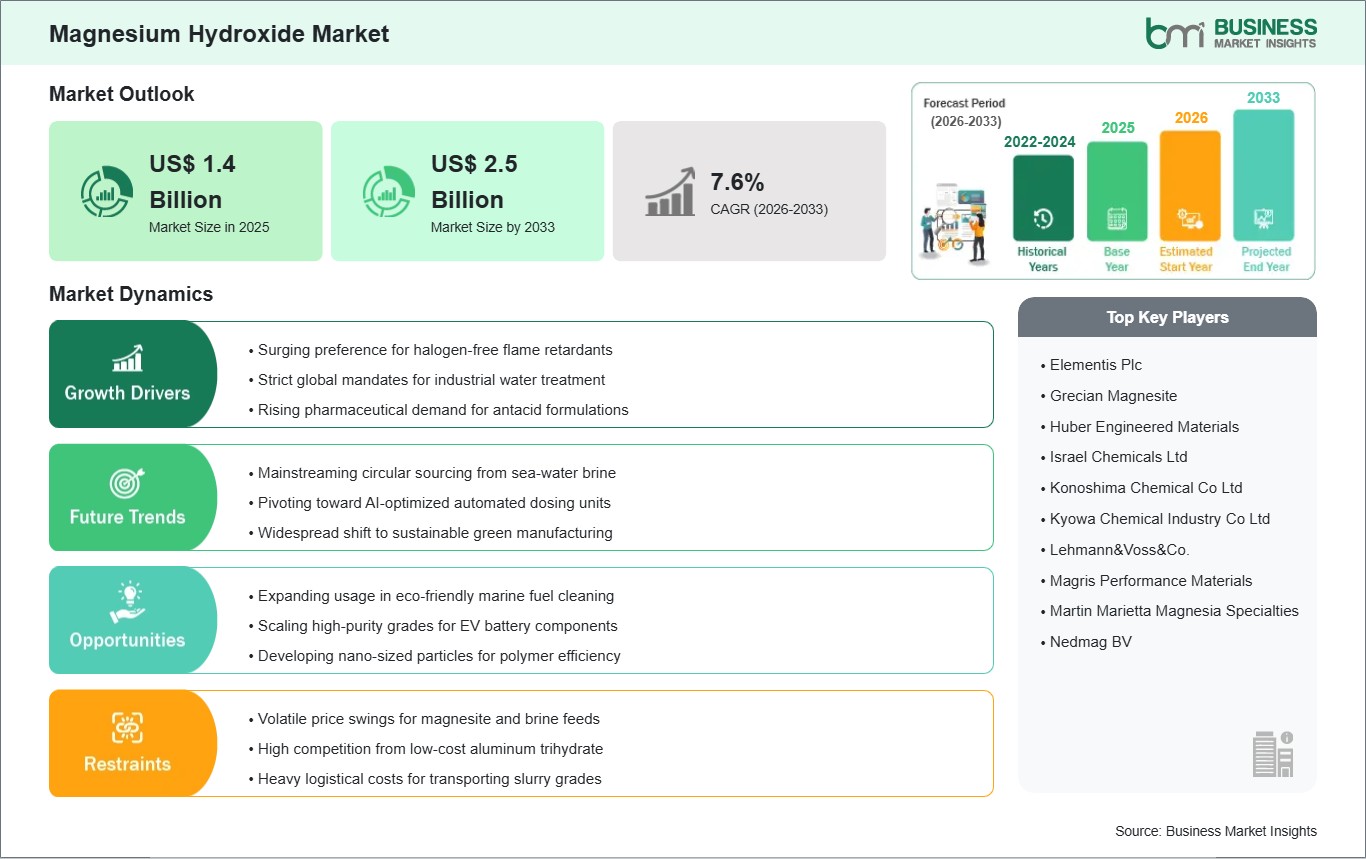
Magnesium Hydroxide (Mg (OH)-) is a versatile inorganic alkaline chemical, widely valued for its non-toxic, eco-friendly properties, particularly as a neutralizing agent and non-halogenated flame retardant. This compound is essential for core sectors: Environmental Protection (Wastewater Treatment & Flue Gas Desulphurization), Flame Retardants (Plastics & Polymers), and Pharmaceuticals. Magnesium Hydroxide offers advantages including highly efficient acid neutralization (superior to caustic soda in certain applications), effective smoke suppression and heat absorption in polymers, and its use as a safe, gentle antacid and laxative in medicine. The market is fueled by increasingly stringent global environmental regulations driving the need for efficient pollution control (FGD and wastewater), the massive shift away from toxic halogenated flame retardants in construction and electronics, and the consistent demand from the growing pharmaceutical sector.
However, several challenges restrain market growth: significant price volatility of feedstocks (Magnesite ore or seawater/brine) creates cost uncertainty for manufacturers. Competition from established, cheaper alternatives such as calcium carbonate (lime) and sodium hydroxide (caustic soda) in neutralizing applications limits market share, despite Magnesium Hydroxide's superior non-toxic profile. Furthermore, the industry faces constraints due to the need for precise particle size and purity control for high-end applications (flame retardants and pharma), requiring complex and costly manufacturing processes. Despite these hurdles, opportunities arise due to the accelerated adoption of ultrafine and surface-treated magnesium hydroxide. Grades for enhanced flame retardancy in advanced polymers, the expansion into specialized electronic and EV components where high thermal performance is critical, and substantial market dominance and growth in the Asia-Pacific region due to intense industrial and municipal wastewater treatment needs.
Segment Analysis
Magnesium Hydroxide Market Segmentation
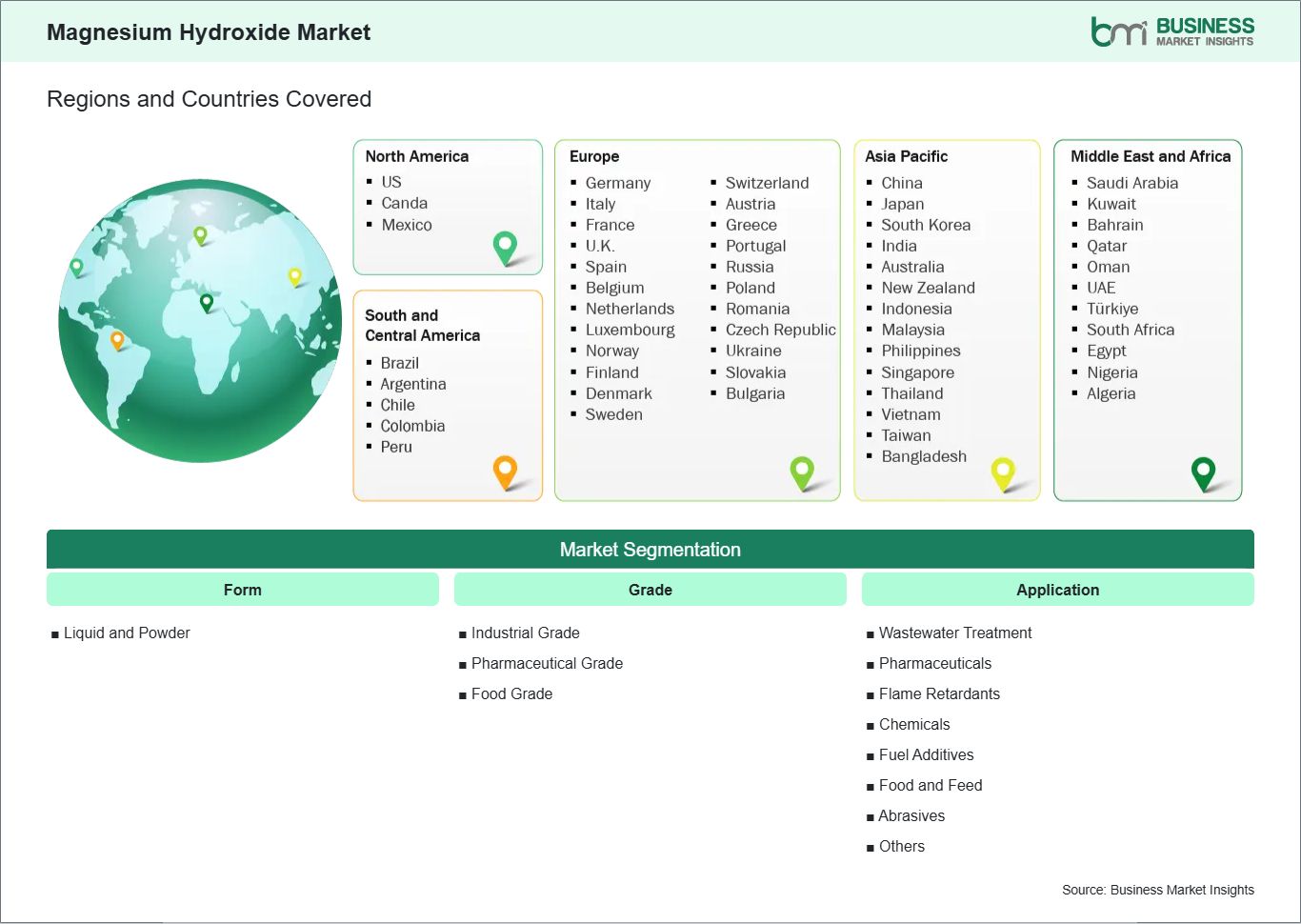
Key segments that contributed to the derivation of the Magnesium Hydroxide Market analysis are form, grade, and application.
- By Form, the market is segmented into Liquid and Powder.
- By Grade, the market is segmented into Industrial Grade, Pharmaceutical Grade, and Food Grade.
- By Application, the market is segmented into Wastewater Treatment, Pharmaceuticals, Flame Retardants, Chemicals, Fuel Additives, Food and Feed, Abrasives, and Others.
Market Forces
Magnesium Hydroxide Market Drivers and Opportunities
Growing Demand for Non-Halogenated Flame Retardants
Magnesium Hydroxide is essentially used as a non-toxic, non-halogenated flame retardant and smoke suppressant in the plastics, rubber, and construction industries. Stringent global safety regulations, particularly in Europe and North America, are forcing manufacturers to phase out traditional halogenated flame retardants due to concerns over their release of highly corrosive and toxic smoke during a fire. Magnesium hydroxide offers an environmentally friendly and safer alternative. Its flame-retardant mechanism is superior: when subjected to heat (over 340-°C), Magnesium Hydroxide decomposes to magnesium oxide (MgO) and water vapor. This process absorbs heat, cooling the polymer, while the released water vapor dilutes combustible gases, effectively suppressing fire and smoke generation without releasing harmful fumes. This unique, eco-safe performance secures its demand in high-growth sectors such as electric vehicle components, wire/cable insulation, and building materials.
Superior Neutralization and Environmental Applications
A key opportunity for market expansion lies in magnesium hydroxide’s superior acid neutralization properties in environmental management and its ability to act as a replacement for harsher industrial alkalis. Magnesium hydroxide is an alkaline agent used extensively in wastewater treatment and flue gas desulfurization (FGD). Unlike strong bases such as sodium hydroxide or lime, Magnesium Hydroxide is a mild alkali, allowing for gradual, self-regulating pH control. This gentler action minimizes scaling, reduces the total volume of sludge generated, and is highly effective in neutralizing acidic industrial effluent and removing heavy metals. Furthermore, the push for cleaner air and acid rain control drives its demand in FGD systems to capture sulfur dioxide. This trend, coupled with the need for high-purity grades in the pharmaceutical sector (as an antacid and laxative), offers significant diversification and high-margin growth outside of bulk industrial uses.
Magnesium Hydroxide Market Size and Share Analysis
The Magnesium Hydroxide Market demonstrates steady growth, with size and share analysis revealing evolving trends and competitive positioning among key players. The report further examines subsegments categorized within form, grade, and application, offering insights into their contribution to overall market performance.
For instance, the Industrial Grade of magnesium hydroxide, predominantly produced in Liquid slurry, holds a significant share of the market due to its widespread use in Wastewater Treatment. This segment is primarily driven by the compound's efficiency as a non-hazardous alkaline agent for pH neutralization and heavy metal precipitation, outperforming traditional alternatives like caustic soda in environmental safety and ease of handling.
Size and Share Analysis
Magnesium Hydroxide Market Size and Share Analysis
The Magnesium Hydroxide Market demonstrates steady growth, with size and share analysis revealing evolving trends and competitive positioning among key players. The report further examines subsegments categorized within form, grade, and application, offering insights into their contribution to overall market performance.
For instance, the Industrial Grade of magnesium hydroxide, predominantly produced in Liquid slurry, holds a significant share of the market due to its widespread use in Wastewater Treatment. This segment is primarily driven by the compound's efficiency as a non-hazardous alkaline agent for pH neutralization and heavy metal precipitation, outperforming traditional alternatives like caustic soda in environmental safety and ease of handling.
Report Coverage
Magnesium Hydroxide Market Report Coverage and Deliverables
The "Magnesium Hydroxide Market Size and Forecast (2022–2033)" report provides a detailed analysis of the market covering below areas:
- Magnesium Hydroxide Market size and forecast at global, regional, and country levels for all the key market segments covered under the scope
- Magnesium Hydroxide Market trends, as well as market dynamics such as drivers, restraints, and key opportunities
- Magnesium Hydroxide Market analysis covering key market trends, global and regional framework, major players, regulations, and recent market developments
- Industry landscape and competition analysis covering market concentration, heat map analysis, prominent players, and recent developments for the Magnesium Hydroxide Market
- Detailed company profiles, including SWOT analysis
Geographic Insights
Magnesium Hydroxide Market Geographic Insights
The geographical scope of the Magnesium Hydroxide Market report is divided into five regions: North America, Asia Pacific, Europe, the Middle East & Africa, and South & Central America.
The Asia-Pacific Magnesium Hydroxide Market is segmented into Australia, China, India, Japan, South Korea, Indonesia, Malaysia, the Philippines, Singapore, Thailand, Vietnam, Bangladesh, New Zealand, and Taiwan. The Asia-Pacific market is driven by rapid industrialization and increasingly stringent environmental regulations on wastewater and emissions. China and India lead the consumption, fueled by soaring demand in wastewater treatment (for pH neutralization and heavy metal removal) and flue gas desulfurization (FGD).
Growth is further accelerated by the region's position as a global electronics and automotive manufacturing hub, which drives the demand for non-halogenated flame retardants (such as magnesium hydroxide) as an eco-friendly and safer alternative in plastics, cables, and EV battery casings. The expanding pharmaceutical sector (for antacids) and the abundant local feedstock availability also secures Asia-Pacific's dominance in the global market.
Industry Activity
Recent Developments
The Magnesium Hydroxide Market is evaluated by gathering qualitative and quantitative data post-primary and secondary research, which includes important corporate publications, association data, and databases. A few of the key developments in the Magnesium Hydroxide Market are:
- In May 2025, J.M. Huber Corporation (a global leader in the production of fine precipitated alumina trihydrate and magnesium hydroxide, both non-halogenated fire retardants) is announced the acquisition of The R.J. Marshall Company's Alumina Trihydrate (ATH), Antimony-Free Flame Retardant, and Molybdate-Based Smoke Suppressant assets. This acquisition will be incorporated into the Huber Advanced Materials (HAM) strategic business unit of Huber Engineered Materials—an operating company of J.M. Huber Corporation.
- In December 2025, Magrathea Metals and Tidal Metals (magnesium start-ups) are making plans to start production of the metal in the US. The US Departments of Defense, Interior, and Energy all list magnesium as critical because its alloys are lightweight and strong.
Trust & Transparency
Research Methodology
The market analysis combines proprietary research with secondary data from government agencies, company disclosures, regulatory filings, industry databases and expert interviews. Market estimates are validated through data triangulation, cross-market benchmarking and analyst
review.
View Full Research Methodology
Key Sources Referred:
World Bank – Global Trade IndicatorsWorld Trade Organization (WTO)International Monetary Fund (IMF)International Trade Administration (ITA)Company WebsitesCompany Annual ReportsCompany Investor Presentations