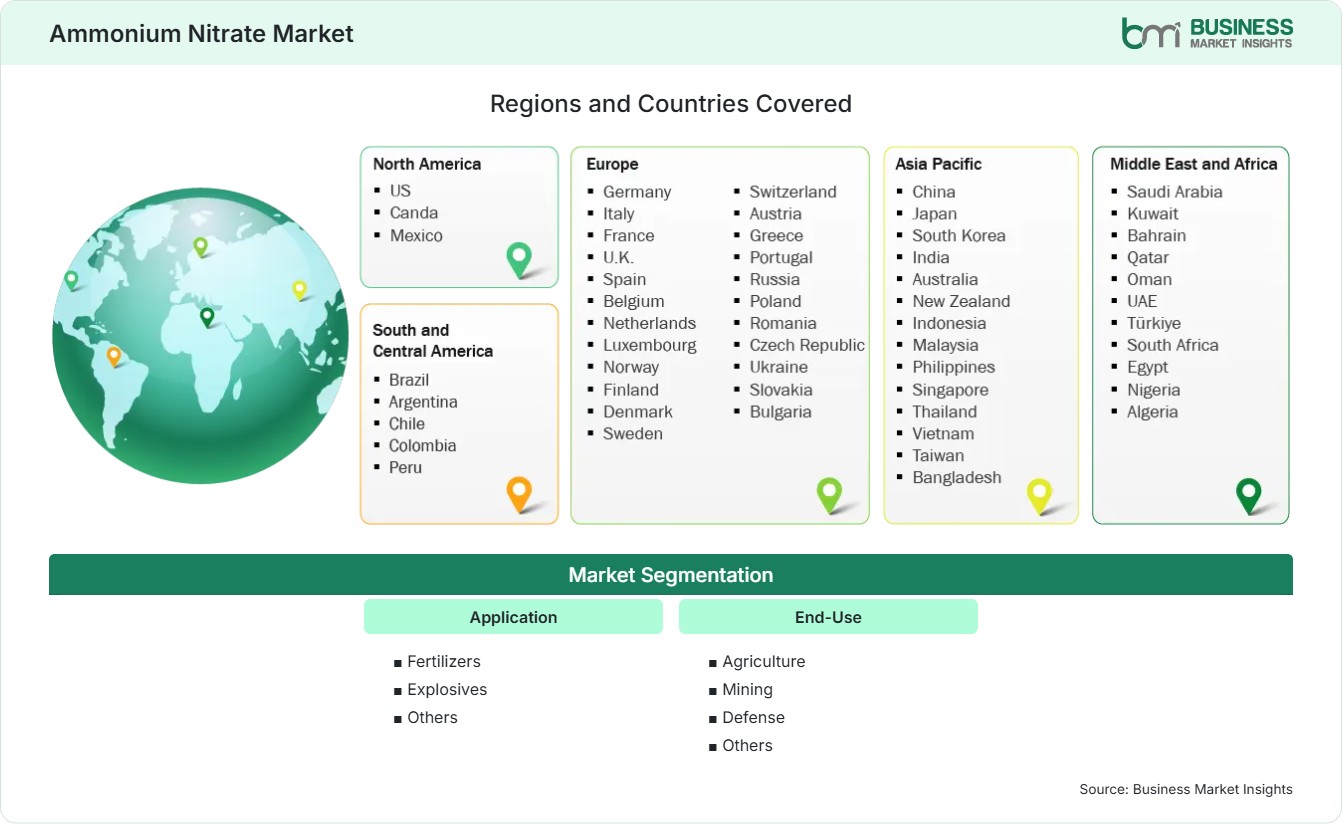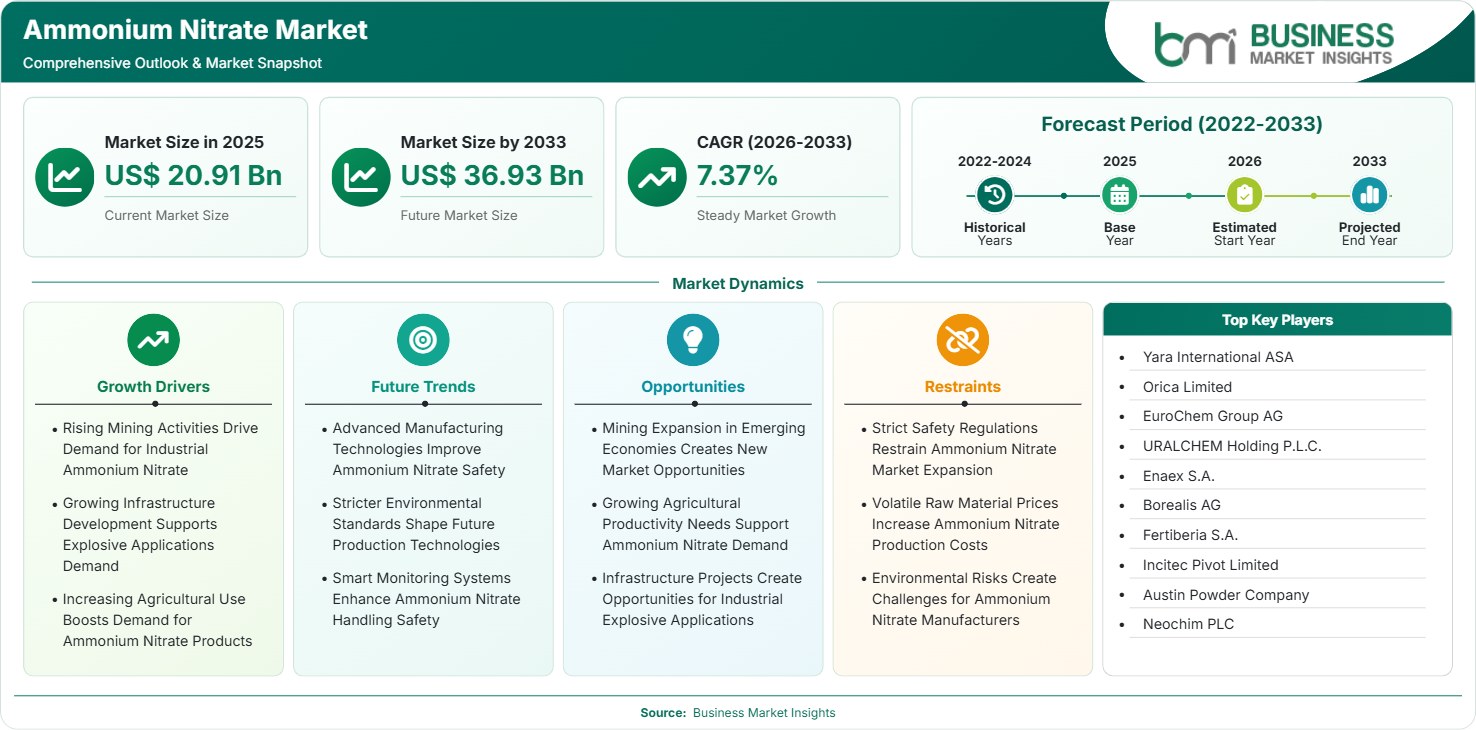
Ammonium Nitrate Market Regional Highlights
North America Ammonium Nitrate Market
North America holds a 28%–32% share of the Ammonium Nitrate Market in 2025 and is projected to grow at a CAGR of 6.4%–7.2% through 2033. The region benefits from large-scale agriculture, mining, quarrying, and infrastructure investment. The United States represents the primary demand center, while Canada contributes through agricultural consumption and resource extraction.
- The agricultural demand is structurally significant due to the need for constant nitrogen supply in order to support effective crop cultivation and therefore continuous fertilizer demand.
- There is also a presence of mining and quarrying that increases industrial demand due to blasting services provided for mining activities.
- Infrastructure investment supports demand from construction-related applications, although regulatory requirements and specialized transportation procedures influence distribution economics.
- Regional producers benefit from established chemical infrastructure, while supply disruptions can increase reliance on imported material and create opportunities for localized capacity expansion.
US Ammonium Nitrate Market
The US represents approximately 72%–76% of North America's Ammonium Nitrate Market share in 2025 and is projected to grow at a CAGR of 6.5%–7.3% through 2033. Agricultural consumption remains a core demand driver, supported by extensive commercial farming. Mining, quarrying, and infrastructure development broaden industrial demand. The market is influenced by strict safety requirements, making supply chain resilience increasingly important for agricultural and industrial customers.
- Large-scale agricultural operations maintain demand for nitrogen fertilizers, particularly where crop productivity depends on timely and efficient nutrient application.
- Mining and quarrying activity supports industrial consumption, with demand linked to resource extraction, construction materials, and infrastructure development.
- Domestic supply reliability remains strategically important because transportation restrictions and production disruptions can influence regional availability and delivered costs.
Europe Ammonium Nitrate Market
Europe holds a 20%–24% share of the Ammonium Nitrate Market in 2025 and is projected to grow at a CAGR of 5.8%–6.6% through 2033. Germany, France, and Poland represent important agricultural demand centers, while Spain and Italy offer comparatively attractive growth opportunities. European producers face stringent safety, environmental, and fertilizer conformity requirements. High-nitrogen ammonium nitrate fertilizers are subject to detonation resistance testing and formal conformity assessment procedures under EU regulatory frameworks.
- Germany and France remain leading agricultural markets, supported by established fertilizer distribution networks and intensive crop production requirements.
- Poland is positioned for steady demand growth as agricultural modernization and regional fertilizer consumption support nitrogen nutrient requirements.
- Spain and Italy provide comparatively higher-growth opportunities, supported by commercial agriculture and demand for productivity-enhancing nutrient management.
- Regulatory compliance remains a major competitive factor, increasing the importance of certified production, safety systems, and controlled supply chains.
Asia Pacific Ammonium Nitrate Market
Asia Pacific holds a 27%–31% share of the Ammonium Nitrate Market in 2025 and is projected to record the fastest regional CAGR of 8.0%–8.8% through 2033. China and India represent major agricultural and industrial demand centers, while Indonesia and Australia provide attractive growth opportunities. Mining investment, infrastructure expansion, agricultural intensification, and industrial development collectively support consumption. Regional demand is also influenced by domestic fertilizer policies, import requirements, production capacity, and evolving controls over ammonium nitrate handling.
- China and India provide substantial agricultural demand, supported by large cultivated areas, food production requirements, and ongoing efforts to improve nutrient efficiency.
- Australia represents an important growth market because mining activity creates sustained requirements for industrial blasting applications and specialized supply networks.
- Indonesia offers growth potential from agricultural development and infrastructure investment, increasing demand across fertilizer and industrial applications.
- Regional production expansion can reduce import dependence, while regulatory controls encourage investment in secure storage, transportation, and distribution infrastructure.
- Mining-led demand provides stronger growth momentum than mature agricultural markets, particularly where mineral extraction investment and infrastructure development advance simultaneously.
Rest of World Ammonium Nitrate Market
South and Central America account for a substantial portion of Rest of World demand, supported by commercial agriculture, mining, and infrastructure development. Brazil remains a leading regional demand center, while Chile and Peru offer strong industrial opportunities linked to mineral extraction. The Middle East and Africa provide additional potential through fertilizer production integration, agricultural development, and mining investment. Saudi Arabia and South Africa represent important markets, while selected African economies offer higher-growth opportunities as agricultural productivity and resource extraction investments expand. The RoW segment holds an 18%–22% share of the Ammonium Nitrate Market in 2025 and is projected to grow at a CAGR of 7.0%–8.0% through 2033.
- Brazil represents a leading agricultural demand center, while Chile and Peru benefit from mining investment and industrial explosive requirements.
- Saudi Arabia benefits from integrated chemical and fertilizer production capabilities, supporting regional supply potential and export-oriented positioning.
- South Africa provides industrial demand through mining activity, while agricultural applications support additional consumption across commercial farming operations.
- Emerging African agricultural markets offer long-term potential as food production requirements increase and fertilizer access improves.