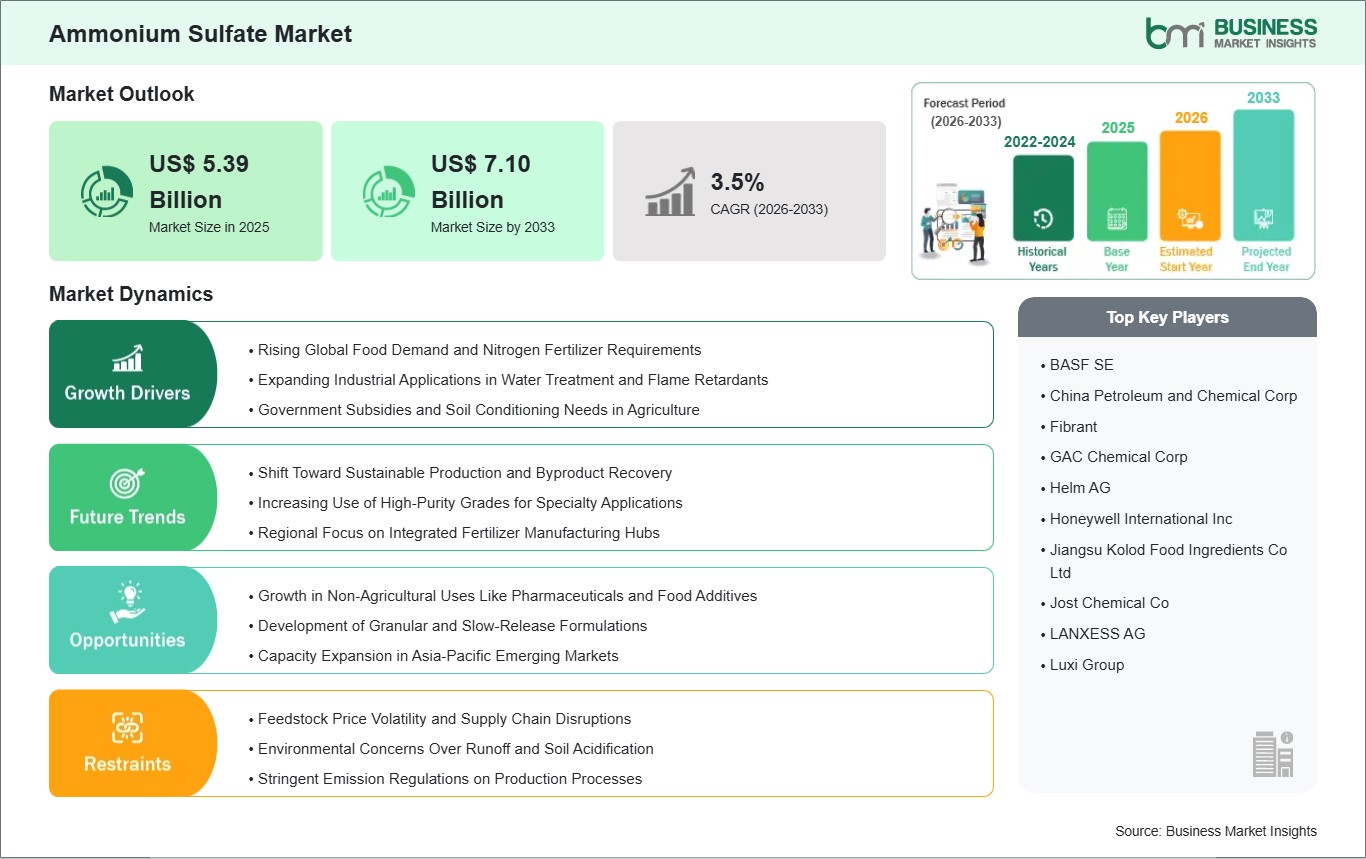
The Ammonium Sulfate market size is expected to reach US$ 7.10 billion by 2033 from US$ 5.39 billion in 2025. The market is estimated to record a CAGR of 3.5% from 2025 to 2033.
Ammonium sulfate is crucial for boosting agricultural productivity by improving soil nutrient balance, increasing crop yields, and supporting healthy plant growth. It is particularly effective in sulfur-deficient soils and alkaline conditions, making it essential for a variety of crops, including cereals, oilseeds, fruits, vegetables, and forage crops. Besides agriculture, ammonium sulfate is used in industries like water treatment, food processing, pharmaceuticals, textiles, and chemical manufacturing. Demand for ammonium sulfate is growing in both developed and developing areas due to rising global food needs, expanding agricultural activities, and increasing awareness of balanced fertilization practices. The market is also driven by the need to improve soil quality, boost farm productivity, and ensure sustainable crop nutrition. In emerging economies, population growth, urbanization, and government support for modern farming are leading to higher fertilizer use. In established agricultural markets, the focus on precision farming and efficient nutrient use is reinforcing steady demand.
Ammonium sulfate is available in various forms, including solid (granular and crystalline) and liquid, providing flexibility for different farming methods. Its compatibility with blended fertilizers and suitability for direct application make it a popular choice among farmers. Additionally, its relatively low nitrogen loss and steady nutrient release enhance its effectiveness and reliability. Industrial demand is also driving market growth, as ammonium sulfate is used in flue gas treatment, fermentation processes, and as a flame retardant or food additive under regulated conditions. Increased investment in recovering by-products from caprolactam production, coke ovens, and other chemical processes has improved supply availability and cost-effectiveness. At the same time, the market faces influences from environmental rules, sustainability goals, and changing agricultural policies aimed at reducing nutrient runoff and improving fertilizer efficiency. Manufacturers are working on cleaner production methods, optimized formulations, and responsible sourcing to meet regulations and environmental standards.
Despite challenges like fluctuating raw material prices and logistical issues, ongoing improvements in fertilizer technology, rising food demand, and expanding industrial applications are expected to support steady growth in the global ammonium sulfate market.

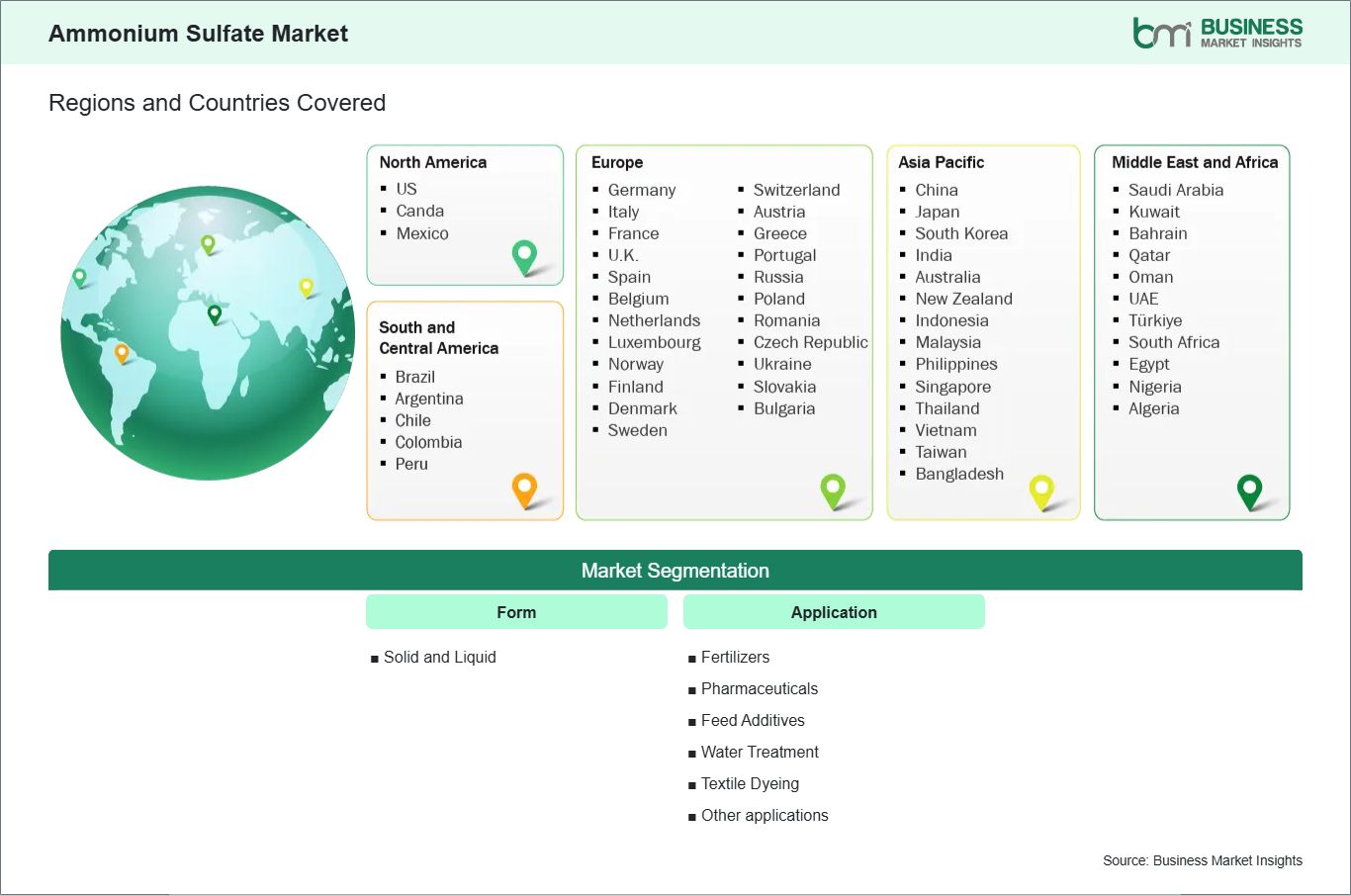
Key segments that contributed to the derivation of the Ammonium Sulfate market analysis are form and application.
The growing global demand for food is increasing the need for fertilizers that boost crop yields and improve soil health. Ammonium sulphate has emerged as a key nutrient source. It supplies both nitrogen and sulfur, which are essential for protein synthesis, chlorophyll formation, and overall plant development. Sulfur deficiency is becoming more common due to less atmospheric sulfur deposition and intensive farming practices. This makes sulfur-containing fertilizers more necessary. Ammonium sulphate works well in alkaline and sulfur-deficient soils, making it suitable for many crops, including cereals, oilseeds, fruits, and vegetables. Its low nitrogen loss and steady nutrient release improve fertilizer efficiency, helping farmers achieve better nutrient uptake. As awareness of balanced fertilization grows, helped by agricultural extension programs and precision farming practices, more farmers in both developed and emerging markets are adopting ammonium sulphate.
The ammonium sulphate market is also growing due to its use in various industrial applications, such as water treatment, food processing, pharmaceuticals, textiles, and chemical manufacturing. It is often used in water purification processes, fermentation industries, and as a food additive under regulated conditions. Furthermore, ammonium sulphate is frequently recovered as a by-product from caprolactam production, coke ovens, and flue gas desulfurization systems. This recovery improves supply availability and cost efficiency. The growth of chemical and industrial manufacturing, particularly in developing areas, is raising the demand for ammonium sulphate as a dependable and affordable input material. At the same time, environmental regulations that promote sulfur recovery and emission control support by-product generation, which strengthens supply chains. This combined demand from agriculture and industry continues to drive the steady growth of the ammonium sulphate market.
The ammonium sulfate market demonstrates steady growth, with size and share analysis revealing evolving trends and competitive positioning among key players. The report further examines subsegments categorized within form and application, offering insights into their contribution to overall market performance. By form, the solid subsegment dominates the market because it is easy to handle, store, and transport. This is particularly important in large-scale agricultural operations. Solid ammonium sulfate has better shelf stability and is ideal for bulk application and fertilizer mixing, making it a popular choice for distributors and farmers.
In terms of application, the fertilizers subsegment holds the largest share of the market due to its dual nutrient content of nitrogen and sulfur, which supports balanced crop nutrition. Its effectiveness in sulfur-deficient soils, low nitrogen loss, and suitability for a wide range of crops have led to strong use across global agricultural markets.
| Report Attribute | Details |
|---|---|
| Market size in 2025 | US$ 5.39 Billion |
| Market Size by 2033 | US$ 7.10 Billion |
| Global CAGR (2026 - 2033) | 3.5% |
| Historical Data | 2022-2024 |
| Forecast period | 2026-2033 |
| Segments Covered | By Form
|
|
Regions and Countries Covered
| |
| North America | US, Canada, Mexico |
| Europe | Belgium, Austria, Finland, Denmark, Greece, Poland, Romania, Russia, Ukraine, Czech Republic, Slovakia, Bulgaria, Italy, Luxembourg, Germany, Switzerland, France, Netherlands, Norway, Portugal, Spain, Sweden, United Kingdom |
| Asia-Pacific | Australia, China, India, Japan, South Korea, Indonesia, Malaysia, Philippines, Singapore, Thailand, Vietnam, Bangladesh, New Zealand, Taiwan |
| South and Central America | Brazil, Argentina, Peru, Chile, Colombia |
| Middle East and Africa | Bahrain, Kuwait, Oman, Qatar, Saudi Arabia, United Arab Emirates, Turkiye, South Africa, Egypt, Algeria, Nigeria |
| Market leaders and key company profiles |
|
The "Ammonium Sulfate Market Size and Forecast (2022–2033)" report provides a detailed analysis of the market covering below areas:
The geographical scope of the Ammonium Sulfate market report is divided into five regions: North America, Asia Pacific, Europe, the Middle East & Africa, and South & Central America. The Ammonium Sulfate market in the Asia Pacific is expected to grow significantly during the forecast period.
The Asia Pacific Ammonium Sulfate market is segmented into China, Japan, South Korea, India, Australia, New Zealand, Indonesia, Malaysia, the Philippines, Singapore, Thailand, Vietnam, Taiwan, Bangladesh, and the Rest of the Asia Pacific.
The ammonium sulfate market in the Asia Pacific is growing steadily. This growth is driven by expanding agricultural activities, rising food demand, and ongoing economic development in the region. Key players include China, India, Japan, Indonesia, and other Southeast Asian countries, where agriculture is an important part of the economy. The increasing population, shrinking arable land, and the need to boost crop productivity encourage farmers to use efficient fertilizers like ammonium sulfate. This product is widely applied in cereals, rice, oilseeds, fruits, vegetables, and plantation crops, especially in sulfur-deficient and alkaline soils found in many areas. Another factor helping the market grow is the strong industrial and chemical manufacturing presence. Ammonium sulfate is produced not only as a primary product but also as a by-product in caprolactam manufacturing, coke ovens, and flue gas desulfurization systems, which ensures a stable local supply. Local production facilities, better distribution networks, and government support for fertilizer access are reducing reliance on imports and making it more affordable for farmers. Technological advances in fertilizer formulation, granulation, and blending also help expand the market. Manufacturers focus on improving nutrient efficiency, product uniformity, and ease of application while following environmental rules.
Growing awareness of balanced fertilization, sustainable farming practices, and soil health management is leading to higher adoption rates. Additionally, supportive agricultural policies, fertilizer subsidies, and investments in modern farming techniques are reinforcing the Asia Pacific’s role as a crucial production and consumption hub in the global ammonium sulfate market.

The Ammonium Sulfate market is evaluated by gathering qualitative and quantitative data post-primary and secondary research, which includes important corporate publications, association data, and databases. A few of the key developments in the Ammonium Sulfate market are:
The Ammonium Sulfate Market is valued at US$ 5.39 Billion in 2025, it is projected to reach US$ 7.10 Billion by 2033.
As per our report Ammonium Sulfate Market, the market size is valued at US$ 5.39 Billion in 2025, projecting it to reach US$ 7.10 Billion by 2033. This translates to a CAGR of approximately 3.5% during the forecast period.
The Ammonium Sulfate Market report typically cover these key segments-
The historic period, base year, and forecast period can vary slightly depending on the specific market research report. However, for the Ammonium Sulfate Market report:
The Ammonium Sulfate Market is populated by several key players, each contributing to its growth and innovation. Some of the major players include:
The Ammonium Sulfate Market report is valuable for diverse stakeholders, including:
Essentially, anyone involved in or considering involvement in the Ammonium Sulfate Market value chain can benefit from the information contained in a comprehensive market report.
Please tell us your area of interest
(Market Segments/ Regions and Countries/ Companies)