Market Summary
Executive Summary and Global Market Analysis
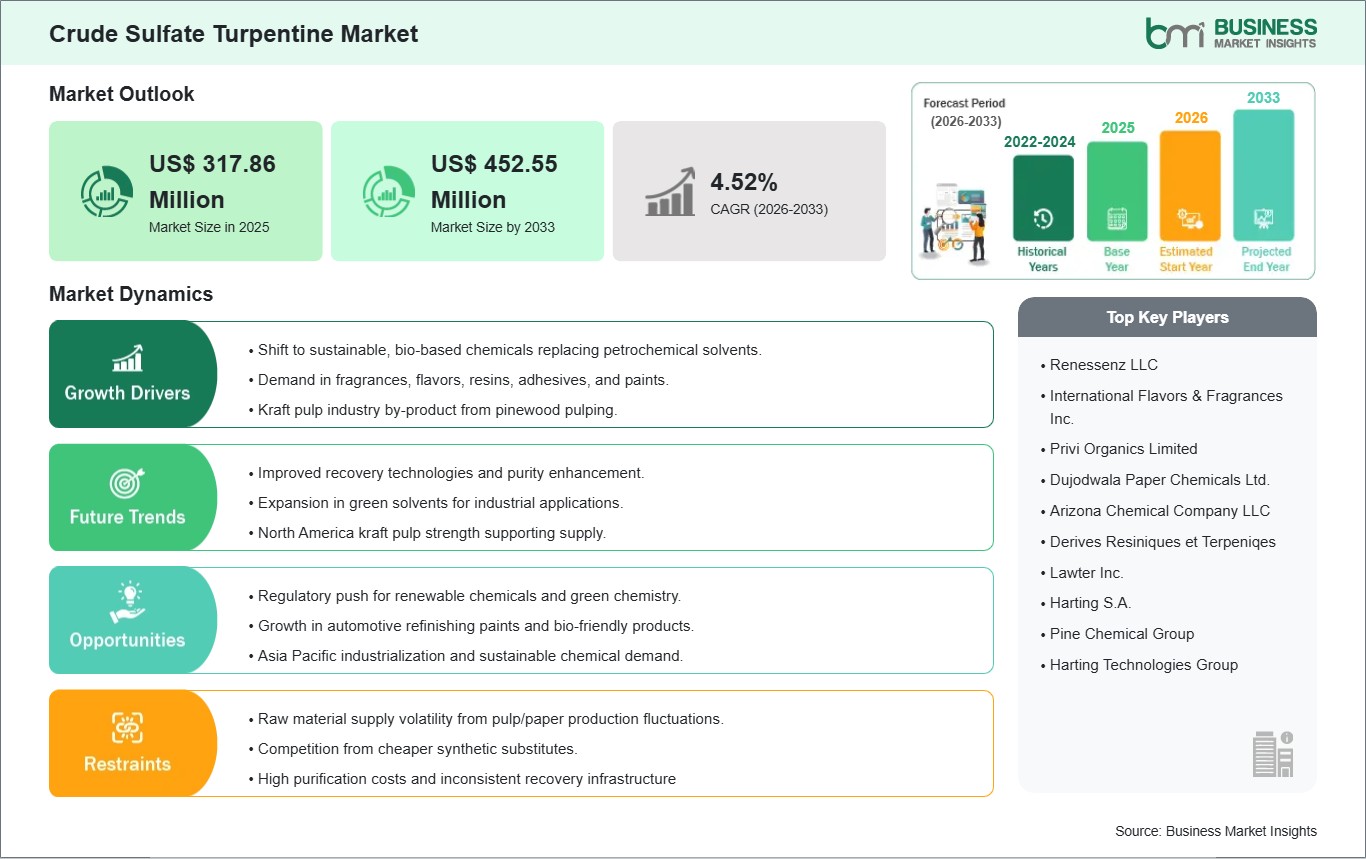
Crude sulfate turpentine is essential in many industrial uses. It serves as a raw material in chemicals, adhesives, solvents, and resins. This product is appreciated for its natural composition, high reactivity, and versatility in manufacturing. It aids in efficient production, reduces costs, and improves product performance. Crude sulfate turpentine also finds applications in making fragrances, cleaning agents, and bio-based chemicals. Its key benefits include being renewable, compatible with various chemical mixtures, and being a strong solvent. The market for crude sulfate turpentine is growing due to the increasing demand for bio-based chemicals, rising industrialization, and its expanding use in sectors like paints, coatings, and pharmaceuticals. Advances in extraction and refining methods further boost market growth.
However, the crude sulfate turpentine market faces several challenges, such as fluctuations in supply due to raw material availability, and price changes can hinder growth. Environmental concerns about emissions and proper handling present additional issues. Also, specialized processing and formulation require technical expertise for safe and effective use. Despite these hurdles, there are opportunities in innovations related to green chemistry, sustainable sourcing, and the rising preference for renewable industrial materials. Future developments will likely focus on better extraction techniques, stricter environmental standards, and a move toward bio-based alternatives in industrial applications.
Segment Analysis
Crude Sulfate Turpentine Market Segmentation
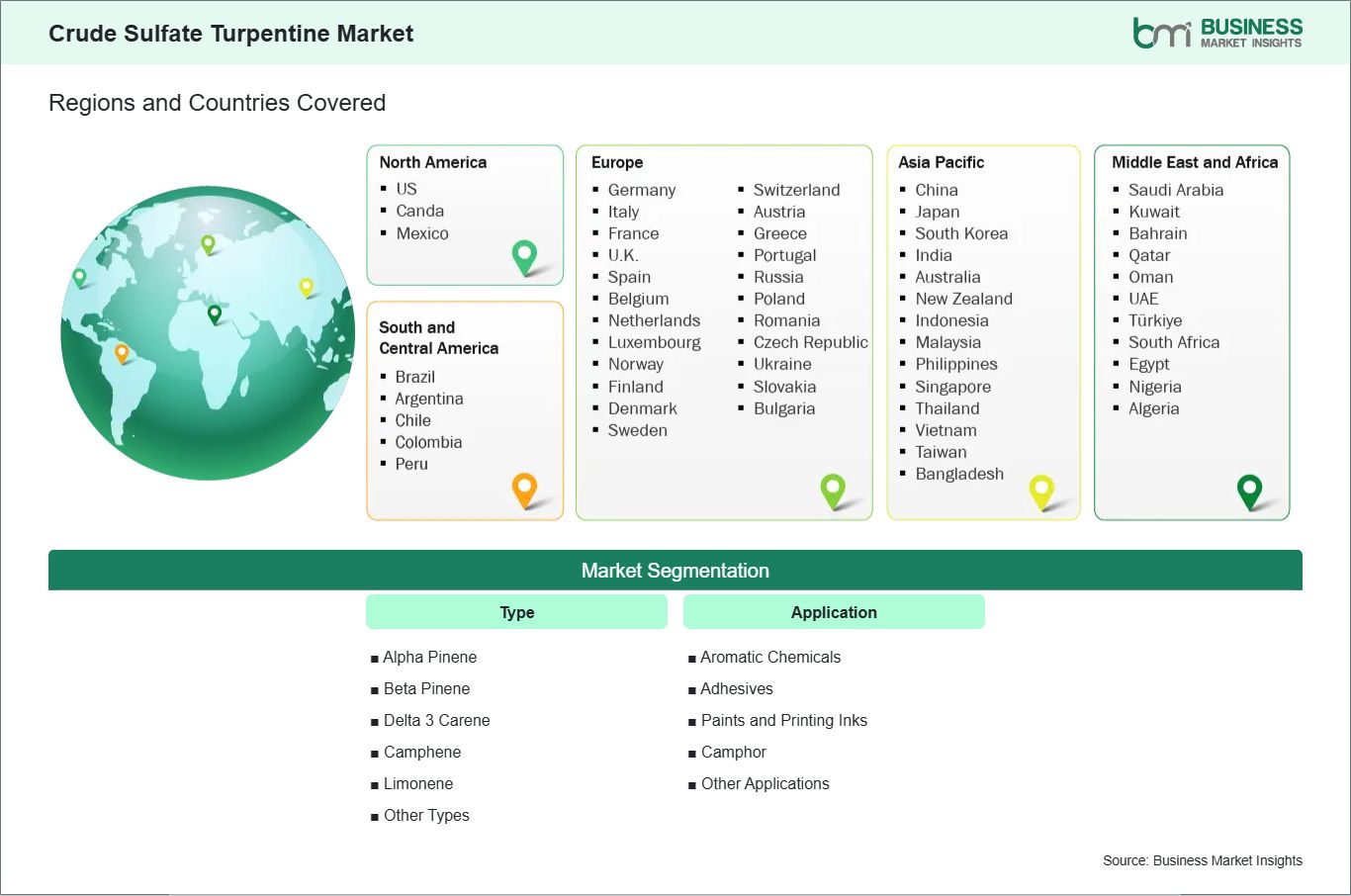
Key segments that contributed to the derivation of the crude sulfate turpentine market analysis are type and application.
- By type, the crude sulfate turpentine market is segmented into alpha pinene, beta pinene, delta 3 carene, camphene, limonene, and other types. The alpha pinene segment dominated the market in 2025.
- By application, the market is categorized into aromatic chemicals, adhesives, paints and printing inks, camphor, and other applications. The aromatic chemicals segment held the largest share of the market in 2025.
Market Forces
Crude Sulfate Turpentine Market Drivers and Opportunities
Rising Demand for Bio-Based Industrial Chemicals
Crude sulfate turpentine is becoming more popular as a renewable raw material for making solvents, adhesives, resins, and fragrances. Its natural source and flexibility make it a good substitute for petroleum-based chemicals. This helps manufacturers lessen their reliance on fossil fuels while keeping product performance strong. More people are aware of sustainable supply chains and eco-friendly products, which is encouraging industries to use turpentine-derived compounds. This trend is especially noticeable in paints, coatings, and cleaning products, where quality and cost-effectiveness are essential. Improvements in refining and chemical conversion also boost the attractiveness of crude sulfate turpentine, leading to broader use in various industries.
Expansion Opportunities in Green and Specialty Chemicals
The market shows significant potential in specialty chemicals and bio-based innovations. Companies are looking into using turpentine for valuable applications like natural flavors, fragrances, and bio-resins. This exploration is opening new revenue streams. A rising global focus on environmental sustainability and renewable resources is driving investment in research and development of new turpentine derivatives. Emerging applications in pharmaceuticals, agrochemicals, and biodegradable solvents are likely to support long-term growth. As industries move toward greener alternatives, crude sulfate turpentine is becoming a key feedstock. It helps meet regulatory requirements while enabling innovative, eco-friendly products.
Size and Share Analysis
Crude Sulfate Turpentine Market Size and Share Analysis
The crude sulfate turpentine market demonstrates steady growth, with size and share analysis revealing evolving trends and competitive positioning among key players. The report further examines subsegments categorized within type and application, offering insights into their contribution to overall market performance.
Based on type, the alpha pinene subsegment dominates the crude sulfate turpentine market. Alpha-pinene is highly valued for its versatility, chemical reactivity, and natural origin. It is widely used to make adhesives, resins, solvents, and fragrances. Its strong performance, renewable sourcing, and cost-efficiency make it the preferred choice for manufacturers looking for reliable and sustainable raw materials. The compound's consistent quality and compatibility with different chemical formulations ensure high productivity and effectiveness across applications. This secures its position as the leading segment in the market.
Report Coverage
Crude Sulfate Turpentine Market Report Coverage and Deliverables
The " Crude Sulfate Turpentine Market Size and Forecast (2022 - 2033)" report provides a detailed analysis of the market covering the following areas:
- Crude Sulfate Turpentine market size and forecast at global, regional, and country levels for all the key market segments covered under the scope
- Crude Sulfate Turpentine market trends, as well as market dynamics such as drivers, restraints, and key opportunities
- Crude Sulfate Turpentine market analysis covering key market trends, global and regional framework, major players, regulations, and recent market developments
- Industry landscape and competition analysis covering market concentration, heat map analysis, prominent players, and recent developments for the crude sulfate turpentine market
- Detailed company profiles, including SWOT analysis
Geographic Insights
Crude Sulfate Turpentine Market Geographic Insights
The geographical scope of the Crude Sulfate Turpentine market report is divided into five regions: North America, Asia Pacific, Europe, the Middle East & Africa, and South & Central America. The Asia Pacific Crude Sulfate Turpentine Market is segmented into China, Japan, South Korea, India, Australia, New Zealand, Indonesia, Malaysia, the Philippines, Singapore, Thailand, Vietnam, Taiwan, Bangladesh, and the Rest of Asia Pacific. Asia Pacific is a key player in the crude sulfate turpentine market. This growth is fueled by rapid industrial development and a rising need for bio-based chemicals. Increased use in paints, adhesives, solvents, and aromatic chemicals supports this expansion. The region emphasizes sustainable and renewable raw materials.
Strong manufacturing capabilities, growing industrial activity in countries like China and India, and greater use of green chemical solutions make the Asia Pacific a central hub for producing and consuming crude sulfate turpentine. Economic growth, environmental awareness, and supportive policies all help keep the region important in the global market.
Industry Activity
Recent Developments
The crude sulfate turpentine market is evaluated by gathering qualitative and quantitative data post-primary and secondary research, which includes important corporate publications, association data, and databases. A few of the key developments in the crude sulfate turpentine market are:
- In May 2023, Sika completed the acquisition of MBCC Group, enhancing its global presence and product offerings in the construction industry. Based in Mannheim, Germany, MBCC Group, previously owned by Lone Star Funds, specializes in construction and admixture systems. To meet regulatory requirements, Sika divested MBCC Group's chemical admixtures operations in several markets to Cinven. The acquired business generated US$ 2.63 billion (CHF 2.1 billion) in sales in 2022, employs 6,200 people, and has over 95 production facilities worldwide.
- In February 2026, Breakthrough Minerals Ltd announced a 3,000-metre diamond drilling campaign at its Queensland Copper-Gold Project, aiming for significant resource expansion at the Turpentine Deposit. Scheduled for March 2026, this program seeks to extend previous impressive intercepts of 11 metres 2.0% Cu & 0.5g/t Au, including a notable 3 metres 5.1% Cu & 1.3g/t Au, marking a critical step in the company's growth strategy in Queensland's copper district.
Trust & Transparency
Research Methodology
The market analysis combines proprietary research with secondary data from government agencies, company disclosures, regulatory filings, industry databases and expert interviews. Market estimates are validated through data triangulation, cross-market benchmarking and analyst
review.
View Full Research Methodology
Key Sources Referred:
World Bank - Global Trade IndicatorsEuropean Chemicals AgencyInternational Council of Chemical AssociationsInternational Monetary Fund (IMF)World Trade Organization (WTO)International Trade Administration (ITA)Company WebsitesCompany Annual ReportsCompany Investor Presentations