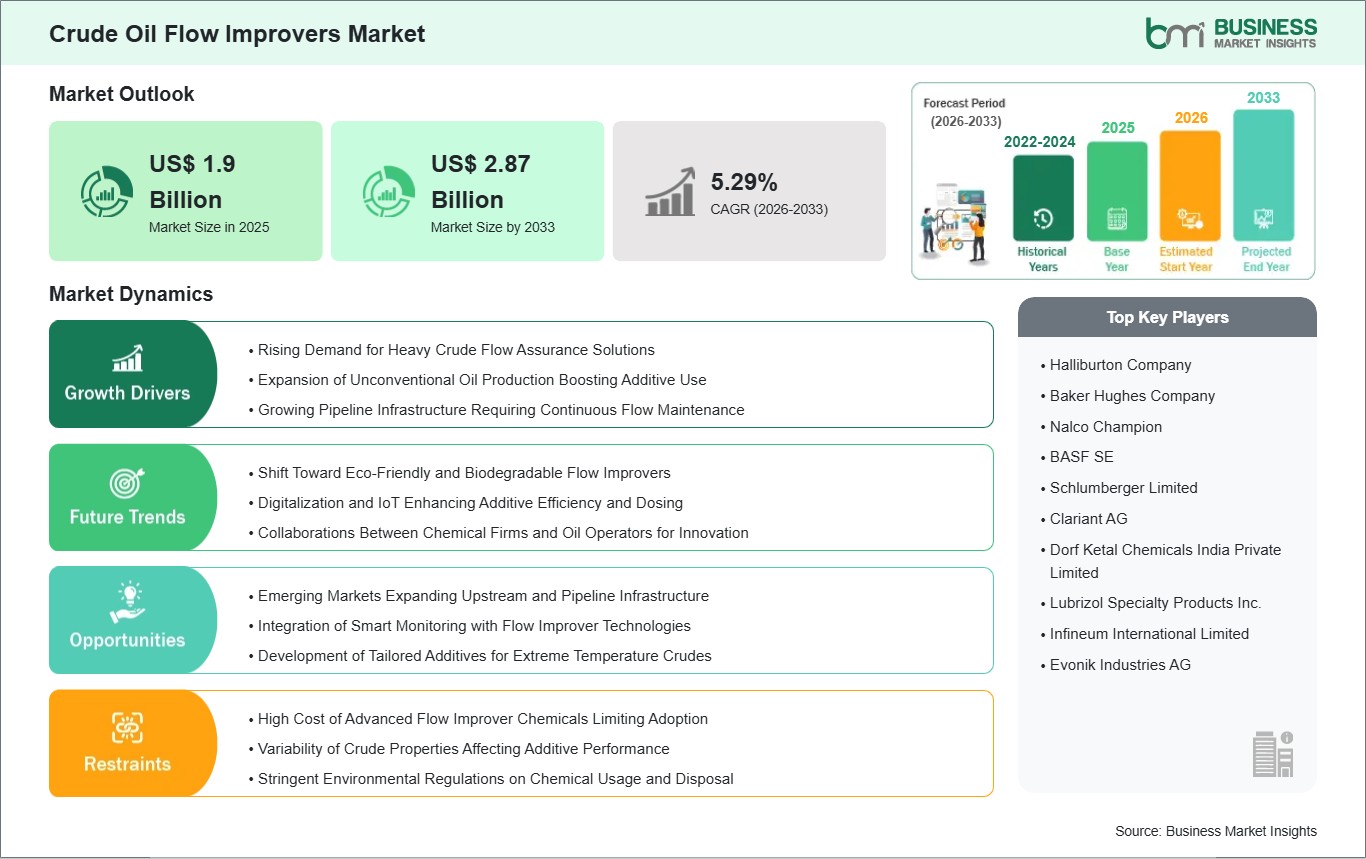
The Crude Oil Flow Improvers Market size is expected to reach US$ 2.87 Billion by 2033 from US$ 1.9 Billion in 2025. The market is estimated to record a CAGR of 5.29% from 2026 to 2033.
The global crude oil flow improvers market is an important industry in the optimization of crude oil transportation and production, especially in areas where heavy, waxy, and viscous crude oil is exploited. Flow improvers are chemical formulations that are used in the optimization of the rheological properties of crude oil. These chemical formulations are important in ensuring that there is an uninterrupted flow of crude oil in areas where harsh environmental conditions affect the fluidity of crude oil. In recent years, the complexity of crude oil has increased, especially with the exploitation of unconventional crude oil. These include heavy crude oil, bitumen oil, and shale oil. These factors have increased the demand for advanced flow improver technology that is used in the optimization of crude oil flow. One of the major factors contributing to the global market is the rising production from unconventional and remote oil wells. As the supply of accessible light crude oil declines, the trend is to increasingly rely on heavier and more viscous oils that need chemical treatment to maintain the performance of the oil as it flows through the production, collection, and long-distance transportation processes. Furthermore, the expansion of export infrastructure such as the extension of pipelines and marine facilities in the Middle East, Latin America, and West Africa has also highlighted the role of oil flow improvers in maintaining the performance of the oil as it flows throughout the year, especially in colder climates or deep waters where temperature gradients can affect the oil significantly. Despite the high demand, the oil flow improver market also faces significant restraints. The effectiveness of these flow improvers may vary significantly, depending on the crude oil composition, the presence of sulfur, and the properties of the wax, making the specificity of the formulation as well as the field test a crucial, though time-consuming, process. In addition, the concerns over the additive-related effects on the refinery units have led some manufacturers to be cautious, leading to the exploration of specially designed chemistries that address the balance between the flow improvers and refinery compatibility. The environmental concerns with regard to the chemicals used during the treatment process are also a key aspect of the regulatory environment, especially in sensitive regions of the world. Nevertheless, the continued advances in the field of polymers and the development of molecular additives continue to expand the versatility of the crude oil flow improvers market as a key enabler of the global crude oil mobility.

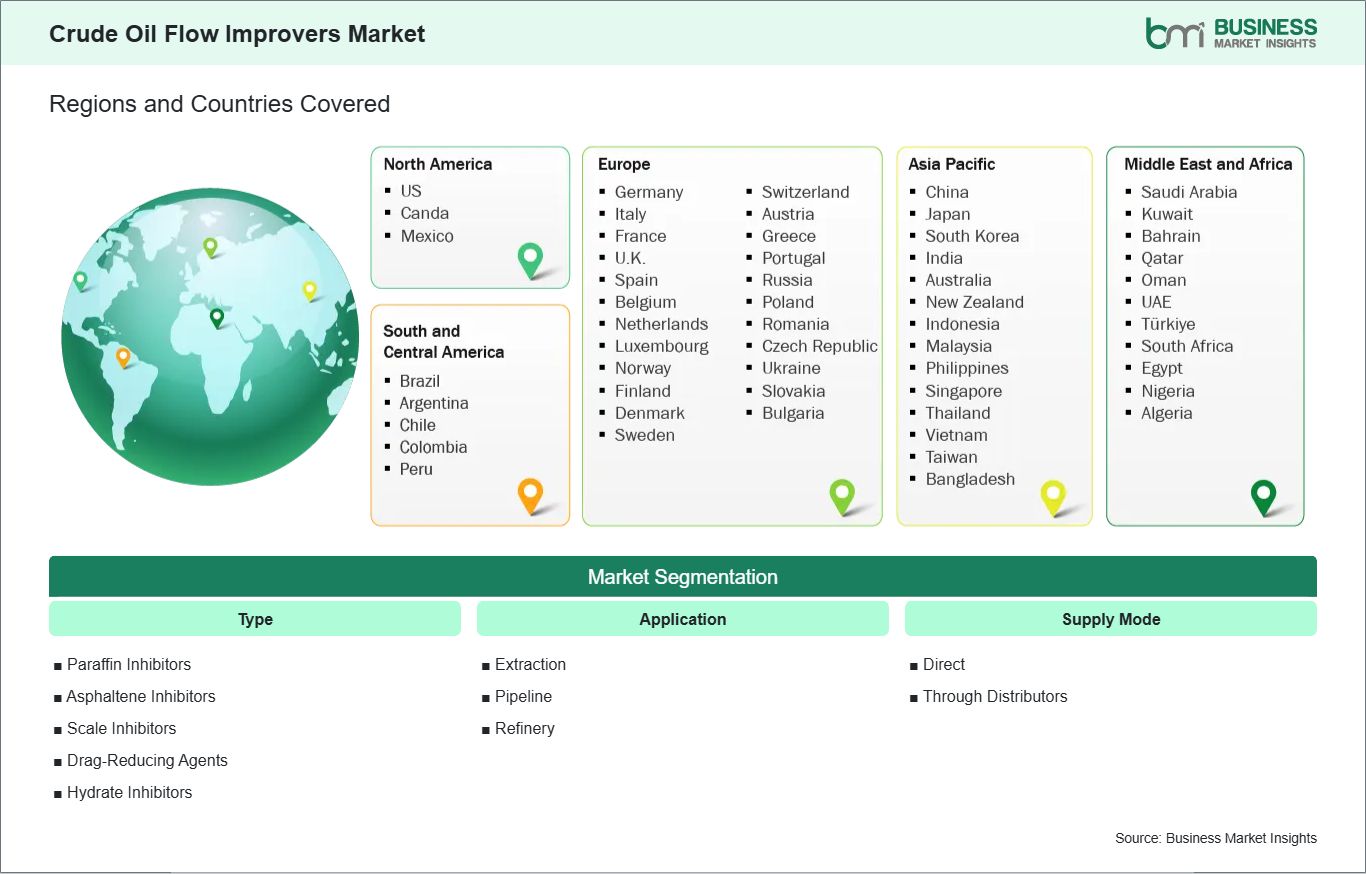
Key segments that contributed to the derivation of the crude oil flow improvers market analysis are type, application, and supply mode.
The global crude oil flow improvers market is experiencing strong growth due to the rising production of heavy, waxy, and unconventional crude oils, which create substantial flow assurance challenges across upstream and midstream operations. Heavy crude oils often have high viscosity and a tendency to form wax and asphaltene deposits, which can obstruct pipelines, increase pumping energy requirements, and raise operational risks. To mitigate these issues, operators are increasingly using chemical additives such as pour point depressants, drag-reducing agents, and viscosity modifiers that enhance crude fluidity, reduce friction, and prevent blockages. Adoption is particularly high in regions with significant heavy crude reserves, including Canada`s oil sands, Venezuela`s Orinoco Belt, and deepwater fields in Asia, where pipeline and storage conditions demand constant flow management. Integrating flow improvers into production, transportation, and storage systems helps maintain continuous crude movement, lowers maintenance costs, and optimizes overall operational efficiency, making these additives a vital component of modern global energy logistics.
Emerging markets are becoming increasingly critical to the global crude oil flow improvers market as these regions expand upstream production and develop new pipeline infrastructure to meet growing energy demands. In Asia Pacific, countries such as China, India, and Southeast Asian nations are investing heavily in unconventional, offshore, and deepwater oil fields. These operations face challenges from wax deposition, hydrates, and high-viscosity crude, driving the adoption of specialized flow improvers to maintain smooth transport over long pipelines and through varying temperature conditions. In the Middle East & Africa, key producers including Saudi Arabia, Iraq, and Nigeria rely on chemical additives to ensure uninterrupted throughput in heavy crude pipelines exposed to extreme heat, desert climates, or subsea environments. Meanwhile, South & Central America, including Brazil and Venezuela, are increasingly incorporating flow improvers as new production and export infrastructure develops, particularly for heavy and waxy crude grades. Across these regions, flow improvers are essential for enhancing operational efficiency, preventing blockages, and enabling reliable transport from wells to refineries or export terminals.

The crude oil flow improvers market demonstrates steady growth, with size and share analysis highlighting evolving trends and competitive dynamics among key players. The report examines subsegments categorized within type, application, and supply mode, offering insights into their contribution to overall market performance.
By type, the paraffin inhibitors subsegment dominated the market in 2025, driven by their critical role in preventing wax deposition in crude oil pipelines, ensuring smooth flow and reducing operational downtime.
Based on application, the extraction subsegment dominated the market in 2025, driven by the high demand for flow improvers during crude oil production to enhance mobility and support efficient extraction processes.
In terms of supply mode, the direct subsegment dominated the market in 2025, driven by the preference of oil & gas companies to procure flow improvers directly from manufacturers for customization, technical support, and reliable supply.
| Report Attribute | Details |
|---|---|
| Market size in 2025 | US$ 1.9 Billion |
| Market Size by 2033 | US$ 2.87 Billion |
| Global CAGR (2026 - 2033) | 5.29% |
| Historical Data | 2022-2024 |
| Forecast period | 2026-2033 |
| Segments Covered | By Type
|
|
Regions and Countries Covered
| |
| North America | US, Canada, Mexico |
| Europe | Belgium, Austria, Finland, Denmark, Greece, Poland, Romania, Russia, Ukraine, Czech Republic, Slovakia, Bulgaria, Italy, Luxembourg, Germany, Switzerland, France, Netherlands, Norway, Portugal, Spain, Sweden, United Kingdom |
| Asia-Pacific | Australia, China, India, Japan, South Korea, Indonesia, Malaysia, Philippines, Singapore, Thailand, Vietnam, Bangladesh, New Zealand, Taiwan |
| South and Central America | Brazil, Argentina, Peru, Chile, Colombia |
| Middle East and Africa | Bahrain, Kuwait, Oman, Qatar, Saudi Arabia, United Arab Emirates, Turkiye, South Africa, Egypt, Algeria, Nigeria |
| Market leaders and key company profiles |
|
The "Crude Oil Flow Improvers Market Size and Forecast (2022 - 2033)" report provides a detailed analysis of the market covering below areas:
The geographical scope of the Crude Oil Flow Improvers Market report is divided into North America, Asia Pacific, Europe, Middle East & Africa, and South & Central America. North America held the largest share in 2025.
The Crude Oil Flow Improvers Market has unique regional trends, with North America being the leading region in the global market, driven by the presence of unconventional crude production, a developed midstream sector, and early adoption of advanced flow assurance technologies. In the United States and Canada, crude producers and pipeline companies commonly employ pour point depressants, viscosity modifiers, and drag-reducing agents for heavy, waxy, and unconventional crude oils, especially in long-distance pipelines and under varying climatic conditions, with active cooperation between chemical companies and energy companies. In the Asia Pacific, the region is witnessing a surge in exploration activities in countries such as China, India, Southeast Asia, and Australia, especially in dealing with crude oils with high wax content and long-distance pipelines, thus indicating the demand for flow improvers in the region, along with the development of refining facilities and export terminals. The market in Europe is affected by production in the North Sea as well as imports of heavy crude oils from Africa and the Middle East, thus encouraging refining and pipeline companies to employ unique flow improvers that address specific problems while adhering to stringent environmental regulations. The Middle East & Africa region has developed extensive export infrastructure, and heavy crude oils are being developed in countries such as Saudi Arabia, Iraq, and Nigeria, thus encouraging the need for effective flow improvers for smooth flow into global markets, especially in such regions where temperatures are extreme. The region of South & Central America is also gaining prominence as countries such as Brazil, Venezuela, and Argentina are developing infrastructure for the extraction of heavy crude oils, thus encouraging the need for flow improvers to mitigate problems in these regions, especially due to varying temperatures. In all regions, the interaction of crude complexity, infrastructure development, and efficiency drivers in operation remains a key influencer in the demand for flow assurance chemistries, but maturity in terms of application expertise and technology integration in North America supports the region`s lead in the global crude oil flow improvers market.

The Crude Oil Flow Improvers Market is evaluated by gathering qualitative and quantitative data post primary and secondary research, which includes important corporate publications, association data, and databases. A few of the key developments in the crude oil flow improvers market are:
The Crude Oil Flow Improvers Market is valued at US$ 1.9 Billion in 2025, it is projected to reach US$ 2.87 Billion by 2033.
As per our report Crude Oil Flow Improvers Market, the market size is valued at US$ 1.9 Billion in 2025, projecting it to reach US$ 2.87 Billion by 2033. This translates to a CAGR of approximately 5.29% during the forecast period.
The Crude Oil Flow Improvers Market report typically cover these key segments-
The historic period, base year, and forecast period can vary slightly depending on the specific market research report. However, for the Crude Oil Flow Improvers Market report:
The Crude Oil Flow Improvers Market is populated by several key players, each contributing to its growth and innovation. Some of the major players include:
The Crude Oil Flow Improvers Market report is valuable for diverse stakeholders, including:
Essentially, anyone involved in or considering involvement in the Crude Oil Flow Improvers Market value chain can benefit from the information contained in a comprehensive market report.
Please tell us your area of interest
(Market Segments/ Regions and Countries/ Companies)