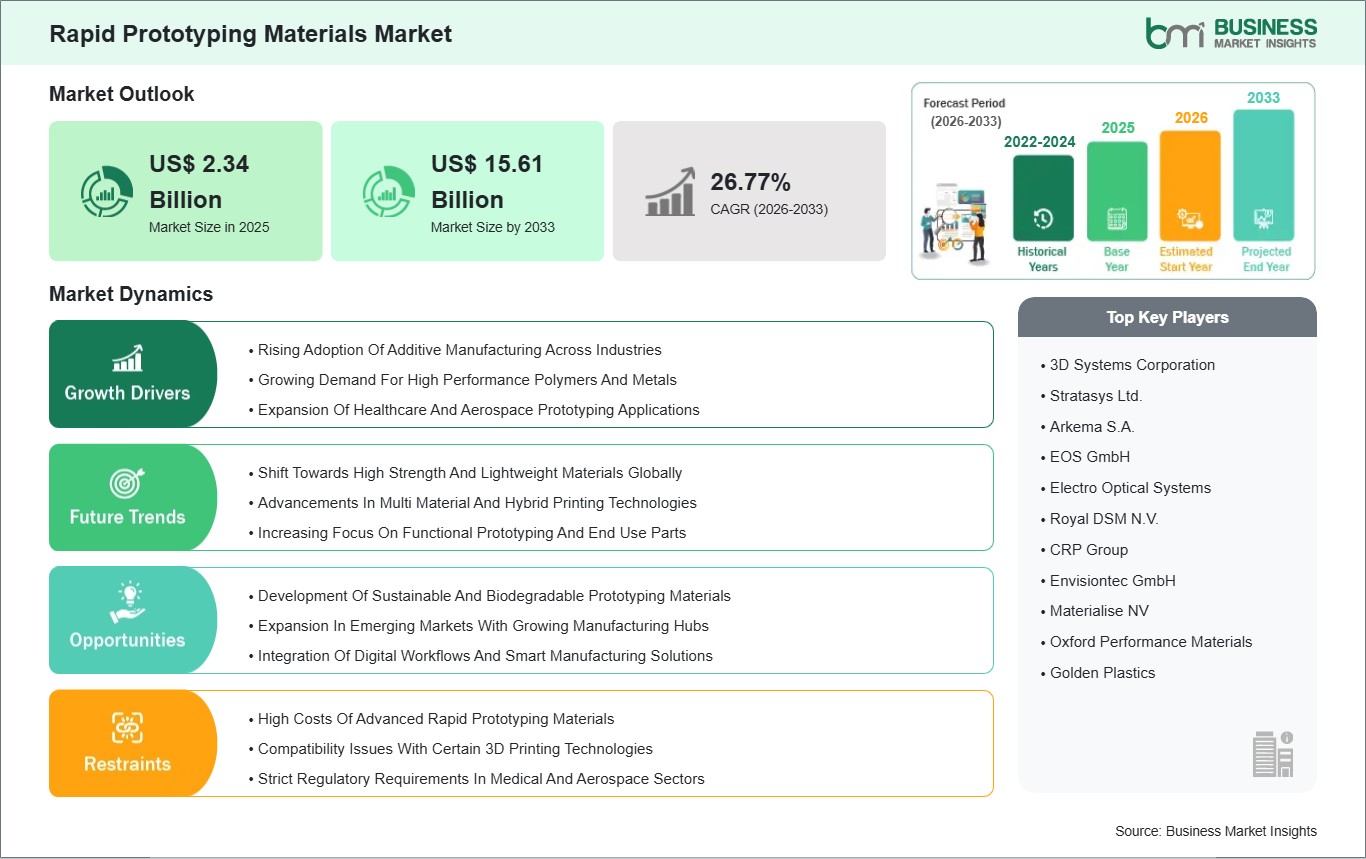
The Rapid Prototyping Materials Market size is expected to reach US$ 15.61 billion by 2033 from US$ 2.34 billion in 2025. The market is estimated to record a CAGR of 26.77% from 2026 to 2033.
The market for rapid prototyping materials throughout the world experiences growth because various industries including automotive, aerospace, healthcare, consumer goods and industrial tooling adopt additive manufacturing technologies. The materials used for rapid prototyping which include photopolymers and thermoplastics and metals and composites enable product design validation and customization and iterative development processes to occur at a faster pace. Companies throughout the world now use rapid prototyping to decrease their product development time while they gain more design options and conduct better functional testing before starting mass production.
Material science innovation has expanded the materials that engineers can use for rapid prototyping because advanced polymers provide better mechanical performance and metal powders create functional parts that withstand high-demand usage. The demand patterns in different regions of the world depend on the industrial transformation projects and digitalization initiatives that are currently being implemented. The digital manufacturing workflows of manufacturing hubs now include prototyping materials which help companies achieve faster product delivery and support their distributed production operations. The medical field requires death, patient-specific implants, and surgical models to create medical devices that need biocompatible polymers and metal alloys.
The aerospace and defense sectors require materials that meet their strict performance and safety needs, which creates demand for high-strength engineering materials like high-temperature polymers and lightweight metal alloys that manufacturers use to develop functional prototypes and specialized tooling. The market attracts strong global interest, but it encounters various problems. The high-performance polymers and specialty metal powders used material costs create barriers that prevent small and medium enterprises from adopting new technologies. The specific additive manufacturing systems and post-processing requirements create limitations that restrict available material options.
The medical field and aerospace industry implementation of materials requires regulatory validation to establish material safety before their use in end-use components. The ongoing material development improvements together with new application areas will create a path for regional growth and innovation development.

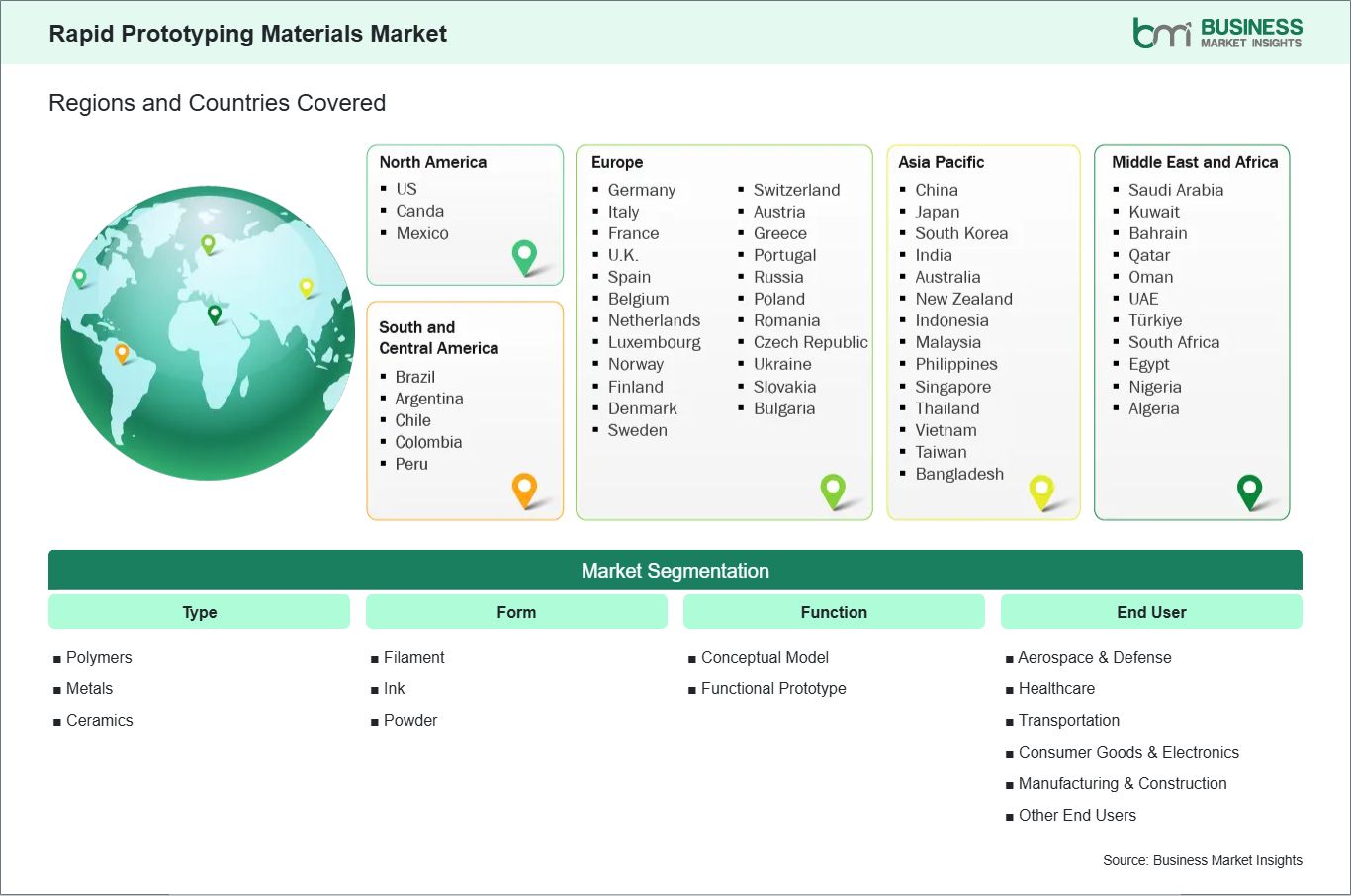
Key segments that contributed to the derivation of the rapid prototyping materials market analysis are type, form, function, and end user.
The rising adoption of additive manufacturing (AM) across industries is a primary driver of the global rapid prototyping materials market. In sectors like aerospace, automotive, and consumer electronics, companies are increasingly using 3D printing to accelerate product development and reduce lead times. Materials such as high-performance polymers, photopolymers, and metal powders are essential for producing functional prototypes and complex geometries that traditional manufacturing methods cannot achieve efficiently. North America and Europe are key adopters, leveraging established manufacturing infrastructures and strong R&D ecosystems to integrate prototyping materials into production workflows.
Automotive companies are employing rapid prototyping materials to develop lightweight components, interior parts, and tooling that can be tested quickly for durability and design accuracy. Similarly, in aerospace, metal alloys and high-temperature polymers are used to create functional prototypes for engines, structural components, and tooling, reducing costs while meeting strict performance and safety standards. The global consumer electronics market also relies on AM for rapid testing of housings, connectors, and functional modules, enabling faster iterations of design cycles.
Sustainability concerns and regulatory pressures are prompting the development of biodegradable and environmentally friendly rapid prototyping materials. Companies globally are exploring bio-based polymers such as PLA, PHA, and other renewable feedstock resins for additive manufacturing. These materials reduce environmental impact during prototyping and enable easier end-of-life disposal compared to conventional thermoplastics. Europe and North America are leading in this trend, driven by stringent environmental regulations and increasing corporate sustainability commitments. Emerging economies are also contributing to demand for sustainable materials, particularly in Asia Pacific, where manufacturing hubs are integrating greener alternatives into prototyping workflows.
Industries such as consumer goods, packaging, and automotive are leveraging biodegradable resins for rapid prototyping, demonstrating that sustainability does not compromise design flexibility or functional performance. Collaborative R&D programs between universities, material suppliers, and AM equipment manufacturers are further accelerating innovations in this space. As the global market increasingly prioritizes green innovation, demand for these advanced materials is expected to rise across multiple industry verticals, positioning sustainable prototyping materials as a key growth segment.
The rapid prototyping materials market demonstrates steady growth, with size and share analysis highlighting evolving trends and competitive dynamics among key players. The report examines subsegments categorized within type, form, function, and end user, offering insights into their contribution to overall market performance.
By type, the polymers subsegment dominated the market in 2025, driven by their versatility and wide adoption in various prototyping applications.
Based on form, the filament subsegment dominated the market in 2025, driven by its extensive use in common additive manufacturing processes.
On the basis of function, the functional prototype subsegment dominated the market in 2025, driven by the need for testing product feasibility, performance, and durability.
In terms of end user, the aerospace & defense subsegment dominated the market in 2025, driven by high demand for advanced prototyping and material innovations.
| Report Attribute | Details |
|---|---|
| Market size in 2025 | US$ 2.34 Billion |
| Market Size by 2033 | US$ 15.61 Billion |
| Global CAGR (2026 - 2033) | 26.77% |
| Historical Data | 2022-2024 |
| Forecast period | 2026-2033 |
| Segments Covered | By Type
|
|
Regions and Countries Covered
| |
| North America | US, Canada, Mexico |
| Europe | Belgium, Austria, Finland, Denmark, Greece, Poland, Romania, Russia, Ukraine, Czech Republic, Slovakia, Bulgaria, Italy, Luxembourg, Germany, Switzerland, France, Netherlands, Norway, Portugal, Spain, Sweden, United Kingdom |
| Asia-Pacific | Australia, China, India, Japan, South Korea, Indonesia, Malaysia, Philippines, Singapore, Thailand, Vietnam, Bangladesh, New Zealand, Taiwan |
| South and Central America | Brazil, Argentina, Peru, Chile, Colombia |
| Middle East and Africa | Bahrain, Kuwait, Oman, Qatar, Saudi Arabia, United Arab Emirates, Turkiye, South Africa, Egypt, Algeria, Nigeria |
| Market leaders and key company profiles |
|
The "Rapid Prototyping Materials Market Size and Forecast (2022 - 2033)" report provides a detailed analysis of the market covering below areas:
The geographical scope of the Rapid Prototyping Materials Market report is divided into North America, Asia Pacific, Europe, Middle East & Africa, and South & Central America. North America held the largest share in 2025.
North America leads as the main region of the global rapid prototyping materials market because of its advanced industrial base and extensive use of additive manufacturing and its robust research and development facilities. The United States and Canada lead the market, driven by the aerospace, automotive, electronics, and healthcare sectors, where high-performance polymers, engineered thermoplastics, and specialty metal powders are extensively used for functional prototypes, tooling, and end-use parts.
North America maintains its position as market leader because manufacturers use predictive analytics and automation and quality standards to optimize both design processes and production methods.
The Asia Pacific region represents the fastest-growing market because of its rapid industrial development and government programs that promote additive manufacturing and its cheap manufacturing capacity in China and India and Japan and South Korea. The region sees increasing adoption of photopolymers, PLA, ABS, and metal powders for automotive parts, consumer electronics, and medical devices, supported by a large pool of skilled engineers and expanding manufacturing hubs.
Europe maintains a strong presence, with Germany, France, and the UK leading in aerospace, automotive, and healthcare applications. The market experiences growth restrictions because of increased production expenses, which are balanced by the strict quality standards and regulatory requirements and the market's commitment to using sustainable bio-based polymer materials.
The Middle East and Africa region experiences growing demand which mainly comes from aerospace and defense and industrial prototyping requirements of countries such as the United Arab Emirates and Saudi Arabia and South Africa that seek advanced polymer and metal products which their local markets cannot provide. The automotive and industrial prototyping markets in South America and Central America experience consistent growth because of Brazil and Mexico which benefit from their affordable manufacturing options and expanding knowledge about additive manufacturing advantages. The worldwide adoption trends combine three factors which include technological development and industrial requirements and investment growth for material research in different regions.

The Rapid Prototyping Materials Market is evaluated by gathering qualitative and quantitative data post primary and secondary research, which includes important corporate publications, association data, and databases. A few of the key developments in the rapid prototyping materials market are:
The Rapid Prototyping Materials Market is valued at US$ 2.34 Billion in 2025, it is projected to reach US$ 15.61 Billion by 2033.
As per our report Rapid Prototyping Materials Market, the market size is valued at US$ 2.34 Billion in 2025, projecting it to reach US$ 15.61 Billion by 2033. This translates to a CAGR of approximately 26.77% during the forecast period.
The Rapid Prototyping Materials Market report typically cover these key segments-
The historic period, base year, and forecast period can vary slightly depending on the specific market research report. However, for the Rapid Prototyping Materials Market report:
The Rapid Prototyping Materials Market is populated by several key players, each contributing to its growth and innovation. Some of the major players include:
The Rapid Prototyping Materials Market report is valuable for diverse stakeholders, including:
Essentially, anyone involved in or considering involvement in the Rapid Prototyping Materials Market value chain can benefit from the information contained in a comprehensive market report.
Please tell us your area of interest
(Market Segments/ Regions and Countries/ Companies)