Aluminium Trihydrate Market Regional Highlights
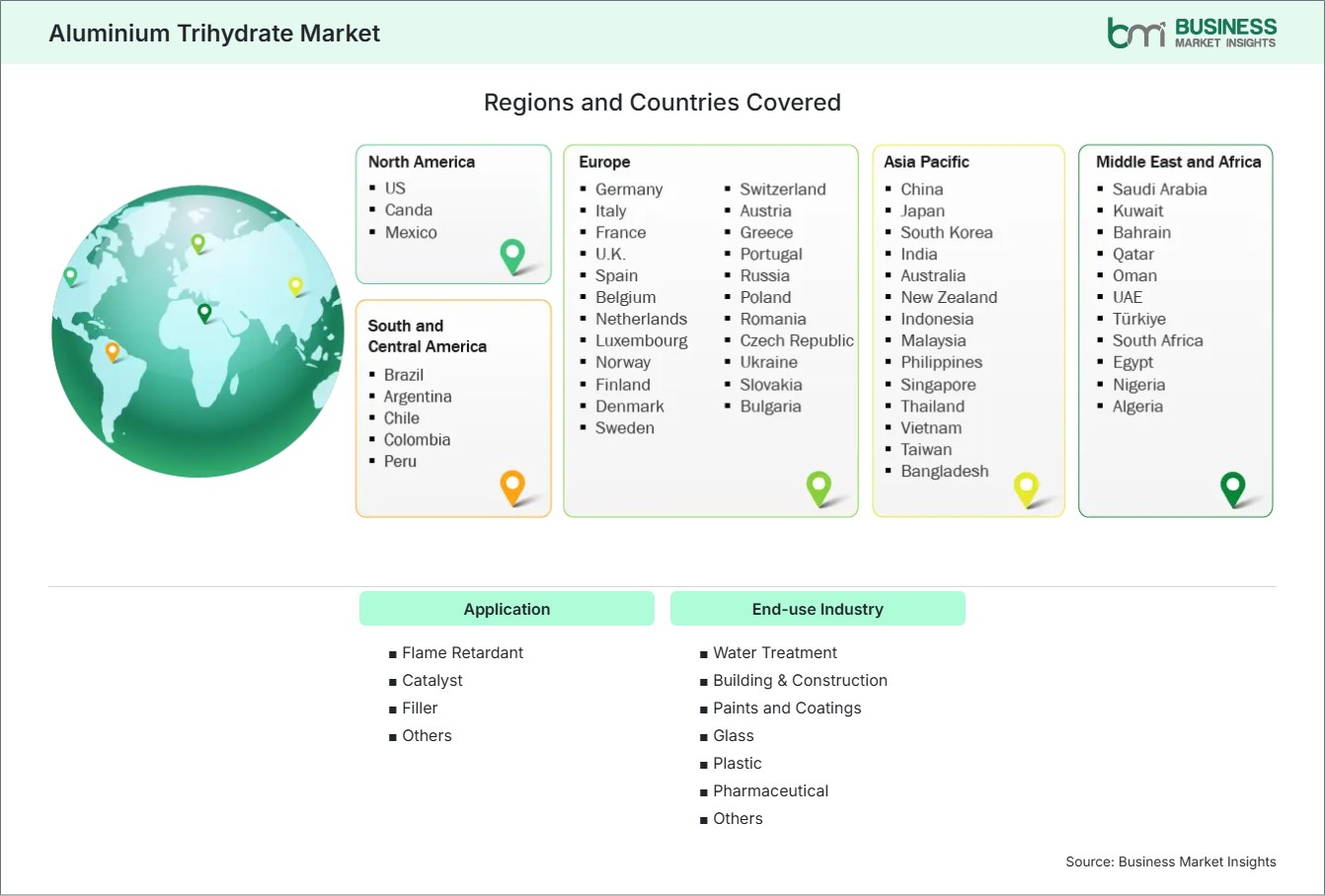
North America Aluminium Trihydrate Market
North America accounted for 24%–27% of the global market in 2025 and is projected to expand at a CAGR of 7.3%–7.8% during 2026–2033. Strong demand from construction materials, wire and cable manufacturing, and water treatment applications continues supporting regional growth. The Aluminium Trihydrate Market share remains significant due to stringent fire safety regulations encouraging adoption of halogen-free flame-retardant additives across multiple industries.
- The United States continues leading regional consumption through increasing investments in commercial construction, electrical infrastructure modernization, and advanced polymer manufacturing.
- Rising adoption of low-smoke, halogen-free cable insulation materials is increasing utilization of aluminium trihydrate across power transmission and telecommunication infrastructure.
- Water treatment modernization and industrial wastewater management projects continue supporting demand for aluminium-based treatment chemicals throughout municipal and industrial sectors.
- Manufacturers are investing in specialty fine-particle ATH grades offering improved dispersion, flame retardancy, and compatibility with advanced polymer compounds.
- Increasing infrastructure rehabilitation programs continue supporting long-term demand for flame-retardant construction materials and specialty fillers.
US Aluminium Trihydrate Market
The United States represented 20%–23% of the global market in 2025 and is anticipated to grow at a CAGR of 7.4%–7.9% through 2026–2033. Expanding construction activity, rising electrical infrastructure investments, and growing polymer processing industries continue driving Aluminium Trihydrate Market growth while strengthening domestic demand for environmentally friendly flame-retardant materials.
- Federal infrastructure investments continue increasing consumption of flame-retardant materials across transportation, energy, and public construction projects.
- Growing electric vehicle charging infrastructure is supporting demand for halogen-free cable compounds utilizing aluminium trihydrate fillers.
- Increasing production of polymer composites and engineered plastics expands utilization of ATH across industrial and electrical applications.
- Environmental regulations continue encouraging replacement of conventional halogen-based flame retardants with sustainable mineral alternatives.
Europe Aluminium Trihydrate Market
Europe held 22%–25% of global revenue in 2025 and is expected to register a CAGR of 7.5%–8.0% during 2026–2033. Strict environmental regulations, sustainable construction methods, and high volume of low-smoke cable manufacturing are driving regional expansion. Germany remains the largest regional market, while Poland is expected to exhibit the highest growth rate during the forecast period.
- Germany leads regional demand owing to advanced construction materials, automotive manufacturing, and strong adoption of environmentally compliant flame-retardant technologies.
- Poland is projected to expand at a CAGR of 8.1%–8.6%, supported by industrial development, infrastructure investments, and growing plastics manufacturing capacity.
- France and Italy continue increasing utilization of ATH across paints, coatings, wire insulation, and specialty industrial fillers.
- Rising renewable energy installations are strengthening demand for fire-resistant cable compounds and electrical insulation materials.
- European manufacturers continue developing sustainable, high-purity ATH grades aligned with evolving environmental compliance requirements.
Asia Pacific Aluminium Trihydrate Market
Asia Pacific accounted for 45%–48% of global Aluminium Trihydrate market revenue in 2025 and is projected to register the fastest CAGR of 8.2%–8.7% during 2026–2033. Rapid urbanization, production of more plastics, construction work, and investment in electricity infrastructure will continue to drive demand in the region. China is the largest market, whereas India is the fastest-growing country in the region.
- China dominates global consumption through extensive construction activity, cable manufacturing, plastics processing, and integrated alumina production capacity.
- India is projected to register a CAGR of 8.8%–9.3%, supported by infrastructure expansion, electrical grid modernization, and increasing polymer manufacturing investments.
- Japan and South Korea continue emphasizing high-performance flame-retardant materials for advanced electronics and industrial manufacturing applications.
- Expansion of renewable energy infrastructure continues increasing demand for fire-resistant electrical insulation materials and specialty fillers.
- Regional manufacturers continue expanding production capacities to meet rising domestic and export demand for high-purity aluminium trihydrate.
Rest of World Aluminium Trihydrate Market
The Rest of the World accounted for 6%–8% of global market revenue in 2025 and is anticipated to expand at a CAGR of 7.1%–7.6% during 2026–2033. Aluminium Trihydrate Market Growth is supported by increasing infrastructure development across the Middle East and expanding industrial manufacturing throughout South & Central America.
Rising investments in construction, water treatment facilities, mining, and electrical infrastructure continue creating opportunities for aluminium trihydrate suppliers serving emerging industrial markets requiring cost-effective flame-retardant and filler materials.
- Brazil remains the leading South & Central American market through increasing plastics processing, paints production, and infrastructure development.
- Saudi Arabia continues strengthening industrial mineral demand through downstream petrochemical expansion and large-scale construction projects.
- The United Arab Emirates supports market growth through commercial infrastructure investments and expanding electrical installation activities.
- Growing industrial diversification across emerging economies increases utilization of ATH in polymer compounds, coatings, and specialty industrial applications.
- Continued investment in power transmission infrastructure supports long-term demand for halogen-free cable compounds and electrical insulation materials.