
Aluminium Powder Market Outlook: Size, Share, Trends, Growth Analysis, Competitive Landscape & Forecast, 2026–2033

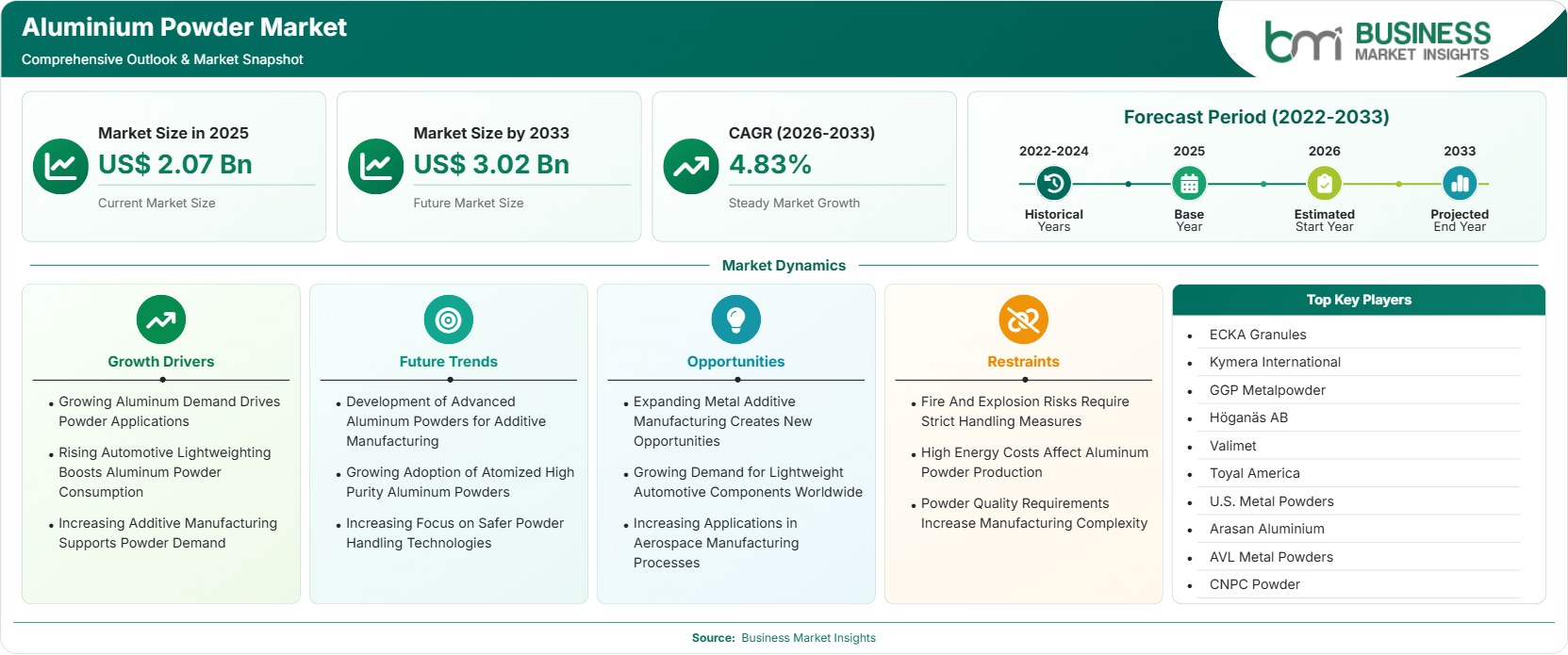
The Aluminium Powder Market size was valued at US$ 2.07 billion in 2025 and is projected to reach US$ 3.02 billion by 2033, growing at a CAGR of 4.83% during 2026–2033, supported by lightweighting, additive manufacturing, industrial demand, aerospace applications, and advanced powder technologies.

Report Coverage
  • Type: Atomized Aluminium Powder, Flake Aluminium Powder
  • Application: Industrial, Automotive, Aerospace & Defense, Building & Construction, Electronics & Semiconductors, Others
US$ 2.07 Bn Market size in 2025
US$ 3.02 Bn Market Size by 2033
4.83% CAGR, 2026 - 2033
2026-2033 Forecast Period

AI Overview

Aluminium Powder Market Summary

  • North America Region: North America holds a 18%–22% share in 2025 and is projected to grow at a 4.0%–4.6% CAGR through 2033, supported by aerospace manufacturing, automotive lightweighting, additive manufacturing, domestic powder production, industrial coatings, and advanced materials investment. The US market advances at a 4.0%–4.5% CAGR, supported by aerospace, defense, automotive, and additive manufacturing demand.
  • Fastest Growing Region: Asia Pacific holds a 43%–47% share in 2025 and is projected to grow at a 5.2%–5.8% CAGR through 2033, supported by industrialization, automotive lightweighting, electronics manufacturing, construction activity, additive manufacturing, and expanding regional powder production capabilities.
  • Leading Segment: Atomized Aluminium Powder holds a 62%–66% share in 2025 and is projected to grow at a 5.0%–5.6% CAGR through 2033, supported by controlled particle morphology, additive manufacturing, thermal spraying, automotive components, aerospace applications, and customized alloy development.
  • High Growth Segment: Aerospace & Defense holds a 14%–18% share in 2025 and is projected to grow at a 6.0%–6.8% CAGR through 2033, supported by lightweight structures, complex component production, additive manufacturing, material efficiency, advanced alloy development, and defense modernization programs.
  • Key Market Opportunity: Lightweight component production, metal additive manufacturing, aerospace applications, customized alloy powders, and digitally controlled powder processing create attractive opportunities for suppliers offering consistent morphology, purity, flowability, and application-specific performance.
  • Major Market Players: ECKA Granules Germany GmbH; Kymera International, LLC; GGP Metalpowder AG; Höganäs AB; VALIMET, Inc.; Toyal America, Inc.; United States Metal Powders, Inc.; The Arasan Aluminium Industries (P) Ltd.; AVL METAL POWDERS n.v.; CNPC POWDER NORTH AMERICA INC.
Strategic Insights

Aluminium Powder Market: Strategic Insights

Aluminium Powder Market Strategic Framework
FREE PDF
Request your free sample
Request free sample
Stakeholder View

Key Takeaways

  • Supply-chain competitiveness increasingly depends on consistent feedstock quality, reliable raw-material access, controlled atomization, classification expertise, and application-specific technical support.
  • The strongest upside lies where aluminium's low density combines with complex geometries, material efficiency, and demanding performance requirements, particularly advanced manufacturing applications.
  • Innovation is shifting toward engineered particle morphology, customized alloy chemistry, tighter distribution control, improved flow behavior, and powders designed around specific manufacturing processes.
  • Asia Pacific presents the most compelling case for expansion due to the continuous growth of industrial capacity, automotive manufacturing, electronics manufacturing, construction, and advanced manufacturing systems.
  • The priority investment areas would be atomization scalability, automation classification, quality laboratories, improved handling facilities, and customer development.
  • Long-term competitiveness will increasingly depend on converting commodity powder production into higher-value application solutions through alloy engineering, technical services, process integration, and consistent supply.
Geographic Outlook

Aluminium Powder Market Regional Highlights

North America Aluminium Powder Market

North America holds a 18%–22% share in 2025 and is projected to grow at a 4.0%–4.6% CAGR through 2033. The Aluminium Powder Market share reflects a mature customer base with comparatively high technical requirements and increasing interest in localized supply chains.

  • Aerospace and defense manufacturers increasingly value engineered powders capable of supporting lightweight component production, complex geometries, thermal management, repair technologies, and advanced manufacturing processes requiring controlled feedstock characteristics.
  • Automotive applications benefit from lightweighting objectives, particularly where aluminium components can reduce vehicle mass while maintaining structural performance, thermal behavior, corrosion resistance, and manufacturing flexibility.
  • Additive manufacturing supports demand for spherical aluminium alloy powders with controlled morphology, particle-size distribution, oxygen content, and flow characteristics suitable for repeatable production.
  • Industrial users continue consuming aluminium powders in coatings, thermal applications, metallurgical processes, and specialized formulations where conductivity, reflectivity, lightweight properties, or controlled reactivity provide functional advantages.

US Aluminium Powder Market

The United States represents approximately 78%–83% of North American demand in 2025 and is projected to grow at a 4.0%–4.5% CAGR through 2033. Aerospace, defense, automotive, industrial manufacturing, and additive manufacturing provide the principal demand base.

  • Aerospace and defense programs create demand for qualified aluminium alloy powders where repeatability, traceability, low contamination, and consistent particle characteristics influence component certification and manufacturing performance.
  • Automotive manufacturers increasingly evaluate aluminium powder solutions for lightweight components, thermal applications, advanced coatings, and additive manufacturing as vehicle architectures become more material-efficient.
  • Domestic production capabilities strengthen supply resilience by reducing dependence on distant suppliers while enabling closer collaboration between powder producers, material engineers, component manufacturers, and technology developers.

Europe Aluminium Powder Market

Europe holds a 23%–27% share in 2025 and is projected to grow at a 3.6%–4.2% CAGR through 2033. Germany, Italy, France, and the United Kingdom remain leading markets, while Poland and other Central European economies offer higher-growth opportunities. Demand reflects automotive engineering, aerospace production, industrial coatings, construction materials, electronics, and additive manufacturing.

  • Germany remains a leading demand center because of its automotive engineering base, industrial manufacturing ecosystem, aerospace capabilities, and established powder-processing expertise supporting sophisticated customer applications.
  • France and Italy provide opportunities through aerospace, automotive, industrial manufacturing, coatings, and specialized engineering applications requiring lightweight materials and increasingly customized metallic feedstocks.
  • The United Kingdom maintains demand through aerospace, defense, advanced manufacturing, electronics, and research-driven additive manufacturing programs that require specialized aluminium alloy powder formulations.
  • Poland and Central European markets offer higher-growth potential as manufacturing investment, automotive localization, construction activity, and industrial modernization expand demand for engineered aluminium materials.

Asia Pacific Aluminium Powder Market

Asia Pacific holds a 43%–47% share in 2025 and is projected to grow at a 5.2%–5.8% CAGR through 2033. China, Japan, India, South Korea, and Southeast Asian economies represent important demand centers. China leads regional volume, while India and Southeast Asia provide attractive growth opportunities through industrial expansion, automotive manufacturing, electronics production, construction, and additive manufacturing.

  • China benefits from extensive automotive, electronics, construction, industrial, and manufacturing activity, creating broad consumption opportunities for both conventional and engineered aluminium powder grades.
  • India offers strong expansion potential through automotive manufacturing, infrastructure development, defense localization, electronics production, and growing adoption of additive manufacturing across industrial applications.
  • Japan and South Korea support technically demanding demand through advanced automotive, electronics, aerospace, precision engineering, and materials-development ecosystems that favor consistent specialty powder products.
  • Southeast Asia provides incremental opportunities as manufacturing relocation, automotive investment, electronics production, infrastructure development, and regional supply-chain diversification increase demand for lightweight metallic materials.

Rest of World Aluminium Powder Market

Rest of World represents approximately 8%–12% of global demand in 2025 and is projected to grow at a 3.8%–4.5% CAGR through 2033. South and Central America are supported by construction, automotive, coatings, metallurgy, and industrial manufacturing. Brazil and Mexico lead regional demand, while Colombia and Chile offer developing opportunities.

Growth in the Middle East is increasingly connected with industrial diversification, aerospace ambitions, construction, and advanced manufacturing investment. Saudi Arabia and the United Arab Emirates represent leading opportunities, while South Africa remains important in Africa through established industrial and automotive capabilities.

  • Brazil and Mexico provide the strongest Latin American opportunities because industrial manufacturing, automotive activity, construction, coatings, and specialized materials consumption create diversified demand channels.
  • Colombia and Chile offer developing opportunities through infrastructure, industrial modernization, mining-related applications, construction materials, and expanding manufacturing capabilities requiring lightweight metallic inputs.
  • Saudi Arabia and the United Arab Emirates provide premium opportunities through industrial diversification, aerospace development, construction, defense investment, and advanced manufacturing initiatives.
  • South Africa remains an important African market because of automotive manufacturing, industrial activity, mining-related applications, construction demand, and established regional distribution capabilities.
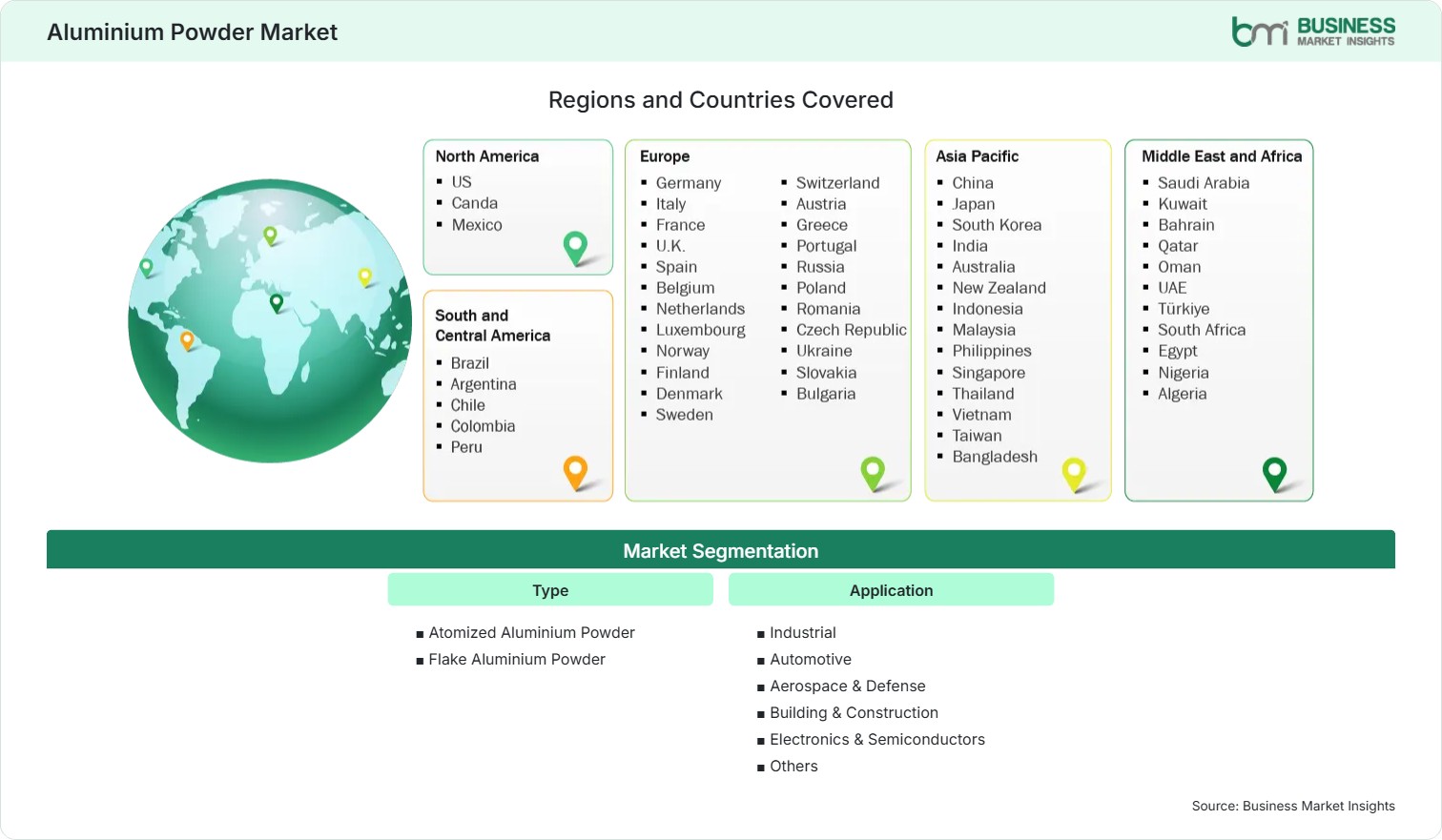
Global Market Geography
FREE PDF
Request your free sample
Request free sample
Segment Analysis

Aluminium Powder Market Segmentation

Type

Atomized Aluminium Powder holds a 62%–66% share in 2025 and is projected to grow at a 5.0%–5.6% CAGR through 2033. Its controlled morphology, scalable production, and suitability for advanced manufacturing support segment leadership. The Aluminium Powder Market scope increasingly favors engineered grades where particle characteristics determine process efficiency, dimensional accuracy, and finished-component performance.

  • Atomized Aluminium Powder: Atomized grades provide controlled particle morphology and distribution for additive manufacturing, thermal spraying, powder metallurgy, and industrial applications requiring consistent flow and processing behavior.
  • Flake Aluminium Powder: Flake grades provide high surface coverage and reflective characteristics, supporting coatings, pigments, construction materials, specialized formulations, and applications where particle geometry improves functional performance.

Application

Aerospace & Defense represents a 14%–18% share in 2025 and is projected to grow at a 6.0%–6.8% CAGR through 2033. These include lightweighting, advanced manufacturing, modernization of the defense industry, and the manufacturing of complex components. The applications of aluminium powders continue to be diverse and include industrial applications alongside the automobile, construction, electronic and semiconductor industries.

  • Industrial: Industrial applications use aluminium powder in coatings, thermal processes, metallurgy, chemicals, and specialized manufacturing, with demand influenced by functional performance, material efficiency, and process reliability.
  • Automotive: Automotive applications benefit from lightweighting, thermal management, advanced coatings, and additive manufacturing, particularly where aluminium enables lower mass and more complex component designs.
  • Aerospace & Defense: Aerospace and defense applications prioritize lightweight, high-performance components, specialized alloys, additive manufacturing, and controlled powder characteristics for demanding production and qualification environments.
  • Building & Construction: Construction uses aluminium powder in lightweight materials, aerated concrete, coatings, and specialized formulations where controlled reaction, density reduction, and functional performance support material efficiency.
  • Electronics & Semiconductors: Electronics applications leverage aluminium powders for thermal management, conductive functions, coatings, and specialized materials where heat dissipation, lightweight characteristics, and controlled particle properties are important.
  • Others: Other applications include specialty chemicals, energy, metallurgical processes, pigments, and advanced formulations where aluminium powder provides tailored physical, thermal, or chemical characteristics.
Market Forces

Aluminium Powder Market Dynamics

Key Market Drivers

Growing Aluminium Demand Drives Powder Applications

Increased demand for aluminium products in the industry will favor the application of powdered forms due to the benefits offered by particle properties in comparison to traditional material forms. More often, demands for aluminium products are driven by the need to build something that weighs less, has some reactivity properties, is thermally conductive, functional, and efficient in its use. As a result, product development by producers is based on certain particle morphology and alloys rather than being limited to standardized grades only. Moreover, the Aluminium Powder Market development trend also depends on better collaboration between powder producers and consumers of such products in order to optimize the requirements for feedstock.

Rising Automotive Lightweighting Boosts Aluminium Powder Consumption

The practice of automotive lightweighting creates new opportunities for aluminium materials due to the need of automakers to reduce the weight of the car and maintain performance. Powder processing technology will be helpful in creating complex geometry, efficient use of materials, thermal processes, and production of certain components. With the move towards electrified cars, the need for aluminium does not disappear since lightweight solutions, thermal processes, and advanced manufacturing techniques are important in all kinds of automobiles. The powder producers could gain from creating powder types for certain automotive processes, like additive manufacturing and coating.

Increasing Additive Manufacturing Supports Powder Demand

The use of metal additive manufacturing technology is enhancing the technological significance of aluminium powders by allowing complex geometry formation, part integration, weight reduction, and material conservation. Studies are still ongoing to create aluminium alloys that are strong, thermally stable, printable, and resilient to manufacturing problems. The recent success of engineered aluminium alloys in attaining excellent performance using computational alloy design and metal additive manufacturing has shown their great potential. Therefore, suppliers have to be concerned about morphology, flowability, oxygen content, alloy chemistry, and recycling of powders.

Key Market Opportunities

Expanding Metal Additive Manufacturing Creates New Opportunities

The growing market of metal additive manufacturing provides a good opportunity for powder makers due to the characteristics of aluminium, which include a lightweight nature, strength, corrosion resistance, and good thermal conductivity. Applications range from prototyping to mass production, tooling, repairing, heat exchangers, mobility parts, and aircraft. The Aluminium Powder Market Forecast becomes more and more contingent on the ability of powder makers to certify specific powders for applications. Producers can benefit from making custom alloys, proper particle size distribution, technical assistance, reuse of powders, and process collaboration.

Growing Demand for Lightweight Automotive Components Worldwide

Automotive OEMs are seeking lightweight solutions in structural, thermal management, powertrain, and interior applications, and this presents opportunities for aluminium powders to facilitate cost-effective and adaptable manufacturing. The greatest opportunities lie in areas where traditional manufacturing techniques encounter geometric or material constraints. Automotive-specific materials can be created by controlling the particle size and metallurgy, among others. The more vehicles become computerized and manufacturing becomes automated, the more important it will become for material suppliers to offer consistent material quality and process-oriented technical assistance to automotive engineers.

Increasing Applications in Aerospace Manufacturing Processes

Additive Manufacturing in the Aerospace Industry is an attractive proposition owing to the fact that lightweight alloys, complicated geometries, component integration, and efficient material usage will allow the creation of tailor-made powder grades. Additive manufacturing in aluminium is under study in the case of components where weight savings and geometrical freedom add value to the design process. This has been validated in the case of manufacturing aluminium parts for aerospace-related applications, including lightweight optical components. Suppliers may gain through customized alloys, qualification assistance, powder analysis, traceability, and partnering with aerospace companies.

Market Restraints and Challenges

Fire And Explosion Risks Require Strict Handling Measures

Factor: Aluminium powder can create an explosive dust atmosphere under certain conditions, as particle size, dust concentration, oxygen supply, moisture, and igniting energy affect explosivity. Impact: The production and handling parties need to make investments towards dust suppression, grounding, ventilation, housekeeping, equipment classification, proper storage, and emergency measures, thus creating extra complexities in operations. OSHA states that aluminium dust is a combustible metal dust and emphasizes the risks of possible severe deflagrations that may occur due to dispersal of the combustible dust under certain conditions.

High Energy Costs Affect Aluminium Powder Production

Factor: The manufacture of aluminium involves high energy requirements of melting, atomizing, classifying, drying, and handling of materials. This makes production economics very dependent on the price of power and fuels used. Impact: The volatility of energy prices may squeeze margins, raise costs, and make supply agreements difficult, especially for players operating in highly price-sensitive end-markets. The powder makers can hedge against this risk by using energy-efficient furnaces, atomization optimization, energy recovery, improved utilization of the facility, green electricity sourcing, and process automation.

Company Analysis

Competitive Landscape

The competitive environment combines specialty powder manufacturers, diversified materials companies, aluminium pigment specialists, additive manufacturing suppliers, and regional producers. Aluminium Powder Market analysis indicates that differentiation increasingly depends on atomization expertise, particle-size control, alloy customization, application knowledge, safety systems, production consistency, and technical support.

Company Name

Overview

Products and Services relevant to this market

ECKA Granules Germany GmbH

Kymera-affiliated German powder producer with established capabilities in aluminium and aluminium-alloy powders.

Aluminium powders, aluminium-alloy powders, metallic powders, customized grades, and application-focused material solutions.

Kymera International, LLC

Global specialty-materials producer with broad non-ferrous powder capabilities and strong advanced-manufacturing expertise.

Aluminium alloy powders, additive manufacturing powders, powder metallurgy materials, cold-spray powders, and custom alloys.

GGP Metalpowder AG

German metal-powder producer with established international distribution and extensive powder-processing experience.

Metal powders, specialized powder products, and application-focused materials for industrial manufacturing and processing.

Höganäs AB

Global powder-metallurgy specialist supporting material development across industrial, automotive, additive manufacturing, and engineering applications.

Aluminium-based AM powders, metal powders, powder-development services, and application engineering.

VALIMET, Inc.

U.S. specialty manufacturer focused on spherical aluminium and aluminium-alloy powders produced through gas atomization.

Spherical aluminium powders, alloy powders, additive manufacturing grades, custom atomization, and particle classification.

Toyal America, Inc.

U.S. aluminium powder and pigment specialist serving industrial and advanced-material applications.

Atomized aluminium powders, aluminium alloy powders, additive manufacturing materials, pigments, and thermal-management products.

United States Metal Powders, Inc.

Long-established U.S. supplier of engineered aluminium powders serving advanced industrial and manufacturing customers.

Spherical and nodular aluminium powders, aluminium pellets, blends, engineered grades, and specialized powder products.

The Arasan Aluminium Industries (P) Ltd.

Indian aluminium powder manufacturer with broad experience in atomized powders and specialized aluminium products.

Atomized aluminium powder, pyrotechnic powder, lightweight concrete powder, pigments, pastes, and specialty grades.

AVL METAL POWDERS n.v.

Belgian family-owned powder producer specializing in metallic pigments and functional powders for global industrial markets.

Aluminium functional powders, aluminium pigments, metallic powders, pastes, and application-specific powder solutions.

CNPC POWDER NORTH AMERICA INC.

International metal-powder supplier serving additive manufacturing, powder metallurgy, aerospace, chemical, and industrial applications.

Aluminium alloy powders, 3D-printing powders, atomized powders, powder-metallurgy materials, and specialty metal products.

Trust & Transparency

Research Methodology

The market analysis combines proprietary research with secondary data from government agencies, company disclosures, regulatory filings, industry databases and expert interviews. Market estimates are validated through data triangulation, cross-market benchmarking and analyst review.

View Full Research Methodology

Questions Answered

Frequently Asked Questions

What does the Aluminium Powder Market report indicate about future competition?

Competition will increasingly center on powder consistency, alloy customization, production safety, application engineering, additive manufacturing expertise, and reliable supply. Companies combining scalable production with technical development capabilities should be better positioned to capture demand from high-value aerospace, automotive, industrial, and advanced-manufacturing applications.

Why are aerospace and automotive applications creating new opportunities for aluminium powder solutions?

Both sectors prioritize weight reduction, material efficiency, design flexibility, and advanced manufacturing. Aluminium powder can support complex component geometries and specialized processing routes while maintaining the material's lightweight characteristics, making it relevant to evolving aerospace structures and automotive component-development strategies.

How are advanced powder technologies influencing Aluminium Powder Market adoption?

Advanced atomization, particle classification, alloy engineering, and powder characterization improve consistency and processing performance. These technologies help manufacturers develop feedstocks tailored to additive manufacturing, thermal spraying, powder metallurgy, coatings, and other applications where morphology and particle distribution directly affect production outcomes.

Which applications present the strongest opportunity in the market?

Aerospace and defense, automotive lightweighting, additive manufacturing, advanced industrial processing, electronics, and construction materials present attractive opportunities. Applications requiring complex geometries, reduced weight, thermal performance, or specialized powder characteristics offer stronger potential for higher-value products.

What factors are improving Aluminium Powder Market return on investment?

Expansion of lightweight materials, additive manufacturing, aerospace production, automotive component development, advanced coatings, and industrial applications can improve investment returns. Producers can strengthen margins through customized alloys, automated classification, efficient atomization, premium grades, and application-specific technical services.

Access the Full Aluminium Powder Market Report

Get segment-level forecasts, regional estimates, competitive benchmarking, company profiles and downloadable Excel datasets.

Access the full Aluminium Powder Market Report
350 pages PDF & Excel | 2026-08-19