
Iron Powder Market Outlook: Size, Share, Trends, Growth Analysis, Competitive Landscape & Forecast, 2026-2033

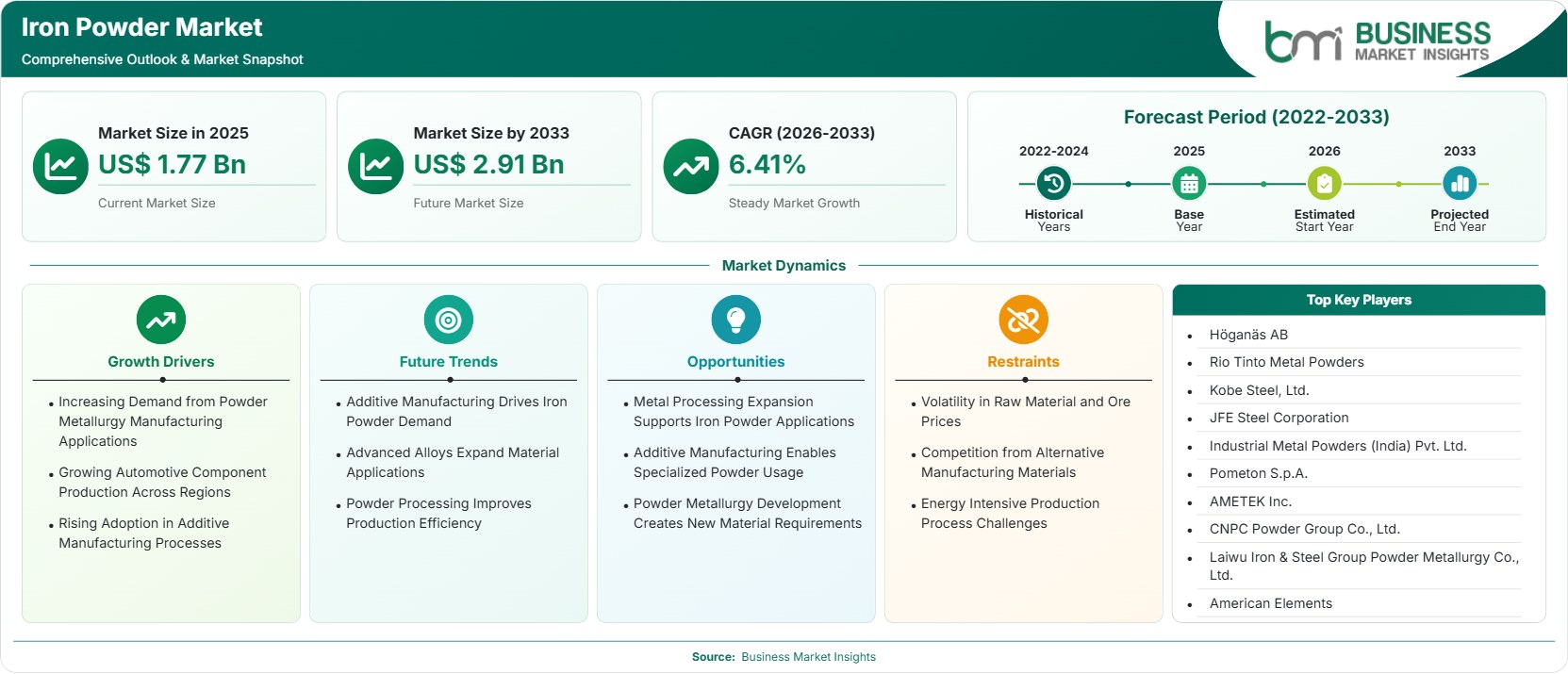
The Iron Powder Market size was valued at US$ 1.77 Billion in 2025 and is projected to reach US$ 2.91 Billion by 2033, growing at a CAGR of 6.41% during 2026–2033. Growth is supported by powder metallurgy adoption, automotive lightweighting, industrial component manufacturing, additive manufacturing expansion, and rising demand for sustainable metal-processing solutions.

Report Coverage
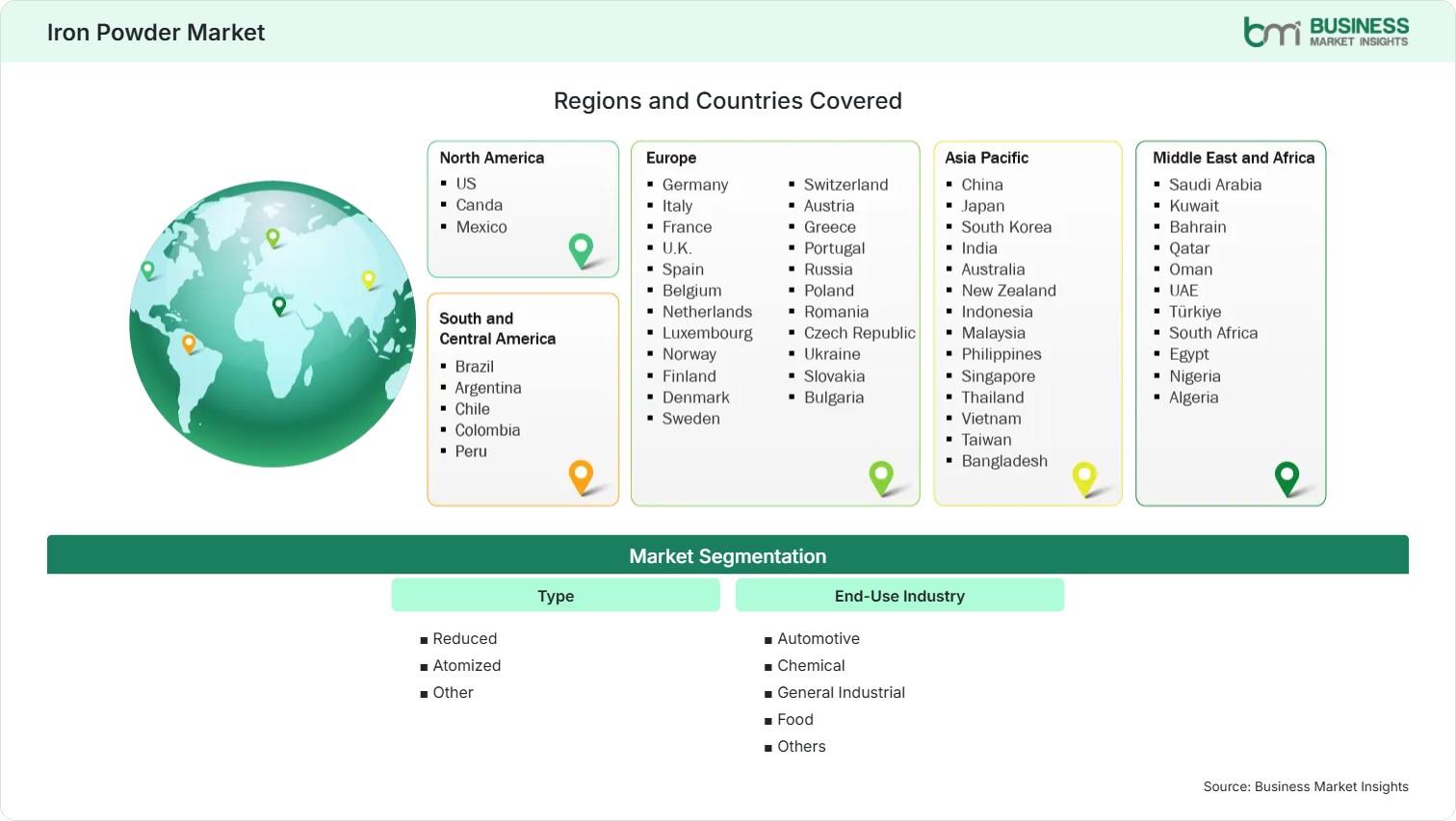
  • Type: Reduced, Atomized, Other
  • End-Use Industry: Automotive, Chemical, General Industrial, Food, Others
US$ 1.77 Bn Market size in 2025
US$ 2.91 Bn Market Size by 2033
6.41% CAGR, 2026 - 2033
2026-2033 Forecast Period

AI Overview

Iron Powder Market Summary

  • North America Region: North America holds a market share of 24%–27% in 2025, growing at a CAGR of 5.6%–6.0% during 2026–2033. Growth is supported by automotive powder metallurgy demand, manufacturing modernization, component localization, recycling initiatives, advanced materials development, industrial automation investments, energy infrastructure expansion, defense procurement programs, and additive manufacturing adoption across sectors. U.S. demand remains strong, supported by industrial reshoring and automotive component production, advancing at approximately 5.8%–6.2% CAGR.
  • Fastest Growing Region: Asia Pacific holds a market share of 42%–46% in 2025, growing at a CAGR of 7.0%–7.5% during 2026–2033. Rising vehicle production, electronics manufacturing, industrialization, infrastructure investments, expanding powder metallurgy applications, domestic steel capacity growth, export-oriented manufacturing, government incentives, and increasing machinery production continue supporting regional expansion.
  • Leading Segment: Automotive accounts for 35%–39% share in 2025 and advances at 6.4%–6.8% CAGR. Increasing use of sintered components, transmissions, engines, electric-drive systems, material efficiency benefits, cost optimization, mass production suitability, durability requirements, and evolving mobility technologies collectively support sustained segment leadership.
  • High Growth Segment: Atomized accounts for 38%–42% share in 2025 and grows at 6.8%–7.3% CAGR. Superior flowability, uniform particle size distribution, additive manufacturing demand, magnetic applications, advanced component fabrication, precision engineering requirements, technological innovations, and expanding industrial specifications contribute to accelerated growth.
  • Key Market Opportunity: Growing utilization of metal powders in additive manufacturing, energy applications, and high-performance industrial components creates opportunities for premium-grade products, localized supply chains, sustainability initiatives, and advanced material innovation.
  • Major Market Players: Höganäs AB, Rio Tinto Metal Powders, Kobe Steel, Ltd., JFE Steel Corporation, Industrial Metal Powders (India) Pvt. Ltd., Pometon S.p.A., AMETEK Inc., CNPC Powder Group Co., Ltd., Laiwu Iron & Steel Group Powder Metallurgy Co., Ltd., American Elements.
Strategic Insights

Iron Powder Market: Strategic Insights

Iron Powder Market Strategic Framework
FREE PDF
Request your free sample
Request free sample
Stakeholder View

Key Takeaways

  • Supply chains are becoming increasingly integrated, with producers aligning raw-material sourcing, powder manufacturing, and downstream component fabrication to improve reliability and cost competitiveness.
  • Significant upside exists in automotive transmission components, electric mobility systems, magnetic materials, and precision-engineered industrial parts utilizing powder metallurgy technologies.
  • Innovation is shifting toward atomized grades, additive-manufacturing powders, advanced coatings, and high-purity materials designed for demanding industrial environments.
  • Asia-Pacific offers the strongest investment case due to expanding industrial production, automotive manufacturing concentration, and large-scale infrastructure development programs.
  • Strategic partnerships, capacity expansions, and sustainability-focused investments are becoming more common as producers seek technology differentiation and regional market access.
  • Recycling, resource efficiency, and lower-emission production methods are increasingly influencing purchasing decisions across industrial customer groups.
Geographic Outlook

Iron Powder Market Regional Highlights

North America Iron Powder Market

North America accounted for approximately 24%–27% Iron Powder Market share in 2025 and is projected to record a CAGR of 5.6%–6.0% through 2033. Regional demand is supported by automotive manufacturing, industrial automation, defense applications, and additive manufacturing investments. Powder metallurgy remains widely adopted for cost-efficient component production. The United States represents the dominant regional consumer, while Mexico benefits from automotive supply-chain expansion. Continued reshoring initiatives and advanced manufacturing investments are reinforcing long-term consumption patterns across multiple end-use industries.

  • Automotive manufacturers continue increasing powder-metallurgy component usage to enhance cost efficiency and reduce machining waste across high-volume vehicle production.
  • Additive manufacturing investments support greater consumption of high-performance powders in aerospace, defense, and industrial applications.
  • Industrial reshoring programs encourage localized material procurement and strengthen demand for domestically supplied products.
  • Sustainability initiatives promote recycling and resource efficiency, improving the attractiveness of powder-based manufacturing techniques.

US Iron Powder Market

The United States represented approximately 75%–80% of North American demand in 2025 and continues to expand at an estimated 5.8%–6.2% CAGR. Market development is linked to automotive manufacturing, industrial machinery production, defense spending, and advanced manufacturing technologies. Growth is supported by strong engineering capabilities, research investment, and continuing modernization of industrial operations. High-value applications increasingly favor premium powder grades with strict consistency requirements and enhanced processing performance.

  • Advanced manufacturing programs support broader adoption of powder metallurgy and additive-manufacturing technologies.
  • Defense and aerospace applications create demand for premium-quality engineered materials and precision manufacturing solutions.
  • Industrial automation investments strengthen consumption across machinery, tooling, and equipment production activities.
  • Expanding electric vehicle production increases requirements for sintered and magnetic components.

Europe Iron Powder Market

Europe held approximately 22%–25% share in 2025 and is expected to record a CAGR of 5.4%–5.9% through the Iron Powder Market Forecast Period. Germany remains the leading national market due to its automotive and industrial manufacturing base, while Central and Eastern European economies represent faster-growing demand centers with estimated growth exceeding regional averages. Sustainability regulations, efficiency requirements, and advanced engineering capabilities continue to support powder metallurgy adoption. Producers are also strengthening circular-economy strategies and low-carbon manufacturing initiatives.

  • Germany leads regional consumption because of extensive automotive and machinery manufacturing activity.
  • Poland and Czech Republic demonstrate stronger growth owing to industrial investments and expanding supplier networks.
  • Environmental regulations encourage efficient material utilization and reduced production waste.
  • Advanced engineering sectors support demand for high-quality atomized and specialty powder grades.

Asia Pacific Iron Powder Market

Asia Pacific accounted for 42%–46% Iron Powder Market share in 2025 and delivers the strongest regional expansion at 7.0%–7.5% CAGR through 2033. China represents the largest market, while India records one of the fastest growth rates across the region. Rapid industrialization, automotive production, infrastructure development, electronics manufacturing, and machinery output continue driving consumption. Expanding domestic manufacturing ecosystems and government industrial policies further support long-term capacity additions and downstream application growth.

  • China remains the leading consumer due to extensive automotive, machinery, and industrial manufacturing activity.
  • India benefits from industrial expansion, infrastructure spending, and rising domestic vehicle production.
  • Electronics and consumer-goods manufacturing strengthen regional demand for precision components.
  • Government programs supporting local manufacturing contribute to increased powder metallurgy adoption.
  • Expansion of export-oriented manufacturing creates sustained material consumption opportunities.

Rest of World Iron Powder Market

The Rest of World region accounted for 8%–11% Iron Powder Market share in 2025 and is forecast to grow at 5.8%–6.4% CAGR through 2033. South and Central America benefit from automotive production recovery and expanding industrial activities.

Middle East and Africa markets are supported by infrastructure projects, industrial diversification programs, and manufacturing investments. Brazil leads regional demand in Latin America, while Saudi Arabia and the UAE demonstrate increasing growth potential through industrial development initiatives.

  • Brazil remains a key consumer supported by automotive and industrial manufacturing operations.
  • Gulf countries are investing in industrial diversification and advanced production capabilities.
  • Infrastructure developments stimulate machinery and equipment manufacturing demand.
  • Mining-related industrial activities support requirements for wear-resistant components and materials.
Global Market Geography
FREE PDF
Request your free sample
Request free sample
Segment Analysis

Iron Powder Market Segmentation

Type

Type segment dynamics are shaped by performance, application suitability, and production economics. The category accounted for 100% of market demand collectively, with atomized products representing the largest contributor. The Iron Powder Market scope continues expanding across powder metallurgy, additive manufacturing, and magnetic applications. Atomized products drive growth, with a 38%–42% share and a 6.8%–7.3% CAGR.

  • Reduced: Widely utilized in powder metallurgy, welding consumables, and chemical applications owing to porosity characteristics, cost effectiveness, and reliable performance across conventional industrial processes.
  • Atomized: Preferred for advanced manufacturing and precision applications due to superior flowability, particle uniformity, consistency, and suitability for high-performance engineered components.

End-Use Industry

End-use demand is led by transportation and industrial manufacturing applications. Automotive remains the largest contributor with 35%–39% market share in 2025 and a 6.4%–6.8% CAGR, driven by sintered parts and lightweight component production. The segment also reflects evolving Iron Powder Market trends associated with electrification and efficiency improvements.

  • Automotive: Extensive use in gears, bearings, transmission systems, and structural components supports sustained demand from global vehicle production.
  • Chemical: Utilized in catalysts, purification processes, and specialty formulations requiring controlled purity and performance characteristics.
  • General Industrial: Supports machinery, tools, friction materials, magnetic products, and numerous engineered manufacturing applications.
  • Food: Applied in nutrient fortification and specialized processing requirements where regulated iron content remains essential.
Market Forces

Iron Powder Market Dynamics

Key Market Drivers

Growing Automotive Powder Metallurgy Penetration

Global vehicle manufacturers continue adopting powder metallurgy technologies to reduce material waste, improve production efficiency, and support high-volume manufacturing. As indicated by production trends of OICA, cars are mainly produced in Asia and developed countries, hence driving the demand for the products. Electrification is also another factor that has resulted in more use of the products in motors and drive shafts. There is excellent cooperation between the automotive and powder metallurgy industries, which drives further product development.

Expansion of Industrial Manufacturing Activities

Industrial output growth across Asia-Pacific, North America, and parts of Europe continues supporting demand for engineered metal powders. Machine building, manufacture of automation equipment, and capital investment plans ensure a constant need for wear-resisting and precision engineering parts. The powder metallurgy technique brings some efficiency benefits to the material use and designing process. Productivity-oriented industries are using more and more sintered components. Additional investments into factory equipment and production processes help maintain strong demand.

Rising Adoption in Additive Manufacturing

Three-dimensional printing technologies increasingly employ specialized metal powders for complex industrial components. The capability to limit waste, lower the demands for tooling, and increase design flexibility makes the material more attractive for use in aerospace, healthcare, and other industries. Manufacturers continue improving their products by developing more compact particle size distributions and creating improved grades specifically for use in additive manufacturing. Premium powder groups are becoming increasingly important due to the wider industrial adoption of the technology.

Key Market Opportunities

Advanced Energy and Magnetic Material Applications

The worldwide trend towards the adoption of electrical and energy-efficient technologies is leading to a growing application of sophisticated magnetic materials in transformers, motors, inductors, and other electrical components. The increased investment in grid upgrades, renewable energy facilities, and electric vehicles is generating a considerable demand for specific types of materials featuring enhanced properties. Companies that are able to deliver such products will likely thrive amid the described trends. As these applications expand, producers can strengthen high-value product portfolios, improve margins, and enhance overall industry profitability.

Regional Manufacturing Localization

Both the government and the manufacturers are focusing on resilience through localized manufacturing. There are considerable growth opportunities for domestic manufacturers in the form of investments in setting up new production facilities and industrial policies. Through localized manufacturing, dependence on international logistics, costs of transportation, and delivery time will be reduced. The increased investment activities in Asia, North America, and some selected Middle Eastern nations are increasing the manufacturing capabilities in these regions. These structural trends are expected to support sustained Iron Powder Market growth and positive long-term prospects for the market.

Sustainable Low-Emission Production Technologies

Growing environmental concerns and stricter sustainability targets are encouraging manufacturers to adopt low-emission production technologies, recycling programs, and resource-efficient operational practices. Customers increasingly prefer suppliers that demonstrate strong environmental responsibility and commitment to reducing their carbon footprint. Through the early adoption of greener technologies, corporations can distinguish themselves from their rivals, improve their brand reputation and open up additional markets for themselves. Enhanced environmental performance is also crucial for corporations to adapt to new regulatory pressures and consumer demands.

Market Restraints and Challenges

Raw Material Price Volatility

Fluctuations in the prices of key raw materials such as iron ore, steel scrap, and energy significantly influence manufacturing operations and financial performance. These cost differences create uncertainty in profits, make it difficult for a company to price its products, and increase the risks in purchasing planning. In the case of manufacturers who conduct their businesses in competitive industries, difficulties may arise as the increasing cost of raw materials cannot always be transferred to consumers. Uncertainty in price also creates difficulties in inventory planning, budgeting, and making investments. Persistent uncertainty about the cost of raw materials results in decreased profitability and production planning.

Competition from Alternative Manufacturing Methods

Continuous advancements in casting, machining, and other alternative material-processing technologies create significant competition for powder-based manufacturing methods. For a variety of reasons, such as better performance, lower cost, and greater manufacturing efficiency, end users might find these competing processes more attractive. On the other hand, there are also certain industries that are skeptical about employing any new powder technology because of the need for qualification, the cost of transition, and engineering difficulties. Thus, alternative manufacturing processes will restrict the growth of demand in certain areas, and innovations are crucial for powder manufacturers.

Company Analysis

Competitive Landscape

The competitive environment reflects ongoing capacity investments, product innovation, and regional expansion strategies. Current Iron Powder Market analysis indicates strong participation from global leaders and specialized producers.

Company Name

Overview

Products and Services relevant to this market

Höganäs AB

Global metal powder leader with significant expertise across powder metallurgy and advanced material technologies.

Iron powders, atomized powders, additive manufacturing materials, magnetic and industrial powder solutions.

Rio Tinto Metal Powders

Major supplier leveraging metallurgical expertise and broad industrial materials capabilities.

Iron powders, specialty ferrous materials, industrial-grade powder solutions.

Kobe Steel, Ltd.

Diversified industrial company with established presence in metallic powder technologies.

Iron powders, powder metallurgy materials, engineered industrial powders.

JFE Steel Corporation

Japanese producer supplying reduced and atomized grades across industrial applications.

Reduced iron powder, atomized iron powder, alloy powder products.

Industrial Metal Powders (India) Pvt. Ltd.

Key regional supplier serving automotive and engineering industries.

Reduced iron powders, specialty industrial powder materials.

Pometon S.p.A.

European producer focused on metallic powders and advanced industrial materials.

Atomized powders, ferrous powders, specialty metal powder solutions.

AMETEK Inc.

Industrial technology company supporting advanced materials and engineered products markets.

Specialty powders, engineered material solutions and industrial technologies.

CNPC Powder Group Co., Ltd.

Chinese manufacturer serving powder metallurgy and industrial sectors.

Iron powders, alloy powders, powder metallurgy materials.

Laiwu Iron & Steel Group Powder Metallurgy Co., Ltd.

Integrated producer focused on powder metallurgy materials and industrial applications.

Reduced powders, atomized powders, industrial iron powder grades.

American Elements

Advanced materials supplier serving research and industrial markets globally.

High-purity iron powders, specialty metal materials, engineered compounds.

Trust & Transparency

Research Methodology

The market analysis combines proprietary research with secondary data from government agencies, company disclosures, regulatory filings, industry databases and expert interviews. Market estimates are validated through data triangulation, cross-market benchmarking and analyst review.

View Full Research Methodology

Questions Answered

Frequently Asked Questions

What does this Iron Powder Market Report help stakeholders evaluate?

It supports assessment of regional opportunities, competitive positioning, technology developments, segment performance, investment priorities, and long-term industry demand dynamics.

How does sustainability influence purchasing decisions?

Industrial buyers increasingly evaluate emissions performance, recycling capabilities, material efficiency, and environmental compliance when selecting suppliers and production technologies.

Why are atomized products gaining popularity?

They provide consistent particle distribution, improved flow characteristics, and suitability for high-performance manufacturing applications including advanced powder metallurgy and additive manufacturing.

Which region offers the strongest growth potential?

Asia Pacific presents the strongest growth profile because of industrialization, vehicle production growth, infrastructure investment, and expansion of manufacturing supply chains across major economies.

What factors are shaping demand patterns in the industry?

Automotive production, industrial automation, additive manufacturing adoption, and sustainability-focused manufacturing practices are the primary demand drivers. Rising use of precision-engineered components also supports consumption.

Access the Full Iron Powder Market Report

Get segment-level forecasts, regional estimates, competitive benchmarking, company profiles and downloadable Excel datasets.

Access the full Iron Powder Market Report
350 pages PDF & Excel | 2026-09-04
Similar Research

Related Market Reports