
Alternative Credentials Market Outlook: Size, Share, Trends, Growth Analysis, Competitive Landscape & Forecast, 2022-2033

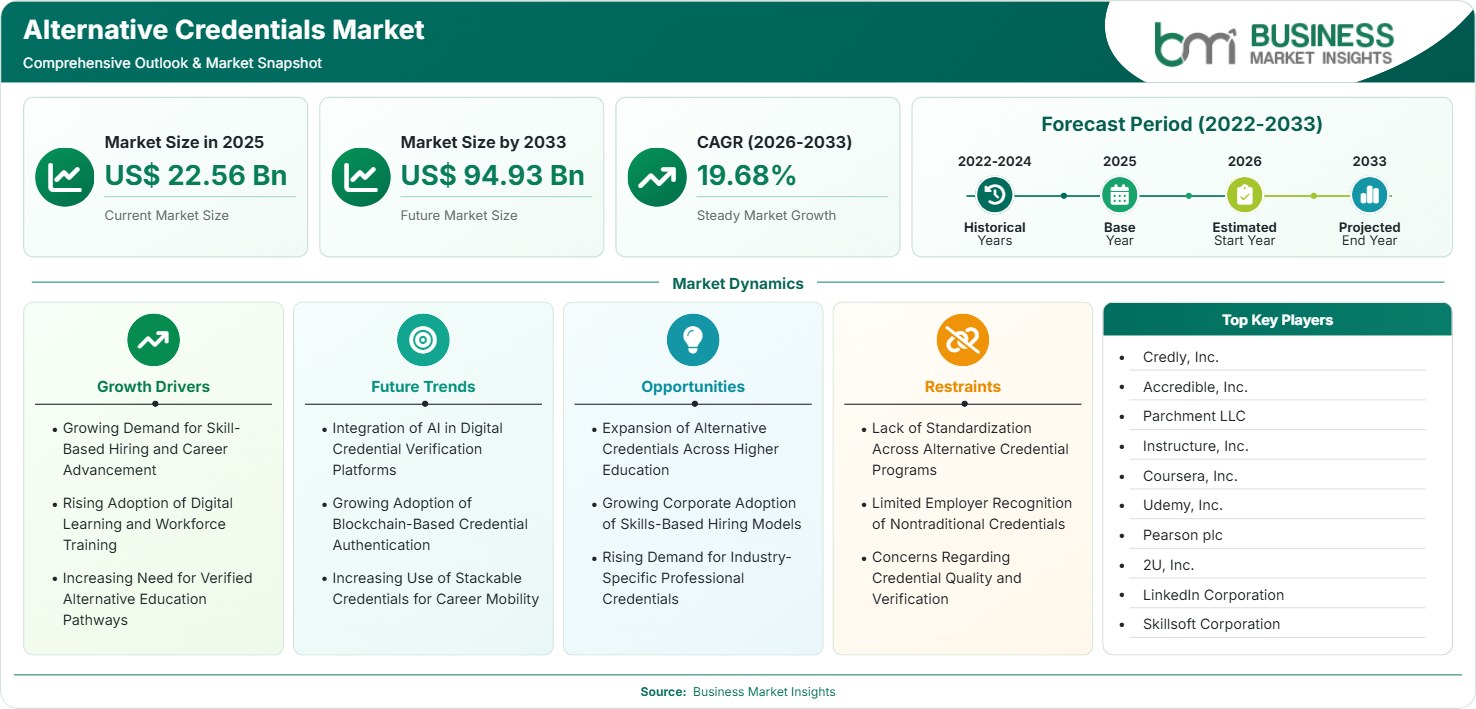
The Alternative Credentials Market size was valued at US$ 22.56 billion in 2025 and is projected to reach US$ 94.93 billion by 2033, growing at a CAGR of 19.68% during 2026–2033, driven by skills-based hiring, digital learning, workforce reskilling, verified credentials, employer adoption, and demand for industry-specific qualifications.

Report Coverage
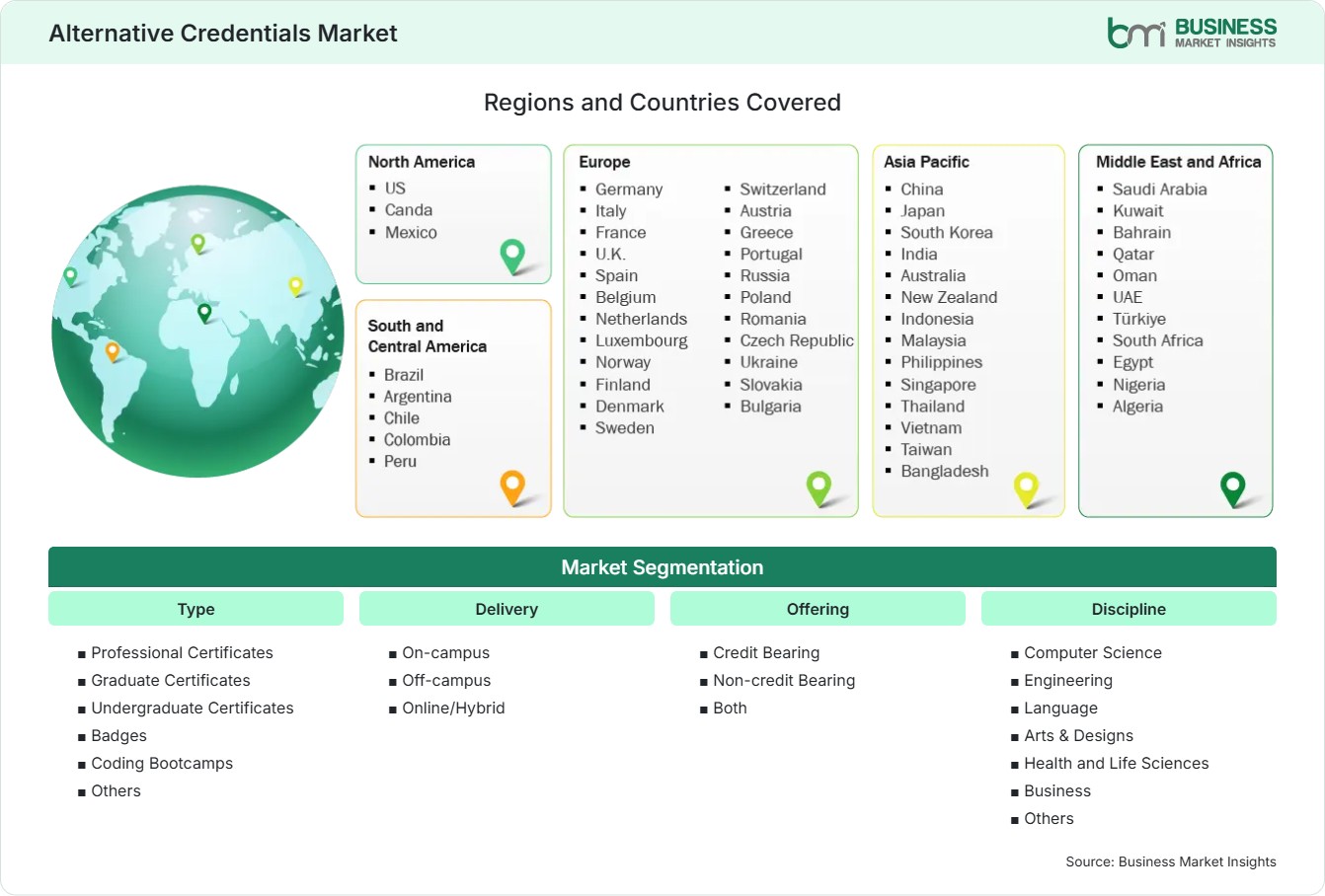
  • Type: Professional Certificates, Graduate Certificates, Undergraduate Certificates, Badges, Coding Bootcamps, Others
  • Delivery: On-campus, Off-campus, Online/Hybrid
  • Offering: Credit Bearing, Non-credit Bearing, Both
  • Discipline: Computer Science, Engineering, Language, Arts & Designs, Health and Life Sciences, Business, Others
US$ 22.56 Bn Market size in 2025
US$ 94.93 Bn Market Size by 2033
19.68% CAGR, 2026 - 2033
2026-2033 Forecast Period

01 AI Overview

Alternative Credentials Market Summary

  • North America Region: North America holds a 35%–39% share in 2025, growing with a CAGR of 17.0%–19.0%, influenced by employer-led skills hiring, mature online education infrastructure, university-industry partnerships, professional upskilling, and expanding digital credential ecosystems. The US market is expanding at a CAGR of 17.5%–19.5%, supported by corporate reskilling, demand in the technology sector, digital badges, professional certificates, and the growing integration of credentials into recruitment platforms.
  • Fastest Growing Region: Asia Pacific holds a 23%–27% share in 2025, growing with a CAGR of 22.0%–24.0%, supported by expanding digital education access, large working-age populations, technology skills shortages, government workforce initiatives, and increasing demand for affordable career-focused learning pathways.
  • Leading Segment: Professional Certificates hold a 31%–35% share in 2025, growing with a CAGR of 19.0%–21.0%, driven by employer-recognized skills development, career transitions, technology training, flexible learning formats, and demand for credentials aligned with specific occupational requirements.
  • High Growth Segment: Online/Hybrid delivery holds a 51%–55% share in 2025, growing with a CAGR of 21.0%–23.0%, supported by flexible access, scalable content delivery, remote learning infrastructure, working-professional participation, and expanding employer-sponsored digital training.
  • Key Market Opportunity: Alternative credentials can bridge education and employment by connecting universities, technology platforms, employers, and learners through verifiable skill pathways, particularly in rapidly changing occupations requiring continuous workforce reskilling.
  • Major Market Players: Credly, Inc., Accredible, Inc., Parchment LLC, Instructure, Inc., Coursera, Inc., Udemy, Inc., Pearson plc, 2U, Inc., LinkedIn Corporation, and Skillsoft Corporation.
02 Strategic Insights

Alternative Credentials Market: Strategic Insights

Alternative Credentials Market Strategic Framework
FREE PDF
Request your free sample
Request free sample
03 Stakeholder View

Key Takeaways

  • The ecosystem is evolving from standalone certificate providers toward interconnected platforms that combine credential issuance, verification, learner records, skills taxonomies, professional profiles, and employer recruitment workflows.
  • Professional certificates and online or hybrid delivery formats offer strong growth opportunities by addressing workforce reskilling needs while providing learners with greater flexibility than conventional degree programs.
  • Skills-based hiring is encouraging credential providers to map learning outcomes against specific occupational competencies, increasing the importance of measurable assessments, practical projects, and employer validation.
  • The Asia Pacific region represents a great opportunity for expansion due to the need for a scalable model to address the technology skills gap and facilitate economic transformation in the digital economy.
  • Strategic partnerships between universities, technology companies, employers, and credential platforms are becoming increasingly important for improving credential credibility, curriculum relevance, and employment outcomes.
  • By developing interoperable verification and establishing high-level employer awareness, organizations can create robust competitive positions through credential portability between organizations, locations, and institutions.
04 Geographic Outlook

Alternative Credentials Market Regional Highlights

North America Alternative Credentials Market

North America held a 35%–39% share in 2025 and is projected to grow at a 17.0%–19.0% CAGR during 2026–2033. The region benefits from mature online learning infrastructure, established professional education ecosystems, and strong employer interest in skills-based recruitment. Alternative Credentials Market share remains highest in North America because universities and businesses increasingly use certificates and digital badges for workforce development, career transitions, and targeted technology training.

  • Employers are increasingly evaluating demonstrated skills alongside traditional degrees, supporting demand for credentials aligned with specific technical, professional, and occupational competencies.
  • Universities are expanding certificate programs and shorter learning pathways to attract working professionals seeking targeted skills without pursuing full degree programs.
  • Technology companies and professional platforms are strengthening digital credential ecosystems through skills verification, online learning partnerships, and integration with professional profiles.

US Alternative Credentials Market

The United States Market held a market share of 31% to 35% in 2025 and is anticipated to grow at a rate of 17.5% to 19.5% CAGR until 2033. The nation has a well-developed higher education ecosystem, high adoption of online learning, and a growing need for technological skills. Alternative Credentials Market growth and development are driven by employer-driven reskilling, professional certifications, digital badges, and university-technology companies seeking more flexible workforce development models.

  • US employers are increasingly experimenting with skills-based hiring practices, creating demand for verifiable credentials that demonstrate practical capabilities beyond conventional academic qualifications.
  • Universities are expanding non-degree programs in technology, business, healthcare, and professional disciplines to meet evolving workforce needs and attract career-focused learners.
  • Digital credential platforms are improving verification and portability, allowing employers to evaluate certificates and badges through professional profiles and integrated recruitment systems.
  • Corporate learning programs are increasingly combining online courses, assessments, and credentials to document employee development and support internal mobility initiatives.

Europe Alternative Credentials Market

The Europe region captured a 20%–24% share of the worldwide Alternative Credentials Market in 2025 and is estimated to grow at a 17.0%–19.0% CAGR from 2025 to 2033. The UK emerges as a dominant adopter in the region, whereas Germany and France offer immense growth prospects for developing and learning vocational skills. The UK market is expected to grow at a 18.0%–20.0% CAGR, while the Germany market is projected to grow at a 16.0%–18.0% CAGR. Digital learning and skills shortages are supporting adoption.

  • The UK benefits from strong online education adoption and a mature professional learning ecosystem supporting certificates, microcredentials, and employer-oriented skills development.
  • Germany's vocational education tradition creates opportunities for alternative credentials that complement formal qualifications and address specialized technical and digital skills requirements.
  • France is expanding flexible professional education pathways as employers seek workforce development models capable of responding to evolving technology and occupational requirements.
  • European providers are increasingly emphasizing credential transparency, quality assurance, and portability to strengthen recognition across education institutions and labor markets.

Asia Pacific Alternative Credentials Market

The Asia Pacific region accounted for 23%–27% of the market share in 2025, and the Asia Pacific Alternative Credentials Market forecasts is estimated to grow at a 22.0%–24.0% CAGR between 2024 and 2033. China dominates the regional demand, and India denotes a high-potential market. China is expected to grow at a CAGR of 20.0%–22.0%, while India is expected to grow at a CAGR of 24.0%–26.0%. Digital education expansion, technology skills shortages, and workforce transformation are accelerating adoption.

  • China's large technology workforce and expanding digital economy are increasing demand for targeted professional credentials supporting software, data, artificial intelligence, and business capabilities.
  • India's expanding digital learning ecosystem and young workforce are creating strong opportunities for affordable, career-focused credentials aligned with technology and emerging employment requirements.
  • Southeast Asian economies are adopting digital learning and workforce development programs to improve employability and address gaps in specialized technology and professional skills.
  • Universities and employers are increasingly exploring industry-linked credentials that combine practical learning with recognized assessments, improving alignment between education outcomes and labor market needs.

Rest of World Alternative Credentials Market

South and Central America Market held a market share of 7%-9% in 2025 and is expected to register a 18.0%-20.0% CAGR between 2026 and 2033, with Brazil and Mexico leading. The Middle East & Africa market has a market share of 6%-8% and is expected to register a 17.0%- 19.0% CAGR, with stronger growth prospects in the UAE and Saudi Arabia. Alternative Credentials Market share is expanding as digital education and workforce transformation accelerate.

  • Brazil's growing online education ecosystem is supporting flexible professional learning, while employers increasingly seek targeted capabilities in technology, business, and digital operations.
  • Mexico benefits from manufacturing and technology investments that are increasing demand for workforce credentials aligned with specialized technical and digital competencies.
  • Gulf economies are investing in workforce modernization and digital transformation, creating opportunities for professional credentials linked to technology, business, cybersecurity, and emerging industries.
  • African markets offer longer-term potential as mobile connectivity and digital learning platforms expand access to affordable professional development and employment-oriented skills training.
Global Market Geography
FREE PDF
Request your free sample
Request free sample
05 Segment Analysis

Alternative Credentials Market Segmentation

Type

The Professional Certificates segment accounted for 31%–35% in 2025 and is expected to grow at a 19.0%–21.0% CAGR over the forecast period of 2026–2034 within the Global Alternative Credentials Market. There has been an increasing need for job-specific skills, which is strengthening adoption, while universities and technology companies increasingly offer short-duration programs.

  • Professional Certificates: Professional certificates support career advancement and reskilling by validating targeted competencies, particularly across technology, business, data, cybersecurity, healthcare, and other rapidly evolving occupational areas.
  • Graduate Certificates: Graduate certificates provide specialized post-baccalaureate learning pathways, attracting professionals seeking focused academic credentials without completing a full postgraduate degree program.
  • Undergraduate Certificates: Undergraduate certificates offer shorter, structured pathways for learners seeking foundational or specialized knowledge that can complement degree studies or support entry-level career development.
  • Badges: Digital badges provide portable evidence of specific competencies or completed learning achievements, supporting skills visibility across professional profiles, recruitment systems, and internal workforce platforms.
  • Coding Bootcamps: Coding bootcamps provide intensive, practical technology training designed to accelerate entry into software development and related digital occupations through project-based learning.

Delivery

Online/Hybrid delivery held a 51%–55% share in 2025 and is expected to grow at a 21.0%–23.0% CAGR through 2034. Flexible access, scalable digital platforms, and working-professional participation are driving adoption.

  • On-campus: On-campus credentials provide structured academic environments and direct institutional engagement, remaining relevant for learners seeking specialized training with access to faculty, facilities, and peer networks.
  • Off-campus: Off-campus programs expand access through employer locations, training centers, and community settings, supporting workforce development initiatives and flexible professional education models.
  • Online/Hybrid: Online and hybrid delivery enables scalable, flexible learning for working professionals while supporting multimedia instruction, remote assessments, self-paced courses, and geographically distributed credential programs.

Offering

Credit-bearing programs accounted for 28%-32% of total enrollment in 2025 and are expected to register a 18.0%-20.0% CAGR over 2034. Credit-based certifications enjoy greater academic acceptance, while non-credit courses allow flexibility for faster workforce skill development.

  • Credit-bearing: Credit-bearing credentials integrate with academic programs and provide learners with transferable educational value, supporting progression toward degrees and other formal qualifications.
  • Non-credit-bearing: Non-credit credentials offer flexible, targeted learning for professionals seeking specific competencies without pursuing formal academic credit or extended degree commitments.
  • Both: Combined models connect non-credit workforce training with credit-bearing pathways, enabling learners to stack credentials and potentially progress toward broader academic qualifications.

Discipline

Computer Science held a 22%–26% share in 2025 and is projected to grow at a 22.0%–24.0% CAGR through 2033. The driving forces behind the demand for courses in this field are the shortage of employees and rapid digitalization. In addition to business and engineering, there are growing areas such as health and life sciences, languages, and creativity.

  • Computer Science: Computer science credentials address demand for software development, artificial intelligence, data analytics, cloud computing, cybersecurity, and other technology capabilities required across digitally transforming industries.
  • Engineering: Engineering credentials support specialized technical development and continuing education in fields influenced by automation, advanced manufacturing, energy transition, infrastructure, and emerging technologies.
  • Language: Language credentials support professional communication and employability, with digital platforms enabling flexible learning and targeted proficiency development for international and multilingual workplaces.
  • Arts & Designs: Arts and design credentials help learners develop specialized creative and digital skills spanning graphic design, user experience, multimedia, content creation, and emerging digital production tools.
  • Health and Life Sciences: Health and life sciences credentials provide targeted learning opportunities in rapidly evolving fields where professionals require continuing education and specialized knowledge updates.
  • Business: Business credentials help to develop skills in such areas as management, finance, marketing, entrepreneurship, leadership, and digital strategies.
06 Market Forces

Alternative Credentials Market Dynamics

Key Market Drivers

Growing Demand for Skill-Based Hiring and Career Advancement

The requirement for employers to assess employees’ skills has grown as technology advances, outpacing the pace at which academic programs can adjust. There has been increased demand for alternative credentials owing to portable proofs of specific competencies that students can acquire alongside their degrees and professional experience. Credentials, badges, and bootcamps enable students to demonstrate their abilities across fields such as data, cybersecurity, software, and digital business. The growing emphasis on measurable competencies is strengthening the Alternative Credentials Market growth and encouraging providers to develop assessments.

Rising Adoption of Digital Learning and Workforce Training

The growth of digital learning systems infrastructure has enabled access to professional education without being limited by location or scheduling constraints. More scalable online and hybrid credentialing systems are emerging, enabling educators to reach more learners and employers to deliver training to their dispersed teams. Digital technologies also enable continuous learning through modules, tests, and stackable credentials. This is especially applicable to workers who need regular skills upgrades because of technological changes.

Increasing Need for Verified Alternative Education Pathways

There is a need for efficient ways for both organizations and learners to validate competencies gained through unconventional means, as such forms of learning are becoming increasingly common. Digital credentialing services are utilizing verifiable certifications, badges, secure credentials, and metadata standards to showcase learning outcomes. Credential verification may help alleviate recruiters' doubts while enhancing the portability of these credentials across institutions and organizations. Technology companies are creating an alternative credentials market trend that relates credentials to skills frameworks and professional profiles.

Key Market Opportunities

Expansion of Alternative Credentials Across Higher Education

There is an opportunity for universities to go beyond standard degree frameworks by creating stackable certificates, microcredentials, professional courses, and badges. Such an approach would enable universities to attract professionals who need specific skills and generate additional income streams. Collaboration with businesses and tech companies will enhance the relevance of programs and facilitate acceptance of the resulting credentials. Universities may also incorporate certificates into degrees, allowing learners to earn credentials incrementally. The opportunity becomes most evident in fields where technologies evolve fast.

Growing Corporate Adoption of Skills-Based Hiring Models

The emergence of skills-based hiring practices among corporations is paving the way for credentialing providers to design assessment and training programs aligned with specific competencies. Employers will be able to leverage these credentials for recruiting, promoting, developing an internal mobility program, and workforce planning. This approach allows credentialing providers to enhance their value by linking credentials to occupations and integrating verification tools into application-tracking and human resources software. This creates opportunities for recurring enterprise contracts rather than one-time learner transactions.

Rising Demand for Industry-Specific Professional Credentials

Specialized industry credentials help meet the needs of particular skills that general education qualifications do not necessarily cover. Technology, information security, medicine, finance, advanced manufacturing, and renewable energy are areas where specialized knowledge evolves rapidly. Educational institutions can work with employers and professional organizations to develop credentials for specific occupational skills. Such programs can improve employer confidence while giving learners clearer pathways toward specific roles.

Market Restraints and Challenges

Lack of Standardization Across Alternative Credential Programs

Factor: Alternative credentials are issued by universities, private educational organizations, tech firms, employers, and other specialist entities, using different types of assessment, learning standards, and verification systems. Impact: Inconsistent credentialing systems can complicate the evaluation of qualifications, making it hard for employers to determine whether different certifications represent comparable levels of proficiency. The situation can undermine learners' trust and stall the spread of credentials, especially where there is no transparency regarding learning outcomes and independent verification.

Limited Employer Recognition of Nontraditional Credentials

Factor: Many employers still give preference to traditional academic credentials and recognized professional credentials while making decisions about candidates, especially those jobs that require official certification or licensing. Impact: This may devalue alternative credentials and prevent learners from pursuing such programs due to their uncertain market value. It is therefore important that credential providers make strong connections between intended learning outcomes and job competency needs. This can be achieved through collaborations with employers, industry groups, and universities.

07 Company Analysis

Competitive Landscape

Competitors include credentialing technology solutions firms, online learning systems, higher education technology companies, and professional education companies. As per the Alternative Credentials Market analysis, it is observed that the key players are not limiting themselves to offering courses but are creating integrated ecosystems for learning, assessment, credential issuance, professional identity, and workforce management.

Company Name

Overview

Products and Services relevant to this market

Credly, Inc.

Digital credential platform specializing in verified badges and workforce skills recognition for organizations.

Digital badges, credential issuance, verification, skills mapping, analytics, and enterprise credential management solutions.

Accredible, Inc.

Digital credentialing provider helping organizations issue secure, verifiable certificates and badges globally.

Digital certificates, badges, credential verification, analytics, integrations, and branded credentialing platforms.

Parchment LLC

Education technology company focused on digital credentials, academic records, and credential exchange infrastructure.

Digital diplomas, transcripts, credentials, verification services, and secure academic record exchange solutions.

Instructure, Inc.

Education technology provider operating learning management and credentialing capabilities across academic and professional environments.

Learning management systems, professional learning, assessment, digital credentials, and education technology integrations.

Coursera, Inc.

Global online learning platform offering university and industry-aligned professional education and credentials.

Professional certificates, online courses, degrees, specializations, assessments, and workforce learning programs.

Udemy, Inc.

Online learning marketplace providing skills-focused education for individuals and enterprise workforces.

Professional courses, technical training, enterprise learning, assessments, and skills development programs.

Pearson plc

Global education company providing learning, assessment, and professional development solutions across multiple disciplines.

Professional certifications, assessments, digital learning, workforce training, and academic credentialing services.

2U, Inc.

Education technology company partnering with universities to deliver online degree and professional learning programs.

Online certificates, bootcamps, short courses, degree programs, and career-focused digital learning experiences.

LinkedIn Corporation

Professional networking platform integrating learning content, skills profiles, and employer talent solutions.

LinkedIn Learning, skills assessments, professional profiles, learning certificates, and talent management services.

Skillsoft Corporation

Digital learning provider focused on workforce skills development and enterprise training programs.

Professional courses, certifications, leadership training, technology learning, compliance programs, and enterprise learning platforms.


10 Trust & Transparency

Research Methodology

The market analysis combines proprietary research with secondary data from government agencies, company disclosures, regulatory filings, industry databases and expert interviews. Market estimates are validated through data triangulation, cross-market benchmarking and analyst review.

View Full Research Methodology

11 Questions Answered

Frequently Asked Questions

How can credential providers improve learner outcomes?

Providers can improve outcomes by aligning programs with employer requirements, incorporating practical assessments, and offering career services.

Which industries have strong potential to show in the Alternative Credentials Market report?

Technology, cybersecurity, data analytics, healthcare, finance, advanced manufacturing, and renewable energy have strong potential because their skills requirements evolve rapidly.

Can alternative credentials be stacked toward larger qualifications?

Stackable credentials allow learners to accumulate smaller certificates or microcredentials that may contribute toward broader academic or professional pathways.

What makes an alternative credential more credible to employers?

Employer recognition improves when credentials have transparent learning outcomes, rigorous assessments, practical projects, industry partnerships, secure verification, and clear alignment with occupational competencies.

How do alternative credentials complement traditional degrees?

Alternative credentials can provide targeted, up-to-date skills that complement broader academic education.

Access the Full Alternative Credentials Market Report

Get segment-level forecasts, regional estimates, competitive benchmarking, company profiles and downloadable Excel datasets.

Access the full Alternative Credentials Market Report
350 pages PDF & Excel | 2026-08-03