
Allulose Market Outlook: Size, Share, Trends, Growth Analysis, Competitive Landscape & Forecast, 2026-2033

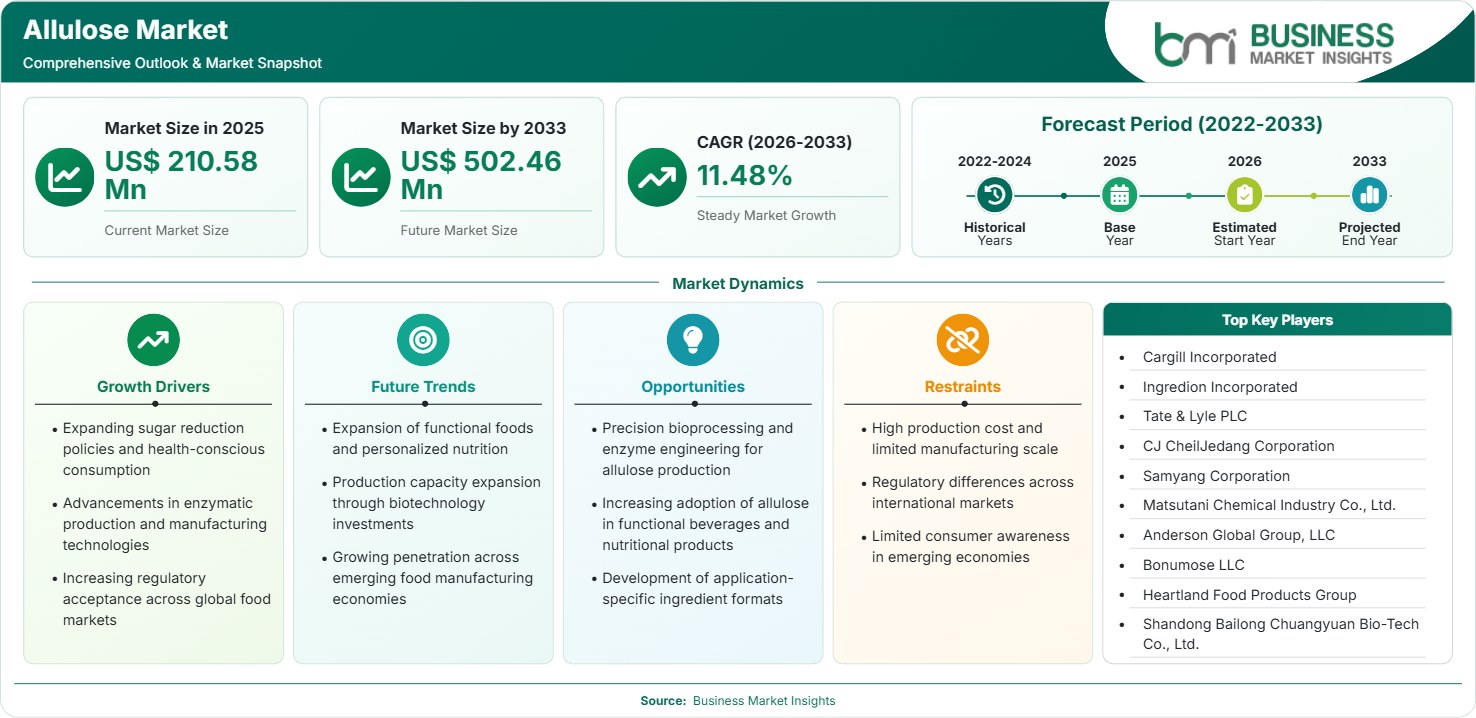
The Allulose Market size was valued at US$ 210.58 Million in 2025 and is projected to reach US$ 502.46 Million by 2033, growing at a CAGR of 11.48% during 2026–2033. Rising demand for low-calorie sweeteners, expanding sugar-reduction initiatives, increasing functional food innovation, and regulatory approvals across major economies are creating attractive opportunities for ingredient manufacturers, food processors, and beverage companies.

Report Coverage
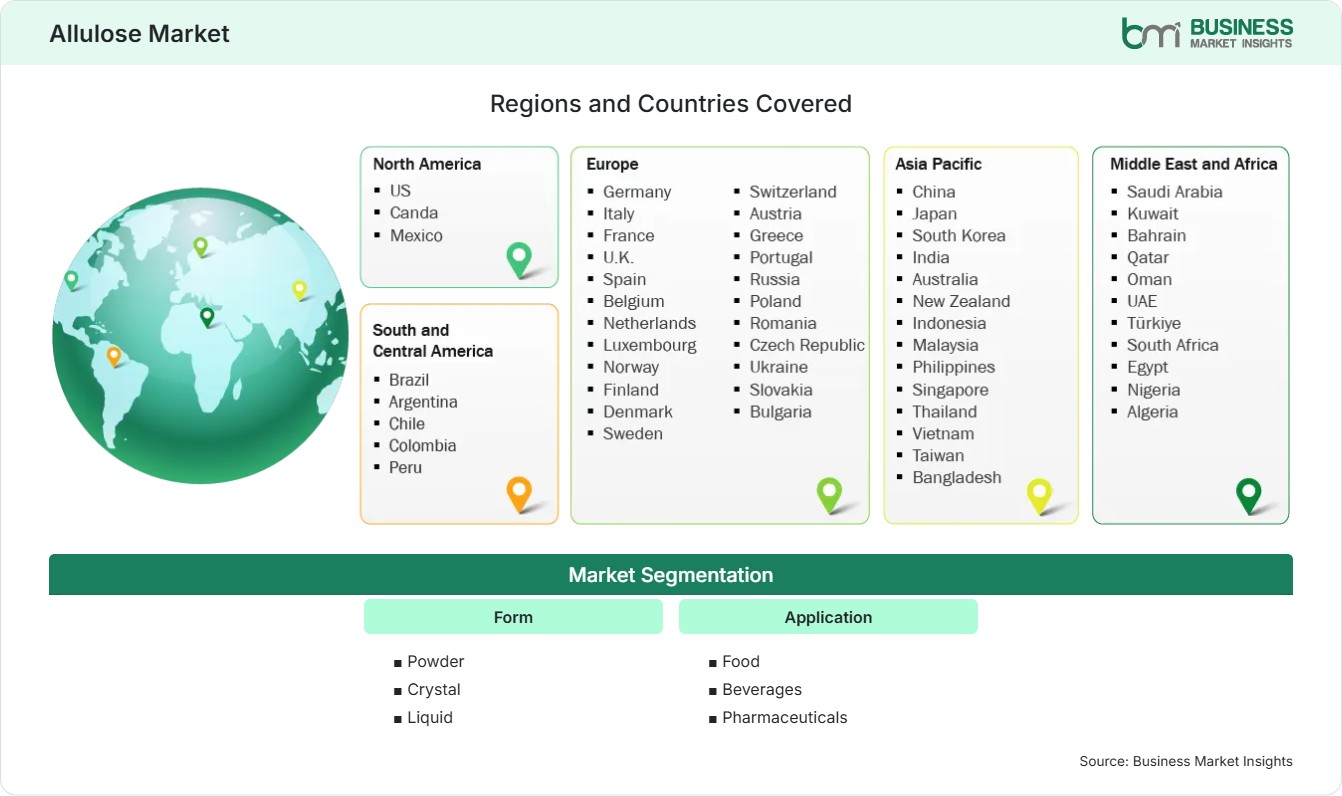
  • Form: Powder, Crystal, Liquid
  • Application: Food, Beverages, Pharmaceuticals
US$ 210.58 Mn Market size in 2025
US$ 502.46 Mn Market Size by 2033
11.48% CAGR, 2026 - 2033
2026-2033 Forecast Period

AI Overview

Allulose Market Summary

  • North America Region: North America holds 39%–42% market share in 2025, expanding at a 10.8%–11.4% CAGR during 2026–2033. Strong regulatory acceptance, extensive reduced-sugar product launches, expanding food processing investments, and rising health-conscious consumer demand continue supporting commercial adoption across multiple food applications. The U.S. dominates regional demand through strong food innovation, favorable ingredient regulations, and expanding reduced-sugar product portfolios, advancing at approximately 11.0%–11.6% CAGR.
  • Fastest Growing Region: Asia Pacific accounts for 24%–27% market share in 2025 while advancing at 12.6%–13.4% CAGR through 2033. Rapid urbanization, expanding specialty ingredient manufacturing, rising diabetic populations, increasing premium food consumption, and investments in biotechnology-based sweetener production continue accelerating regional expansion.
  • Leading Segment: Food represents 56%–60% market share in 2025 and is projected to register a 11.2%–11.8% CAGR through 2033. Continuous reformulation of bakery, confectionery, dairy products, and sugar-reduction strategies encourages sustained ingredient demand across global food manufacturing industries.
  • High Growth Segment: Beverages account for 21%–24% market share during 2025 while growing at 12.4%–13.1% CAGR between 2026 and 2033. Consumer preference for reduced-calorie beverages, clean-label formulations, sports nutrition, and functional drinks continues driving accelerated ingredient utilization worldwide.
  • Key Market Opportunity: Expansion of precision fermentation, enzyme-based production technologies, and premium functional nutrition products enables manufacturers to improve production efficiency, lower manufacturing costs, broaden commercial availability, and strengthen long-term industry competitiveness across international markets.
  • Major Market Players: Cargill Incorporated, Ingredion Incorporated, Tate & Lyle PLC, CJ CheilJedang Corporation, Samyang Corporation, Matsutani Chemical Industry Co., Ltd., Anderson Global Group, LLC, Bonumose LLC, Heartland Food Products Group, and Shandong Bailong Chuangyuan Bio-Tech Co., Ltd.
Strategic Insights

Allulose Market: Strategic Insights

Allulose Market Strategic Framework
FREE PDF
Request your free sample
Request free sample
Stakeholder View

Key Takeaways

  • Expansion of enzyme-based production technologies is improving manufacturing efficiency while strengthening the upstream supply chain for specialty sweeteners, creating a more resilient ecosystem capable of supporting increasing commercial demand across global food industries.
  • Food manufacturers focusing on bakery, dairy, confectionery, and reduced-calorie beverages present the strongest commercial opportunities as consumers increasingly prioritize healthier sugar alternatives without compromising taste or product quality.
  • Research and development efforts are shifting toward precision bioprocessing, improved sweetness optimization, and enhanced formulation compatibility, enabling ingredient suppliers to deliver superior functionality across diverse food and beverage applications.
  • Asia Pacific offers one of the most attractive long-term investment destinations due to expanding food manufacturing infrastructure, increasing disposable incomes, growing diabetic populations, and supportive government initiatives encouraging healthier food innovation.
  • Strategic partnerships, production capacity expansions, licensing agreements, and acquisitions are becoming increasingly important as manufacturers seek technological advantages, improve economies of scale, and strengthen regional distribution capabilities in competitive international markets.
  • Sustainability initiatives emphasizing efficient resource utilization, lower production waste, and environmentally responsible ingredient manufacturing are increasingly influencing procurement decisions among multinational food producers and brand owners.
Geographic Outlook

Allulose Market Regional Highlights

North America Allulose Market

North America accounts for 39%–42% of the global Allulose Market share in 2025 and is projected to expand at a 10.8%–11.4% CAGR during 2026–2033. The region benefits from favorable regulatory frameworks, mature food processing infrastructure, and increasing consumer demand for reduced-calorie sweeteners. Food manufacturers continue reformulating products to meet sugar-reduction objectives while maintaining taste and texture. Innovation in specialty ingredients, expanding functional food categories, and strong investment in research and commercial production continue reinforcing regional leadership and sustained market competitiveness.

  • The United States remains the regional innovation hub, supported by FDA recognition of allulose labeling advantages, encouraging manufacturers to expand reduced-sugar formulations across bakery, dairy, beverages, confectionery, and nutritional products.
  • Growing prevalence of obesity and diabetes is accelerating demand for healthier sugar alternatives, prompting food producers to invest in clean-label ingredient solutions with lower caloric contribution and improved sensory characteristics.
  • Major ingredient suppliers continue expanding manufacturing capabilities and strategic collaborations to strengthen domestic supply chains, improve production efficiency, and meet rising commercial demand from multinational food companies.
  • Increasing adoption of functional foods, ketogenic diets, and wellness-focused nutrition products continues supporting ingredient utilization across premium consumer segments while encouraging continuous formulation innovation.
  • Research into enzymatic production technologies and process optimization is reducing manufacturing costs, enabling broader commercial accessibility and improving long-term competitiveness within regional food ingredient markets.

US Allulose Market

The United States represents approximately 82%–86% of the North American Allulose Market in 2025 and is anticipated to register a 11.0%–11.6% CAGR through 2033. Strong consumer awareness regarding sugar reduction, an advanced food manufacturing ecosystem, and continuous innovation in functional nutrition products support robust commercial adoption. Regulatory clarity surrounding ingredient labeling has encouraged manufacturers to accelerate product development while strengthening investments in large-scale production facilities and research partnerships.

  • FDA guidance supporting differentiated nutrition labeling has encouraged manufacturers to increase product launches utilizing allulose across multiple consumer food and beverage categories.
  • Strong investments in biotechnology, food science, and ingredient innovation continue improving production economics while supporting commercialization of advanced sweetening solutions.
  • Rapid expansion of health-focused retail channels and e-commerce platforms has increased consumer accessibility to products formulated with next-generation low-calorie sweeteners.
  • Strategic collaborations among ingredient suppliers, food brands, and contract manufacturers continue strengthening domestic production capabilities and accelerating commercialization timelines.

Europe Allulose Market

Europe captures 24%–27% of global Allulose Market revenue in 2025 and is forecast to expand at a 10.5%–11.2% CAGR throughout 2026–2033. Consumer preference for healthier diets, expanding clean-label product development, and increasing sugar-reduction initiatives across packaged food categories continue supporting regional demand. Manufacturers are investing in product reformulation and specialty ingredient sourcing while regulatory developments gradually improve commercial opportunities. Germany remains the leading regional market, whereas the United Kingdom demonstrates the fastest projected expansion owing to accelerating functional food innovation.

  • Germany leads regional consumption through its strong food processing industry, advanced ingredient manufacturing capabilities, and increasing investment in reduced-sugar product development.
  • The United Kingdom is projected to record the fastest regional expansion with an estimated CAGR of 11.3%–11.8%, supported by growing consumer demand for healthier packaged foods.
  • Bakery and dairy manufacturers continue increasing adoption of innovative sweetening ingredients to comply with evolving nutritional objectives and changing consumer purchasing preferences.
  • Rising private-label product development across supermarkets encourages ingredient suppliers to strengthen regional partnerships and expand commercial distribution networks.
  • Continuous research into formulation optimization enables manufacturers to improve sweetness profiles while maintaining desirable product texture and shelf stability.

Asia Pacific Allulose Market

Asia Pacific accounts for 24%–27% of global Allulose Market revenue in 2025 and is expected to achieve the fastest regional expansion with a 12.6%–13.4% CAGR during the forecast period. Rapid urbanization, increasing disposable incomes, expanding biotechnology investments, and rising demand for healthier processed foods continue driving market development. Countries including Japan, South Korea, China, and Australia are strengthening manufacturing capacity while encouraging innovation in specialty food ingredients for domestic and export applications.

  • Japan remains the leading regional market owing to its established specialty sweetener industry, advanced food technology expertise, and strong consumer acceptance of functional food ingredients.
  • China is forecast to register the fastest regional growth at approximately 13.2%–13.8% CAGR, supported by expanding production capacity and increasing health-conscious consumption.
  • South Korea continues investing in biotechnology-based ingredient manufacturing, strengthening exports and supporting innovation in reduced-calorie sweetening technologies.
  • Growing demand for premium beverages, nutritional supplements, and healthy snacks encourages manufacturers to incorporate advanced low-calorie sweeteners into new product launches.
  • Regional government initiatives promoting healthier dietary habits continue encouraging food manufacturers to accelerate sugar-reduction strategies across packaged food categories.

Rest of World Allulose Market

The Rest of World region represents 9%–12% of global Allulose Market revenue in 2025 and is projected to expand at a 10.9%–11.7% CAGR through 2033. South & Central America is experiencing increasing demand from beverage and bakery manufacturers responding to sugar-reduction initiatives. Meanwhile, the Middle East & Africa is gradually expanding through premium food imports, functional nutrition adoption, and investments in modern food processing infrastructure. Brazil leads South & Central America, while the United Arab Emirates demonstrates the fastest regional expansion supported by premium health-oriented food consumption.

  • Brazil benefits from expanding processed food production and increasing consumer awareness regarding healthier sweetening alternatives across beverages and packaged food categories.
  • The United Arab Emirates records the strongest regional momentum with an estimated CAGR of 11.8%–12.4%, supported by premium retail expansion and growing functional food demand.
  • International ingredient suppliers continue strengthening regional distribution partnerships to improve product availability and support local food manufacturing industries.
  • Rising investments in modern food processing facilities encourage adoption of innovative specialty ingredients while improving production efficiency and product quality.
  • Growing demand for imported premium nutrition products creates favorable opportunities for ingredient suppliers expanding commercial operations across emerging economies.
Global Market Geography
FREE PDF
Request your free sample
Request free sample
Segment Analysis

Allulose Market Segmentation

Form

The Form segment represents an important foundation for product commercialization, with Powder, Crystal, and Liquid formats addressing diverse formulation requirements across food, beverage, and pharmaceutical industries. This segment accounts for approximately 100% of total product distribution by format, while demand expands at an estimated 11.3%–11.9% CAGR during 2026–2033. The Allulose Market scope continues broadening as manufacturers develop application-specific ingredient formats offering improved handling, solubility, processing efficiency, and formulation flexibility.

  • Powder: Widely utilized across bakery mixes, dairy products, nutritional supplements, and dry beverage formulations because of excellent stability, longer shelf life, convenient transportation, and compatibility with industrial food manufacturing processes.
  • Crystal: Preferred for confectionery, tabletop sweeteners, premium bakery products, and specialty food applications requiring sugar-like appearance, desirable texture, controlled sweetness delivery, and enhanced consumer acceptance.
  • Liquid: Increasingly adopted in beverages, flavored syrups, dairy formulations, and processed foods owing to rapid solubility, efficient blending characteristics, simplified processing, and improved manufacturing productivity.

Application

The Food segment dominates overall demand with a 56%–60% market share in 2025 and is anticipated to expand at a 11.2%–11.8% CAGR during the forecast period. Strong demand for healthier formulations, sugar-reduction initiatives, premium product innovation, and expanding functional food development continue strengthening adoption across multiple food categories. Allulose Market trends indicate increasing commercialization beyond traditional foods into beverages and pharmaceutical formulations as manufacturers diversify application portfolios.

  • Food: Largest application supported by continuous reformulation of bakery, confectionery, dairy products, and frozen desserts, enabling reduced-calorie offerings while maintaining sweetness, texture, and overall product quality.
    • Bakery: Manufacturers increasingly replace conventional sugar with low-calorie sweeteners to support reduced-sugar bread, cakes, cookies, muffins, and premium baked products without compromising taste or texture.
    • Confectionery: Growing demand for healthier chocolates, candies, chewing gums, and sugar-free confectionery continues encouraging manufacturers to adopt advanced specialty sweetening ingredients.
    • Dairy & Frozen Desserts: Ice cream, yogurt, flavored milk, and frozen desserts increasingly utilize low-calorie sweeteners to deliver healthier nutritional profiles while preserving desirable mouthfeel and sweetness.
  • Beverages: Rapid innovation across carbonated drinks, flavored water, sports beverages, energy drinks, and functional beverages continues supporting accelerated adoption among global beverage manufacturers.
  • Pharmaceuticals: Expanding use in syrups, chewable tablets, oral nutritional products, and patient-friendly formulations is increasing demand for healthier excipient alternatives with improved taste characteristics.
Market Forces

Allulose Market Dynamics

Key Market Drivers

Expanding Sugar Reduction Policies and Health-Conscious Consumption

Growing consumer awareness regarding obesity, diabetes, and excessive sugar intake is accelerating the transition toward low-calorie sweetening ingredients across global food and beverage industries. According to the World Health Organization (WHO), reducing free sugar intake remains a key recommendation for lowering risks associated with non-communicable diseases, encouraging manufacturers to reformulate existing products. Food companies are increasingly replacing conventional sugars with alternative sweeteners that deliver desirable taste and functional performance while supporting calorie-reduction objectives. Allulose Market growth will continue to benefit from this shift in structure due to the introduction of healthy products by bakeries, dairies, confectioneries, and beverages. The increased demand for natural formulations, nutritious products, and low-sugar snacks is driving the signing of long-term procurement contracts between specialty sweetener suppliers and multinational food processors. With governments adopting more nutrition policies and customers seeking healthier lifestyles, demand for specialty sweeteners will remain robust during the forecast period.

Advancements in Enzymatic Production and Manufacturing Technologies

Advancements in the technology for enzymatic reactions, precision bioprocessing, and carbohydrate transformation have greatly increased the possibilities of scale-up processes and decreased production expenses. Manufacturers are developing new approaches in fermentation technology, process automation, and product purification to increase production yield and provide consistent quality of products. This contributes to greater efficiency in manufacturing and the wide usage of common food products. Constant studies on enzyme engineering have also resulted in improving the efficiency of fructose conversion to allulose, thereby enhancing the economic feasibility of the large-scale manufacture of the ingredient. There is now an ongoing cooperation between food ingredients companies and biotech companies, which aims at enhancing innovation, increasing manufacturing capacities, and ensuring a reliable supply throughout the world. The improved economics of manufacturing encourage food producers to use specialty sweeteners in their products.

Increasing Regulatory Acceptance Across Global Food Markets

Approvals and supportive labeling practices are enhancing commercial confidence amongst suppliers of ingredients and producers of food. In some developed nations, there are clear regulations and a clear path to approval for the use of low-calorie sweeteners in processed foods and drinks. This enhances commercial confidence and stimulates the development and production of such products. Multinationals have also been reformulating products based on nutritional requirements without any loss of quality. Growing acceptance among food safety authorities also facilitates international trade and cross-border ingredient supply chains. As additional countries evaluate scientific evidence supporting specialty sweeteners, regulatory harmonization is expected to improve market accessibility, stimulate innovation, and encourage broader utilization across both developed and emerging food manufacturing industries.

Key Market Opportunities

Expansion of Functional Foods and Personalized Nutrition

The rapid evolution of functional foods, medical nutrition, and personalized dietary solutions presents substantial long-term opportunities for ingredient manufacturers. Consumers increasingly seek products supporting weight management, metabolic wellness, and healthier lifestyles without sacrificing flavor or product experience. Allulose Market Forecasts indicate that there will be a growing demand for functional beverages, protein bars, nutritionals, and meal replacements owing to diverse product ranges introduced by companies that focus on healthy products. With progress in nutritional science and the emergence of digital health platforms, companies are now in a position to create foods that are formulated to help consumers achieve certain goals in terms of nutrition. In such a case, the specialty ingredients suppliers have a chance of partnering with major global food companies.

Production Capacity Expansion Through Biotechnology Investments

Large-scale investments in biotechnology, enzyme engineering, and precision fermentation technologies are creating opportunities to improve manufacturing efficiency while lowering production costs. The global ingredient suppliers are investing in increased capacity in order to respond to the increased demand coming from food processors around the world. The process economics will lead to more supply availability and usage in mass market products like beverages, bakery goods, sweets, and dairy products. Technology licensing agreements, joint ventures, and manufacturing partnerships are accelerating commercialization while reducing barriers to entry for regional food producers. Furthermore, continued efforts at optimizing production will make the specialty sweeteners supply chain more resilient through the elimination of manufacturing limitations and ensuring a continuous supply of the products in foreign markets.

Growing Penetration Across Emerging Food Manufacturing Economies

Rapid expansion of processed food industries throughout the Asia Pacific, Latin America, the Middle East, and selected African economies offers considerable commercial potential for global ingredient suppliers. Increasing disposable income levels, urbanization, development of retail infrastructure, and health consciousness among consumers are prompting food processors to develop healthy products. Foreign companies are reinforcing their regional distribution channels by developing local business links. Government initiatives promoting healthier diets and sugar reduction further support adoption across the packaged food and beverage industries. As regional manufacturing capabilities continue improving, demand for innovative specialty ingredients is expected to expand beyond premium products into broader consumer categories, creating sustainable long-term growth opportunities for industry participants.

Market Restraints and Challenges

High Production Cost and Limited Manufacturing Scale

Factor: Limitation on industrial growth is due to the relatively higher production costs involved in enzymatic conversions and downstream processing than the traditional caloric sweeteners. Industrial production of the compound is done by only a few specific companies, leading to limited supplies and increased prices of the components.

Impact: High production costs make products less affordable to most food companies due to the fact that these costs may be high in cost-conscious areas, due to tight budgets for formulation. Small and medium-sized food firms may avoid adopting such technologies since premium ingredients are expensive and could result in low profit margins for the business. Continuous investment in biotechnology and process improvements is making production more efficient, but commercialization still requires that more economies of scale be attained through increased production and a reduction in unit production costs.

Regulatory Differences and Consumer Awareness Gaps

Factor: Influencing commercial adoption is the variation in regulatory approvals, labeling requirements, and food ingredient standards across international markets. While several developed economies have established clear regulatory pathways, approval timelines, and permitted applications continue to differ between jurisdictions.

Impact: These regulatory discrepancies pose higher compliance costs, delayed product launch, and difficult international business strategies for the ingredient manufacturers and multinational food companies. Further, consumer awareness about rare sugars is rather low in most developing countries, thus posing a low demand for this product due to increasing demand for better nutrition. It becomes essential for the manufacturers to comply with regulations, document scientifically, educate consumers, and market their products in order to achieve greater acceptance. A harmonized regulatory environment and increased awareness about nutrition will be vital to fast-track global commercialization.

Company Analysis

Competitive Landscape

The competitive environment is characterized by strategic investments in biotechnology, production capacity expansion, and application development as companies strengthen their global presence. The Allulose Market analysis indicates that established ingredient manufacturers are prioritizing enzymatic production technologies, partnerships with food brands, and innovation in reduced-calorie formulations to improve competitiveness and meet rising demand across food, beverage, and pharmaceutical applications.

Company Name

Overview

Products and Services Relevant to This Market

Cargill Incorporated

Global food ingredient leader investing in specialty sweeteners, sustainable ingredient solutions, and extensive food innovation capabilities serving multinational manufacturers worldwide.

Low-calorie sweeteners, starches, texturizers, food ingredients, formulation support, application development, and specialty ingredient solutions for reduced-sugar foods and beverages.

Ingredion Incorporated

International ingredient solutions provider with broad expertise in starches, sweeteners, clean-label ingredients, and food formulation technologies across multiple industries.

Specialty sweeteners, starch-based ingredients, texture solutions, formulation services, clean-label ingredients, and product development support for food manufacturers.

Tate & Lyle PLC

Global supplier specializing in healthier food ingredient solutions, sugar reduction technologies, and innovative sweetening systems for international food companies.

Low-calorie sweeteners, soluble fibers, texturizers, formulation expertise, sugar reduction solutions, and specialty food ingredient development services.

CJ CheilJedang Corporation

Leading biotechnology and food ingredient manufacturer with strong fermentation capabilities supporting specialty ingredient production and global market expansion.

Functional ingredients, biotechnology solutions, specialty sweeteners, fermentation technologies, food ingredients, and industrial-scale manufacturing capabilities.

Samyang Corporation

Diversified South Korean manufacturer focusing on food ingredients, specialty chemicals, and advanced carbohydrate processing technologies for regional and international markets.

Specialty sweeteners, starch derivatives, food ingredients, formulation support, and ingredient manufacturing for processed food applications.

Matsutani Chemical Industry Co., Ltd.

Japanese specialty ingredient producer recognized for carbohydrate research, functional ingredients, and innovative sweetening technologies supporting healthier food formulations.

Rare sugars, functional carbohydrates, food ingredients, nutritional ingredients, specialty sweeteners, and application research services.

Anderson Global Group, LLC

U.S.-based ingredient supplier supporting commercialization, sourcing, and distribution of specialty food ingredients for industrial food manufacturers.

Specialty sweeteners, ingredient sourcing, food formulation support, distribution services, and customized ingredient supply solutions.

Bonumose LLC

Biotechnology company developing innovative enzymatic technologies for efficient production of rare sugars and next-generation specialty sweeteners.

Rare sugar production technology, allulose manufacturing processes, enzyme innovation, licensing solutions, and commercial production partnerships.

Heartland Food Products Group

Consumer and industrial sweetener manufacturer expanding healthier sweetening portfolios across retail and commercial food applications.

Tabletop sweeteners, reduced-calorie sweeteners, food ingredients, consumer sweetening products, and industrial formulation solutions.

Shandong Bailong Chuangyuan Bio-Tech Co., Ltd.

Chinese biotechnology company specializing in functional carbohydrates and specialty food ingredients with expanding international production capabilities.

Functional carbohydrates, specialty sweeteners, dietary fibers, food ingredients, nutritional ingredients, and industrial manufacturing solutions.

Trust & Transparency

Research Methodology

The market analysis combines proprietary research with secondary data from government agencies, company disclosures, regulatory filings, industry databases and expert interviews. Market estimates are validated through data triangulation, cross-market benchmarking and analyst review.

View Full Research Methodology

Questions Answered

Frequently Asked Questions

Why should businesses invest in the Allulose Market Report?

The Allulose Market Report provides comprehensive insights into market sizing, competitive benchmarking, regional opportunities, segmentation, emerging technologies, regulatory developments, and strategic growth prospects, enabling stakeholders to make informed investment, expansion, and product development decisions.

Which region is expected to witness the fastest growth?

Asia Pacific is projected to record the fastest expansion owing to increasing biotechnology investments, growing health-conscious populations, expanding processed food industries, and rising production capacity in countries including China, Japan, and South Korea.

Why is North America the leading regional market?

North America benefits from favorable regulatory policies, advanced food processing infrastructure, strong consumer awareness regarding healthier diets, and continuous product innovation by leading ingredient manufacturers, making it the largest regional market.

Which application segment accounts for the largest market share?

The Food segment holds the leading share due to widespread adoption across bakery, confectionery, dairy products, and frozen desserts. Manufacturers increasingly utilize allulose to reduce sugar content while maintaining taste, texture, and overall product quality.

What is driving demand for allulose worldwide?

Growing consumer preference for reduced-calorie foods, rising diabetes and obesity concerns, government sugar-reduction initiatives, and increasing innovation in functional foods and beverages are the primary factors accelerating global adoption of allulose across multiple end-use industries.

Access the Full Allulose Market Report

Get segment-level forecasts, regional estimates, competitive benchmarking, company profiles and downloadable Excel datasets.

Access the full Allulose Market Report
350 pages PDF & Excel | 2026-08-27