Algae Products Market Regional Highlights
North America Algae Products Market
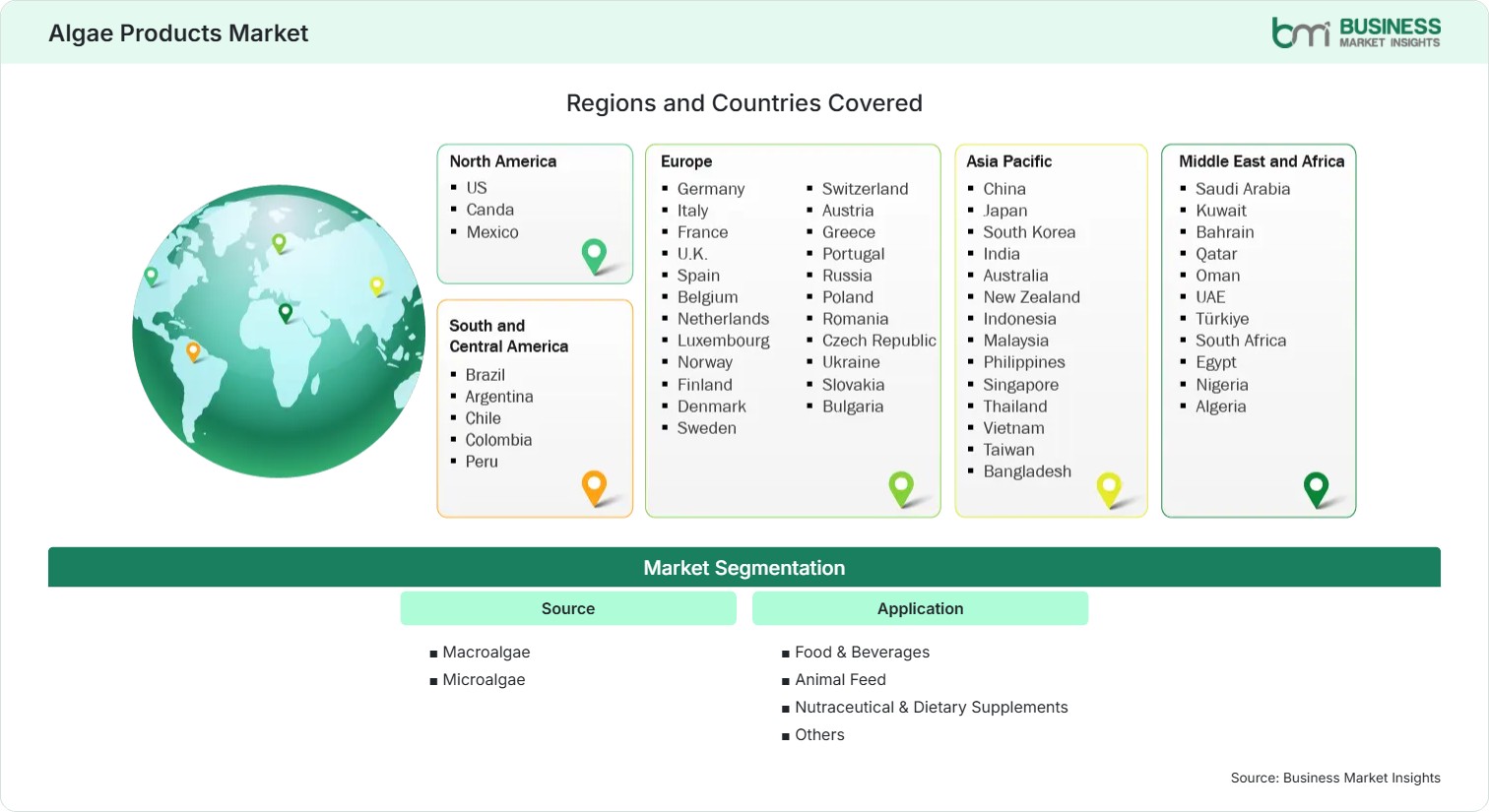
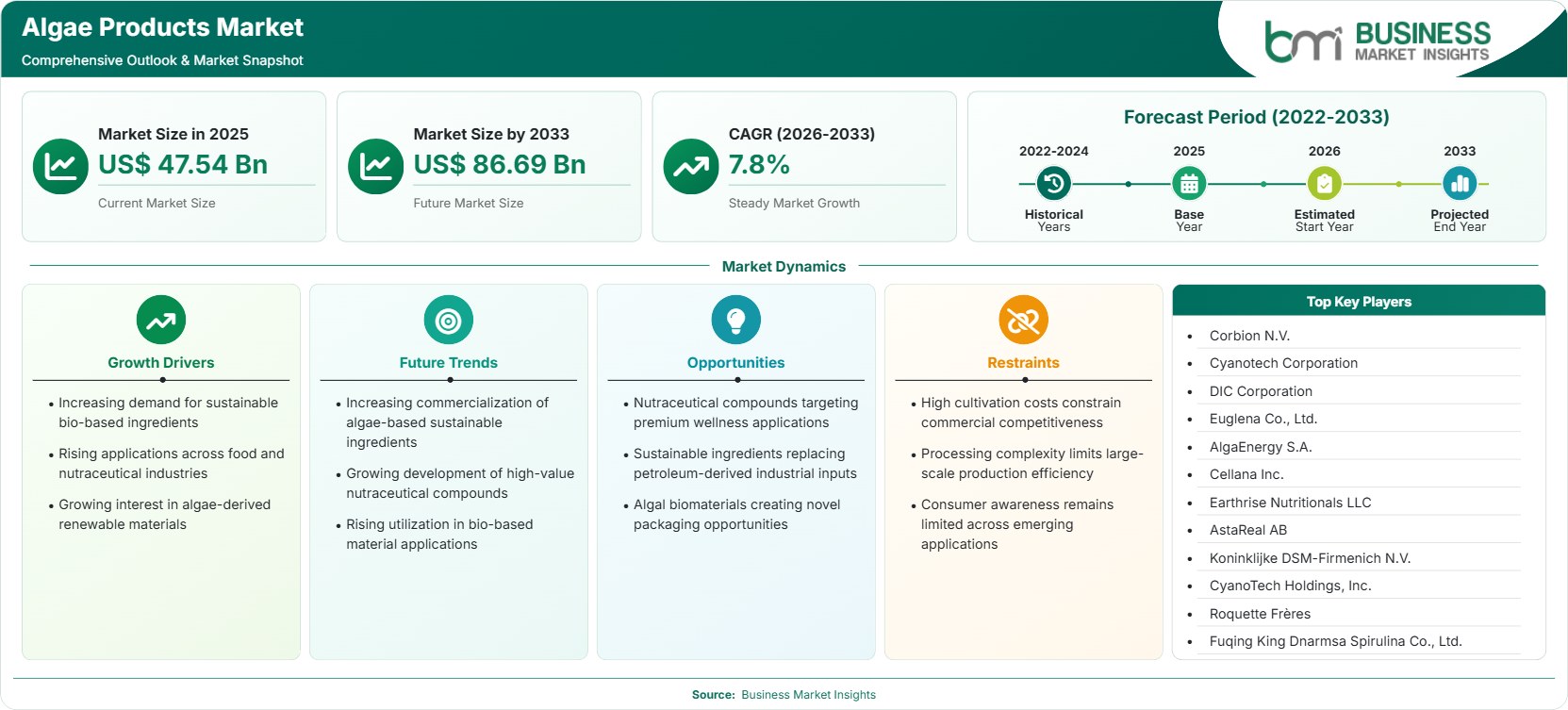
- North America accounted for approximately 34%–37% of global revenue in 2025 and is anticipated to register a 7.1%–7.6% CAGR through 2033. The region benefits from advanced biotechnology ecosystems, strong dietary supplement consumption, and established commercial cultivation facilities. The Algae Products Market share remains concentrated among producers supplying nutraceutical, feed, and food ingredient applications. Strong R&D activity, venture funding, and commercialization of premium algae-derived products continue strengthening regional competitiveness while creating opportunities for technology-driven manufacturing expansion.
- The increasing demand for supplements made from spirulina and chlorella is leading to higher prices and is prompting major biotechnology and nutrition companies to expand their capacity.
- The ongoing provision of regulatory clarity regarding food ingredients and feed additives is helping to promote commercialisation, and the need for sustainable sourcing is contributing to greater acceptance among manufacturers.
- Increasingly, producers in the field of aquaculture are using nutritional ingredients based on algae in order to improve the quality of the feed, decrease their dependence on fishmeal, and help to achieve sustainable seafood production.
- The production consistency, productivity, and scalability being achieved through the development of advanced photobioreactor systems are all improving across commercial cultivation facilities.
- The investment activity is still concentrated on specialty proteins, natural pigments, and omega-rich compounds which are aimed at high-value nutritional applications.
US Algae Products Market
The U.S. represents roughly 74%–78% of North American revenue and is forecast to expand at a 7.2%–7.7% CAGR through 2033. Strong consumer awareness of functional nutrition, extensive biotechnology research infrastructure, and robust dietary supplement distribution channels support market leadership. Commercial algae cultivation projects continue expanding across multiple states. Food manufacturers and health-focused brands increasingly incorporate algae-based proteins, pigments, and bioactive compounds into product portfolios to address sustainability and nutritional differentiation objectives.
- Increasingly, dietary supplement companies are launching formulations based on algae which aim to support immunity, general wellness, energy, and meet the nutrient needs of a plant-based diet.
- Universities and private research organisations are still working to improve cultivation efficiency, genetic optimisation, and extraction technologies so that they can be scaled up for commercial use.
- There is a strong demand for natural food colouring and for clean-label ingredients, which therefore leads to greater use of pigments derived from algae in processed foods.
- By entering into strategic collaborations with consumer brands, ingredient suppliers speed up the process of bringing innovative algae-based formulations to market.
Europe Algae Products Market
Europe represented approximately 24%–27% of global Algae Products Market revenue in 2025 and is expected to expand at a 7.3%–7.8% CAGR through 2033. Demand is supported by sustainability regulations, circular economy initiatives, and growing preference for plant-based nutrition. Ingredient manufacturers continue investing in algae-derived proteins, omega fatty acids, and natural pigments. Germany remains the leading regional market, while Spain demonstrates the strongest expansion profile. Regulatory emphasis on resource efficiency and low-carbon production supports continued adoption across food, nutraceutical, and feed sectors.
- Germany is ahead of the other countries in terms of consumption because of its sophisticated food processing industries, the high demand for nutraceuticals, and its well-developed research capabilities which support innovation in commercial algae products.
- Spain is experiencing one of the fastest rates of growth in Europe, thanks to favourable cultivation conditions, rising investments, and its partnerships in the field of biotechnology.
- The demand for sustainable proteins and functional ingredients obtained from algae biomass is still increasing because more people are choosing vegan and flexitarian diets.
- The EU's sustainability targets promote the commercialisation of renewable biological resources and thus contribute to their greater integration into food and feed value chains.
- Cooperation strategies undertaken by suppliers of ingredients, research institutes, and food manufacturers speed up the development of next-generation algae applications.
Asia Pacific Algae Products Market
Asia Pacific held around 27%–30% of global Algae Products Market revenue in 2025 and is projected to achieve a 8.8%–9.4% CAGR through 2033, making it the fastest-growing region. China leads production and consumption volumes, while India demonstrates strong expansion potential. The region benefits from favorable climatic conditions, increasing health consciousness, expanding aquaculture industries, and government support for biotechnology development. Rapid investment in cultivation facilities and processing technologies is strengthening supply capabilities while enhancing competitiveness across domestic and export markets.
- China is still the biggest contributor within the region due to its large production capacity, the presence of well-developed processing systems, and increasing use in nutrition applications.
- India is experiencing rapid growth as a result of increasing demand for nutraceuticals, ongoing food security programmes, and greater investments in biotechnology.
- The growth in aquaculture in Southeast Asia is still helping to meet the demand for feed ingredients and nutritional additives derived from algae.
- The growing popularity of functional foods and beverages is creating new opportunities for manufacturers who produce protein-rich and nutrient-dense ingredients.
- The strategies aimed at export orientation are helping to improve regional competitiveness within global supply chains for high-end algae products.
Rest of World Algae Products Market
The Rest of World region accounted for approximately 10%–13% of Algae Products Market revenue in 2025 and is anticipated to expand at a 7.9%–8.5% CAGR through 2033. South & Central America benefits from favorable cultivation environments and growing agricultural applications. The Middle East and Africa are gradually increasing adoption through food security initiatives and sustainable resource management programs. Brazil leads demand within South America, while the United Arab Emirates demonstrates notable growth prospects due to investments in biotechnology and alternative protein production.
- Brazil continues to be a major contributor to the region by increasing its use in animal feed and through the expansion of its biotechnology research.
- The Gulf states are putting their money into controlled-environment cultivation systems in order to enhance food resilience and promote sustainable use of resources.
- Increased awareness of nutritional supplements is providing opportunities for high-end algae ingredient suppliers in emerging economies.
- The use of agricultural products such as biofertilizers and feed additives is still helping to promote their commercial use in a number of developing markets.
- Partnerships involving the public and private sectors in the area of sustainable biotechnology are helping to enhance innovation ecosystems and commercialisation capabilities.