
Airport Runway Safety Systems Market Outlook: Size, Share, Trends, Growth Analysis, Competitive Landscape & Forecast, 2026-2033

Airport Runway Safety Systems Market Size, Share, Trends & Forecast Report, 2026–2033

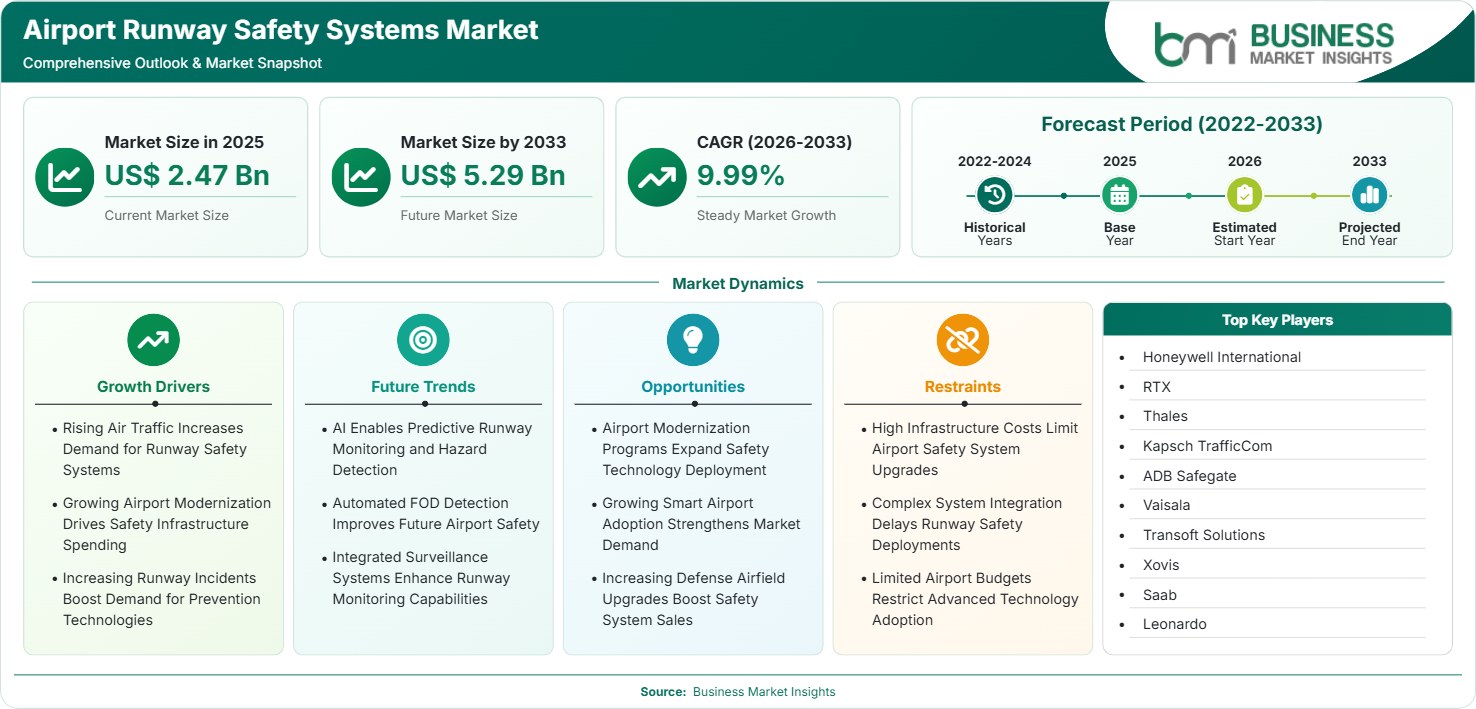
The Airport Runway Safety Systems Market size was valued at US$ 2.47 billion in 2025 and is projected to reach US$ 5.29 billion by 2033, growing at a CAGR of 9.99% during 2026–2033, driven by rising air traffic, airport modernization, smart airport adoption, and safety infrastructure investment.

Report Coverage
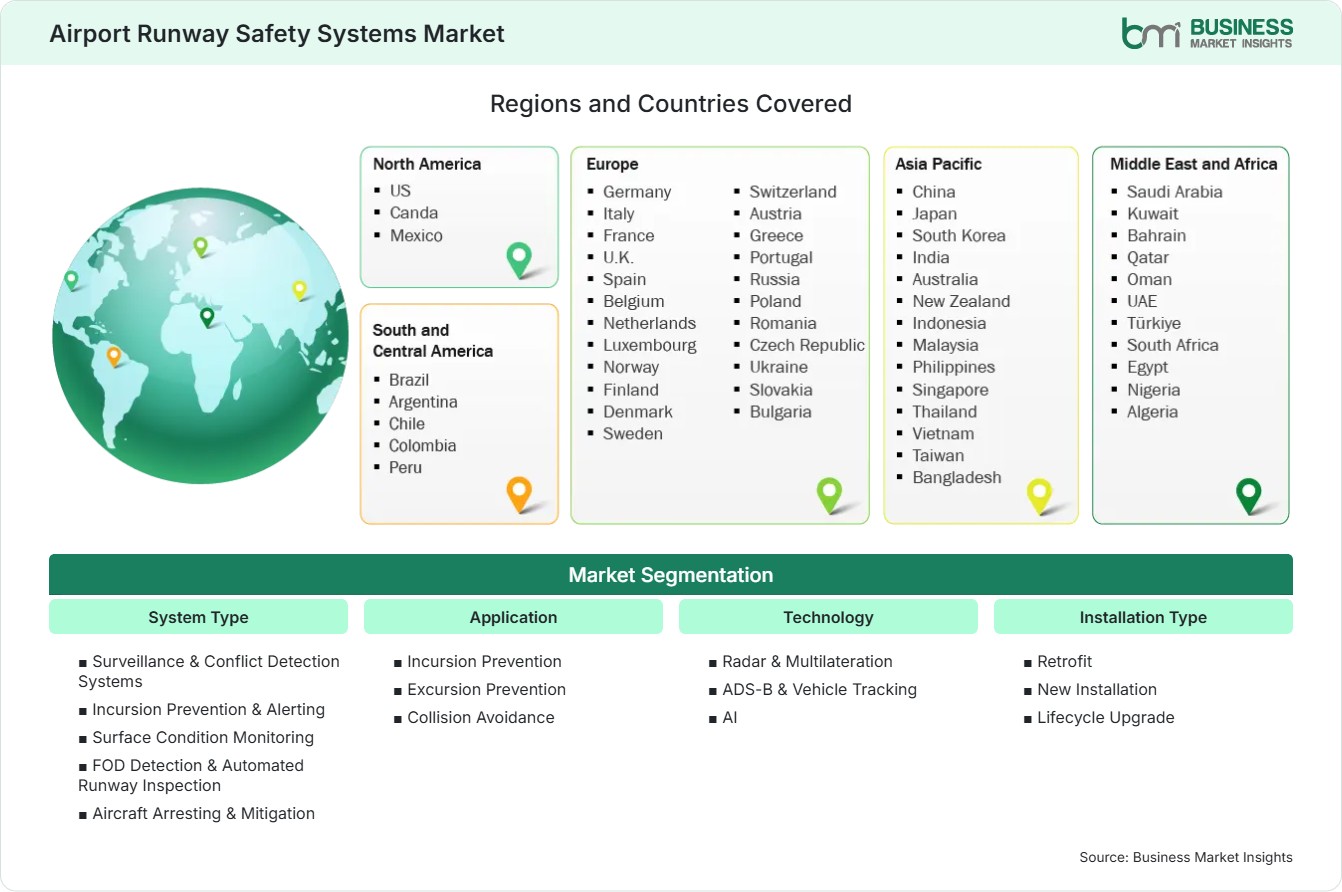
  • System Type: Surveillance & Conflict Detection Systems, Incursion Prevention & Alerting, Surface Condition Monitoring, FOD Detection & Automated Runway Inspection, Aircraft Arresting & Mitigation
  • Application: Incursion Prevention, Excursion Prevention, Collision Avoidance
  • Technology: Radar & Multilateration, ADS-B & Vehicle Tracking, AI
  • Installation Type: Retrofit, New Installation, Lifecycle Upgrade
  • End User: Airport Operators, Aviation Agencies, Defense Airfield
US$ 2.47 Bn Market size in 2025
US$ 5.29 Bn Market Size by 2033
9.99% CAGR, 2026 - 2033
2026-2033 Forecast Period

AI Overview

Airport Runway Safety Systems Market Summary

  • North America Region: North America holds a 32%–37% share in 2025, growing at a CAGR of 8.5%–10.5% during 2026–2033, supported by high airport traffic, runway modernization, advanced surveillance infrastructure, regulatory safety requirements, and technology upgrades. The US Airport Runway Safety Systems Market is projected to grow at a CAGR of 9.0%–11.0% during 2026–2033, driven by airport infrastructure renewal, surface surveillance, and runway incursion prevention.
  • Fastest Growing Region: Asia Pacific holds a 24%–29% share in 2025 and is projected to expand at a CAGR of 11.5%–13.5%, driven by new airport construction, rising passenger traffic, smart airport initiatives, runway expansion, aviation infrastructure investment, and increasing adoption of automated safety technologies.
  • Leading Segment: Surveillance & Conflict Detection Systems hold a 30%–35% share in 2025 and are projected to grow at a CAGR of 9.5%–11.5%, supported by rising traffic density, real-time monitoring requirements, multilateration, radar deployment, and increasing focus on preventing runway conflicts.
  • High Growth Segment: AI technology represents a 15%–20% share in 2025 and is projected to grow at a CAGR of 14.0%–16.0%, supported by automated object detection, predictive analytics, intelligent alerting, sensor fusion, and increasing demand for autonomous airport safety operations.
  • Key Market Opportunity: Airport modernization, smart infrastructure deployment, AI-enabled monitoring, and defense airfield upgrades create opportunities for integrated safety platforms combining surveillance, automated alerts, surface monitoring, and predictive analytics.
  • Major Market Players: Honeywell International, RTX, Thales, Kapsch TrafficCom, ADB Safegate, Vaisala, Transoft Solutions, Xovis, Saab, and Leonardo.
Strategic Insights

Airport Runway Safety Systems Market: Strategic Insights

Airport Runway Safety Systems Market Strategic Framework
FREE PDF
Request your free sample
Request free sample
Stakeholder View

Key Takeaways

  • The Airport Runway Safety Systems Market ecosystem is shifting toward integrated runway safety platforms that connect surveillance, conflict detection, surface monitoring, FOD detection, and automated alerting within unified operational environments.
  • AI-enabled monitoring presents a strong growth opportunity because airports increasingly require automated interpretation of large volumes of surveillance and sensor data.
  • Radar, multilateration, ADS-B, and vehicle tracking are becoming more closely integrated, improving surface awareness and supporting faster identification of potentially hazardous movements.
  • Asia Pacific offers a compelling investment case because airport construction, capacity expansion, and modernization programs are increasing demand for advanced safety infrastructure.
  • Retrofit and lifecycle upgrade projects provide recurring opportunities for suppliers because established airports require modernization while maintaining continuous operations and minimizing infrastructure disruption.
  • Suppliers with capabilities spanning software, sensors, surveillance, weather monitoring, and automated decision support can strengthen competitive positioning through broader integrated solutions.
Geographic Outlook

Airport Runway Safety Systems Market Regional Highlights

North America Airport Runway Safety Systems Market

North America holds a 32%–37% share in 2025 and is projected to grow at a CAGR of 8.5%–10.5% during 2026–2033. The region benefits from extensive airport infrastructure, high aircraft movement volumes, and established safety programs. Airport Runway Safety Systems Market share remains supported by modernization of surveillance and alerting infrastructure. The US remains the largest regional market, supported by mature aviation infrastructure and technology adoption.

  • Established airports are upgrading surveillance and alerting systems to improve surface awareness while maintaining continuous operations.
  • Advanced multilateration, radar, and ADS-B technologies are supporting more accurate tracking of aircraft and ground vehicles.
  • AI adoption is increasing as airport operators seek automated monitoring and faster identification of potentially unsafe movements.
  • Lifecycle replacement programs provide sustained opportunities for technology providers serving aging airport infrastructure.

US Airport Runway Safety Systems Market

The US represents a 27%–32% share of the global market in 2025 and is projected to grow at a CAGR of 9.0%–11.0% through 2033. The country has extensive airport infrastructure requiring continuous upgrades to surveillance, surface monitoring, and runway safety capabilities. Airport operators are increasingly adopting technologies that improve situational awareness and reduce risks associated with complex ground movements. AI, sensor fusion, and automated alerting are strengthening opportunities across major commercial airports and defense airfields.

  • High aircraft movement volumes increase the importance of accurate surface surveillance and timely conflict alerts.
  • Modernization programs are supporting upgrades to aging runway monitoring and safety infrastructure.
  • Defense airfields provide additional opportunities for advanced surveillance, tracking, and automated threat detection capabilities.

Europe Airport Runway Safety Systems Market

Europe accounts for a 22%–27% share in 2025 and is forecast to expand at a CAGR of 8.5%–10.5% during 2026–2033. Germany, the UK, France, Spain, and Italy represent leading Airport Runway Safety Systems Markets, while Poland offers strong growth potential. Germany is projected to grow at a CAGR of 9.0%–11.0%, while Poland could reach a CAGR of 11.5%–13.5%. Airport modernization, operational safety requirements, and increasing automation are supporting investment across commercial and defense aviation facilities.

  • Major European airports are upgrading surveillance and monitoring infrastructure to manage complex and increasingly busy airside operations.
  • Germany and France offer opportunities through airport modernization and advanced technology deployment.
  • Eastern European markets are expanding infrastructure, creating demand for modern runway safety systems in new and upgraded facilities.
  • AI and sensor integration are improving automated detection and decision support across increasingly complex airport environments.

Asia Pacific Airport Runway Safety Systems Market

Asia Pacific holds a 24%–29% share in 2025 and is projected to register a CAGR of 11.5%–13.5% during 2026–2033, making it the fastest-growing regional market. China, India, Japan, South Korea, Singapore, and Australia represent major demand centers. India is projected to grow at a CAGR of 13.0%–15.0%, while Southeast Asian markets are expected to expand rapidly. New airports, passenger growth, and smart infrastructure investment are supporting adoption.

  • China is expanding airport capacity and modernizing infrastructure, creating demand for integrated surveillance and runway safety systems.
  • India offers strong opportunities as airport development and passenger traffic increase, requiring modern safety infrastructure.
  • Southeast Asia is benefiting from airport construction, tourism growth, and smart airport initiatives.
  • Japan, South Korea, and Australia provide mature opportunities through modernization and technology upgrades at established airports.

Rest of World Airport Runway Safety Systems Market

South and Central America account for a 6%–9% share in 2025 and are projected to expand at a CAGR of 8.0%–10.0% during 2026–2033. Brazil, Mexico, and Colombia lead demand as airports improve infrastructure and operational safety. The Middle East and Africa represent a 7%–11% share and are projected to grow at a CAGR of 10.0%–12.0%, supported by airport construction, aviation hubs, and defense investment.

  • Gulf aviation hubs are investing in advanced safety technologies to support high traffic volumes and increasingly complex airside operations.
  • Saudi Arabia and the UAE offer opportunities through major airport development and infrastructure modernization programs.
  • Brazil and Mexico are upgrading airport facilities, creating demand for surveillance, monitoring, and runway safety technologies.
  • African aviation markets provide longer-term opportunities as airport infrastructure and operational standards continue to develop.
Global Market Geography
FREE PDF
Request your free sample
Request free sample
Segment Analysis

Airport Runway Safety Systems Market Segmentation

System Type

The System Type segment is led by Surveillance & Conflict Detection Systems, representing a 30%–35% share in 2025 and growing at a CAGR of 9.5%–11.5% through 2033. Airports increasingly require real-time surface awareness as aircraft movements and ground traffic become more complex. Incursion prevention, surface monitoring, FOD detection, and arresting technologies provide complementary safety capabilities across airport environments.

  • Surveillance & Conflict Detection Systems: These systems monitor aircraft and vehicle movements, improving surface awareness and supporting automated identification of potentially hazardous conflicts.
  • Incursion Prevention & Alerting: Automated alerts warn controllers and airside personnel about unsafe movements, helping reduce runway incursion risks at busy airports.
  • Surface Condition Monitoring: Sensors assess runway conditions and weather-related hazards, supporting operational decisions during rain, snow, ice, or reduced visibility.
  • FOD Detection & Automated Runway Inspection: Automated inspection technologies identify debris and surface hazards, reducing risks associated with foreign objects and improving inspection efficiency.
  • Aircraft Arresting & Mitigation: Arresting and mitigation systems provide additional protection during runway overruns, supporting aircraft safety at commercial and defense airfields.

Application

The Application segment is led by Incursion Prevention, representing a 42%–47% share in 2025 and growing at a CAGR of 9.5%–11.5% through 2033. Increasing aircraft and vehicle movements are encouraging airports to strengthen surface awareness and automated alerting. Excursion prevention and collision avoidance also support demand by addressing runway and airside operational hazards.

  • Incursion Prevention: Technologies improve awareness of aircraft and vehicle positions, helping airports identify and prevent unauthorized or conflicting runway movements.
  • Excursion Prevention: Runway monitoring, surface condition assessment, and mitigation systems help reduce risks associated with aircraft leaving designated runway areas.
  • Collision Avoidance: Integrated tracking and alerting technologies support safer aircraft and vehicle movements by identifying potential conflicts across airport operating areas.

Technology

The Technology segment is led by Radar & Multilateration, representing a 45%–50% share in 2025 and growing at a CAGR of 8.5%–10.5% through 2033. These technologies provide established capabilities for tracking aircraft and vehicles. ADS-B and vehicle tracking are expanding connectivity, while AI is emerging as a high-growth technology for automated interpretation and intelligent alerting.

  • Radar & Multilateration: These technologies provide accurate position information for aircraft and vehicles, supporting surveillance and conflict detection across airport surfaces.
  • ADS-B & Vehicle Tracking: Connected tracking systems improve visibility of aircraft and ground vehicles, supporting integrated operational awareness and automated monitoring.
  • AI: AI supports automated object recognition, anomaly detection, predictive analysis, and intelligent alerting, improving the speed and efficiency of runway safety operations.

Installation Type

The Installation Type segment is led by Retrofit, representing a 46%–51% share in 2025 and growing at a CAGR of 9.0%–11.0% through 2033. Established airports require modernization without extensive operational disruption, supporting retrofit demand. New installations benefit from airport construction, while lifecycle upgrades create recurring replacement opportunities as technologies advance.

  • Retrofit: Retrofit projects modernize existing airport infrastructure, allowing operators to improve safety capabilities while maintaining established airport operations.
  • New Installation: New airport projects enable integrated safety systems to be designed into infrastructure from the beginning, reducing compatibility limitations.
  • Lifecycle Upgrade: Lifecycle upgrades replace aging components and introduce advanced technologies, supporting continuous improvement in safety performance and system reliability.

End User

The End User segment is led by Airport Operators, representing a 60%–65% share in 2025 and growing at a CAGR of 9.5%–11.5% through 2033. Commercial airports manage high traffic volumes and complex ground operations, creating substantial demand for safety technologies. Aviation agencies and defense airfields provide additional opportunities through regulatory and operational modernization.

  • Airport Operators: Airport operators deploy surveillance, monitoring, and alerting technologies to improve runway safety, operational efficiency, and situational awareness.
  • Aviation Agencies: Aviation agencies support safety standards, infrastructure programs, and technology adoption across national and regional aviation networks.
  • Defense Airfield: Defense airfields require advanced surveillance and monitoring systems for aircraft movement, operational security, and complex military aviation environments.
Market Forces

Airport Runway Safety Systems Market Dynamics

Key Market Drivers

Rising Air Traffic Increases Demand for Runway Safety Systems

Growing aircraft movements are increasing the need for real-time surface awareness across busy airports. Radar, multilateration, ADS-B, and vehicle tracking help operators monitor aircraft and ground traffic more effectively. Market growth is supported by demand for conflict detection and automated alerts that improve operational safety. The Airport Runway Safety Systems Market trend toward integrated monitoring is also encouraging airports to combine multiple data sources within unified safety platforms.

Growing Airport Modernization Drives Safety Infrastructure Spending

Airport upgrades are contributing to investments in surveillance, monitoring, and runway protection technologies. Older technology solutions are increasingly being upgraded to more advanced systems better suited to supporting airside operations in the current environment. This is especially important for retrofitting since existing airports need to enhance their safety features without causing major disruptions to operations. There are also many possibilities of building new airports that can incorporate safety solutions right from the start.

Increasing Runway Incidents Boost Demand for Prevention Technologies

Runway incursions, excursions, and surface conflict cases are becoming an increasing cause for concern and have prompted greater demand for safety technologies designed to help prevent them. In this regard, airfields are installing surveillance systems, automated alerting tools, surface management technology, and foreign object detection systems to detect potential hazards early. AI can enhance the performance of these technologies by analyzing sensor data and detecting unusual activity.

Key Market Opportunities

Airport Modernization Programs Expand Safety Technology Deployment

Airport modernization programs are creating opportunities for suppliers offering integrated runway safety systems. The Airport Runway Safety Systems Market forecast reflects continued demand for radar, multilateration, ADS-B, automated alerts, surface monitoring, and FOD detection as airports replace aging infrastructure. New airport projects provide additional potential because safety architecture can be designed around connected technologies from the outset. Lifecycle upgrades also create recurring demand as airports replace aging equipment and introduce advanced capabilities. Vendors offering modular and upgradeable solutions can strengthen their position across both new installations and retrofit projects.

Growing Smart Airport Adoption Strengthens Market Demand

Intelligent airport systems have created a growing need for runway safety technologies that provide connectivity between operational platforms. AI-enabled analytics can integrate surveillance, weather, tracking, and surface-monitoring data to facilitate more efficient risk detection. Connectivity through cloud computing and centralized data management may also help enhance remote monitoring and maintenance prediction. Suppliers of compatible systems can profit from digitization efforts as automation becomes more prevalent within airports.

Increasing Defense Airfield Upgrades Boost Safety System Sales

Airfield upgrades in defense are creating opportunities for advanced systems for surveillance, tracking, and runway protection. The military needs systems that can assist with the complex movement of its aircraft and operate in special conditions. Advanced radar, multilateration, vehicle tracking, and AI-based monitoring can help enhance situational awareness at airfields. Manufacturers with expertise in building defense-related products can participate in such projects.

Market Restraints and Challenges

High Infrastructure Costs Limit Airport Safety System Upgrades

Factor: Advanced runway safety systems require substantial investment in sensors, radar, communications, software, installation, and maintenance. Impact: High capital requirements can delay upgrades, particularly for smaller airports with constrained budgets. Retrofit projects may require additional infrastructure modifications, increasing total costs. Operators must therefore balance safety improvements against procurement and lifecycle expenses. Modular systems, phased deployment, and lifecycle service agreements can help reduce financial barriers while enabling airports to modernize critical safety capabilities progressively.

Complex System Integration Delays Runway Safety Deployments

Factor: Runway safety environments combine surveillance, radar, multilateration, ADS-B, weather monitoring, communications, and airport management systems. Impact: Integrating these technologies can increase technical complexity, extend deployment timelines, and require extensive testing. Airports must ensure compatibility with existing infrastructure while maintaining continuous operations. Data interoperability and cybersecurity requirements can further complicate implementation. Vendors offering strong integration capabilities and upgradeable architectures can help reduce deployment challenges and improve adoption across complex airport environments.

Company Analysis

Competitive Landscape

The Airport Runway Safety Systems Market analysis indicates competition is shaped by surveillance expertise, airport automation capabilities, sensor technologies, AI integration, infrastructure modernization, and global project execution. Leading providers are increasingly expanding integrated solutions that combine monitoring, tracking, alerting, and operational intelligence.

Company Name

Overview

Products and Services relevant to this market

Honeywell International

Global technology company providing aviation systems and integrated technologies for airport and airspace operations.

Airport surveillance, navigation, airfield systems, safety technologies, automation, monitoring, and operational management solutions.

RTX

Aerospace and defense company with extensive capabilities across aviation systems, sensing, surveillance, and advanced technologies.

Radar, surveillance, air traffic technologies, sensing, airport systems, and aviation safety-related solutions.

Thales

Global technology provider serving aviation markets with advanced air traffic management and airport technology solutions.

Surface movement guidance, surveillance, radar, multilateration, airport operations, and runway safety technologies.

Kapsch TrafficCom

Transportation technology company specializing in intelligent mobility, traffic management, and connected infrastructure solutions.

Airport surface monitoring, intelligent transportation systems, tracking, data management, and connected operational technologies.

ADB Safegate

Specialized aviation technology provider focused on airfield operations, lighting, and airport safety systems.

Runway lighting, airfield guidance, surface movement, airport safety, operational management, and intelligent airfield solutions.

Vaisala

Environmental and measurement technology company providing weather and atmospheric monitoring solutions for aviation operations.

Runway weather monitoring, visibility systems, surface condition monitoring, weather sensors, and aviation decision-support technologies.

Transoft Solutions

Software provider specializing in aviation and transportation planning, design, and operational analysis tools.

Airport design software, runway planning, airside analysis, safety assessment, and operational simulation solutions.

Xovis

Technology company specializing in sensor-based monitoring and intelligent analytics for movement and infrastructure environments.

3D sensor technology, people and object tracking, analytics, monitoring, and intelligent airport operational applications.

Saab

Aerospace and defense company providing surveillance, sensing, and command technologies for civil and military applications.

Radar, surveillance, air traffic management, sensor systems, and defense airfield monitoring technologies.

Leonardo

Global aerospace and defense company providing advanced electronics, sensing, radar, and aviation technologies.

Radar, surveillance, air traffic systems, sensors, airport technologies, and integrated monitoring solutions.

Trust & Transparency

Research Methodology

The market analysis combines proprietary research with secondary data from government agencies, company disclosures, regulatory filings, industry databases and expert interviews. Market estimates are validated through data triangulation, cross-market benchmarking and analyst review.

View Full Research Methodology

Questions Answered

Frequently Asked Questions

What information is included in an Airport Runway Safety Systems Market Report?

The report covers market size, growth projections, segmentation, regional analysis, technology trends, competitive positioning, drivers, opportunities, restraints, installation patterns, end-user demand, and industry dynamics.

Why are retrofit projects important for airport safety technology suppliers?

Retrofit projects allow established airports to modernize aging safety infrastructure without constructing entirely new facilities. This creates recurring opportunities for surveillance upgrades, lifecycle replacements, AI integration, and improved surface monitoring.

How is AI influencing runway safety systems?

AI enables automated object detection, anomaly recognition, predictive analytics, intelligent alerting, and sensor data interpretation. These capabilities can help airport operators identify potential risks faster and support more informed operational decisions.

Which system type represents the leading segment?

Surveillance & Conflict Detection Systems represent the leading system category because airports require continuous monitoring of aircraft and ground vehicle movements to improve surface awareness and identify potential runway conflicts.

What factors are supporting Airport Runway Safety Systems Market growth?

Rising air traffic, airport modernization, increasing focus on runway incursion prevention, smart airport initiatives, lifecycle infrastructure upgrades, and growing adoption of automated surveillance technologies are supporting market expansion.

Access the Full Airport Runway Safety Systems Market Report

Get segment-level forecasts, regional estimates, competitive benchmarking, company profiles and downloadable Excel datasets.

Access the full Airport Runway Safety Systems Market Report
350 pages PDF & Excel | 2026-08-06
Similar Research

Related Market Reports