
Airport Passenger Flow Analytics Market Outlook: Size, Share, Trends, Growth Analysis, Competitive Landscape & Forecast, 2026-2033

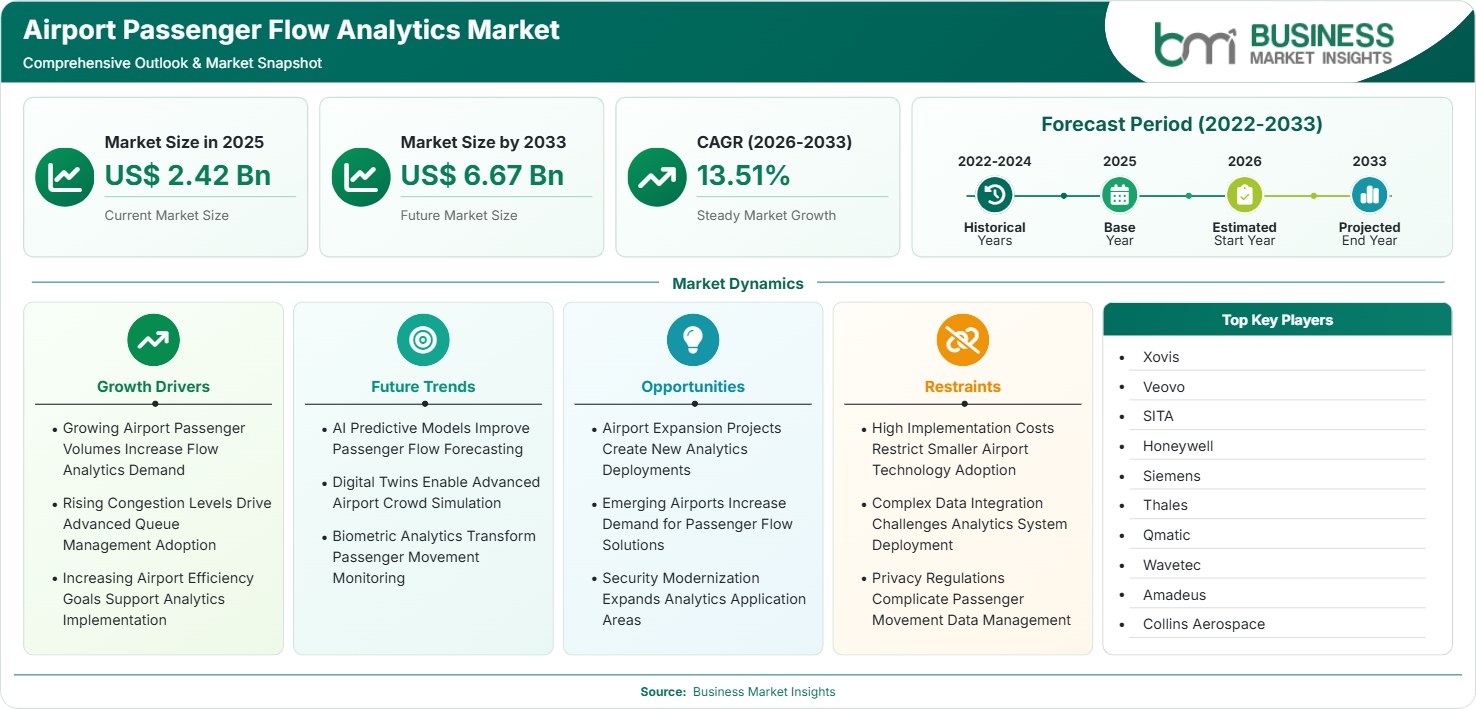
The Airport Passenger Flow Analytics Market size was valued at US$ 2.42 billion in 2025 and is projected to reach US$ 6.67 billion by 2033, growing at a CAGR of 13.51% during 2026–2033. Rising passenger traffic, airport modernization programs, smart infrastructure adoption, and demand for efficient terminal operations are creating growth opportunities for analytics providers across global aviation networks.

Report Coverage
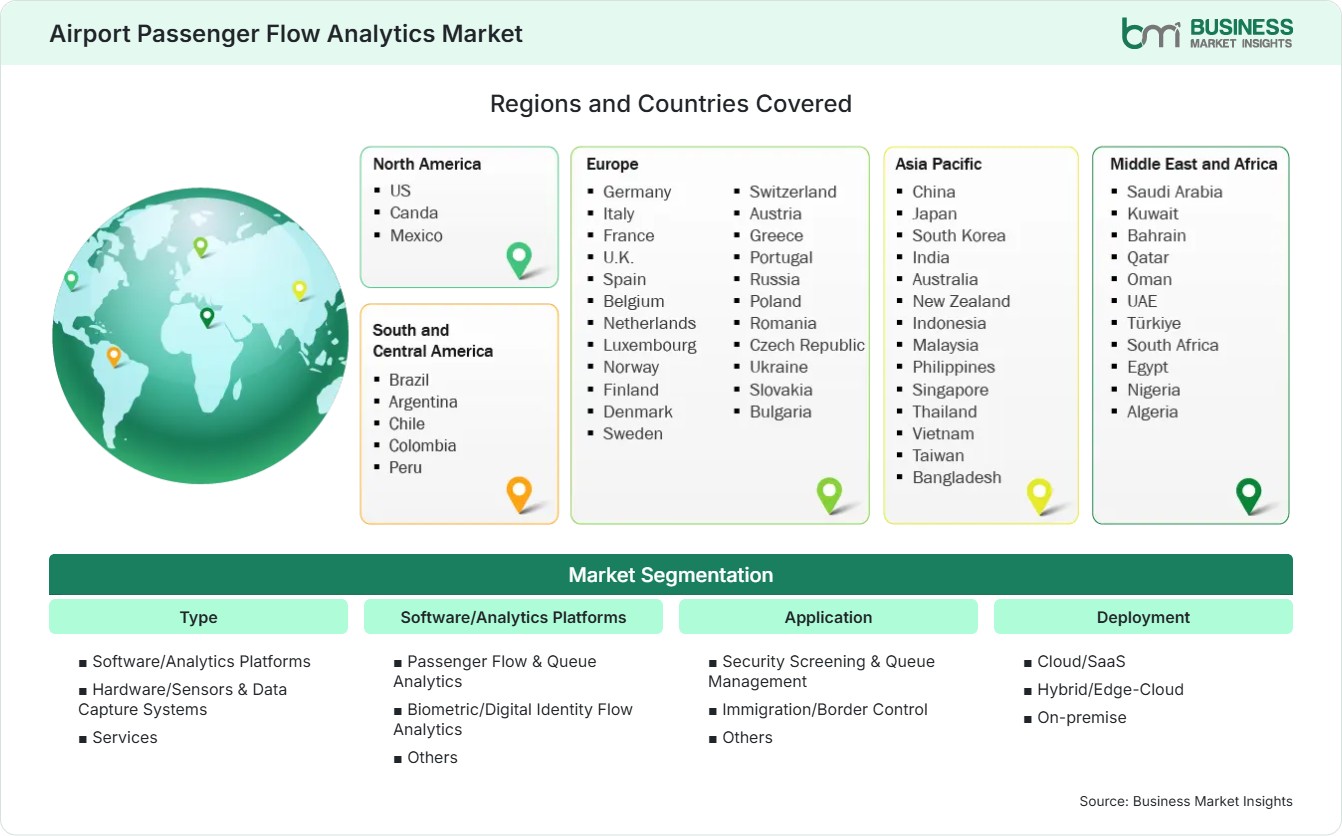
  • Type: Software/Analytics Platforms, Hardware/Sensors & Data Capture Systems, Services
  • Software/Analytics Platforms: Passenger Flow & Queue Analytics, Biometric/Digital Identity Flow Analytics, Others
  • Application: Security Screening & Queue Management, Immigration/Border Control, Others
  • Deployment: Cloud/SaaS, Hybrid/Edge-Cloud, On-premise
  • Airport Size
US$ 2.42 Bn Market size in 2025
US$ 6.67 Bn Market Size by 2033
13.51% CAGR, 2026 - 2033
2026-2033 Forecast Period

AI Overview

Airport Passenger Flow Analytics Market Summary

  • North America Region: North America holds a leading position with a share ranging between 35%–38% in 2025 and is projected to grow at a CAGR of 12.7%–13.3% through 2033. Advanced airport infrastructure, technology investments, and demand for operational efficiency support regional adoption. The U.S. market benefits from smart airport initiatives, passenger experience programs, and digital transformation projects, supporting a CAGR of 12.8%–13.4%.
  • Fastest Growing Region: Asia Pacific represents the fastest-growing region with a share of 26%–29% in 2025 and is expected to expand at a CAGR of 14.5%–15.2%. Airport expansion, increasing air travel demand, and modernization initiatives are accelerating analytics platform adoption across developing aviation markets.
  • Leading Segment: Software/Analytics Platforms represent the leading segment with a share of 42%–45% in 2025 and are projected to grow at a CAGR of 14.0%–14.6%. Demand for real-time insights, predictive analytics, and passenger journey optimization supports segment leadership.
  • High Growth Segment: Cloud/SaaS deployment demonstrates strong expansion with a share of 30%–33% in 2025 and a CAGR of 15.0%–15.7%. Flexible deployment models, scalability, and lower infrastructure requirements are increasing adoption among airports.
  • Key Market Opportunity: Airport modernization programs, digital identity initiatives, and demand for seamless passenger experiences are enabling providers to deploy analytics solutions supporting congestion reduction, operational visibility, and improved terminal management.
  • Major Market Players: Xovis, Veovo, SITA, Honeywell International Inc., Siemens AG, Thales Group, Qmatic, Wavetec, Amadeus IT Group SA, and Collins Aerospace.
Strategic Insights

Airport Passenger Flow Analytics Market: Strategic Insights

Airport Passenger Flow Analytics Market Strategic Framework
FREE PDF
Request your free sample
Request free sample
Stakeholder View

Key Takeaways

  • The Airport Passenger Flow Analytics Market ecosystem is shifting toward integrated airport intelligence platforms that combine sensors, analytics software, biometric systems, and operational management technologies to improve passenger movement visibility.
  • Airports with high passenger density and expanding terminals present strong opportunities for analytics adoption through queue optimization, capacity planning, and operational automation.
  • Artificial intelligence, computer vision, and predictive analytics are shaping solution development by enabling proactive congestion management and improved passenger experience strategies.
  • Asia Pacific offers significant investment potential due to airport expansion programs, rising air connectivity, and modernization initiatives across emerging aviation markets.
  • Strategic collaborations between airport technology providers, airlines, and infrastructure companies are increasing as stakeholders seek comprehensive passenger flow management capabilities.
  • Growing emphasis on smart airports is encouraging technology vendors to develop interoperable solutions supporting security, operational efficiency, and digital passenger journeys.
Geographic Outlook

Airport Passenger Flow Analytics Market Regional Highlights

North America Airport Passenger Flow Analytics Market

North America accounted for approximately 35%–38% of global revenue in 2025 and is expected to expand at a CAGR of 12.7%–13.3% through 2033. The region maintains leadership due to advanced airport infrastructure, high technology adoption, and increasing investments in passenger experience improvement initiatives across major aviation facilities.

  • The United States remains the largest contributor due to extensive airport modernization programs, advanced security infrastructure, and increasing adoption of real-time passenger analytics solutions.
  • Canada demonstrates steady adoption through airport digitalization efforts, operational efficiency programs, and investments in passenger processing technologies.
  • Airport operators are integrating analytics platforms with existing infrastructure to improve queue management, resource allocation, and terminal performance.
  • Technology providers are focusing on artificial intelligence and computer vision capabilities to support predictive passenger movement analysis.

US Airport Passenger Flow Analytics Market

The United States represents the dominant country-level contributor within North America, supported by major airport networks, technology investments, and increasing focus on passenger experience optimization. The market is projected to grow at a CAGR of 12.8%–13.4% through 2033, driven by smart airport initiatives and operational modernization programs.

  • Major airports are adopting advanced analytics solutions to reduce congestion, improve security screening efficiency, and enhance terminal operations.
  • Airlines and airport operators are increasing collaboration to improve passenger journey visibility and optimize resource utilization.
  • Government-led aviation modernization initiatives are supporting adoption of digital technologies across airport infrastructure.

Europe Airport Passenger Flow Analytics Market

Europe represented approximately 28%–31% of global revenue in 2025 and is projected to grow at a CAGR of 12.6%–13.2% through 2033. Germany leads regional adoption through advanced airport operations, while the United Kingdom demonstrates strong growth through digital passenger experience initiatives and smart aviation investments.

  • Germany maintains strong demand due to technologically advanced airports, automation adoption, and focus on operational efficiency improvements.
  • The United Kingdom experiences increasing deployment through airport modernization programs and digital transformation initiatives.
  • European airports are prioritizing passenger analytics to improve capacity management and enhance service quality.
  • Regulatory focus on security and efficient passenger processing is encouraging investment in advanced analytics platforms.

Asia Pacific Airport Passenger Flow Analytics Market

Asia Pacific accounted for approximately 26%–29% of global revenue in 2025 and is expected to register the fastest CAGR of 14.5%–15.2% through 2033. China leads regional demand, while India demonstrates rapid growth through airport expansion, rising passenger traffic, and smart infrastructure development.

  • China continues expanding through large-scale airport projects, digital transformation initiatives, and increasing adoption of intelligent aviation technologies.
  • India demonstrates strong potential due to new airport development, passenger growth, and government-supported aviation infrastructure expansion.
  • Japan and South Korea are adopting advanced analytics solutions to improve passenger processing and operational efficiency.
  • Regional airports are increasingly investing in cloud-based solutions for scalable passenger flow management.

Rest of World Airport Passenger Flow Analytics Market

Rest of World regions contribute approximately 6%–9% of global revenue in 2025 and are projected to grow at a CAGR of 13.2%–13.8% through 2033. Latin America shows rising adoption through airport upgrades, while Middle East and Africa markets benefit from new aviation infrastructure projects.

  • Brazil represents an important Latin American market with increasing airport modernization efforts and demand for operational analytics solutions.
  • Middle Eastern airports are investing heavily in smart infrastructure, passenger experience technologies, and advanced terminal management systems.
  • African aviation markets are gradually adopting digital airport solutions to improve efficiency and passenger processing capabilities.
  • International partnerships are supporting technology deployment across emerging airport networks seeking modernization.
Global Market Geography
FREE PDF
Request your free sample
Request free sample
Segment Analysis

Airport Passenger Flow Analytics Market Segmentation

Type

The Type segment defines the technology structure of passenger flow management solutions, with Software/Analytics Platforms accounting for 42%–45% share in 2025 and expanding at a CAGR of 14.0%–14.6% through 2033. The segment is supported by demand for real-time insights, predictive capabilities, operational visibility, and integration with airport management ecosystems.

  • Software/Analytics Platforms: Enables passenger movement monitoring, congestion prediction, queue optimization, and operational decision-making through advanced analytics, artificial intelligence, and data visualization capabilities.
  • Hardware/Sensors & Data Capture Systems: Provides passenger movement data through cameras, sensors, counters, and tracking technologies supporting accurate analytics and airport operational improvements.
  • Services: Includes consulting, implementation, system integration, maintenance, and support services helping airports deploy and optimize passenger flow management solutions.

Software/Analytics Platforms

The Software/Analytics Platforms segment represents a specialized technology category focused on improving passenger movement visibility and operational intelligence. Passenger Flow & Queue Analytics leads adoption due to airport congestion management requirements, while biometric analytics solutions are gaining traction through digital identity initiatives. Increasing demand for predictive insights continues shaping platform development.

  • Passenger Flow & Queue Analytics: Supports real-time monitoring of passenger movement, waiting times, and congestion patterns to improve terminal efficiency and resource allocation.
  • Biometric/Digital Identity Flow Analytics: Enables identity-based passenger processing, automated verification, and improved security workflows through advanced digital identification technologies.
  • Others: Includes analytics applications supporting passenger experience monitoring, operational reporting, and specialized airport management requirements.

Application

The Application segment reflects increasing adoption across critical airport operations, with Security Screening & Queue Management representing the leading application area with 45%–48% Airport Passenger Flow Analytics Market share in 2025 and a CAGR of 13.8%–14.4% through 2033. Airports are deploying analytics solutions to improve passenger processing efficiency, reduce congestion, and optimize resource utilization.

  • Security Screening & Queue Management: Helps airports analyze passenger movement, manage waiting times, and improve screening operations through real-time operational intelligence.
  • Immigration/Border Control: Supports efficient passenger processing, digital identity verification, and improved border management through integrated analytics capabilities.
  • Others: Includes applications such as terminal operations management, passenger experience optimization, and airport resource planning.

Deployment

The Deployment segment highlights changing technology preferences among airports, with Cloud/SaaS gaining strong adoption due to scalability, flexibility, and reduced infrastructure requirements. The Airport Passenger Flow Analytics Market scope continues expanding as airports seek solutions capable of supporting distributed operations, faster deployment, and integration with modern digital infrastructure.

  • Cloud/SaaS: Provides flexible access, simplified maintenance, scalability, and cost advantages for airports adopting analytics-driven operational management solutions.
  • Hybrid/Edge-Cloud: Combines local processing with cloud capabilities, enabling faster analytics response and supporting sensitive operational requirements.
  • On-premise: Remains relevant among airports requiring direct infrastructure control, customized deployment environments, and specific security configurations.

Airport Size

The Airport Size segment demonstrates adoption differences based on passenger volume, operational complexity, and infrastructure requirements. Large airports represent the dominant adoption base due to higher congestion levels and greater technology investment capabilities. Growing modernization initiatives are encouraging smaller airports to adopt scalable analytics solutions.

  • Large Airports: Require advanced analytics platforms for managing high passenger volumes, complex terminals, security operations, and multiple passenger processing points.
  • Medium Airports: Increasingly adopt cost-effective solutions to improve operational efficiency, optimize resources, and enhance passenger service quality.
  • Small Airports: Show gradual adoption through cloud-based solutions that reduce infrastructure requirements and simplify technology implementation.

End User

The End User segment covers multiple stakeholders involved in airport operations and passenger services. Airport Operators represent the largest user group due to their responsibility for terminal efficiency, passenger experience, and operational management. The Airport Passenger Flow Analytics Market trend reflects increasing collaboration among airports, governments, airlines, and technology providers.

  • Airport Operators: Deploy analytics platforms to improve passenger flow visibility, optimize terminal operations, and enhance service performance.
  • Government/Border & Security Agencies: Utilize analytics solutions for security monitoring, border management, and efficient passenger processing.
  • Airlines: Adopt passenger flow insights to improve operational coordination, boarding efficiency, and customer experience management.
  • Others: Includes ground handling companies, service providers, and airport ecosystem participants requiring passenger movement intelligence.
Market Forces

Airport Passenger Flow Analytics Market Dynamics

Key Market Drivers

Growing Airport Passenger Volumes Increase Flow Analytics Demand

Increasing global air travel activity is encouraging airports to adopt advanced analytics solutions for managing passenger movement and operational complexity. Rising passenger volumes create challenges related to queues, terminal capacity, and resource allocation. Analytics platforms help airports understand movement patterns, predict congestion points, and improve service efficiency. The Airport Passenger Flow Analytics Market trend is influenced by the need for smarter airport operations, real-time visibility, and improved passenger experiences. Airports are increasingly combining sensor technologies, artificial intelligence, and data analytics to optimize workflows and support proactive decision-making across terminals.

Rising Congestion Levels Drive Advanced Queue Management Adoption

With increased congestion at the security checkpoint, immigration zone, and boarding point, there is a greater need for technologies to manage passenger flow. Analytics solutions are being employed to help airports track waiting times, identify bottlenecks, and manage queues. With advanced platforms, the airport can respond to the situation and allocate resources where necessary. Real-time analytics have become crucial in helping airports manage increased passenger traffic without compromising their service standards. Technology companies are making their offerings more sophisticated by incorporating predictive analytics to proactively address congestion.

Increasing Airport Efficiency Goals Support Analytics Implementation

Airport management is focusing on improving operational efficiencies through digital transformation projects and intelligent infrastructure investments. Passenger flow analysis helps make the best use of personnel, assets, and airport terminals by offering valuable insights for airport operations. It is common to see airport management using data-driven methods to improve decision-making and passenger satisfaction. Connecting passenger flow analytics to airport management systems can create more integrated environments for airport management. There is an increasing focus on developing smart airports, making the investments worthwhile.

Key Market Opportunities

Airport Expansion Projects Create New Analytics Deployments

The construction and upgrade activities at airports will result in the deployment of passenger flow analytics in new terminals or renovated facilities. The planners of such developments will use analytical capabilities to ensure the effective passage of passengers from the start. New airport developments will open the door to comprehensive approaches that use sensor technologies, software platforms,, and analytics in operations. Providers of scalable and interoperable technology solutions can benefit from the investment in airport infrastructure development. The growth of airport capacity in developing regions will generate greater demand.

Emerging Airports Increase Demand for Passenger Flow Solutions

New airports are increasingly inclined to use digital technologies to improve efficiency and the passenger experience. The increasing air connectivity, urban growth, and development of aviation infrastructure are driving investment in modern airport management systems. Cloud-based analytics solutions are providing easy-to-access options for airports seeking better passenger tracking without extensive infrastructure requirements. Technology vendors can seize opportunities by offering solutions tailored to airports of different sizes. The adoption of these solutions in developing aviation markets is expected to expand the customer base.

Security Modernization Expands Analytics Application Areas

The development of airport security infrastructure is providing new opportunities to implement analytical solutions for screening, authentication, and border control procedures. Airports and security organizations are deploying technologies that help enhance the passenger experience while maintaining high levels of security. The integration of analytics with biometric systems, surveillance technologies, and operation platforms is widening the scope of solutions. Vendors that provide secure, flexible technologies can capitalize on the growing demand for security solutions. An emphasis on efficiency and effectiveness in passenger processing will aid in this regard.

Market Restraints and Challenges

High Implementation Costs Restrict Smaller Airport Technology Adoption

Factor: Passenger flow analytics solutions entail considerable expenditures on sensors, software platforms, integration services, and infrastructure modifications. Impact: Costly implementation could limit adoption among small airports with smaller budgets for technological improvements. It will be crucial for airports to carefully consider the future value of implementation against its cost to develop a viable approach. Cloud computing models and modularity are already contributing to lower costs, but the financial aspect remains relevant.

Complex Data Integration Challenges Analytics System Deployment

Factor: Passenger flow analytics platforms require integration with airport systems, security infrastructure, sensors, and operational databases. Impact: Complex data integration processes can increase deployment timelines, technical requirements, and implementation challenges. Airports need reliable interoperability frameworks to ensure accurate data exchange across multiple systems. Vendors are focusing on flexible architectures, standardized interfaces, and integration support to simplify deployment. Effective data management remains essential for maximizing analytics value and ensuring consistent operational insights across airport environments.

Company Analysis

Competitive Landscape

The competitive environment is shaped by smart airport technology development, passenger experience enhancement, analytics innovation, and integration capabilities across airport ecosystems. The Airport Passenger Flow Analytics Market analysis indicates that leading companies are focusing on artificial intelligence, sensor-based monitoring, cloud platforms, and digital identity solutions to support efficient passenger movement management.

Company Name

Overview

Products and Services relevant to this market

Xovis

Passenger flow management technology provider specializing in people counting, analytics, and operational optimization solutions for airports.

Passenger flow analytics, queue measurement systems, people counting sensors, airport capacity monitoring, and passenger movement intelligence solutions.

Veovo

Aviation technology company providing passenger flow management and airport operations optimization platforms globally.

Passenger flow analytics, queue management solutions, forecasting tools, airport operations analytics, and passenger experience optimization platforms.

SITA

Global air transport technology company delivering digital solutions for airlines, airports, and border agencies.

Passenger processing technologies, airport analytics, digital identity solutions, biometric systems, and operational intelligence platforms.

Honeywell International Inc.

Technology and industrial solutions company providing automation, security, and airport technology solutions.

Airport security technologies, sensors, automation systems, analytics platforms, and passenger processing solutions.

Siemens AG

Global technology company offering infrastructure, automation, and digital solutions across transportation industries.

Airport automation solutions, operational analytics, smart infrastructure technologies, and integrated airport management systems.

Thales Group

Aerospace and defense technology company developing security, digital identity, and transportation solutions.

Biometric identification systems, airport security solutions, passenger processing technologies, and intelligent mobility platforms.

Qmatic

Customer journey management company specializing in queue management and visitor flow optimization technologies.

Queue management platforms, appointment systems, passenger flow solutions, digital signage, and customer journey analytics.

Wavetec

Technology provider focused on queue management, digital solutions, and customer experience optimization systems.

Queue analytics, passenger flow systems, self-service technologies, and airport customer experience solutions.

Amadeus IT Group SA

Travel technology company providing digital platforms supporting airlines, airports, and travel ecosystems.

Airport operations platforms, passenger processing solutions, analytics tools, and travel technology integrations.

Collins Aerospace

Aerospace technology provider offering advanced systems for airports, airlines, and aviation operators.

Airport systems, passenger processing technologies, digital airport solutions, operational analytics, and aviation infrastructure services.

Trust & Transparency

Research Methodology

The market analysis combines proprietary research with secondary data from government agencies, company disclosures, regulatory filings, industry databases and expert interviews. Market estimates are validated through data triangulation, cross-market benchmarking and analyst review.

View Full Research Methodology

Questions Answered

Frequently Asked Questions

What are the emerging opportunities in airport passenger analytics?

According to the Airport Passenger Flow Analytics Market forecast, opportunities are emerging through airport expansion projects, digital identity adoption, security modernization, cloud-based deployments, and increasing demand for intelligent infrastructure across developing aviation markets.

What does this Airport Passenger Flow Analytics Market report provide?

This report provides insights into technology adoption, competitive strategies, segmentation trends, regional opportunities, deployment models, and factors influencing future market development.

Which technologies are influencing the development of passenger flow analytics platforms?

Artificial intelligence, computer vision, sensors, biometric technologies, cloud computing, and predictive analytics are shaping solution development by enabling more accurate monitoring and proactive operational decision-making.

How do passenger flow analytics solutions improve airport operations?

These solutions provide real-time visibility into passenger movement, waiting times, congestion points, and resource utilization. Airports use these insights to improve staffing decisions, reduce delays, and enhance overall passenger experience.

What factors are driving adoption of airport passenger flow analytics solutions?

Increasing passenger volumes, airport congestion challenges, smart airport initiatives, and demand for improved operational efficiency are encouraging airports to adopt analytics platforms that optimize queues, passenger movement, and terminal management.

Access the Full Airport Passenger Flow Analytics Market Report

Get segment-level forecasts, regional estimates, competitive benchmarking, company profiles and downloadable Excel datasets.

Access the full Airport Passenger Flow Analytics Market Report
350 pages PDF & Excel | 2026-08-07