
Aircraft Microturbine Market Outlook: Size, Share, Trends, Growth Analysis, Competitive Landscape & Forecast, 2026-2033

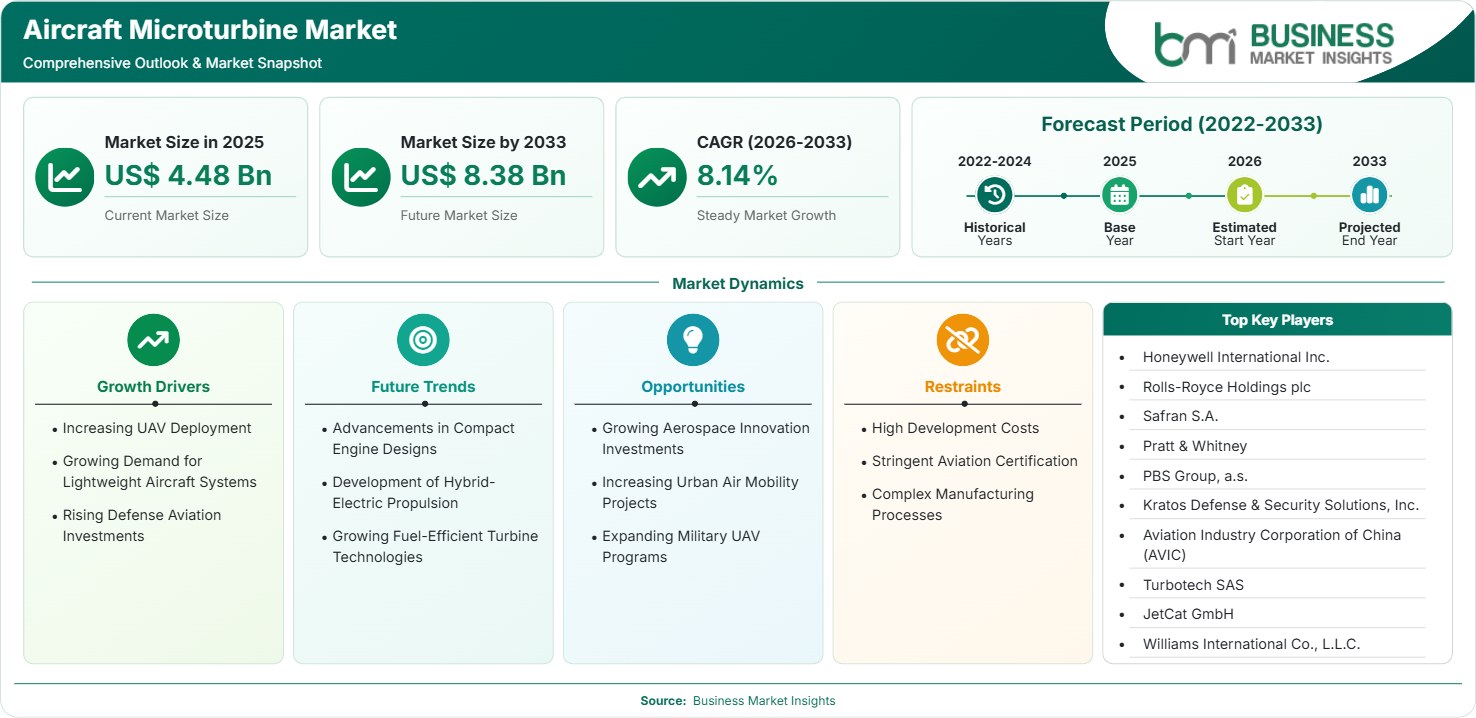
The Aircraft Microturbine Market size was valued at US$ 4.48 Billion in 2025 and is projected to reach US$ 8.38 Billion by 2033, growing at a CAGR of 8.14% during 2026–2033, driven by increasing UAV adoption, urban air mobility development, lightweight propulsion innovation, and defense aviation modernization opportunities.

Report Coverage
  • Micro Engine Type: Turboshaft, Turbojet, Turboprop
  • Fuel Type: JET-A-1, Diesel, Kerosene, Natural Gas, Sustainable Aviation Fuel
  • Application: VTOL, Air Taxi, RC planes, UAVs
  • End-User: Commercial and Military
US$ 4.48 Bn Market size in 2025
US$ 8.38 Bn Market Size by 2033
8.14% CAGR, 2026 - 2033
2026-2033 Forecast Period

AI Overview

Aircraft Microturbine Market Summary

  • North America Region: North America holds a 38%–42% share in 2025, growing at a CAGR of 8.00%–8.50% during 2026–2033, supported by defense UAV programs, advanced aerospace research, electric-hybrid propulsion integration, aviation technology investments, and commercial air mobility initiatives. The US market demonstrates strong expansion with a CAGR of 8.20%–8.70% due to military procurement and emerging air taxi platforms.
  • Fastest Growing Region: Asia Pacific represents a 25%–29% share in 2025, expanding at a CAGR of 8.60%–9.10% during 2026–2033, supported by aerospace manufacturing growth, UAV deployment, defense modernization, urban air mobility investments, and increasing domestic aircraft technology development programs.
  • Leading Segment: Turboshaft micro engines account for a 42%–46% share in 2025, growing at a CAGR of 8.10%–8.60% during 2026–2033, driven by VTOL platforms, UAV propulsion requirements, compact power generation needs, and advanced rotorcraft applications.
  • High Growth Segment: Sustainable Aviation Fuel applications represent a 10%–14% share in 2025, expanding at a CAGR of 9.00%–9.50% during 2026–2033, supported by aviation decarbonization goals, alternative fuel research, emission reduction strategies, and next-generation propulsion development.
  • Key Market Opportunity: Increasing investments in urban air mobility, military unmanned systems, and sustainable propulsion technologies are creating opportunities for microturbine manufacturers through efficient, compact, and high-performance aircraft propulsion solutions.
  • Major Market Players: Honeywell International Inc.; Rolls-Royce Holdings plc; Safran S.A.; Pratt & Whitney; PBS Group, a.s.; Kratos Defense & Security Solutions, Inc.; Aviation Industry Corporation of China (AVIC); Turbotech SAS; JetCat GmbH; Williams International Co., L.L.C.
Strategic Insights

Aircraft Microturbine Market: Strategic Insights

Aircraft Microturbine Market Strategic Framework
FREE PDF
Request your free sample
Request free sample
Stakeholder View

Key Takeaways

  • The supply chain is evolving toward integrated propulsion ecosystems involving turbine manufacturers, aerospace material suppliers, control system developers, and aircraft platform companies seeking optimized micro-engine solutions.
  • UAV propulsion, VTOL platforms, and air taxi applications represent attractive growth areas as developers require compact engines offering high reliability, rapid response, and extended operational capability.
  • Innovation priorities are shifting toward hybrid propulsion compatibility, additive manufacturing, advanced combustion technologies, and sustainable fuel adaptation to improve efficiency and reduce aviation emissions.
  • Asia Pacific provides a strategic investment opportunity due to expanding aerospace manufacturing capabilities, defense modernization programs, and increasing domestic development of unmanned aircraft systems.
  • Aerospace partnerships, technology collaborations, and capability expansion initiatives are strengthening competitive positioning as companies pursue opportunities across military, commercial, and emerging mobility applications.
  • Sustainable propulsion development is becoming a strategic focus as aircraft manufacturers evaluate alternative fuels and next-generation turbine technologies for future aviation requirements.
Geographic Outlook

Aircraft Microturbine Market Regional Highlights

North America Aircraft Microturbine Market

North America represented a 38%–42% share in 2025 and is projected to grow at a CAGR of 8.00%–8.50% during 2026–2033. The region maintains leadership due to defense aerospace investments, advanced aircraft research capabilities, and strong presence of propulsion technology developers. The Aircraft Microturbine Market share is supported by UAV adoption, commercial air mobility initiatives, and military modernization programs across the US and Canada. Increasing aerospace innovation is strengthening regional opportunities.

  • The US market remains the primary contributor due to defense procurement programs, UAV development activities, and increasing investments in advanced propulsion technologies for military and commercial applications.
  • Canada is expanding aerospace capabilities through research initiatives, aircraft manufacturing activities, and growing interest in sustainable aviation technologies supporting future propulsion system development.
  • Defense agencies are increasing adoption of compact turbine systems for unmanned platforms requiring reliable power generation, extended endurance, and improved mission performance capabilities.
  • Aerospace companies are developing hybrid propulsion solutions by integrating microturbines with electric systems to improve efficiency and operational flexibility across emerging aircraft platforms.

US Aircraft Microturbine Market

The US accounted for a 31%–35% share in 2025 and is expected to expand at a CAGR of 8.20%–8.70% during 2026–2033. Strong defense spending, aerospace manufacturing capabilities, and commercial aviation innovation are supporting demand. The Aircraft Microturbine Market growth in the country is driven by UAV programs, urban air mobility projects, and investments in compact propulsion technologies across military and civilian aircraft applications.

  • Military organizations are increasing investments in unmanned aircraft systems requiring efficient propulsion technologies with improved reliability and mission endurance.
  • Commercial aerospace companies are advancing air taxi concepts and evaluating microturbine-based solutions for hybrid-electric aircraft development.
  • Research institutions and manufacturers are collaborating on lightweight turbine technologies focused on improving fuel efficiency and reducing emissions.

Europe Aircraft Microturbine Market

Europe represented a 22%–26% share in 2025 and is projected to grow at a CAGR of 7.50%–8.00% during 2026–2033. The region benefits from advanced aerospace manufacturing, sustainability initiatives, and strong aviation research networks. France, Germany, the UK, and Italy are major contributors. European decarbonization strategies and urban mobility programs are supporting development of efficient propulsion technologies for next-generation aircraft applications.

  • France is strengthening aerospace innovation through propulsion research programs, aircraft manufacturing expertise, and investments in advanced turbine technologies.
  • Germany is focusing on sustainable aviation solutions, hybrid propulsion development, and engineering capabilities supporting future aircraft platforms.
  • The UK continues expanding aerospace research activities through partnerships focused on lightweight materials, turbine efficiency, and advanced propulsion systems.
  • European aviation regulations promoting lower emissions are encouraging manufacturers to explore alternative fuels and efficient micro-engine architectures.
  • Italy is developing aerospace capabilities through specialized manufacturing networks and research programs supporting unmanned and lightweight aircraft applications.

Asia Pacific Aircraft Microturbine Market

Asia Pacific represented a 25%–29% share in 2025 and is expected to grow at a CAGR of 8.60%–9.10% during 2026–2033. The region is the fastest-expanding market due to aerospace manufacturing growth, defense modernization, and increasing UAV deployment. China, Japan, India, and South Korea are strengthening propulsion capabilities through research investments and domestic aircraft development programs. The Aircraft Microturbine Market share is increasing through rising demand for compact propulsion solutions.

  • China is advancing micro-engine development through aerospace investments, military UAV programs, and domestic aircraft technology initiatives supporting propulsion independence.
  • India is expanding aerospace capabilities through defense modernization programs, indigenous aircraft development, and increasing demand for unmanned aviation systems.
  • Japan and South Korea are focusing on advanced mobility solutions, robotics, and aerospace technologies requiring efficient compact propulsion systems.
  • Southeast Asian countries are increasing aviation investments through defense procurement, commercial drone adoption, and emerging air mobility initiatives.
  • Regional manufacturers are developing partnerships with global aerospace companies to improve turbine technology capabilities and production expertise.

Rest of World Aircraft Microturbine Market

Latin America, Middle East, and Africa collectively represented a 7%–10% share in 2025 and are projected to grow at a CAGR of 7.20%–7.70% during 2026–2033. Growth is supported by increasing defense modernization, aviation infrastructure development, and rising UAV adoption. Countries including Brazil, UAE, Saudi Arabia, and South Africa are investing in aerospace capabilities and unmanned systems. Emerging aviation programs are creating opportunities for specialized propulsion suppliers.

Brazil is developing aerospace capabilities through aircraft manufacturing expertise, defense programs, and increasing interest in advanced propulsion technologies. Middle Eastern countries are investing in UAV systems, military aviation modernization, and advanced aerospace infrastructure. Africa is gradually expanding drone applications across surveillance, logistics, and commercial activities.

  • The UAE is investing in aerospace innovation programs, autonomous aircraft technologies, and advanced aviation infrastructure supporting propulsion demand.
  • Saudi Arabia is expanding defense aviation capabilities through modernization programs and technology partnerships with international aerospace companies.
  • Brazil continues supporting aircraft manufacturing activities and research initiatives focused on efficient propulsion solutions.
  • South Africa is increasing UAV adoption for security, monitoring, and industrial applications requiring reliable aircraft engines.
  • Regional governments are encouraging aerospace investments through technology partnerships, defense initiatives, and aviation capability development programs.

Global Market Geography
FREE PDF
Request your free sample
Request free sample
Segment Analysis

Aircraft Microturbine Market Segmentation

Micro Engine Type

Micro engine type segmentation represents a major component of the Aircraft Microturbine Market scope, with compact propulsion systems supporting diverse aircraft applications. This segment accounted for a 42%–46% share in 2025 and is projected to grow at a CAGR of 8.10%–8.60% during 2026–2033. Increasing UAV usage, VTOL development, and demand for lightweight propulsion solutions are strengthening adoption across aerospace platforms.

  • Turboshaft: Supports VTOL aircraft, rotorcraft, and UAV applications requiring compact power generation, high reliability, and efficient rotational energy delivery for advanced flight operations.
  • Turbojet: Provides propulsion solutions for small aircraft, target drones, and specialized aviation platforms requiring high-speed performance and compact engine configurations.
  • Turboprop: Enables efficient propulsion for lightweight aircraft by combining turbine technology with propeller systems, supporting endurance-focused aviation applications.

Fuel Type

Fuel type segmentation reflects increasing demand for flexible propulsion systems compatible with conventional and alternative aviation fuels. This segment represented a significant share in 2025 and is expected to expand at a CAGR of 8.30%–8.80% during 2026–2033. The Aircraft Microturbine Market trends indicate rising research toward sustainable fuels and improved combustion efficiency for future aircraft propulsion.

  • JET-A-1: Remains widely adopted aviation fuel due to established infrastructure, compatibility with turbine engines, and extensive commercial aviation usage.
  • Diesel: Supports specific aircraft applications requiring fuel availability, operational flexibility, and efficient combustion characteristics for specialized platforms.
  • Kerosene: Provides reliable turbine fuel performance and continues supporting aircraft systems requiring stable energy output and operational efficiency.
  • Natural Gas: Offers potential alternative fuel applications through cleaner combustion characteristics and research into future aviation propulsion systems.
  • Sustainable Aviation Fuel: Gains attention through emission reduction objectives, aviation sustainability initiatives, and compatibility development with next-generation turbine technologies.

Application

Application segmentation demonstrates increasing adoption across commercial mobility, defense, and specialized aviation platforms. The segment accounted for a substantial share in 2025 and is expected to expand at a CAGR of 8.40%–8.90% during 2026–2033. The Aircraft Microturbine Market benefits from rising demand for compact propulsion systems supporting autonomous aircraft, urban transportation concepts, and advanced unmanned aviation platforms requiring efficient power solutions.

  • VTOL: Microturbines support vertical takeoff and landing platforms by delivering compact, reliable propulsion capabilities for emerging air mobility applications and specialized aircraft operations.
  • Air Taxi: Supports urban mobility concepts through hybrid propulsion integration, enabling longer range, improved efficiency, and operational flexibility for future passenger transportation systems.
  • RC planes: Utilizes miniature turbine systems for recreational and professional applications requiring realistic flight performance, lightweight configurations, and efficient propulsion characteristics.
  • UAVs: Represents a major application area due to increasing military, commercial, and surveillance drone adoption requiring endurance, reliability, and high-performance propulsion solutions.

End-User

End-user segmentation reflects increasing utilization among commercial aerospace companies and defense organizations adopting advanced propulsion technologies. The segment represented a notable share in 2025 and is projected to grow at a CAGR of 8.20%–8.70% during 2026–2033. Expanding aircraft development programs, defense modernization, and next-generation mobility projects are strengthening demand for microturbine-based propulsion systems.

  • Commercial: Increasing adoption across air taxis, lightweight aircraft, and specialized aviation platforms as manufacturers pursue efficient propulsion systems for future mobility solutions.
  • Military: Driving demand through UAV programs, defense modernization initiatives, and requirements for compact propulsion systems supporting surveillance, reconnaissance, and tactical operations.
Market Forces

Aircraft Microturbine Market Dynamics

Key Market Drivers

Increasing UAV Deployment

Increasing UAV deployment is accelerating demand for compact and efficient propulsion systems across defense, commercial, and industrial applications. Military organizations are expanding unmanned aircraft fleets for surveillance, intelligence, and tactical missions, while commercial operators are adopting drones for inspection, logistics, and monitoring activities. The market growth is supported by increasing requirements for long-endurance UAV platforms that need reliable engines with high power density. The Aircraft Microturbine Market trends reflect growing investments in miniature turbine technologies, improved fuel efficiency, and advanced control systems. Manufacturers are focusing on developing propulsion units capable of supporting extended flight durations, reduced maintenance requirements, and enhanced operational reliability across diverse UAV applications.

Growing Demand for Lightweight Aircraft Systems

Rising demands for light-weight aircraft systems are encouraging aerospace companies to devise small but efficient propulsion systems that are lighter in weight. High performance components that enable fuel efficiency, higher range, and enhanced payload capacity are being preferred by aircraft manufacturers. Utilization of advanced materials, micro-engineering techniques, and efficient turbine design architectures is helping the growing popularity of such systems in both civil and military aviation sectors. Electrification initiatives in aviation are also driving the use of hybrid systems that utilize microturbines for range expansion. The Aircraft Microturbine Market is witnessing rising R&D activities that focus on lightweight and efficient propulsion systems for aircraft.

Rising Defense Aviation Investments

Rising defense aviation investments are increasing procurement opportunities for advanced propulsion systems used in unmanned aircraft, surveillance platforms, and specialized military applications. Defense forces are improving their capabilities by modernizing them with the help of initiatives involving autonomous solutions, intelligence acquisition, and operational agility. Microturbine engines have features such as small size, fast deployment, and performance in harsh conditions. Growing defense budgets in leading nations are facilitating collaborations between aerospace firms and governments. Improvement in terms of thermal efficiency, durability, and versatility is increasing the importance of microturbines in future defense aviation systems.

Key Market Opportunities

Growing Aerospace Innovation Investments

Growing aerospace innovation investments are creating opportunities for microturbine manufacturers through advanced propulsion research, hybrid aircraft development, and next-generation mobility solutions. Increasing funds are being provided by aerospace firms and research organizations in the fields of efficiency turbine technology, digital engineering solutions, and alternative fuel technology. The Aircraft Microturbine Market forecast reveals that more chances will emerge from the new aircraft design that necessitates compact engine systems. R&D projects related to additive manufacturing technology, advanced combustion technique, and smart engine diagnostics will help with future product development.

Increasing Urban Air Mobility Projects

Increasing urban air mobility projects are creating new demand opportunities for propulsion systems designed for electric-hybrid aircraft and air taxi platforms. Firms involved in next-generation mobility technologies are exploring microturbines as possible means to extend range, enhance their flexibility, and lessen dependency on the restrictions of batteries. The increasing emphasis on the availability of transportation options for cities is motivating airplane manufacturers to investigate new propulsion systems. Certification programs and demonstration activities are paving ways towards commercialization of future mobility products. Next-generation microturbines with improved performance in terms of efficiency and emissions, along with smaller sizes, are poised to aid the development of new passenger mobility concepts.

Expanding Military UAV Programs

Military UAV program expansion presents considerable opportunities for microturbine producers due to the need for new propulsion means for unmanned vehicles by defense agencies. The need for more durable, capable of carrying increased loads, and flexible unmanned aerial vehicles is boosting the need for efficient turbine engines. Defense organizations are purchasing unmanned vehicles for surveillance, reconnaissance, and combat operations, thus providing opportunities for development of propulsion systems. The growth in UAVs purchasing by military forces in various regions stimulates cooperation between engine producers and defense agencies.

Market Restraints and Challenges

High Development Costs

Factor: High development costs associated with microturbine engineering, advanced materials, testing procedures, and certification activities increase financial requirements for manufacturers. Impact: These costs may lead to delayed commercialization of the product, prevent small companies from being involved in the process, and raise the prices of the propulsion system in general. Researching efficient turbine technology is expensive, requiring research, simulations, and prototyping. Firms should find a middle ground between development costs and competition in the market in the under tough aerospace reliability requirements. Development of a compact engine with maximum efficiency and durability presents additional difficulties.

Stringent Aviation Certification

Factor: Stringent aviation certification requirements create extensive testing, documentation, and compliance obligations for microturbine manufacturers. Impact: Certification timelines can extend product launch schedules and increase development complexity across commercial and defense aviation applications. Aviation authorities require detailed validation of engine reliability, safety performance, emissions characteristics, and operational durability before approval. Manufacturers must invest in regulatory expertise and extensive testing programs to achieve certification milestones.

Company Analysis

Competitive Landscape

The Aircraft Microturbine Market analysis indicates a competitive environment shaped by established aerospace engine manufacturers, specialized propulsion developers, and technology providers focusing on compact turbine efficiency, UAV propulsion, sustainable aviation compatibility, and next-generation aircraft platforms.

Company Name

Overview

Products and Services relevant to this market

Honeywell International Inc.

Honeywell develops aerospace propulsion technologies and advanced aviation systems with extensive experience in turbine engines and aircraft power solutions.

Provides compact propulsion technologies, auxiliary power systems, turbine solutions, and aerospace components supporting commercial and defense aircraft applications.

Rolls-Royce Holdings plc

Rolls-Royce is a leading aerospace propulsion company developing advanced turbine technologies and efficient aircraft engine solutions.

Offers aircraft propulsion systems, engine technologies, maintenance services, and research capabilities supporting future aviation propulsion platforms.

Safran S.A.

Safran specializes in aerospace systems, propulsion technologies, and aircraft equipment with global aviation industry presence.

Develops propulsion systems, aerospace components, engine technologies, and integrated solutions for commercial and military aviation applications.

Pratt & Whitney

Pratt & Whitney develops aircraft engines and propulsion technologies focused on efficiency, reliability, and advanced aviation performance.

Provides turbine engines, propulsion systems, maintenance services, and aerospace technologies supporting next-generation aircraft platforms.

PBS Group, a.s.

PBS Group develops aviation propulsion technologies, including small turbine engines designed for specialized aircraft and unmanned systems.

Manufactures microturbine engines, auxiliary power units, and propulsion solutions for UAVs, military systems, and aerospace applications.

Kratos Defense & Security Solutions, Inc.

Kratos provides defense technology solutions with expertise in unmanned systems and advanced aerospace platforms.

Supplies propulsion technologies, target drone systems, UAV solutions, and defense aviation products requiring compact turbine engines.

Aviation Industry Corporation of China (AVIC)

AVIC is a major aerospace organization involved in aircraft manufacturing, aviation research, and defense technologies.

Supports aircraft development, propulsion research, aerospace manufacturing, and integrated aviation systems for commercial and military applications.

Turbotech SAS

Turbotech specializes in innovative turbine propulsion systems focused on lightweight aircraft and hybrid-electric aviation solutions.

Develops compact turbine engines, hybrid propulsion systems, and range-extender technologies for future aviation applications.

JetCat GmbH

JetCat manufactures miniature turbine engines used in model aircraft, UAVs, and specialized aviation applications.

Provides small turbine propulsion units, electronic control systems, and accessories for lightweight aircraft platforms.

Williams International Co., L.L.C.

Williams International develops small turbine engines for business aviation and specialized aerospace applications.

Produces compact jet engines, propulsion systems, and turbine technologies supporting lightweight aircraft and emerging aviation platforms.

Trust & Transparency

Research Methodology

The market analysis combines proprietary research with secondary data from government agencies, company disclosures, regulatory filings, industry databases and expert interviews. Market estimates are validated through data triangulation, cross-market benchmarking and analyst review.

View Full Research Methodology

Questions Answered

Frequently Asked Questions

Why are aerospace partnerships important for microturbine manufacturers?

Partnerships help companies combine propulsion expertise, aircraft integration capabilities, certification knowledge, and manufacturing resources to accelerate commercialization of advanced turbine technologies.

What role does the Aircraft Microturbine Market Report provide for industry participants?

The report provides strategic insights into market dynamics, technology developments, competitive positioning, and future opportunities across aerospace propulsion segments.

Which applications are creating new demand opportunities?

Emerging applications including urban air mobility, military drones, autonomous aircraft, and lightweight aviation platforms are creating additional opportunities for compact propulsion technologies.

How does sustainability influence future microturbine development?

Sustainability is encouraging manufacturers to develop engines compatible with sustainable aviation fuels, improved combustion technologies, and hybrid propulsion architectures designed to reduce emissions.

What factors are increasing adoption of aircraft microturbines market in aviation applications?

Aircraft microturbines are gaining adoption due to compact size, high power density, fuel flexibility, and suitability for UAVs, VTOL platforms, and hybrid-electric aircraft requiring efficient propulsion solutions.

Access the Full Aircraft Microturbine Market Report

Get segment-level forecasts, regional estimates, competitive benchmarking, company profiles and downloadable Excel datasets.

Access the full Aircraft Microturbine Market Report
350 pages PDF & Excel | 2026-08-07