Market Summary
Executive Summary and Global Market Analysis
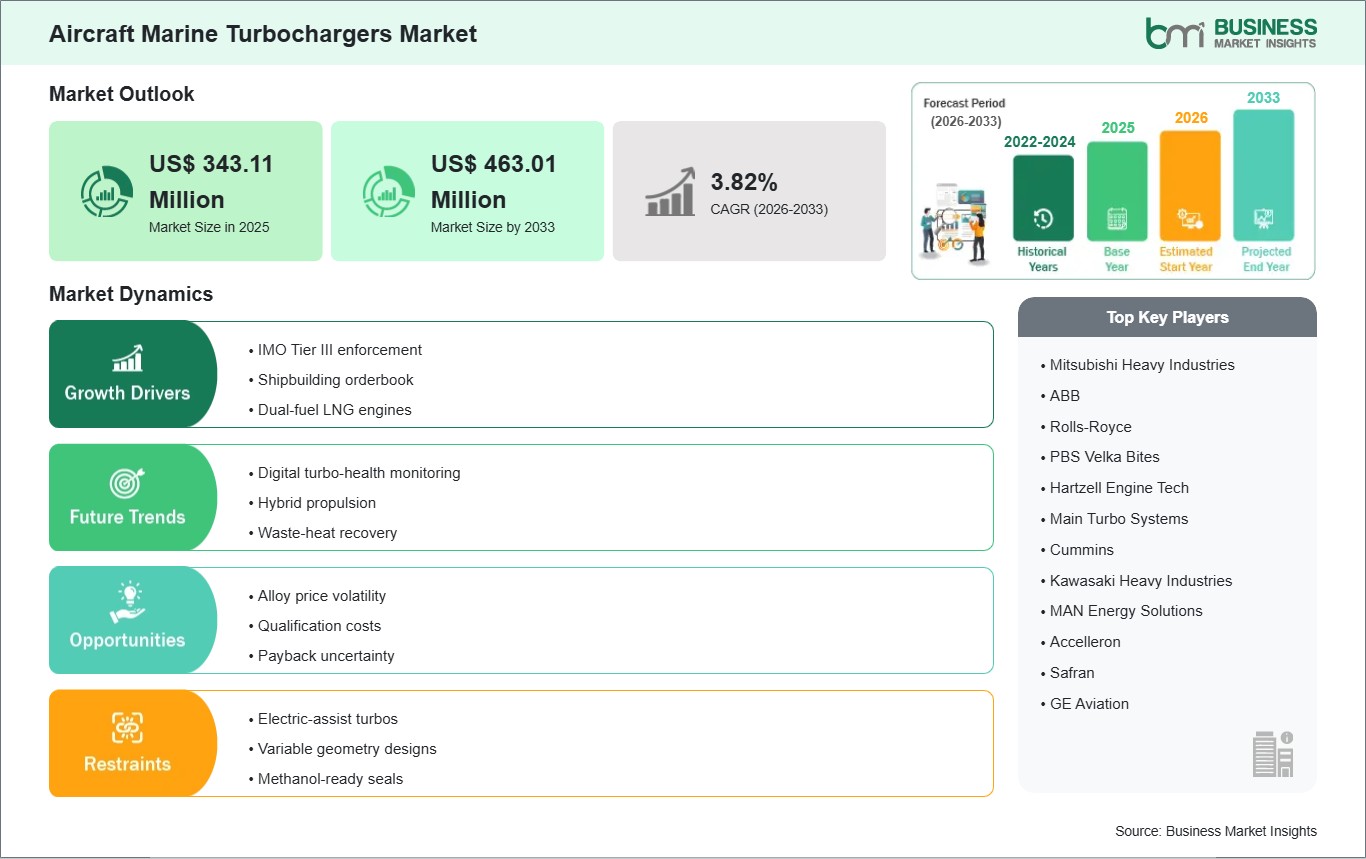
Aircraft marine turbochargers are advanced air compression systems used to improve engine efficiency, power output, and fuel economy in both aviation and marine applications. These systems increase the volume of air entering an engine, allowing for more efficient fuel combustion and improved operational performance. Turbochargers are widely used in commercial aircraft, unmanned aerial vehicles, cargo vessels, tankers, and container ships, where engine reliability and efficiency are critical. The Aircraft Marine Turbochargers Market is expected to grow as a result of the rising demand for fuel-efficient engine propulsion systems, higher global business activity, updating of the aircraft fleet, and stricter environmental policies that seek to minimize emissions. The manufacturers are concentrating on the use of light materials, aerodynamically designed, and digitally controlled turbochargers.
Several challenges continue to influence market growth. High development and maintenance costs associated with advanced turbocharger technologies can limit adoption among cost-sensitive operators. Turbochargers operate under extreme temperatures and pressure conditions, requiring specialized materials and regular maintenance. The use of advanced technology like variable geometry and electric-assisted technologies poses greater challenges for engineering and certification. Additionally, variations in shipment operations and economic uncertainty may influence investment in both the aircraft and marine sectors. Regulations in terms of emissions and safety may add costs in production and operation.
Despite these challenges, the market continues to benefit from technological innovation and sustainability initiatives. Growing interest in low-emission propulsion systems is encouraging the adoption of advanced turbocharging solutions that improve fuel efficiency while reducing environmental impact. Electric-assisted turbochargers, smart monitoring systems, predictive maintenance technologies, and next-generation materials are creating new opportunities. Expanding UAV applications, increasing maritime fleet modernization programs, and the development of advanced aircraft platforms are expected to support long-term growth. Competitive activity remains focused on technological advancements, product reliability, operational efficiency, and compliance with evolving industry standards.
Segment Analysis
Aircraft Marine Turbochargers Market Segmentation
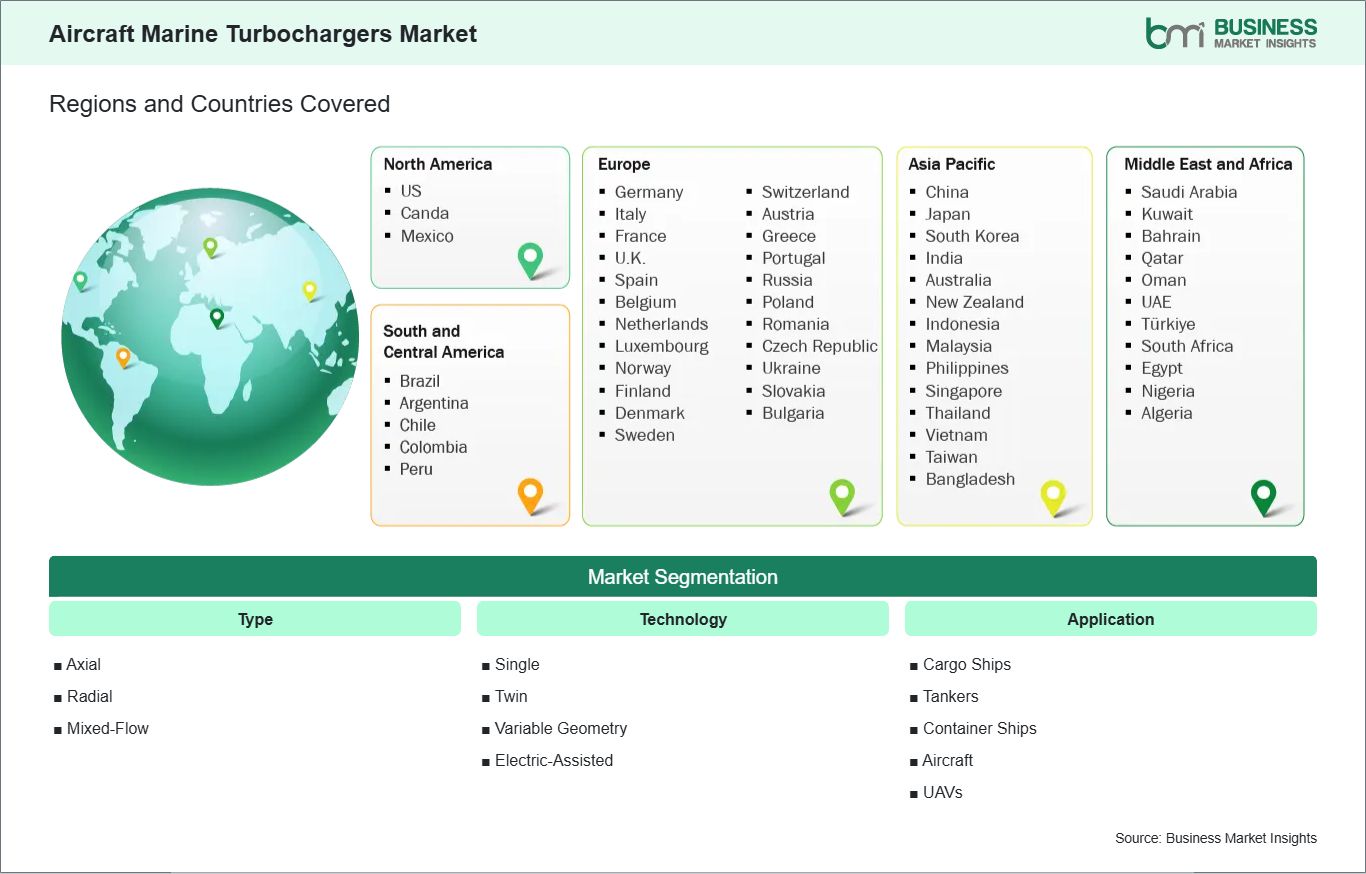
The Aircraft Marine Turbochargers Market is segmented based on type, technology, and application. Each segment addresses specific performance, efficiency, and operational requirements across aviation and marine industries.
By Type
- Axial: Designed for high-flow applications where continuous air movement and efficiency are important.
- Radial: Widely used due to compact design, durability, and strong performance across varying operating conditions.
- Mixed-Flow: Combines benefits of axial and radial configurations to achieve improved efficiency and performance.
By Technology
- Single: Commonly used in standard engine applications due to simplicity and cost-effectiveness.
- Twin: Provides enhanced engine response and improved performance in demanding operating environments.
- Variable Geometry: Enables optimized airflow management across multiple operating conditions.
- Electric-Assisted: Supports improved efficiency, reduced turbo lag, and advanced engine performance.
By Application
- Cargo Ships: Used to improve fuel efficiency and operational reliability in commercial shipping.
- Tankers: Supports high-power engine requirements and long-distance maritime operations.
- Container Ships: Enhances engine efficiency for large-scale cargo transportation.
- Aircraft: Provides improved engine performance and fuel economy in aviation applications.
- UAVs: Increasingly adopted to support endurance, efficiency, and operational capability.
Market Forces
Aircraft Marine Turbochargers Market Drivers and Opportunities
Growing Demand for Fuel-Efficient and Low-Emission Engines
The increasing focus on fuel efficiency and environmental sustainability is a major factor supporting the Aircraft Marine Turbochargers Market. Aviation and maritime operators are under growing pressure to reduce fuel consumption while maintaining operational performance. Turbochargers improve engine efficiency by increasing the amount of compressed air supplied to combustion chambers, resulting in better fuel utilization and enhanced power output. Governments and global agencies keep coming up with tighter emission standards for aircraft and ships. Adherence to these standards would require the use of technology that reduces emissions while still preserving performance levels. Turbocharging plays an important role in achieving this goal by increasing efficiency.
The expansion of commercial aviation activities, global shipping activities, and the usage of unmanned aircraft is also expected to drive the market. To reduce costs in managing their operation, fleet owners will require cost-efficient technology, such as the turbocharger, in their transportation. Advancements in technology will help the turbocharger become more relevant to the industry.
Emergence of Smart and Electrified Turbocharging Technologies
The development of intelligent and electrified turbocharging systems presents significant opportunities for the Aircraft Marine Turbochargers Market. Modern propulsion systems increasingly require technologies that deliver higher efficiency, faster response times, and lower environmental impact. Electric-assisted turbochargers are gaining attention because they help reduce turbo lag and improve engine performance under varying operating conditions. The use of digitalization provides further growth opportunities with the implementation of sensors, predictive maintenance tools, and real-time monitoring systems. These tools ensure efficient operations of engines, minimize downtime, and plan maintenance. Smart turbocharging solutions help generate useful insights that assist in decision-making and expense control.
Growing investments in next-generation aircraft, advanced UAV platforms, and environmentally efficient marine vessels are creating demand for innovative turbocharging solutions. The increasing adoption of hybrid propulsion systems and sustainable transportation technologies is expected to accelerate product development. Manufacturers that focus on efficiency improvements, lightweight materials, and intelligent system integration are likely to benefit from emerging opportunities across the aviation and maritime industries.
Size and Share Analysis
Aircraft Marine Turbochargers Market Size and Share Analysis
The Aircraft Marine Turbochargers Market is projected to grow from US$ 343.11 Million in 2025 to US$ 463.01 Million by 2033 , registering a CAGR of 3.82% from 2026 to 2033.
By type, radial turbochargers account for a significant share of the market due to their compact design, operational reliability, and suitability for a wide range of aviation and marine applications. Mixed-flow turbochargers are gaining attention as operators seek improved efficiency and performance characteristics, while axial turbochargers continue to be utilized in specialized high-flow applications.
By technology, single turbocharger systems maintain a strong presence because of their cost-effectiveness and widespread adoption. Variable geometry and electric-assisted turbochargers are witnessing increased interest as industries focus on improving fuel efficiency, reducing emissions, and enhancing engine responsiveness. Twin turbocharger systems are also gaining traction in applications requiring higher performance and operational flexibility.
Report Coverage
Aircraft Marine Turbochargers Market Report Coverage and Deliverables
The "Aircraft Marine Turbochargers Size and Forecast (2022-2033)" report provides a detailed analysis of the market covering below areas:
- Aircraft Marine Turbochargers Market size and forecast at global, regional, and country levels for all the key market segments covered under the scope
- Aircraft Marine Turbochargers Market trends, as well as market dynamics such as drivers, restraints, and key opportunities
- Aircraft Marine Turbochargers Market analysis covering key market trends, global and regional framework, major players, regulations, and recent market developments
- Industry landscape and competition analysis covering market concentration, heat map analysis, prominent players, and recent developments for the market
- Detailed company profiles, including SWOT analysis
Geographic Insights
Aircraft Marine Turbochargers Market Geographic Insights
The Aircraft Marine Turbochargers Market shows diverse regional adoption patterns influenced by growing transportation activities, propulsion system modernization, fuel efficiency requirements, and environmental compliance initiatives.
North America, being a developed region, has a well-established aviation and maritime industry along with advanced engine manufacturing capabilities. The region comprises the United States and Canada, where investments are being made in aircraft modernization programs, advanced propulsion technologies, and sustainable transportation solutions. This region is concerned with making engines more efficient as well as reducing pollution by installing improved turbochargers. The presence of effective research and development work, adequate infrastructure, and proper regulations ensures that the use of turbochargers remains constant throughout aviation, maritime, and military operations.
Asia Pacific is growing significantly, driven by expanding trade networks, increasing air passenger traffic, and large-scale industrial development. The region comprises countries such as China, India, Japan, and South Korea, where growing investments in aviation infrastructure and maritime fleet expansion are creating strong demand for turbocharger systems. The region focuses on enhancing operational efficiency and meeting evolving environmental standards through advanced engine technologies. The growth of industries, the increasing movement of freight, and government initiatives aimed at improving transportation will further enhance the penetration of this market.
Both regions are contributing significantly to the growth of the Aircraft Marine Turbochargers Market, focusing on transportation modernization, operational efficiency improvements, environmental compliance, and the adoption of advanced propulsion technologies across aviation and maritime applications.
Industry Activity
Recent Developments
The Aircraft Marine Turbochargers Market is analyzed using a mix of primary and secondary research sources, including corporate publications, industry associations, and verified databases. This approach ensures accurate tracking of innovation trends and strategic developments influencing the market.
- In June 2024, Accelleron (formerly ABB Turbocharging) advanced its next-generation Power2 two-stage marine turbocharging portfolio, optimizing high-pressure engine air delivery to significantly boost fuel efficiency. This thermodynamic solution lowers greenhouse gas emissions and stabilizes performance margins, assisting commercial maritime operators in adopting sustainable alternative fuel blends like methanol and ammonia.
- In September 2023, Accelleron expanded its digital fleet intelligence ecosystem, launching comprehensive updates for its cloud-connected Tekomar XPERT performance software. This platform leverages continuous thermodynamic sensor telemetry to track turbocharger efficiency in real time, providing industrial and marine operators with automated diagnostics to enable predictive maintenance and enhance long-term engine reliability.
Trust & Transparency
Research Methodology
The market analysis combines proprietary research with secondary data from government agencies, company disclosures, regulatory filings, industry databases and expert interviews. Market estimates are validated through data triangulation, cross-market benchmarking and analyst
review.
View Full Research Methodology
Key Sources Referred:
World Bank - Global Trade Indicators
World Trade Organization (WTO)
International Monetary Fund (IMF)
International Trade Administration (ITA)
Company Websites
Company Annual Reports
Company Investor Presentations