Market Summary
Executive Summary and Global Market Analysis
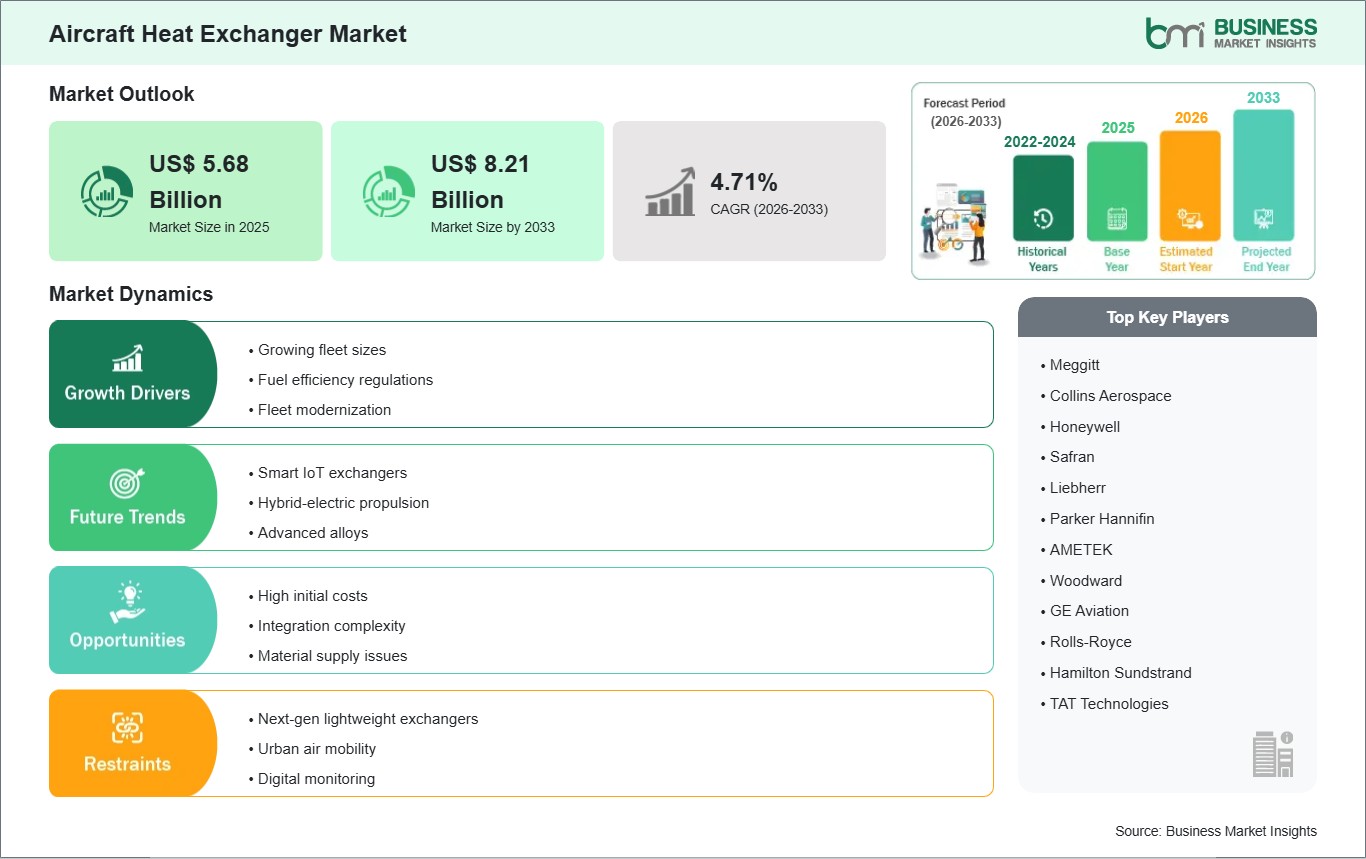
Aircraft heat exchangers are thermal management devices used to transfer heat between different fluids or air streams within an aircraft. They play a critical role in maintaining safe operating temperatures for engines, environmental control systems, avionics, and bleed air systems. These systems help improve aircraft performance, enhance component reliability, and support passenger comfort. The Aircraft Heat Exchanger market is experiencing steady growth as aircraft manufacturers focus on fuel efficiency, weight reduction, and improved thermal management capabilities. Increasing aircraft deliveries, fleet modernization programs, and the adoption of advanced avionics systems are contributing to the demand for efficient heat exchanger technologies.
Several challenges influence market development. Aircraft heat exchangers must operate under extreme temperature and pressure conditions while maintaining high reliability and low weight. The development of advanced thermal management systems often requires specialized materials and complex manufacturing processes, which can increase production costs. Regulatory requirements related to aviation safety, certification, and environmental performance also create additional development and testing requirements. Furthermore, integrating advanced cooling systems into existing aircraft platforms can be technically demanding, particularly during retrofit programs where space and weight limitations must be carefully managed.
Despite these challenges, the market continues to benefit from ongoing technological advancements and the growing need for efficient thermal control solutions. Opportunities are emerging from next-generation aircraft platforms, increasing electrification of aircraft systems, and the expansion of advanced avionics architectures that generate higher thermal loads. Manufacturers are focusing on lightweight materials, compact designs, and enhanced heat transfer performance to meet evolving industry requirements. Growing investments in sustainable aviation technologies and the development of more electric aircraft are expected to create additional demand for innovative heat exchanger solutions, supporting the long-term growth of the Aircraft Heat Exchanger market.
Segment Analysis
Aircraft Heat Exchanger Market Segmentation
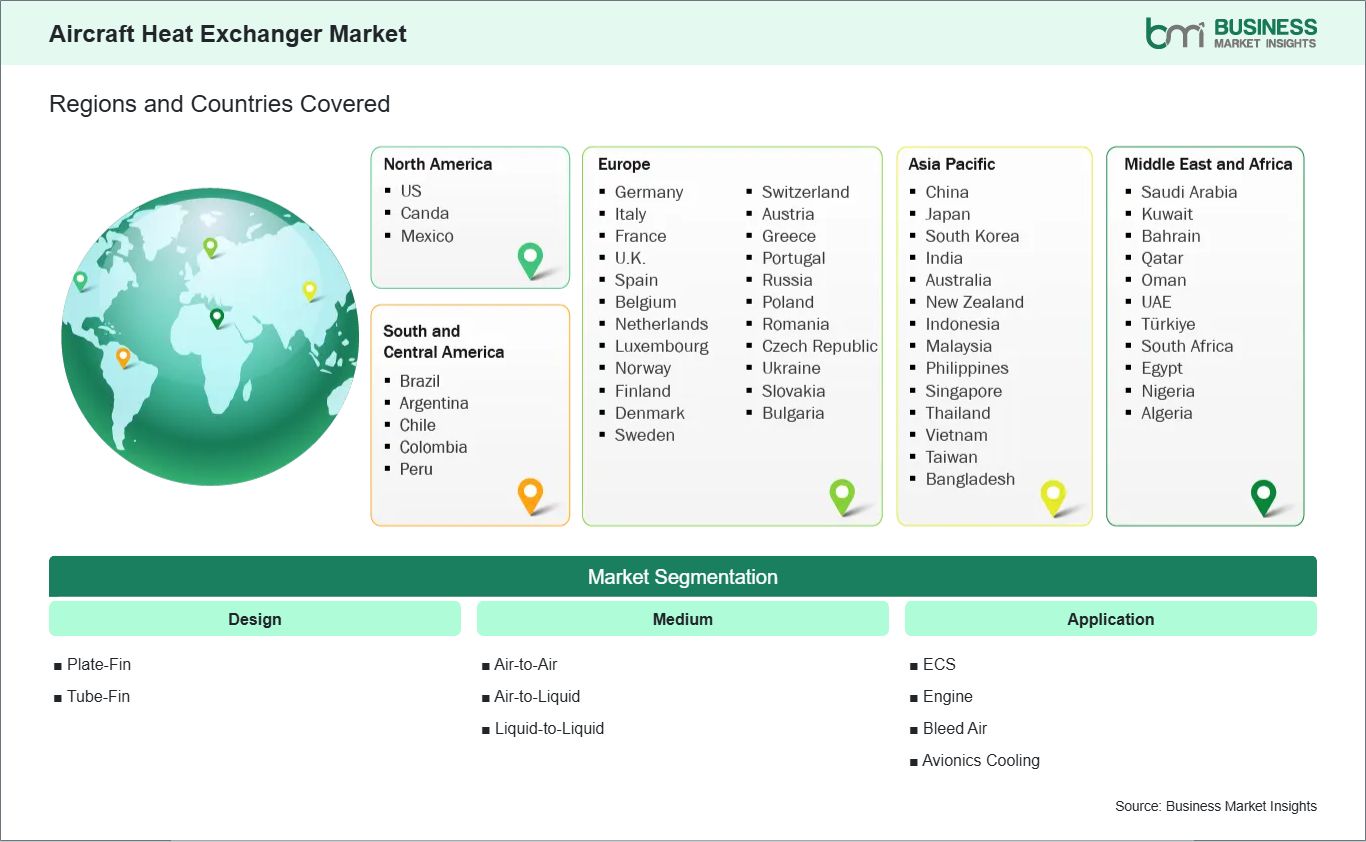
The Aircraft Heat Exchanger market is segmented based on design, medium, and application, reflecting the diverse thermal management requirements across modern aircraft platforms.
By Design
- Plate-Fin: Widely adopted due to high heat transfer efficiency, compact structure, and lightweight characteristics.
- Tube-Fin: Preferred for applications requiring durability, ease of maintenance, and reliable performance under demanding conditions.
By Medium
- Air-to-Air: Commonly used for cooling systems where air serves as both the cooling and heated medium.
- Air-to-Liquid: Supports efficient thermal management in aircraft systems requiring liquid cooling circuits.
- Liquid-to-Liquid: Utilized in specialized applications where controlled heat transfer between liquid systems is required.
By Application
- ECS: Essential for maintaining cabin temperature, air quality, and passenger comfort.
- Engine: Supports engine performance by regulating operating temperatures and improving efficiency.
- Bleed Air: Helps manage thermal loads within aircraft pneumatic systems.
- Avionics Cooling: Critical for maintaining safe operating temperatures of electronic and communication equipment.
Market Forces
Aircraft Heat Exchanger Market Drivers and Opportunities
Increasing Demand for Advanced Aircraft Thermal Management Systems
The growing complexity of modern aircraft systems is driving demand for advanced thermal management technologies. Aircraft today incorporate sophisticated avionics, electronic control systems, and environmental control equipment that generate significant amounts of heat during operation. Effective thermal management has become essential to maintain system reliability, ensure passenger comfort, and support operational efficiency. As aircraft manufacturers focus on improving fuel efficiency and reducing overall weight, there is increased emphasis on compact and lightweight heat exchanger designs. Regulatory requirements related to aviation safety and equipment reliability further encourage the adoption of advanced cooling technologies. Airlines and operators also seek solutions that reduce maintenance requirements and improve component lifespan, creating additional demand for high-performance heat exchangers.
The transition toward more electric aircraft architectures is further increasing thermal management requirements. Electrified systems generate new cooling challenges that require efficient heat transfer solutions. As a result, heat exchangers continue to play an increasingly important role in supporting aircraft performance, safety, and operational reliability across both commercial and military aviation sectors.
Electric Aircraft and Advanced Cooling Technologies
The aviation industry's transition toward more electric aircraft presents significant opportunities for the Aircraft Heat Exchanger market. Modern aircraft increasingly rely on electrically powered systems to improve efficiency and reduce dependence on traditional pneumatic and hydraulic architectures. This shift creates additional thermal loads that require advanced cooling solutions. Emerging technologies such as next-generation avionics, high-capacity power electronics, and electric propulsion components are driving demand for innovative heat exchanger designs. Manufacturers are investing in lightweight materials, compact configurations, and enhanced heat transfer technologies to address evolving aircraft requirements. Advanced manufacturing techniques are also enabling the production of more efficient and complex thermal management components.
Growing interest in sustainable aviation and future aircraft concepts is expected to accelerate innovation in thermal management systems. Research efforts focused on improving cooling performance while minimizing weight and energy consumption are creating new opportunities across commercial, military, and advanced air mobility platforms. These developments are likely to support long-term market expansion and encourage the adoption of next-generation heat exchanger technologies.
Size and Share Analysis
Aircraft Heat Exchanger Market Size and Share Analysis
The Aircraft Heat Exchanger Market is projected to grow from US$ 5.68 Billion in 2025 to US$ 8.21 Billion by 2033 , registering a CAGR of 4.71% from 2026 to 2033.
By design, plate-fin heat exchangers account for a significant share due to their lightweight construction, compact size, and superior heat transfer efficiency. Tube-fin heat exchangers continue to maintain demand in applications requiring durability and reliable operation under varying environmental conditions. By medium, air-to-air and air-to-liquid configurations are widely utilized across commercial and military aircraft platforms.
By application, environmental control systems and engine-related applications represent major demand segments owing to their critical role in aircraft operation and safety. Avionics cooling is gaining increasing importance as aircraft electronics become more advanced and generate higher thermal loads. Growing investments in aircraft efficiency and system reliability continue to support demand across all major application areas.
Report Coverage
Aircraft Heat Exchanger Market Report Coverage and Deliverables
The "Aircraft Heat Exchanger Size and Forecast (2022-2033)" report provides a detailed analysis of the market covering below areas:
- Aircraft Heat Exchanger Market size and forecast at global, regional, and country levels for all the key market segments covered under the scope
- Aircraft Heat Exchanger Market trends, as well as market dynamics such as drivers, restraints, and key opportunities
- Aircraft Heat Exchanger Market analysis covering key market trends, global and regional framework, major players, regulations, and recent market developments
- Industry landscape and competition analysis covering market concentration, heat map analysis, prominent players, and recent developments for the market
- Detailed company profiles, including SWOT analysis
Geographic Insights
Aircraft Heat Exchanger Market Geographic Insights
The Aircraft Heat Exchanger Market shows diverse regional adoption patterns influenced by aircraft manufacturing activities, fleet modernization programs, technological advancements, and increasing demand for efficient thermal management systems.
North America, being a developed region, has a well-established aerospace manufacturing ecosystem and a strong presence of commercial and defense aviation activities. The region comprises the United States and Canada, where aircraft manufacturers and operators continuously invest in advanced thermal management technologies to improve aircraft performance and operational efficiency. The region focuses on innovation in lightweight materials, next-generation avionics systems, and more electric aircraft technologies. Strong regulatory standards, advanced research capabilities, and a mature aerospace supply chain support the adoption of sophisticated heat exchanger solutions across commercial, military, and business aviation segments.
Asia Pacific is growing significantly, driven by expanding commercial aviation fleets, increasing air passenger traffic, and ongoing investments in aerospace infrastructure. The region comprises countries such as China, India, and Japan, where airlines are modernizing fleets and increasing aircraft procurement activities. The region focuses on improving aviation infrastructure and supporting domestic aerospace manufacturing capabilities. Rising demand for fuel-efficient aircraft and enhanced onboard systems is contributing to increased adoption of advanced heat exchanger technologies. Government initiatives supporting aviation growth and industrial development further strengthen market expansion across the region.
Both regions are contributing significantly to the growth of the Aircraft Heat Exchanger Market, focusing on technological advancements, aircraft fleet expansion, and increasing demand for reliable thermal management solutions.
Industry Activity
Recent Developments
The Aircraft Heat Exchanger Market is analyzed using a mix of primary and secondary research sources, including corporate publications, industry associations, and verified databases. This approach ensures accurate tracking of innovation trends and strategic developments influencing the market.
- In February 2024, RTX Corporation's Collins Aerospace advanced in aircraft thermal management solutions designed for commercial and military aviation platforms. The company highlighted efforts to improve cooling capabilities, reduce system weight, and support next-generation avionics and aircraft systems. These developments demonstrate ongoing innovation within the aircraft heat exchanger ecosystem.
- In July 2024, Honeywell announced the expansion of its thermal and environmental control technologies portfolio to support next-generation aircraft programs. The development focused on improving aircraft cooling efficiency and thermal management performance for increasingly electrified aviation systems. The initiative reflects the growing importance of advanced heat exchanger technologies in modern aircraft architectures.
Trust & Transparency
Research Methodology
The market analysis combines proprietary research with secondary data from government agencies, company disclosures, regulatory filings, industry databases and expert interviews. Market estimates are validated through data triangulation, cross-market benchmarking and analyst
review.
View Full Research Methodology
Key Sources Referred:
World Bank - Global Trade Indicators
World Trade Organization (WTO)
International Monetary Fund (IMF)
International Trade Administration (ITA)
Company Websites
Company Annual Reports
Company Investor Presentations