
Aircraft Health Monitoring System Market Outlook: Size, Share, Trends, Growth Analysis, Competitive Landscape & Forecast, 2026-2033

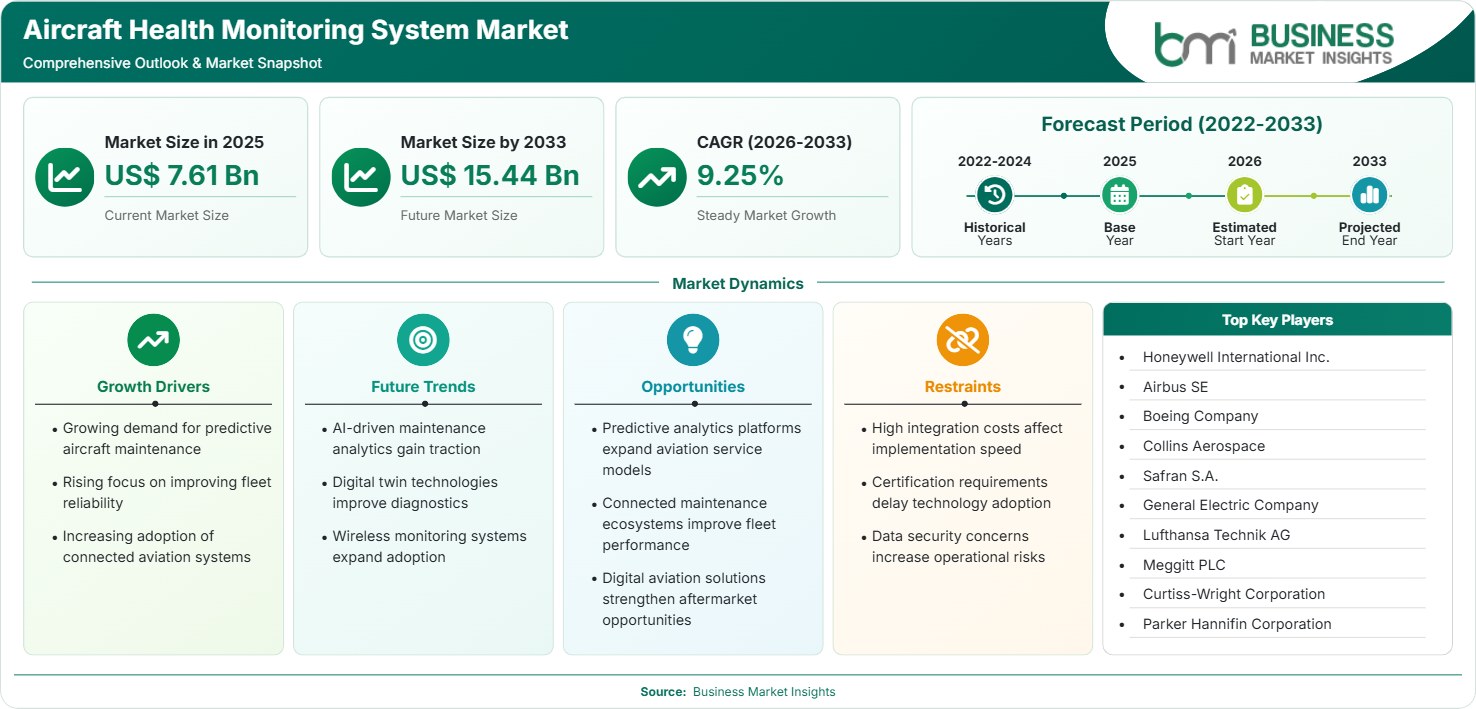
The Aircraft Health Monitoring System Market size was valued at US$ 7.61 billion in 2025 and is projected to reach US$ 15.44 billion by 2033, growing at a CAGR of 9.25% during 2026–2033. Growing demand for predictive aircraft maintenance, increasing emphasis on fleet reliability, and wider adoption of connected aviation technologies continue to accelerate market expansion across commercial and defense aviation.

Report Coverage
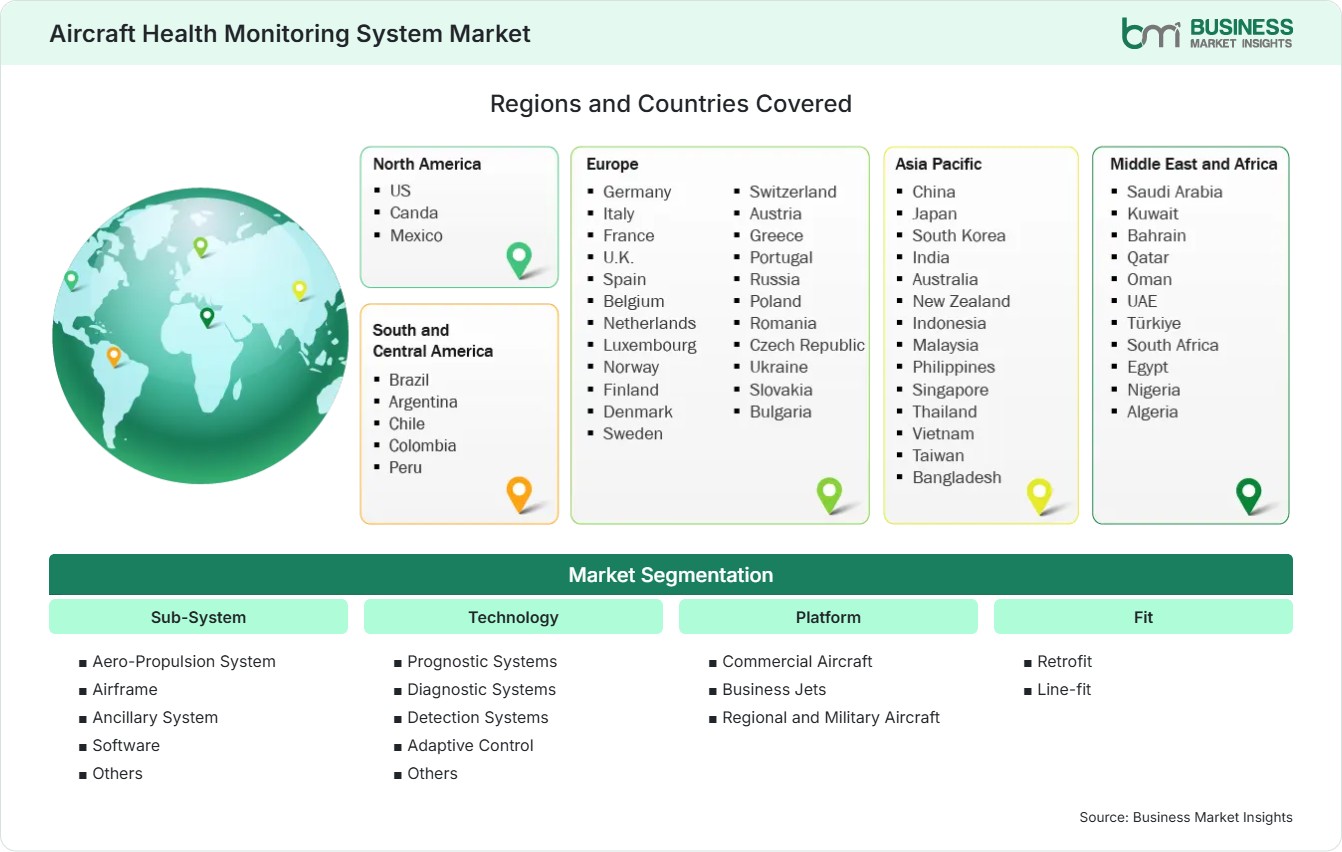
  • Sub-System: Aero-Propulsion System, Airframe, Ancillary System, Software, Others
  • Technology: Prognostic Systems, Diagnostic Systems, Detection Systems, Adaptive Control, Others
  • Platform: Commercial Aircraft, Business Jets, Regional and Military Aircraft
  • Fit: Retrofit, Line-fit
US$ 7.61 Bn Market size in 2025
US$ 15.44 Bn Market Size by 2033
9.25% CAGR, 2026 - 2033
2026-2033 Forecast Period

01 AI Overview

Aircraft Health Monitoring System Market Summary

  • North America Region: North America holds 36%–39% market share in 2025 and is projected to grow at a CAGR of 8.8%–9.3% during 2026–2033. Strong commercial aviation activity, advanced MRO infrastructure, and increasing investment in predictive maintenance support regional growth. The U.S. remains the largest contributor with a CAGR of 8.9%–9.4%, driven by fleet modernization and digital maintenance technologies.
  • Fastest Growing Region: Asia Pacific accounts for 28%–31% market share in 2025 and is expected to register a CAGR of 10.2%–10.8%, supported by expanding airline fleets, increasing aircraft deliveries, and rising investments in aviation maintenance infrastructure.
  • Leading Segment: Commercial Aircraft represents 47%–50% market share in 2025 and is forecast to expand at a CAGR of 9.4%–9.9%, driven by higher fleet utilization, predictive maintenance programs, and operational efficiency initiatives.
  • High Growth Segment: Prognostic Systems captures 31%–34% market share in 2025 and is anticipated to record a CAGR of 9.8%–10.4%, supported by growing deployment of AI-enabled predictive maintenance platforms and real-time aircraft monitoring.
  • Key Market Opportunity: Digital aviation platforms, connected maintenance ecosystems, and predictive analytics continue creating opportunities for advanced aircraft diagnostics, fleet optimization, and aftermarket service expansion.
  • Major Market Players: Honeywell International Inc., Airbus SE, The Boeing Company, Collins Aerospace, Safran S.A., General Electric Company, Lufthansa Technik AG, Meggitt PLC, Curtiss-Wright Corporation, and Parker Hannifin Corporation.
02 Strategic Insights

Aircraft Health Monitoring System Market: Strategic Insights

Aircraft Health Monitoring System Market Strategic Framework
FREE PDF
Request your free sample
Request free sample
03 Stakeholder View

Key Takeaways

  • Predictive maintenance technologies are becoming central to airline maintenance strategies by reducing unscheduled downtime and improving aircraft availability across commercial fleets.
  • Airlines increasingly prioritize integrated health monitoring systems capable of combining sensor data, maintenance records, and operational analytics into unified maintenance platforms.
  • Artificial intelligence, cloud computing, and digital twin technologies continue transforming aircraft diagnostics, enabling faster fault detection and more accurate maintenance planning.
  • Asia Pacific presents the strongest long-term investment opportunity due to expanding airline fleets, airport infrastructure development, and increasing regional MRO capabilities.
  • Strategic collaboration among aircraft manufacturers, avionics suppliers, and maintenance organizations is accelerating deployment of connected maintenance ecosystems worldwide.
  • Continuous investment in software-driven maintenance solutions is improving lifecycle management while supporting higher operational efficiency and lower maintenance costs.
04 Geographic Outlook

Aircraft Health Monitoring System Market Regional Highlights

North America Aircraft Health Monitoring System Market

North America represents 36%–39% Aircraft Health Monitoring System Market share in 2025 and is projected to register a CAGR of 8.8%–9.3% during 2026–2033. The region benefits from advanced aviation infrastructure, strong commercial airline operations, and significant investments in predictive maintenance technologies. Airlines and MRO providers continue deploying connected aircraft monitoring solutions to improve operational efficiency, maintenance scheduling, and fleet reliability.

  • Commercial airlines continue investing in predictive maintenance platforms that reduce aircraft downtime and optimize maintenance planning.
  • Aircraft manufacturers integrate advanced onboard diagnostics and connected monitoring technologies into next-generation aircraft platforms.
  • Strong MRO capabilities support increasing adoption of digital maintenance solutions across commercial and defense aviation.
  • Continuous investment in aviation analytics improves fleet utilization, maintenance accuracy, and operational safety.

US Aircraft Health Monitoring System Market

The United States contributes 82%–85% of North American revenue and is expected to expand at a CAGR of 8.9%–9.4% through 2026–2033. Large commercial fleets, advanced aerospace manufacturing, and significant investment in digital aviation technologies continue supporting market development.

  • Airlines continue modernizing maintenance operations through cloud-based predictive analytics platforms.
  • Defense aviation programs increasingly integrate intelligent aircraft health monitoring technologies.
  • Digital transformation initiatives improve maintenance efficiency and reduce operational disruptions.
  • Connected aircraft technologies strengthen real-time fleet performance monitoring across aviation operators.

Europe Aircraft Health Monitoring System Market

Europe accounts for 27%–30% market share in 2025 and is projected to register a CAGR of 8.7%–9.2% during the forecast period. Strong aerospace manufacturing, expanding MRO capabilities, and regulatory focus on operational safety continue supporting regional adoption. Germany remains the largest market, while France records the fastest growth through continued investment in aviation digitalization.

  • Airlines continue investing in predictive maintenance to improve operational efficiency and aircraft availability.
  • Aerospace manufacturers strengthen development of intelligent onboard monitoring technologies.
  • Digital aviation initiatives accelerate adoption of connected maintenance ecosystems.
  • MRO providers increasingly deploy AI-enabled maintenance planning platforms across commercial fleets.

Asia Pacific Aircraft Health Monitoring System Market

Asia Pacific holds 28%–31% market share in 2025 and is expected to record the fastest 10.2%–10.8% CAGR during 2026–2033. Growing airline fleets, rising aircraft deliveries, expanding airport infrastructure, and increasing regional maintenance capabilities continue driving demand for advanced aircraft health monitoring solutions.

  • Fleet expansion encourages wider deployment of predictive maintenance technologies across commercial aviation.
  • Airlines increasingly adopt connected maintenance platforms to improve operational efficiency.
  • Regional MRO investments strengthen digital aircraft lifecycle management capabilities.
  • Aviation modernization initiatives support long-term demand for intelligent monitoring systems.

Rest of World Aircraft Health Monitoring System Market

The Rest of World region represents 5%–8% market share in 2025 and is anticipated to grow at a CAGR of 9.0%–9.6% during 2026–2033. Fleet modernization, expanding aviation infrastructure, and increasing aircraft maintenance investments continue supporting market development across Latin America, the Middle East, and Africa.

  • GCC countries continue investing in advanced aviation maintenance infrastructure and digital technologies.
  • Brazil remains a key market supported by commercial aviation growth and regional aircraft operations.
  • Fleet modernization programs encourage adoption of predictive maintenance solutions.
  • Growing aftermarket services strengthen regional demand for connected aircraft health monitoring systems.
Global Market Geography
FREE PDF
Request your free sample
Request free sample
05 Segment Analysis

Aircraft Health Monitoring System Market Segmentation

Sub-System

The sub-system segment accounts for a significant portion of industry demand as airlines increasingly invest in integrated monitoring platforms covering critical aircraft components. It represented 38%–41% market share in 2025 and is projected to grow at a CAGR of 9.3%–9.8% during 2026–2033. Expanding predictive maintenance programs and increasing digitalization continue broadening the Aircraft Health Monitoring System Market scope across commercial and military aviation.

  • Aero-Propulsion System: Remains the leading sub-segment owing to continuous monitoring of engines, fuel systems, and propulsion components that improve operational efficiency while minimizing unscheduled maintenance events.
  • Airframe: Growing deployment of structural health monitoring technologies enables early detection of fatigue, corrosion, and component degradation, improving aircraft safety and extending service life.
  • Ancillary System: Increasing monitoring of hydraulic, electrical, environmental control, and auxiliary systems supports higher aircraft reliability and efficient maintenance scheduling.
  • Software: Software platforms integrate aircraft performance data, maintenance history, and predictive analytics, enabling operators to improve maintenance planning and optimize fleet utilization.
  • Others: Includes monitoring solutions for landing gear, cabin systems, avionics, and additional aircraft components that enhance comprehensive fleet health management.

Technology

Technology advancements continue transforming aircraft maintenance by enabling intelligent diagnostics and predictive decision-making. This segment accounted for 34%–37% market share in 2025 and is forecast to register a CAGR of 9.6%–10.1% during 2026–2033. Artificial intelligence, cloud computing, and sensor integration continue improving aircraft condition assessment and maintenance efficiency.

  • Prognostic Systems: Lead technology adoption by forecasting component failures before occurrence, allowing maintenance teams to schedule repairs proactively while reducing aircraft downtime.
  • Diagnostic Systems: Analyze operational data to identify equipment faults accurately, supporting efficient troubleshooting and minimizing maintenance turnaround time.
  • Detection Systems: Enable continuous monitoring of aircraft parameters through advanced sensors capable of identifying abnormal operating conditions during flight and ground operations.
  • Adaptive Control: Improves aircraft system performance by automatically adjusting operational parameters based on changing flight conditions and equipment status.
  • Others: Includes emerging intelligent analytics technologies, digital twin applications, and integrated monitoring platforms supporting comprehensive aircraft lifecycle management.

Platform

Platform-specific requirements continue shaping technology adoption across the aviation industry. The platform segment represented 47%–50% market share in 2025 and is anticipated to grow at a CAGR of 9.4%–9.9% through 2026–2033. Current Aircraft Health Monitoring System Market trends indicate increasing investment in connected monitoring solutions that improve fleet availability and maintenance efficiency across diverse aircraft categories.

  • Commercial Aircraft: Represents the largest sub-segment because airlines prioritize predictive maintenance to maximize aircraft utilization, improve reliability, and reduce operational disruptions.
  • Business Jets: Corporate fleet operators increasingly deploy intelligent monitoring systems to enhance aircraft availability, improve maintenance planning, and support premium operational standards.
  • Regional Aircraft: Regional carriers continue adopting digital maintenance technologies to improve operational efficiency while controlling maintenance expenses across shorter flight routes.
  • Military Aircraft: Defense organizations increasingly implement advanced monitoring systems to improve mission readiness, fleet availability, and lifecycle management of critical aviation assets.

Fit

Fit options continue influencing purchasing decisions as operators balance modernization requirements with new aircraft deliveries. This segment accounted for 58%–61% market share in 2025 and is projected to register a CAGR of 9.1%–9.6% during 2026–2033. Fleet modernization programs and digital maintenance initiatives continue driving demand across both retrofit and factory-installed solutions.

  • Retrofit: Remains the dominant installation approach because airlines upgrade existing aircraft with advanced monitoring technologies to extend operational life and improve maintenance efficiency without replacing fleets.
  • Line-fit: Demand continues increasing as aircraft manufacturers integrate health monitoring systems during production, enabling seamless digital connectivity, improved diagnostics, and enhanced lifecycle performance from initial aircraft delivery.
06 Market Forces

Aircraft Health Monitoring System Market Dynamics

Key Market Drivers

Growing demand for predictive aircraft maintenance

Airline companies and maintenance service providers are currently moving away from scheduled maintenance to predictive maintenance in order to lower the occurrence of unforeseen problems and decrease time off the air. Today’s planes produce considerable amount of data on their operations, allowing to identify the problem even before the failure takes place. According to the statistics provided by IATA, global passenger numbers continue growing, making the need for effective maintenance planning greater. These developments continue supporting Aircraft Health Monitoring System Market growth, helping operators improve fleet reliability, optimize maintenance costs, and maximize aircraft availability across commercial and military aviation.

Rising focus on improving fleet reliability

Fleet reliability remains a primary objective for airlines seeking to improve operational efficiency while minimizing flight delays and maintenance disruptions. Aircraft monitoring systems offer continuous insight into the condition of aircrafts, enabling maintenance personnel to detect any problems before the equipment fails. The use of sophisticated analytics, diagnostics, and condition monitoring helps airlines ensure better dispatch reliability as well as increase the useful life of components. The demand for improving the passenger experience and enhancing performance keeps driving the adoption of smart fleet monitoring systems.

Increasing adoption of connected aviation systems

Connected aviation technologies have brought about changes in the area of maintenance due to the integration of sensors on aircraft, cloud computing, and analytics to the maintenance platforms. Airlines are adopting the use of connected environments that monitor the performance of their aircraft all day long. This helps in improving scheduling and management of spare parts. Ongoing digital transformation initiatives continue shaping Aircraft Health Monitoring System Market trends, supporting higher maintenance efficiency while improving aircraft lifecycle management and operational safety.

Key Market Opportunities

Predictive analytics platforms expand aviation service models

Predictive analytics is still discovering ways to generate more revenues for companies producing planes, offering MRO services and developing software applications. The use of advanced analytics systems allows conducting maintenance services depending on the plane’s state and not the schedule. Aircraft Health Monitoring System Market Forecasts indicate increasing investment in cloud-based predictive maintenance software, artificial intelligence, and digital twin technologies that support long-term service agreements and outcome-based maintenance business models.

Connected maintenance ecosystems improve fleet performance

The aviation industry is increasingly adopting integrated maintenance ecosystems connecting airlines, OEMs, suppliers, and MRO organizations through digital platforms. Operational data sharing results in better maintenance planning, proper management of spare parts and better cooperation along the entire life cycle of the plane. Organizations that are working on smart maintenance ecosystem development increase operational transparency and improve maintenance accuracy and plane availability. It offers great prospects for digital aviation technology vendors.

Digital aviation solutions strengthen aftermarket opportunities

Growing aircraft fleets and extended operational lifecycles continue expanding demand for digital aftermarket services. Smart health monitoring systems help airlines enhance their maintenance planning, lower repair expenses, and optimize their fleet operations via analysis of aircraft performance. Software vendors and maintenance services keep developing new digital offerings incorporating predictive analytics, remote diagnostics, and maintenance optimization that provide them with sustainable recurring revenue streams in the global aviation aftermarket space.

Market Restraints and Challenges

High integration costs affect implementation speed

Advanced aircraft health monitoring systems require substantial investment in sensors, software integration, onboard electronics, cloud infrastructure, and workforce training. Factor: The high cost of implementation poses economic difficulties for small airlines and regional airlines with constrained maintenance budgets. Impact: Many of these airlines tend to put off their projects until later or adopt the systems progressively, even though they have been proved to be beneficial in the long run. Manufacturers are continuously developing modular solutions to ensure affordability.

Certification requirements delay technology adoption

Aircraft monitoring technologies must comply with rigorous aviation certification standards before commercial deployment. Factor: Regulatory approvals and validations take considerable time and money for technological companies. Impact: Slow approvals delay deployment in the market, delay technological upgrade and slow deployment of new monitoring systems. Collaboration between the manufacturers, regulators and certifying organizations will continue to be crucial in fast-tracking the deployment of new technologies.

07 Company Analysis

Competitive Landscape

Competition is characterized by continuous investment in predictive maintenance platforms, connected aircraft technologies, artificial intelligence, and cloud-based analytics. Aircraft Health Monitoring System Market analysis indicates that leading aerospace companies are strengthening digital aviation capabilities through software innovation, integrated diagnostics, and strategic partnerships with airlines and maintenance organizations to improve fleet availability, operational efficiency, and lifecycle management.

Company Name

Overview

Products and Services Relevant to this Market

Honeywell International Inc.

Global aerospace technology company providing avionics, connected aircraft solutions, and intelligent maintenance technologies for commercial and defense aviation.

Aircraft health monitoring systems, predictive maintenance software, avionics, flight management systems, and connected aerospace solutions.

Airbus SE

Leading aircraft manufacturer integrating advanced digital technologies across commercial aircraft and aviation services.

Skywise platform, aircraft diagnostics, predictive maintenance solutions, connected fleet management, and digital aviation services.

The Boeing Company

Global aerospace manufacturer delivering commercial aircraft, defense platforms, and digital aviation technologies.

AnalytX platform, aircraft performance analytics, predictive maintenance software, fleet health monitoring, and engineering services.

Collins Aerospace

Aerospace systems supplier specializing in avionics, connected aircraft solutions, and intelligent maintenance technologies.

Aircraft diagnostics, onboard sensors, avionics systems, health monitoring platforms, and predictive maintenance solutions.

Safran S.A.

International aerospace company supplying propulsion, equipment, and digital aircraft support technologies.

Aircraft monitoring systems, engine health analytics, predictive maintenance software, and connected aviation solutions.

General Electric Company

Global industrial technology provider delivering advanced propulsion systems and digital aviation platforms.

Engine health monitoring, predictive analytics, digital maintenance platforms, aviation software, and fleet optimization services.

Lufthansa Technik AG

Leading aircraft maintenance, repair, and overhaul provider focused on digital maintenance innovation.

AVIATAR platform, predictive maintenance, aircraft diagnostics, digital fleet management, and engineering services.

Meggitt PLC

Aerospace engineering company developing intelligent sensing and aircraft monitoring technologies.

Aircraft sensors, condition monitoring systems, safety technologies, predictive maintenance solutions, and aerospace components.

Curtiss-Wright Corporation

Engineering company providing sensing, control, and monitoring technologies for aerospace applications.

Aircraft monitoring electronics, sensing systems, data acquisition technologies, and aerospace control solutions.

Parker Hannifin Corporation

Motion and control technology company serving commercial and military aerospace sectors.

Hydraulic monitoring systems, condition monitoring technologies, aerospace components, and integrated aircraft system solutions.

10 Trust & Transparency

Research Methodology

The market analysis combines proprietary research with secondary data from government agencies, company disclosures, regulatory filings, industry databases and expert interviews. Market estimates are validated through data triangulation, cross-market benchmarking and analyst review.

View Full Research Methodology

11 Questions Answered

Frequently Asked Questions

What does the Aircraft Health Monitoring System Market Report include?

The Market Report provides comprehensive insights into market trends, competitive landscape, technology developments, regional outlook, segmentation analysis, strategic opportunities, and future business prospects for industry participants.

Which region offers the highest future growth potential?

Asia Pacific is expected to record the fastest growth due to increasing aircraft deliveries, airline fleet expansion, airport modernization programs, and rising investments in regional maintenance, repair, and overhaul infrastructure.

Why are prognostic systems witnessing strong demand?

Prognostic systems help forecast component failures before they occur, enabling airlines to perform maintenance proactively, reduce unscheduled downtime, and optimize maintenance planning using predictive analytics.

Which platform dominates the market?

Commercial aircraft represent the largest platform segment because airlines increasingly deploy health monitoring systems to reduce maintenance costs, improve aircraft availability, and enhance operational efficiency.

What is driving growth in the Aircraft Health Monitoring System Market?

Increasing adoption of predictive maintenance, rising investments in connected aircraft technologies, expanding commercial aircraft fleets, and growing emphasis on improving fleet reliability are the primary factors supporting market expansion.

Access the Full Aircraft Health Monitoring System Market Report

Get segment-level forecasts, regional estimates, competitive benchmarking, company profiles and downloadable Excel datasets.

Access the full Aircraft Health Monitoring System Market Report
350 pages PDF & Excel | 2026-08-12