
Aircraft Electrical System Market Outlook: Size, Share, Trends, Growth Analysis, Competitive Landscape & Forecast, 2026-2033

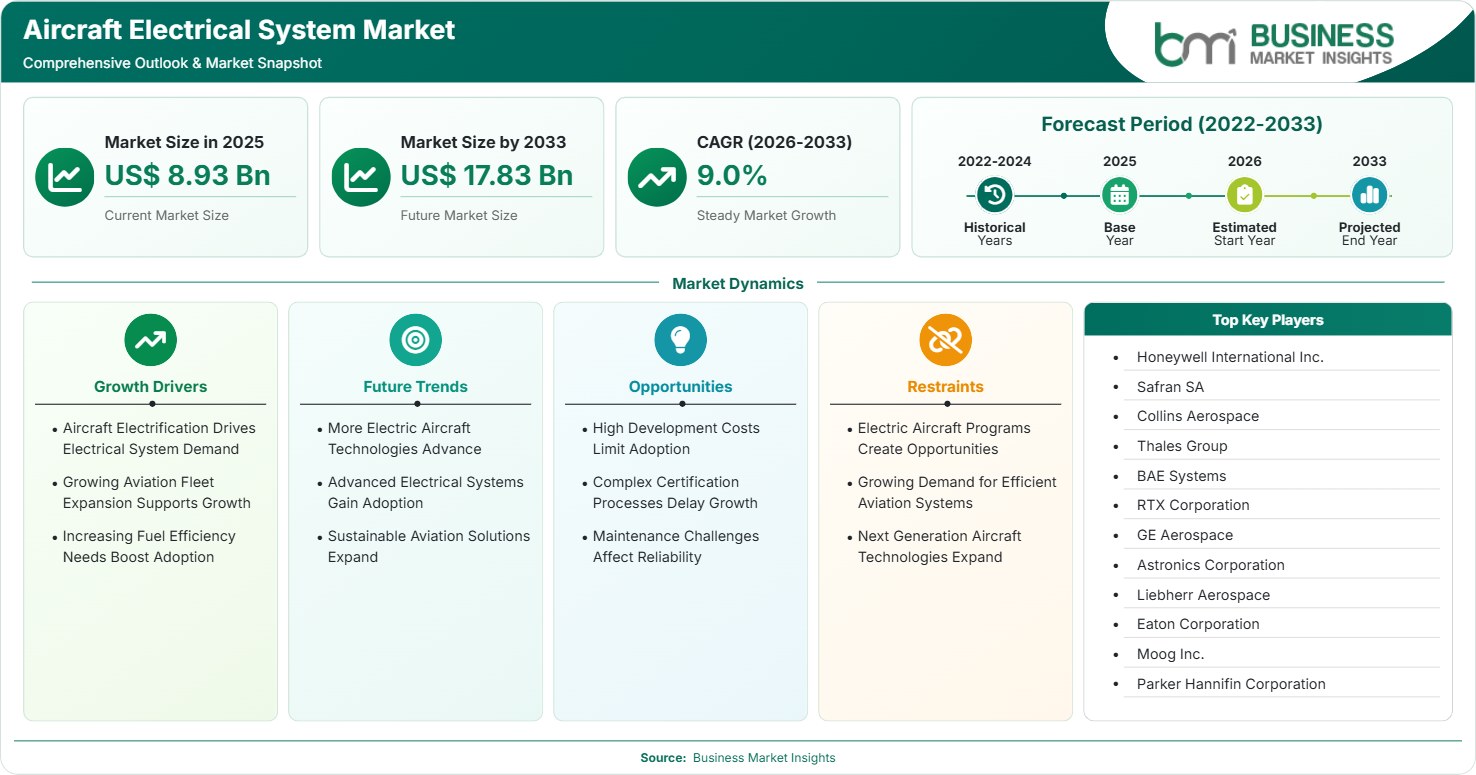
The Aircraft Electrical System Market size was valued at US$ 8.93 billion in 2025 and is projected to reach USD 17.83 billion by 2033, growing at a CAGR of 9.0% during 2026–2033, driven by increasing aircraft electrification, demand for fuel-efficient aviation systems, next-generation aircraft development, and modernization of existing fleets.

Report Coverage
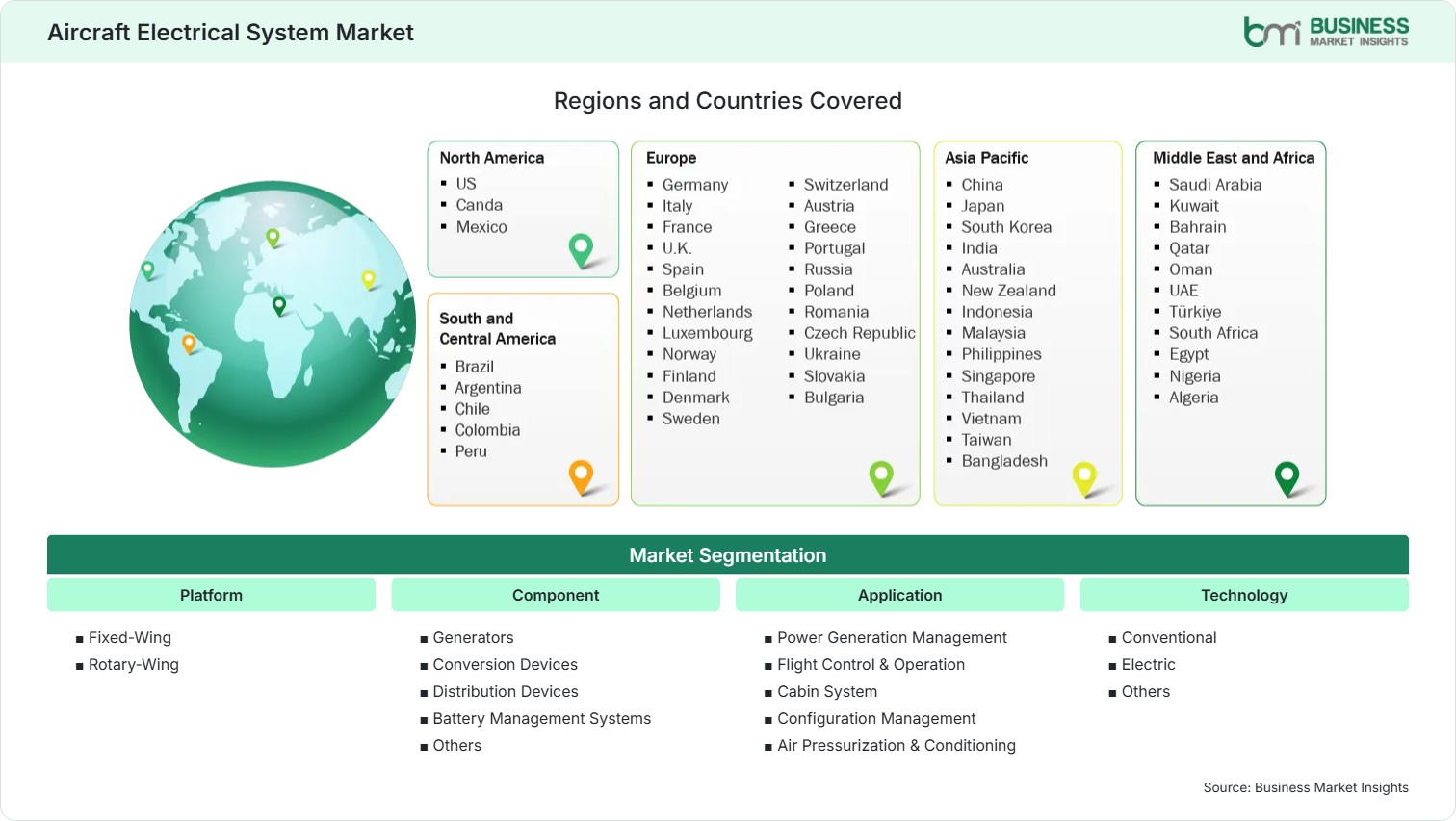
  • Platform: Fixed-Wing, Rotary-Wing
  • Component: Generators, Conversion Devices, Distribution Devices, Battery Management Systems, Others
  • Application: Power Generation Management, Flight Control & Operation, Cabin System, Configuration Management, Air Pressurization & Conditioning
  • Technology: Conventional, Electric, Others
  • End User: OEM, Aftermarket
US$ 8.93 Bn Market size in 2025
US$ 17.83 Bn Market Size by 2033
9.0% CAGR, 2026 - 2033
2026-2033 Forecast Period

01 AI Overview

Aircraft Electrical System Market Summary

  • North America Region: North America holds a market share of 34%–37% in 2025 and is projected to expand at a CAGR of 8.5%–9.2% during 2026–2033, supported by aerospace manufacturing capabilities, aircraft modernization programs, defense investments, and strong presence of aviation system suppliers. The United States leads regional demand with a CAGR of 8.7%–9.4% due to advanced aircraft production.
  • Fastest Growing Region: Asia Pacific accounts for 28%–31% of the global market in 2025 and is expected to grow at a CAGR of 9.5%–10.2% during 2026–2033, driven by fleet expansion, commercial aviation growth, airport infrastructure development, increasing aircraft deliveries, and rising aerospace manufacturing investments.
  • Leading Segment: Fixed-Wing platforms hold a market share of 82%–85% in 2025 and are projected to register a CAGR of 8.8%–9.3% during 2026–2033, supported by commercial aircraft production, passenger traffic growth, aircraft upgrades, and increasing adoption of advanced electrical architectures.
  • High Growth Segment: Electric technology represents 15%–18% of market demand in 2025 and is anticipated to expand at a CAGR of 11.5%–12.5% during 2026–2033, supported by aircraft electrification initiatives, hybrid-electric propulsion development, emission reduction targets, and lightweight electrical component innovation.
  • Key Market Opportunity: Increasing aircraft electrification, hybrid-electric aircraft development, advanced power management systems, fleet modernization programs, and demand for efficient aviation technologies create significant opportunities for aircraft electrical system providers.
  • Major Market Players: Honeywell International Inc.; Safran SA; Collins Aerospace; Thales Group; BAE Systems plc; RTX Corporation; GE Aerospace; Astronics Corporation; Liebherr Aerospace; Eaton Corporation plc; Moog Inc.; Parker Hannifin Corporation; Kawasaki Heavy Industries Ltd.; AMETEK Inc.; Meggitt PLC; Rolls-Royce Holdings plc; Leonardo S.p.A.; Woodward Inc.; Crane Aerospace & Electronics; HENSOLDT AG.
02 Strategic Insights

Aircraft Electrical System Market: Strategic Insights

aircraft-electrical-system-market-market-strategic-framework
FREE PDF
Request your free sample
Request free sample
03 Stakeholder View

Key Takeaways

  • The ecosystem includes aircraft manufacturers, electrical component suppliers, avionics providers, defense contractors, maintenance organizations, and technology developers supporting integrated aircraft power solutions.
  • Commercial fixed-wing aircraft and electric technology applications provide significant growth opportunities due to increasing aircraft deliveries, modernization programs, and sustainability-focused aviation strategies.
  • Innovation is shifting toward lightweight electrical components, high-voltage systems, intelligent power distribution, advanced battery technologies, and hybrid-electric propulsion architectures.
  • Asia Pacific presents strong investment potential due to expanding airline fleets, aerospace manufacturing growth, airport development, and increasing aircraft procurement activities.
  • Companies are strengthening market positions through partnerships, aerospace contracts, technology collaborations, and investments in next-generation electrical aviation systems.
  • Growing emphasis on aircraft efficiency and emissions reduction is accelerating demand for advanced electrical systems across commercial, defense, and emerging aviation platforms.
04 Geographic Outlook

Aircraft Electrical System Market Regional Highlights

North America Aircraft Electrical System Market

North America accounts for 34%–37% Aircraft Electrical System Market share in 2025 while expanding at a CAGR of 8.5%–9.2% through 2026–2033. Regional growth is supported by aerospace manufacturing expertise, defense aviation programs, aircraft modernization activities, and strong supplier networks. The United States remains the largest contributor due to commercial aircraft production and advanced aerospace technology development.

  • The United States dominates regional demand through major aircraft manufacturers, defense programs, and aerospace component suppliers.
  • Aerospace companies are investing in advanced electrical architectures for next-generation commercial and military aircraft.
  • Fleet modernization initiatives are increasing demand for upgraded power management and distribution systems.
  • Defense aviation programs are supporting adoption of advanced electrical technologies and mission systems.
  • Research activities in hybrid-electric aviation are encouraging innovation among aerospace technology providers.

US Aircraft Electrical System Market

The United States represents the largest national Aircraft Electrical System market, accounting for 30%–32% of global revenue in 2025 while growing at a CAGR of 8.7%–9.4% during 2026–2033. Strong aerospace manufacturing capabilities, defense investments, aircraft fleet upgrades, and technology innovation continue supporting demand across commercial, military, and emerging electric aviation applications.

  • Commercial aircraft production remains a major demand driver for advanced electrical system components.
  • Defense modernization programs are increasing requirements for reliable aircraft power management solutions.
  • Aerospace suppliers are developing lightweight electrical technologies to improve aircraft efficiency.
  • Electric aircraft research initiatives are supporting future demand for advanced electrical systems.

Europe Aircraft Electrical System Market

Europe contributes 24%–27% of global revenue in 2025 while registering a CAGR of 8.2%–8.9% through 2026–2033. Regional expansion is influenced by aircraft manufacturing expertise, sustainability regulations, aerospace innovation, and investments in low-emission aviation technologies. France, Germany, and the United Kingdom remain leading markets, while Spain demonstrates increasing aerospace development activity.

  • France leads regional growth through aerospace manufacturing capabilities and aircraft technology innovation.
  • Germany supports Aircraft Electrical System market expansion through aviation engineering expertise and component manufacturing.
  • The United Kingdom is investing in sustainable aviation and electric aircraft research programs.
  • Spain demonstrates growth with a CAGR of 9.0%–9.8% supported by aerospace production activities.
  • European aviation sustainability goals are encouraging adoption of efficient electrical systems.

Asia Pacific Aircraft Electrical System Market

Asia Pacific represents 28%–31% of global revenue in 2025 and records the fastest CAGR of 9.5%–10.2% during 2026–2033. Regional growth is driven by expanding airline fleets, increasing passenger traffic, aircraft manufacturing development, and aviation infrastructure investments. China leads regional demand, while India and Southeast Asian markets demonstrate strong future potential.

  • China dominates regional adoption through aircraft manufacturing expansion and commercial aviation growth.
  • India is expected to grow at a CAGR of 10.5%–11.5% due to airline fleet expansion and aerospace investment.
  • Japan and South Korea are advancing aircraft electrical technology through engineering capabilities.
  • Southeast Asian airlines are increasing aircraft procurement to support regional connectivity.
  • Government aviation initiatives are strengthening aerospace manufacturing ecosystems across the region.

Rest of World Aircraft Electrical System Market

The Rest of World region accounts for 8%–11% of global revenue in 2025 while expanding at a CAGR of 8.0%–8.8% through 2026–2033. Latin America and Middle Eastern markets are supported by airline fleet expansion, aircraft modernization, defense aviation requirements, and increasing aviation infrastructure investments. Growth remains concentrated in countries developing commercial and aerospace capabilities.

  • Brazil represents the leading Latin American Aircraft Electrical System market, while Mexico records faster growth with a CAGR of 9.2%–10.0% through aerospace manufacturing expansion.
  • Middle Eastern airlines are investing in fleet modernization and advanced aircraft technologies.
  • Defense aviation requirements are increasing demand for reliable electrical systems.
  • Regional aircraft operators are upgrading existing fleets with improved electrical components.
  • Aerospace partnerships are supporting technology transfer and local aviation development.
global-market-geography
FREE PDF
Request your free sample
Request free sample
05 Segment Analysis

Aircraft Electrical System Market Segmentation

Platform

Platform segmentation highlights the deployment of electrical systems across different aircraft categories, including fixed-wing and rotary-wing platforms. The segment represented 100% of Aircraft Electrical System market demand in 2025 and is projected to grow at a CAGR of 9.0% during 2026–2033. Increasing aircraft production, fleet modernization, defense requirements, and adoption of advanced electrical architectures are supporting demand across commercial and military aviation platforms.

  • Fixed-Wing: Fixed-wing platforms dominate demand due to commercial aircraft production, passenger fleet expansion, military aircraft programs, and integration of advanced electrical systems.
  • Rotary-Wing: Rotary-wing platforms are adopting advanced electrical solutions through helicopter modernization, defense applications, mission system upgrades, and improved operational efficiency requirements.

Component

Component segmentation reflects demand for aircraft electrical system elements required for power generation, conversion, distribution, and management. The segment represented 100% of demand in 2025 and is expected to expand at a CAGR of 9.0% through 2026–2033. Increasing aircraft electrification, digital aircraft architectures, and reliability requirements are encouraging adoption of advanced electrical components.

  • Generators: Generators support aircraft power generation requirements through efficient energy conversion solutions for commercial and military aircraft operations.
  • Conversion Devices: Conversion devices enable effective voltage management and power optimization across modern aircraft electrical architectures.
  • Distribution Devices: Distribution devices improve aircraft power management through reliable electricity routing, monitoring, and protection systems.
  • Battery Management Systems: Battery management systems support energy storage optimization, safety monitoring, and electric aircraft development initiatives.

Application

Application segmentation demonstrates the growing use of aircraft electrical systems across power management, operational controls, cabin functions, and environmental systems. The segment accounted for 100% of market demand in 2025 and is forecasted to grow at a CAGR of 9.0% through 2026–2033. Increasing aircraft automation and electrification are supporting broader application adoption.

  • Power Generation Management: Power generation management systems improve energy efficiency, reliability, and control across advanced aircraft electrical networks.
  • Flight Control & Operation: Electrical systems support flight control functions through advanced actuation, monitoring, and operational technologies.
  • Cabin System: Cabin systems utilize electrical solutions for passenger comfort, entertainment, lighting, and onboard operational requirements.
  • Configuration Management: Configuration management systems improve aircraft monitoring, control, and integration of multiple electrical functions.
  • Air Pressurization & Conditioning: Electrical solutions support efficient environmental control systems for improved passenger comfort and aircraft performance.

Technology

Technology segmentation reflects the transition from conventional electrical architectures toward advanced electric aviation solutions. The segment represented 100% of market demand in 2025 and is expected to grow at a CAGR of 9.0% during 2026–2033. Aircraft manufacturers are investing in electric technologies to improve efficiency, reduce emissions, and support next-generation aircraft development.

  • Conventional: Conventional technologies remain widely adopted across existing aircraft fleets due to established reliability and maintenance infrastructure.
  • Electric: Electric technologies are gaining adoption through hybrid-electric aircraft programs, advanced propulsion systems, and sustainability-focused aviation initiatives.

End User

End user segmentation includes aircraft manufacturers and aftermarket service providers supporting electrical system installation, maintenance, and upgrades. The segment represented 100% of market demand in 2025 and is projected to expand at a CAGR of 9.0% through 2026–2033. Increasing aircraft deliveries and fleet modernization are strengthening demand across both categories.

  • OEM: OEM demand is supported by new aircraft production, advanced electrical integration, and increasing requirements for efficient aviation systems.
  • Aftermarket: Aftermarket demand is driven by aircraft maintenance, component replacement, fleet upgrades, and modernization of existing aviation systems.
06 Market Forces

Aircraft Electrical System Market Dynamics

Key Market Drivers

Aircraft Electrification Drives Electrical System Demand

Aircraft electrification is becoming a major industry focus as manufacturers seek improved efficiency, reduced emissions, and enhanced aircraft performance. The transition toward more-electric aircraft architectures is increasing demand for advanced generators, power distribution systems, battery management solutions, and electric actuation technologies. Aerospace companies are investing in electrical innovations to replace traditional mechanical and hydraulic systems with efficient alternatives. Hybrid-electric aircraft programs are further accelerating research and development activities across the aviation sector. The increasing adoption of electric technologies in commercial and defense aircraft is strengthening demand for advanced electrical systems capable of supporting future aviation requirements and sustainable mobility objectives.

Growing Aviation Fleet Expansion Supports Growth

Global aviation fleet expansion is increasing demand for reliable aircraft electrical systems across commercial and regional aircraft segments. Rising passenger air travel, airline fleet replacement programs, and aircraft delivery growth are encouraging manufacturers to integrate advanced electrical components into new aircraft platforms. Airlines are investing in modern aircraft equipped with efficient power management systems to improve operational performance and reduce maintenance requirements. Expanding aviation markets in Asia Pacific and emerging economies are creating additional opportunities for electrical system suppliers. The need to support increasing aircraft numbers while maintaining efficiency and reliability is contributing to continued market expansion.

Increasing Fuel Efficiency Needs Boost Adoption

The aviation industry's focus on fuel efficiency is accelerating adoption of lightweight and high-performance electrical systems. Aircraft manufacturers are integrating advanced electrical architectures to reduce weight, optimize energy usage, and improve overall operational efficiency. Efficient power generation and distribution systems contribute to reduced fuel consumption and lower emissions during aircraft operations. Sustainability targets from airlines and regulatory organizations are encouraging investment in technologies that improve aircraft performance. Suppliers are developing innovative components using advanced materials and digital monitoring capabilities to support Aircraft Electrical System Market trends focused on efficiency improvements. These requirements are strengthening demand for next-generation aircraft electrical systems across commercial and defense aviation applications.

Key Market Opportunities

Electric Aircraft Programs Create Opportunities

Electric aircraft programs are creating significant opportunities for electrical system manufacturers by increasing demand for advanced power solutions, energy storage systems, and electric propulsion components. Aerospace companies are developing hybrid-electric and fully electric aircraft concepts to address sustainability goals and reduce aviation emissions. These initiatives require innovative electrical architectures capable of managing higher power requirements and improved efficiency. Collaboration between aircraft manufacturers, technology providers, and energy companies is accelerating development activities. Companies with expertise in high-voltage systems, battery management, and power electronics are positioned to benefit from increasing investments in electric aviation technologies and future aircraft platforms.

Growing Demand for Efficient Aviation Systems

Growing demand for efficient aviation systems is encouraging adoption of advanced electrical technologies that improve aircraft performance and operational reliability. Airlines and aircraft operators are seeking solutions that reduce maintenance requirements, improve energy management, and support cost-effective operations. Electrical systems with enhanced monitoring capabilities and intelligent controls are becoming increasingly important for modern aircraft platforms. Suppliers are developing solutions that enable better power optimization and system integration. The increasing emphasis on sustainable aviation practices and operational efficiency is expected to create Aircraft Electrical System Market opportunities for companies providing advanced electrical components and integrated aircraft power management solutions.

Next Generation Aircraft Technologies Expand

Next-generation aircraft technologies are expanding opportunities for electrical system providers through advancements in autonomous systems, connected aircraft, digital avionics, and hybrid propulsion. Modern aircraft require sophisticated electrical architectures capable of supporting increasing onboard power demands and advanced operational functions. Aerospace companies are investing in technologies that enable improved aircraft connectivity, automation, and energy efficiency. The Aircraft Electrical System Market forecast indicates that the development of new aircraft platforms will continue creating demand for lightweight, reliable, and scalable electrical solutions. The Aircraft Electrical System report highlights that companies developing innovative electrical components and integrated systems can benefit from long-term opportunities created by evolving aviation technology requirements and future aircraft modernization programs.

Market Restraints and Challenges

High Development Costs Limit Adoption

Factor: Aircraft electrical system development requires significant investment in advanced engineering, testing infrastructure, certification procedures, and specialized manufacturing capabilities.

Impact: High development costs can restrict participation among smaller suppliers and increase financial challenges for companies developing next-generation electrical technologies. Extensive research requirements and expensive validation processes increase project timelines and investment requirements. Manufacturers must allocate substantial resources toward reliability testing and compliance activities before commercial deployment. These cost barriers may slow innovation adoption and limit competition within certain technology segments. Companies often require strategic partnerships and long-term investments to successfully develop advanced aircraft electrical systems that meet aviation performance and safety requirements.

Complex Certification Processes Delay Growth

Factor: Aircraft electrical systems must comply with strict aviation safety standards, regulatory requirements, and certification procedures before integration into commercial aircraft.

Impact: Complex certification processes can delay product launches, increase development timelines, and raise operational costs for manufacturers. Regulatory approvals require extensive testing, documentation, and performance validation to ensure aircraft safety and reliability. Differences in certification requirements across regions can create additional challenges for global suppliers. These regulatory complexities may slow adoption of innovative electrical technologies, particularly in emerging electric aircraft applications. Companies must invest in compliance expertise and testing capabilities to successfully navigate certification requirements and accelerate market deployment.

07 Company Analysis

Competitive Landscape

The competitive landscape includes aerospace component manufacturers, aircraft system suppliers, avionics companies, defense technology providers, and aviation electronics specialists competing through advanced power management solutions, aircraft electrification technologies, component innovation, and strategic aerospace partnerships. The Aircraft Electrical System Market analysis highlights that companies are focusing on lightweight electrical architectures, high-efficiency power systems, electric aircraft technologies, and aftermarket modernization solutions to strengthen their position across commercial and defense aviation markets.

Company Name

Overview

Products and Services relevant to this market

Honeywell International Inc.

Aerospace technology company providing aircraft systems and advanced aviation solutions.

Aircraft electrical systems, generators, power management solutions, avionics technologies.

Safran SA

Aerospace company specializing in aircraft systems and propulsion technologies.

Electrical systems, power generation equipment, aircraft components, avionics solutions.

Collins Aerospace

Aerospace systems provider developing advanced aircraft technologies.

Electrical power systems, generators, power distribution, aircraft electrification solutions.

Thales Group

Technology company providing aerospace and defense systems globally.

Aircraft electrical systems, avionics, power management, cockpit solutions.

BAE Systems plc

Defense and aerospace company developing advanced aviation technologies.

Aircraft electrical systems, defense electronics, power management solutions.

RTX Corporation

Aerospace and defense company providing aircraft technologies and systems.

Electrical power systems, aircraft components, aerospace electronics solutions.

GE Aerospace

Aviation company developing aircraft engines and electrical technologies.

Aircraft electrical systems, power generation technologies, aerospace components.

Astronics Corporation

Aerospace electronics company specializing in aircraft electrical solutions.

Aircraft power systems, lighting, electrical test equipment, cockpit electronics.

Liebherr Aerospace

Aerospace supplier producing aircraft systems and components.

Electrical systems, power electronics, aircraft equipment solutions.

Eaton Corporation plc

Power management company serving aerospace and industrial sectors.

Aerospace electrical components, power distribution systems, circuit protection solutions.

Moog Inc.

Aerospace company providing precision control and aircraft systems.

Electrical actuation systems, aircraft controls, power technologies.

Parker Hannifin Corporation

Engineering company providing aerospace motion and control technologies.

Aircraft electrical components, power management systems, aerospace solutions.

Kawasaki Heavy Industries Ltd.

Industrial company manufacturing aerospace and defense products.

Aircraft systems, aerospace components, electrical integration solutions.

AMETEK Inc.

Manufacturer of electronic instruments and aerospace systems.

Aircraft electrical systems, power solutions, monitoring equipment.

Meggitt PLC

Aerospace technology company providing aircraft components and systems.

Electrical systems, sensors, aircraft monitoring solutions.

Rolls-Royce Holdings plc

Aerospace company developing propulsion and aviation technologies.

Electrical power systems, hybrid-electric aviation technologies, aerospace solutions.

Leonardo S.p.A.

Aerospace and defense company providing aircraft technologies.

Aircraft electrical systems, avionics, mission systems, electronics.

Woodward Inc.

Aerospace control systems manufacturer serving aviation markets.

Aircraft power management, electrical controls, energy management systems.

Crane Aerospace & Electronics

Aerospace electronics supplier supporting aircraft manufacturers.

Power supplies, aircraft electronics, electrical components, control systems.

HENSOLDT AG

Defense electronics company developing aerospace technologies.

Aircraft electronics, sensors, avionics systems, electrical integration solutions.

08 Industry Activity

Recent Developments

July, 2026

Rolls-Royce Holdings plc expanded its defence manufacturing capabilities by breaking ground on a major expansion of its Raynesway site in Derby, UK, to increase production capacity for current and future submarine programmes supporting the UK and Australian Royal Navies.

February, 2025

RTX Corporation advanced its aircraft power management technology by successfully testing the Enhanced Power and Cooling System (EPACS), a next-generation power and thermal management system designed to provide increased electrical power and cooling capacity for future defense and commercial aircraft platforms.

February, 2025

Safran SA achieved EASA certification for the ENGINeUS 100 electric motor, becoming the first electric motor certified under EASA’s special conditions for electric and hybrid propulsion systems. The certified motor integrates power and control electronics directly into the motor, supporting next-generation electric and hybrid-electric aircraft architectures.

January, 2025

Honeywell International Inc. expanded its aviation technology partnership with NXP Semiconductors to accelerate next-generation aircraft systems, combining Honeywell’s Anthem avionics platform with NXP’s advanced computing technology to support intelligent aircraft architectures, autonomous flight capabilities, and future electric aviation applications.

10 Trust & Transparency

Research Methodology

The market analysis combines proprietary research with secondary data from government agencies, company disclosures, regulatory filings, industry databases and expert interviews. Market estimates are validated through data triangulation, cross-market benchmarking and analyst review.

View Full Research Methodology

11 Questions Answered

Frequently Asked Questions

Which regions provide strong growth opportunities?

The Aircraft Electrical System Market report highlights that the Asia Pacific region offers strong opportunities due to airline fleet expansion, aircraft manufacturing growth, aviation infrastructure investments, and rising demand for advanced aircraft technologies.

How does aftermarket demand influence this market?

Aftermarket demand is supported by fleet maintenance, component replacement, aircraft upgrades, system modernization, and increasing requirements for reliable aircraft electrical performance.

Why are electric technologies gaining importance in aviation?

Electric technologies support emission reduction goals, improved efficiency, reduced system weight, and development of hybrid-electric and next-generation aircraft platforms.

Which platform segment dominates aircraft electrical system demand?

Fixed-wing aircraft dominate demand due to commercial aviation growth, large aircraft fleets, continuous modernization programs, and integration of advanced electrical architectures.

What factors are driving the Aircraft Electrical System Market?

The market is driven by aircraft electrification, fleet expansion, demand for fuel-efficient aviation systems, modernization programs, hybrid-electric aircraft development, and increasing adoption of advanced power management technologies.

Access the Full Aircraft Electrical System Market Report

Get segment-level forecasts, regional estimates, competitive benchmarking, company profiles and downloadable Excel datasets.

Access the full Aircraft Electrical System Market Report
350 pages PDF & Excel | 2026-07-28