
Aircraft Cooling System Market Outlook: Size, Share, Trends, Growth Analysis, Competitive Landscape & Forecast, 2026-2033

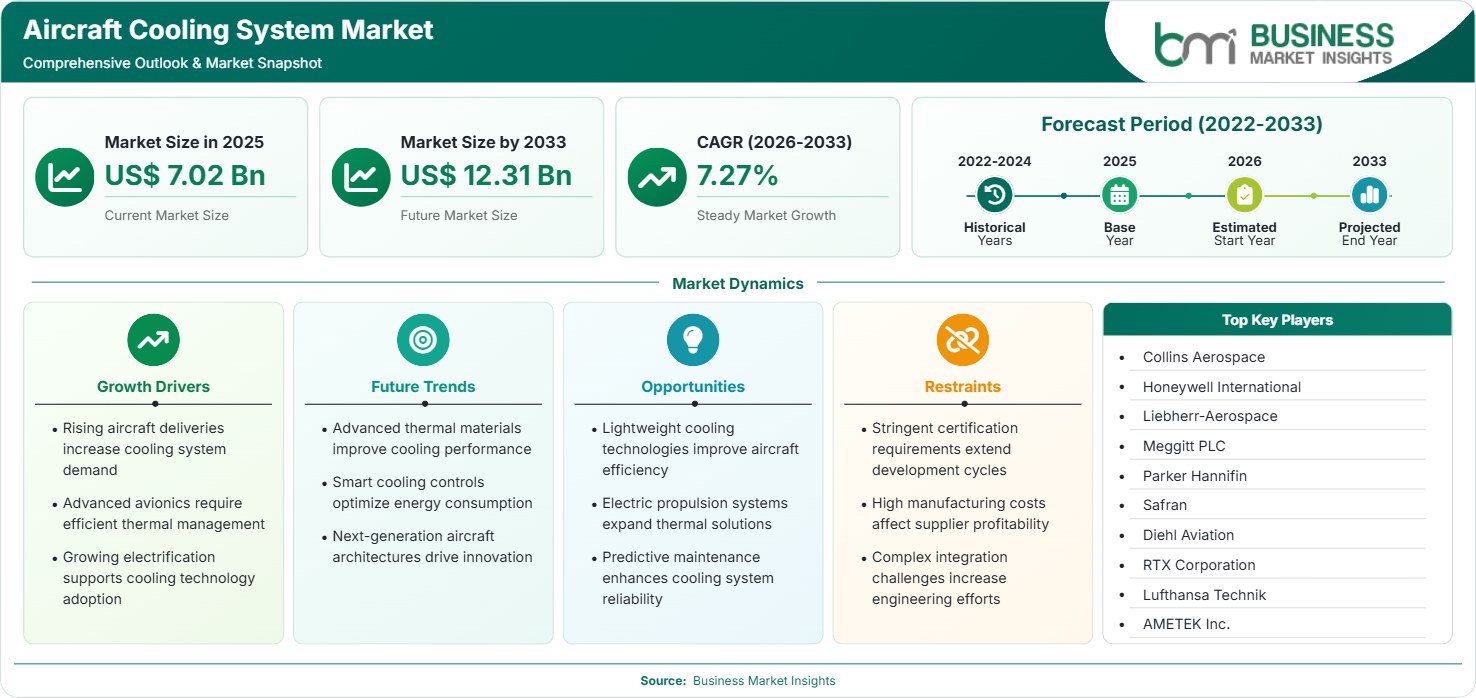
The Aircraft Cooling System Market size was valued at US$ 7.02 billion in 2025 and is projected to reach US$ 12.31 billion by 2033, growing at a CAGR of 7.27% during 2026–2033. Rising aircraft deliveries, increasing electrification of aircraft systems, and growing demand for efficient thermal management technologies continue creating sustained opportunities for cooling system manufacturers worldwide.

Report Coverage
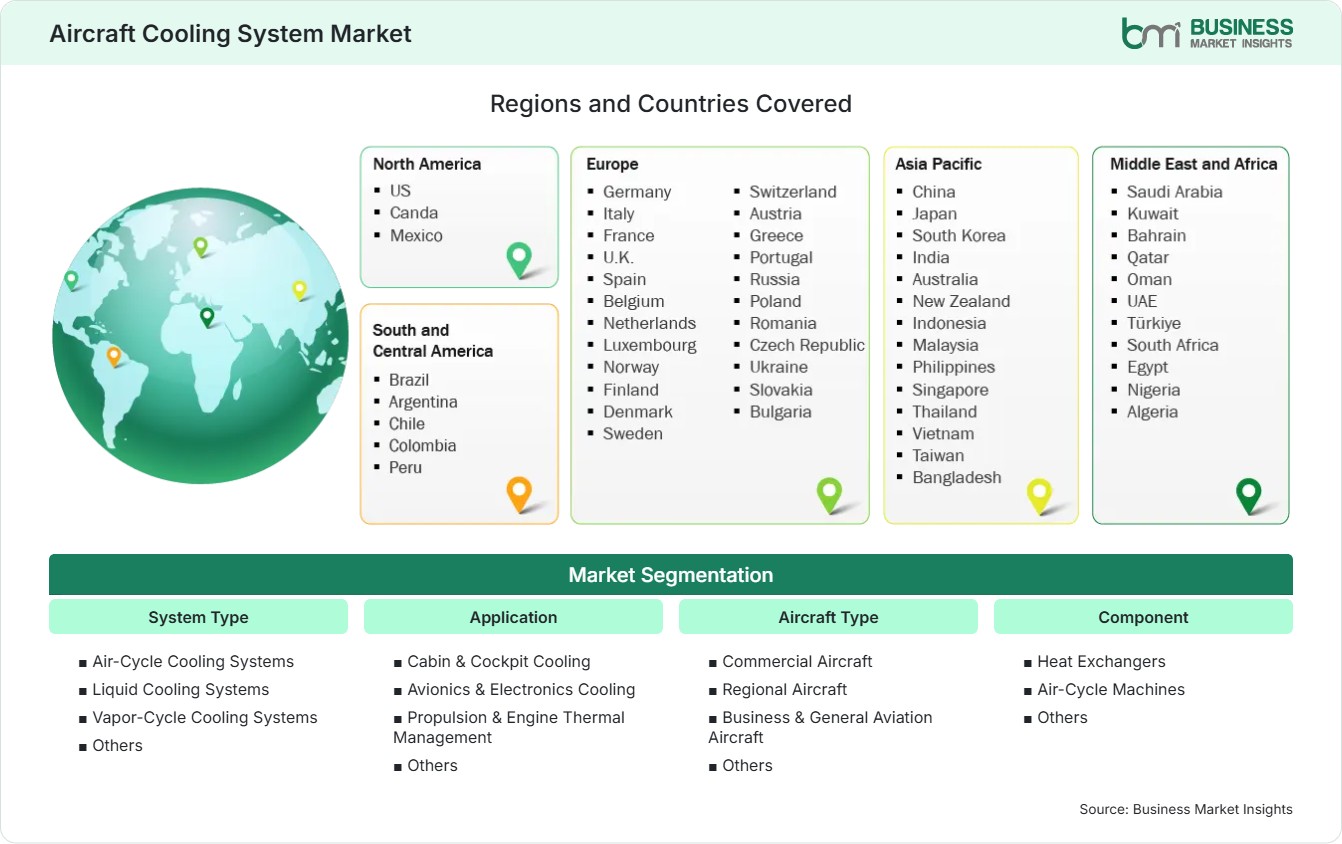
  • System Type: Air-Cycle Cooling Systems, Liquid Cooling Systems, Vapor-Cycle Cooling Systems, Others
  • Application: Cabin & Cockpit Cooling, Avionics & Electronics Cooling, Propulsion & Engine Thermal Management, Others
  • Aircraft Type: Commercial Aircraft, Regional Aircraft, Business & General Aviation Aircraft, Others
  • Component: Heat Exchangers, Air-Cycle Machines, Others
  • End User: OEM Line-Fit, Aftermarket/MRO/Replacement, Others
US$ 7.02 Bn Market size in 2025
US$ 12.31 Bn Market Size by 2033
7.27% CAGR, 2026 - 2033
2026-2033 Forecast Period

AI Overview

Aircraft Cooling System Market Summary

  • North America Region: North America holds 36%–39% market share in 2025 and is projected to expand at a CAGR of 6.9%–7.4% during 2026–2033. Strong aircraft production, defense modernization, and investments in next-generation thermal management technologies continue supporting regional demand. The U.S. remains the largest market with a CAGR of 7.0%–7.5%, supported by major aircraft OEMs, defense spending, and continuous aerospace innovation.
  • Fastest Growing Region: Asia Pacific accounts for 26%–29% market share in 2025 and is expected to register a CAGR of 8.1%–8.7%, driven by commercial fleet expansion, increasing aircraft manufacturing investments, and growing maintenance capabilities.
  • Leading Segment: Commercial Aircraft represents 49%–52% market share in 2025 and is projected to grow at a CAGR of 7.3%–7.8%, supported by fleet modernization, higher aircraft production, and increasing passenger traffic.
  • High Growth Segment: Avionics & Electronics Cooling captures 30%–33% market share in 2025 and is anticipated to expand at a CAGR of 8.0%–8.5%, driven by growing integration of advanced electronic systems and digital flight technologies.
  • Key Market Opportunity: Increasing development of electric aircraft, lightweight thermal management technologies, and predictive maintenance platforms continues generating long-term opportunities for aircraft cooling system suppliers.
  • Major Market Players: Collins Aerospace, Honeywell International Inc., Liebherr-Aerospace, Meggitt PLC, Parker Hannifin Corporation, Safran S.A., Diehl Aviation, RTX Corporation, Lufthansa Technik AG, and AMETEK, Inc.
Strategic Insights

Aircraft Cooling System Market: Strategic Insights

Aircraft Cooling System Market Strategic Framework
FREE PDF
Request your free sample
Request free sample
Stakeholder View

Key Takeaways

  • Commercial aircraft production continues driving demand across the value chain, encouraging suppliers to expand manufacturing capacity and strengthen long-term partnerships with major aircraft manufacturers.
  • Electrification of aircraft systems is increasing demand for advanced thermal management technologies capable of protecting high-performance electronic equipment and improving operational reliability.
  • Research investments in lightweight cooling materials, compact heat exchangers, and intelligent monitoring systems continue accelerating product innovation throughout the aerospace sector.
  • Asia Pacific offers the strongest long-term investment opportunity due to expanding airline fleets, indigenous aircraft programs, and increasing aerospace manufacturing capabilities.
  • Strategic collaborations between OEMs, Tier-1 suppliers, and MRO providers are improving product development, lifecycle support, and aftermarket service capabilities.
  • Digital diagnostics and predictive maintenance technologies are helping operators reduce downtime while improving cooling system efficiency and long-term operational performance.
Geographic Outlook

Aircraft Cooling System Market Regional Highlights

North America Aircraft Cooling System Market

North America accounts for 36%–39% Aircraft Cooling System Market share in 2025 and is projected to grow at a CAGR of 6.9%–7.4% during 2026–2033. The region benefits from extensive commercial aircraft production, defense modernization programs, strong aerospace research capabilities, and advanced component manufacturing. Continuous investment in next-generation aircraft platforms and thermal management technologies supports sustained demand across commercial and military aviation.

  • Major aircraft OEMs continue investing in advanced thermal management systems for future commercial aircraft programs.
  • Defense modernization initiatives support demand for high-performance cooling technologies in military aviation platforms.
  • Increasing aircraft deliveries strengthen production requirements for integrated thermal management components.
  • Growing emphasis on fuel efficiency encourages development of lightweight cooling system technologies.

US Aircraft Cooling System Market

The United States contributes 84%–87% of North American revenue and is expected to register a CAGR of 7.0%–7.5% throughout the forecast period. Strong aerospace manufacturing capabilities, defense procurement, and continued investments in commercial aviation innovation support long-term industry expansion.

  • Advanced avionics integration increases demand for efficient electronic cooling solutions.
  • Expansion of aircraft production programs strengthens supplier opportunities across thermal management systems.
  • Defense aircraft modernization supports adoption of advanced propulsion cooling technologies.
  • Digital maintenance technologies improve cooling system reliability and lifecycle management.

Europe Aircraft Cooling System Market

Europe represents 28%–31% aircraft cooling system market share in 2025 and is expected to expand at a CAGR of 6.8%–7.3% during the forecast period. Strong aerospace manufacturing capabilities, sustainability initiatives, and continued aircraft technology development support regional growth. France remains the leading regional market, while Germany records the fastest growth due to increasing aerospace investments and advanced engineering capabilities.

  • Aircraft manufacturers continue developing lightweight thermal management technologies for next-generation aircraft.
  • Growing investments in sustainable aviation support innovation in energy-efficient cooling systems.
  • Expansion of aerospace supply chains strengthens component manufacturing across the region.
  • MRO providers continue increasing adoption of predictive maintenance solutions for cooling systems.

Asia Pacific Aircraft Cooling System Market

Asia Pacific holds 26%–29% aircraft cooling system market share in 2025 and is projected to record the fastest 8.1%–8.7% CAGR through 2026–2033. Expanding airline fleets, growing domestic aircraft manufacturing, and increasing defense procurement continue supporting regional demand. China remains the largest regional market, while India is expected to record the fastest growth owing to rapid aviation infrastructure development and aerospace manufacturing investments.

  • Fleet expansion by regional airlines increases demand for advanced aircraft cooling technologies.
  • Indigenous aircraft manufacturing programs strengthen domestic supplier opportunities.
  • Government investments support aerospace production and component localization initiatives.
  • Expanding MRO infrastructure creates additional aftermarket demand for cooling system components.

Rest of World Aircraft Cooling System Market

The Rest of World region accounts for 7%–10% market share in 2025 and is anticipated to expand at a CAGR of 7.2%–7.8% during 2026–2033. Growing aviation investments across Latin America, the Middle East, and Africa continue supporting demand for advanced aircraft thermal management systems and aftermarket maintenance services.

  • The UAE continues strengthening its aerospace maintenance and aircraft servicing capabilities.
  • Brazil supports regional demand through commercial aircraft manufacturing and aviation exports.
  • Expanding airline operations increase requirements for efficient aircraft thermal management systems.
  • Continued airport infrastructure development supports long-term commercial aviation growth.
Global Market Geography
FREE PDF
Request your free sample
Request free sample
Segment Analysis

Aircraft Cooling System Market Segmentation

System Type

  • System type remains a key differentiator as aircraft manufacturers select cooling technologies based on thermal efficiency, aircraft architecture, weight, and operational performance. The segment accounted for 35%–38% market share in 2025 and is expected to register a CAGR of 7.3%–7.8% during 2026–2033. Continuous advancements in lightweight thermal management technologies and improved energy efficiency continue expanding the Aircraft Cooling System Market scope across commercial, military, and business aviation platforms.
  • Air-Cycle Cooling Systems: Widely adopted in commercial aircraft because they provide reliable cabin cooling, lower maintenance requirements, and efficient operation by utilizing compressed engine bleed air.
  • Liquid Cooling Systems: Demand continues increasing with the growing use of high-power avionics, electric aircraft subsystems, radar equipment, and advanced electronic components requiring superior heat dissipation.
  • Vapor-Cycle Cooling Systems: Preferred for applications requiring precise temperature control, particularly in avionics bays, specialized mission equipment, and selected cabin cooling configurations with enhanced efficiency.

Application

Application-specific thermal management requirements continue driving technology development as modern aircraft integrate increasingly sophisticated electronic systems. This segment represented 30%–33% market share in 2025 and is projected to expand at a CAGR of 8.0%–8.5% during 2026–2033. Recent Aircraft Cooling System Market trends indicate growing investment in intelligent cooling technologies that improve operational efficiency, component reliability, and aircraft safety.

  • Cabin & Cockpit Cooling: Supports passenger comfort and pilot operating conditions through advanced environmental control systems capable of maintaining consistent cabin temperatures under varying flight conditions.
  • Avionics & Electronics Cooling: Experiences strong adoption because modern aircraft increasingly depend on advanced electronic systems, flight computers, communication equipment, navigation systems, and radar technologies requiring continuous thermal management.
  • Propulsion & Engine Thermal Management: Ensures optimal engine operating temperatures, improves fuel efficiency, protects propulsion components, and enhances long-term operational reliability under demanding flight environments.

Aircraft Type

Aircraft type significantly influences cooling system design because thermal management requirements vary according to aircraft size, mission profile, onboard electronics, and propulsion architecture. The segment accounted for 49%–52% market share in 2025 and is forecast to grow at a CAGR of 7.3%–7.8% during 2026–2033. Expanding global aircraft deliveries and modernization programs continue supporting demand for advanced cooling technologies across multiple aviation categories.

  • Commercial Aircraft: Represents the largest share owing to rising passenger traffic, fleet expansion, higher production rates, and increasing integration of advanced avionics and electrical systems.
  • Regional Aircraft: Benefits from fleet renewal programs and growing regional air connectivity, creating demand for compact, reliable, and energy-efficient thermal management solutions.
  • Business & General Aviation Aircraft: Adoption is supported by increasing deliveries of business jets and private aircraft incorporating sophisticated cabin electronics and advanced cockpit technologies.

Component

Component innovation remains essential as manufacturers focus on improving thermal efficiency, reducing weight, and enhancing system reliability. This segment captured 38%–41% market share in 2025 and is anticipated to register a CAGR of 7.4%–7.9% during 2026–2033. Continuous advancements in compact heat transfer technologies and high-performance materials are strengthening product capabilities across commercial and military aircraft platforms.

  • Heat Exchangers & Pre-Coolers: Account for substantial demand by efficiently transferring heat from aircraft systems while improving cooling performance and supporting fuel-efficient aircraft operation.
  • Air-Cycle Machines: Continue serving environmental control systems by delivering reliable cabin cooling, ventilation, and temperature regulation while maintaining low maintenance requirements and operational efficiency.

End User

Demand differs across OEM production and aftermarket services as airlines seek reliable cooling system performance throughout the aircraft lifecycle. The segment accounted for 61%–64% market share in 2025 and is projected to grow at a CAGR of 7.2%–7.7% during 2026–2033. Increasing aircraft deliveries and expanding global maintenance networks continue supporting long-term demand for advanced aircraft cooling components and replacement systems.

  • OEM Line-Fit: Maintains the largest share as aircraft manufacturers integrate advanced cooling technologies during production to improve operational efficiency, reliability, and compliance with aviation standards.
  • Aftermarket/MRO/Replacement: Continues expanding through rising aircraft utilization, aging fleets, scheduled maintenance activities, component upgrades, and predictive maintenance programs supporting long-term aircraft performance.
Market Forces

Aircraft Cooling System Market Dynamics

Key Market Drivers

Rising aircraft deliveries increase cooling system demand

Global aircraft production continues to recover as airlines expand fleets to meet rising passenger traffic and replace aging aircraft with more fuel-efficient models. All aircraft require thermal management systems, which are designed to provide ideal conditions for all equipment inside the aircraft throughout its operation. The increase in orders for commercial and defense aircraft is generating sustained demand for cooling technology. At the same time, manufacturers are working on developing lightweight cooling technology that will help to improve efficiency of the aircraft.

Advanced avionics require efficient thermal management

Modern aircraft incorporate increasingly sophisticated avionics, flight control computers, communication equipment, radar systems, and navigation technologies that generate significant amounts of heat during operation. Cooling systems are crucial for ensuring the reliability of components, reduction in degradation of performance, and avoidance of overheating. With the ongoing development of digital cockpit technologies, aircraft manufacturers have begun using efficient cooling systems capable of supporting high electrical loads. The development of technology is prompting suppliers to come up with advanced cooling systems.

Growing electrification supports cooling technology adoption

The aviation industry's transition toward more-electric aircraft is increasing demand for advanced thermal management systems capable of handling higher electrical loads and improving system efficiency. Components of electrified propulsion, power electronics, batteries, and electric actuation require highly efficient cooling technologies to ensure stable performance under varying operating conditions. Innovative cooling technologies that will be energy-efficient and effective at dissipating heat keep attracting investment by manufacturers. This is facilitating technological innovations and creating good conditions for the global market.

Key Market Opportunities

Lightweight cooling technologies improve aircraft efficiency

Electrification of propulsion, power electronics, battery technology, and electric actuation demand cooling systems that should have maximum efficiency to ensure stable operation under various conditions of use. Energy-efficient and effective new cooling technologies continue to receive investments from manufacturers. It promotes technological innovation and helps create favorable conditions for the global market. Aircraft Cooling System Market Forecasts indicate that continuous investment in lightweight thermal management technologies will create attractive opportunities for component suppliers and aircraft manufacturers over the coming years.

Electric propulsion systems expand thermal solutions

Growing research into hybrid-electric and fully electric aircraft is creating new opportunities for advanced cooling technologies to manage battery systems, electric motors, and high-power electronics. The aircraft design of the future will need thermal management systems that ensure optimum operating temperature levels and energy efficiency. Manufacturers of cooling technology for electric propulsion systems are likely to increase their competitiveness as future aviation projects advance towards commercialization.

Predictive maintenance enhances cooling system reliability

Digital monitoring platforms and predictive maintenance technologies are transforming aircraft maintenance by enabling early identification of cooling system performance issues before failures occur. Airlines and maintenance providers are increasingly adopting condition-based maintenance strategies that reduce unscheduled downtime, improve fleet availability, and optimize maintenance planning. Integration of sensors, digital diagnostics, and real-time performance analytics is expected to accelerate throughout the forecast period, creating new business opportunities for thermal management solution providers.

Market Restraints and Challenges

Stringent certification requirements extend development cycles

Aircraft cooling systems must comply with rigorous aviation certification standards before installation on commercial or military aircraft. Factor: Extensive testing, validation, documentation, and regulatory approval processes increase product development timelines and engineering complexity. Impact: Longer certification periods delay product commercialization, increase research and development expenditure, and slow the introduction of innovative thermal management technologies, particularly for smaller suppliers with limited certification resources.

High manufacturing costs affect supplier profitability

Aircraft cooling systems require precision engineering, advanced materials, specialized manufacturing processes, and strict quality control throughout production. Factor: High production costs associated with aerospace-grade components, specialized alloys, and advanced manufacturing technologies increase overall operating expenses for suppliers. Impact: Narrow profit margins and rising production costs may limit investment capacity, reduce pricing flexibility, and create challenges for manufacturers competing in cost-sensitive aerospace procurement programs.

Company Analysis

Competitive Landscape

The competitive environment is shaped by continuous product innovation, aircraft program participation, strategic supplier agreements, and investments in lightweight thermal management technologies. Aircraft Cooling System Market analysis indicates that leading companies are expanding engineering capabilities, strengthening aftermarket service networks, and developing advanced cooling solutions for next-generation commercial, military, and electric aircraft platforms.

Company Name

Overview

Products and Services Relevant to this Market

Collins Aerospace

Global aerospace technology company providing integrated aircraft systems for commercial, military, and business aviation markets.

Aircraft environmental control systems, heat exchangers, air-cycle machines, thermal management systems, aftermarket support, and engineering services.

Honeywell International Inc.

Leading aerospace supplier specializing in aircraft systems, avionics, propulsion technologies, and environmental control solutions.

Cabin cooling systems, avionics cooling solutions, thermal management technologies, environmental control systems, and maintenance services.

Liebherr-Aerospace

Aerospace systems manufacturer supplying integrated aircraft equipment to leading commercial and defense aircraft manufacturers.

Air management systems, heat exchangers, cabin cooling equipment, thermal management solutions, and aircraft system components.

Meggitt PLC

International aerospace engineering company focused on high-performance aircraft components and thermal management technologies.

Heat exchangers, cooling systems, engine thermal management products, aerospace components, and aftermarket support solutions.

Parker Hannifin Corporation

Motion and control technology company delivering aerospace fluid, fuel, and thermal management solutions.

Aircraft cooling systems, thermal control equipment, fluid management systems, heat exchangers, and aerospace engineering services.

Safran S.A.

Global aerospace group supplying aircraft propulsion, equipment, and cabin system technologies worldwide.

Environmental control systems, cooling technologies, aircraft equipment, thermal management products, and integrated aerospace solutions.

Diehl Aviation

Aircraft systems supplier specializing in cabin solutions, avionics integration, and environmental technologies.

Cabin environmental systems, cooling components, thermal management equipment, aircraft interiors, and engineering support services.

RTX Corporation

Aerospace and defense technology company delivering advanced aircraft systems through its global business portfolio.

Thermal management systems, aircraft cooling technologies, aerospace components, defense aviation solutions, and integrated engineering services.

Lufthansa Technik AG

Global MRO provider supporting airlines with aircraft maintenance, repair, overhaul, and technical services.

Aircraft cooling system maintenance, component repair, thermal system upgrades, engineering services, and fleet lifecycle support.

AMETEK, Inc.

Manufacturer of electronic instruments and aerospace components supporting commercial and defense aviation applications.

Aerospace heat exchangers, cooling components, thermal management equipment, precision engineering products, and aftermarket services.

Trust & Transparency

Research Methodology

The market analysis combines proprietary research with secondary data from government agencies, company disclosures, regulatory filings, industry databases and expert interviews. Market estimates are validated through data triangulation, cross-market benchmarking and analyst review.

View Full Research Methodology

Questions Answered

Frequently Asked Questions

What does the Aircraft Cooling System Market Report cover?

The Market Report provides detailed insights into market size, competitive landscape, regional outlook, technology developments, segmentation, investment opportunities, growth drivers, challenges, and future industry prospects.

Which region is expected to experience the fastest growth?

Asia Pacific is projected to record the highest growth owing to expanding airline fleets, indigenous aircraft manufacturing programs, increasing defense procurement, and growing investments in aerospace production infrastructure.

Why is thermal management becoming increasingly important in aviation?

Modern aircraft contain high-density electronic systems, flight computers, communication equipment, and electric subsystems that require effective cooling to maintain operational reliability, improve safety, and enhance component lifespan.

Which aircraft category dominates market demand?

Commercial aircraft account for the largest demand because of continuous fleet expansion, rising passenger traffic, increasing aircraft production rates, and widespread adoption of sophisticated onboard electronic systems requiring advanced cooling technologies.

What is driving demand in the Aircraft Cooling System Market?

Growing aircraft deliveries, increasing aircraft electrification, advanced avionics integration, fleet modernization programs, and rising investments in efficient thermal management technologies are supporting long-term market expansion across commercial and defense aviation.

Access the Full Aircraft Cooling System Market Report

Get segment-level forecasts, regional estimates, competitive benchmarking, company profiles and downloadable Excel datasets.

Access the full Aircraft Cooling System Market Report
350 pages PDF & Excel | 2026-08-21
Similar Research

Related Market Reports