
Aircraft Carrier Market Outlook: Size, Share, Trends, Growth Analysis, Competitive Landscape & Forecast, 2026-2033

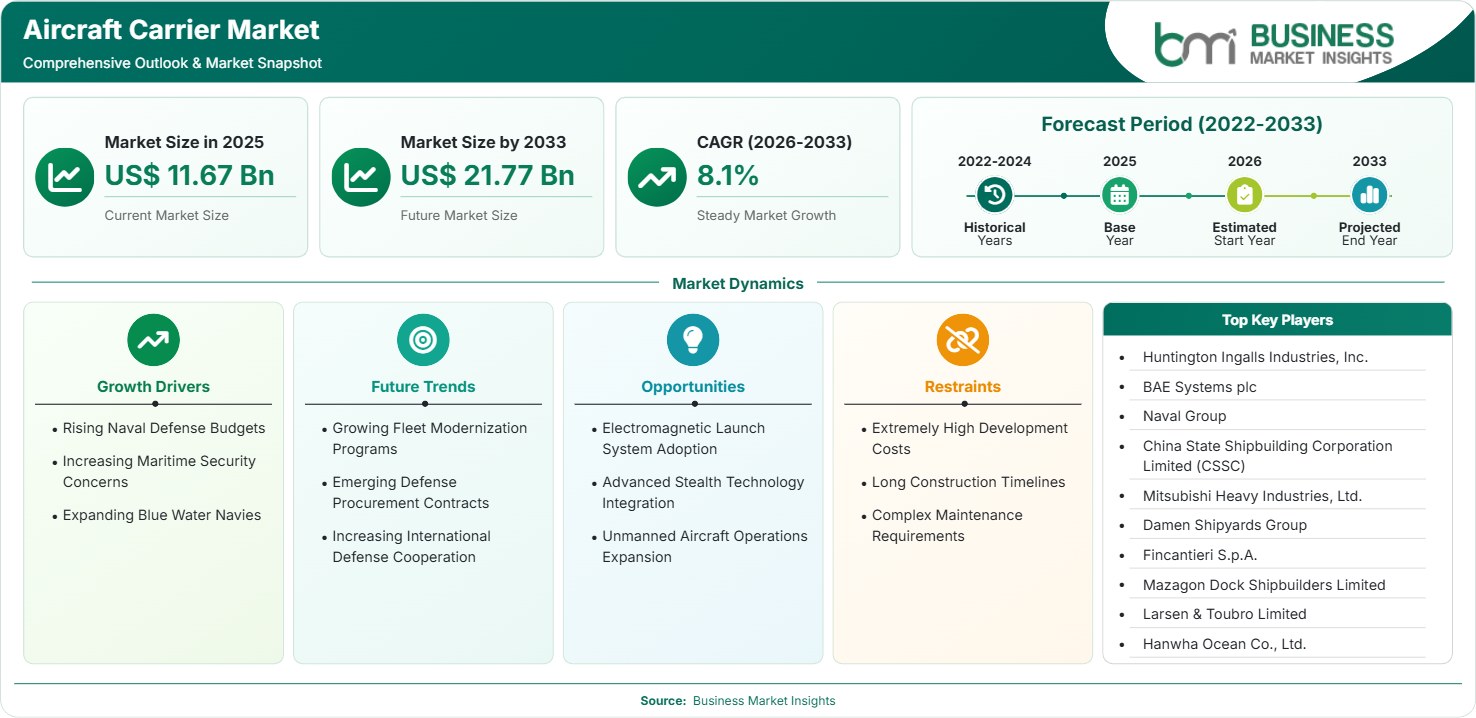
The Aircraft Carrier Market size was valued at US$ 11.67 Billion in 2025 and is projected to reach US$ 21.77 Billion by 2033, growing at a CAGR of 8.1% during 2026–2033. Increasing naval modernization programs, maritime security requirements, and expansion of blue water naval capabilities are driving demand, while advanced launch systems, stealth technologies, and unmanned aircraft integration create new opportunities.

Report Coverage
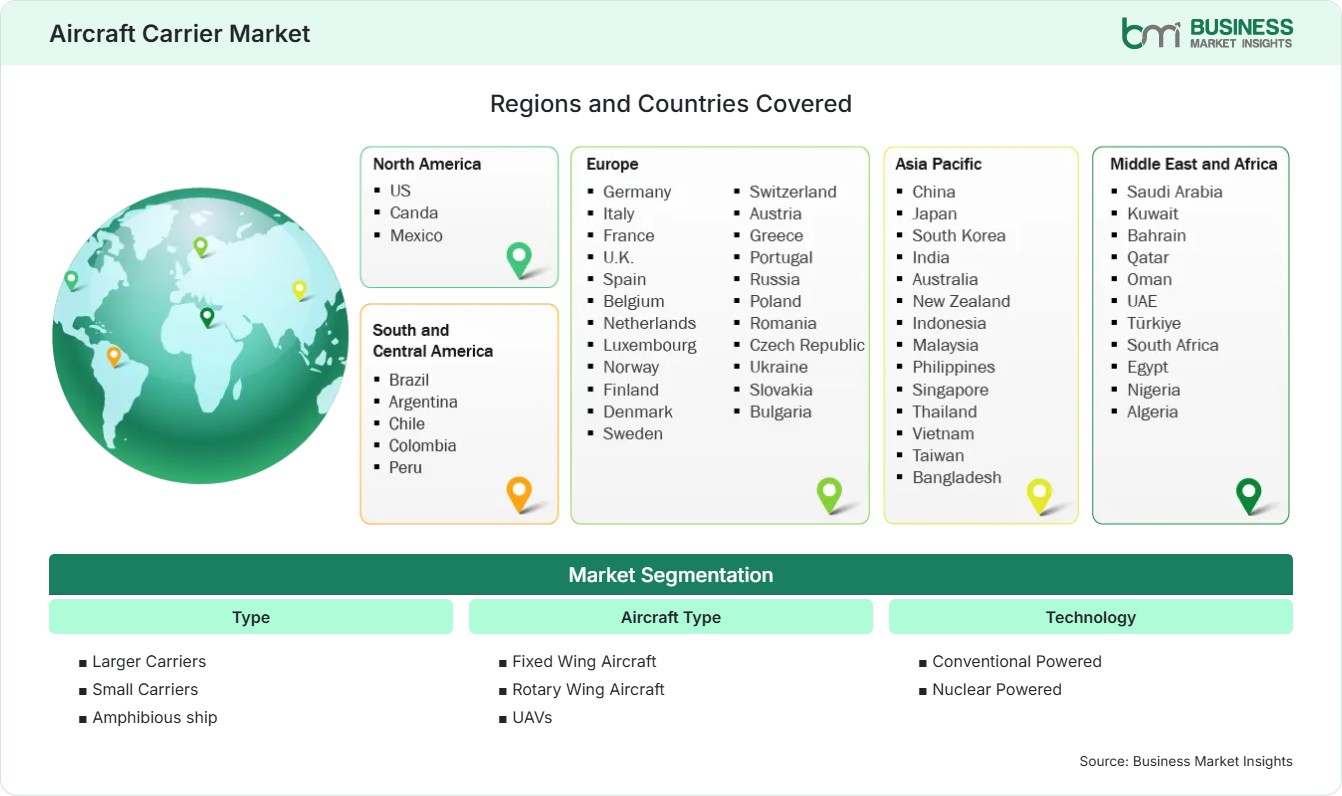
  • Type: Larger Carriers, Small Carriers, Amphibious ship
  • Aircraft Type: Fixed Wing Aircraft, Rotary Wing Aircraft, UAVs
  • Technology: Conventional Powered, Nuclear Powered
US$ 11.67 Bn Market size in 2025
US$ 21.77 Bn Market Size by 2033
8.1% CAGR, 2026 - 2033
2026-2033 Forecast Period

01 AI Overview

Aircraft Carrier Market Summary

  • North America Region: North America holds a market share of 32%–36% in 2025, growing at a CAGR of 7.5%–8.0% during 2026–2033. Regional growth is supported by naval fleet modernization, defense spending, advanced carrier programs, and strategic maritime operations. The U.S. market dominates through aircraft carrier procurement, nuclear-powered carrier programs, and fleet sustainment activities, growing at a CAGR of 7.6%–8.1%.
  • Fastest Growing Region: Asia Pacific represents 34%–38% share in 2025 and is projected to grow at a CAGR of 8.5%–9.0% during 2026–2033. Growth is driven by naval expansion programs, maritime security concerns, regional power competition, domestic shipbuilding capabilities, and increasing investment in advanced naval platforms.
  • Leading Segment: Larger Carriers account for 52%–56% share in 2025, expanding at a CAGR of 7.8%–8.3%. Their dominance is supported by long-range power projection capabilities, advanced aircraft deployment capacity, and strategic importance for major naval forces.
  • High Growth Segment: UAVs represent 12%–16% share in 2025 and are expected to grow at a CAGR of 10.0%–10.8%. Increasing adoption of unmanned systems for surveillance, reconnaissance, and combat missions is accelerating segment growth.
  • Key Market Opportunity: Integration of electromagnetic launch systems, stealth technologies, artificial intelligence, and unmanned aircraft operations is creating opportunities for next-generation aircraft carrier development and modernization programs.
  • Major Market Players: Huntington Ingalls Industries, Inc., BAE Systems plc, Naval Group, China State Shipbuilding Corporation Limited, Mitsubishi Heavy Industries, Ltd., Damen Shipyards Group, Fincantieri S.p.A., Mazagon Dock Shipbuilders Limited, Larsen & Toubro Limited, and Hanwha Ocean Co., Ltd.
02 Strategic Insights

Aircraft Carrier Market: Strategic Insights

Aircraft Carrier Market Strategic Framework
FREE PDF
Request your free sample
Request free sample
03 Stakeholder View

Key Takeaways

  • Aircraft carriers remain strategic naval assets. Countries with blue water naval ambitions continue investing in carrier programs to strengthen maritime influence, enhance power projection capabilities, and support extended operations across international waters.
  • Modernization programs are driving aftermarket demand. Existing fleets require upgrades involving propulsion systems, aircraft handling equipment, electronic warfare capabilities, and advanced combat systems to maintain operational effectiveness.
  • Unmanned technologies are reshaping carrier operations. Naval forces are increasingly exploring UAV integration for surveillance, reconnaissance, and future combat missions, creating demand for carrier-compatible unmanned platforms.
  • Asia Pacific presents strong growth potential. Regional naval expansion, maritime security priorities, and domestic defense manufacturing initiatives are increasing investment in aircraft carrier development programs.
  • Defense partnerships are influencing market strategies. International collaborations, technology transfers, and indigenous production programs are shaping competitive positioning among shipbuilders and defense contractors.
  • Lifecycle support is becoming increasingly important. Operators are focusing on long-term maintenance, modernization, and upgrade programs to maximize carrier operational life and reduce replacement requirements.
04 Geographic Outlook

Aircraft Carrier Market Regional Highlights

North America Aircraft Carrier Market

North America accounted for 32%–36% of the global Market in 2025 and is projected to grow at a 7.5%–8.0% CAGR during 2026–2033. Regional leadership is supported by advanced naval capabilities, large defense budgets, nuclear-powered carrier fleets, and continuous modernization programs. The Aircraft Carrier Market share remains significant due to strong U.S. Navy investments, advanced shipbuilding infrastructure, and strategic maritime requirements.

  • The United States dominates regional demand through aircraft carrier procurement, fleet upgrades, and naval modernization initiatives.
  • Canada maintains limited carrier activity but supports regional maritime security through naval capability development programs.
  • Defense contractors are investing in advanced technologies to improve carrier efficiency, survivability, and operational performance.
  • Nuclear-powered carrier maintenance and modernization programs continue generating long-term demand for specialized services.

US Aircraft Carrier Market

The United States represented 28%–32% of the global market in 2025 and is expected to grow at a 7.6%–8.1% CAGR through 2033. Growth is supported by naval modernization priorities, aircraft carrier fleet sustainment, advanced defense technologies, and strategic maritime operations. The country maintains one of the world’s largest carrier fleets, requiring continuous investment in construction, upgrades, and lifecycle support.

  • U.S. Navy modernization programs are increasing demand for advanced carrier technologies and fleet enhancement solutions.
  • Shipbuilders are developing next-generation carrier systems focused on efficiency, automation, and operational capability.
  • Defense spending supports long-term carrier procurement, maintenance, and technology integration programs.

Europe Aircraft Carrier Market

Europe accounted for 20%–24% of the market in 2025, and Europe Aircraft Carrier Market forecast to grow at a 7.0%–7.6% CAGR during 2026–2033. The United Kingdom, France, Italy, and Spain are key markets supported by naval modernization, regional security requirements, and defense cooperation initiatives. European countries are investing in advanced carrier capabilities, amphibious platforms, and maritime aviation systems to strengthen naval readiness.

  • The United Kingdom supports demand through advanced carrier operations and fleet modernization programs.
  • France maintains strong capabilities through nuclear-powered naval platforms and indigenous defense technology development.
  • Italy and Spain contribute through amphibious carrier programs and maritime defense investments.
  • European defense cooperation is encouraging technology sharing and naval capability enhancement.

Asia Pacific Aircraft Carrier Market

Asia Pacific accounted for 34%–38% of the global Aircraft Carrier Market in 2025 and is projected to register the fastest growth at a 8.5%–9.0% CAGR during 2026–2033. Regional expansion is supported by naval modernization programs, maritime security priorities, territorial concerns, and domestic defense manufacturing initiatives. China, India, Japan, and South Korea are increasing investments in carrier fleets, advanced aircraft systems, and indigenous shipbuilding capabilities to strengthen maritime operational readiness.

  • China represents the largest regional contributor due to extensive naval expansion programs, carrier development initiatives, and investment in advanced maritime defense technologies.
  • India is increasing aircraft carrier capabilities through indigenous construction programs, fleet modernization efforts, and expansion of naval aviation infrastructure.
  • Japan and South Korea are strengthening maritime capabilities through advanced naval platforms, defense technology investments, and regional security initiatives.
  • Southeast Asian countries are exploring naval modernization programs to enhance maritime surveillance, security operations, and regional defense capabilities.
  • Regional shipbuilders are expanding technological capabilities through domestic production, international partnerships, and advanced naval engineering programs.

Rest of World Aircraft Carrier Market

The Rest of World region accounted for 6%–10% of the global Aircraft Carrier Market in 2025 and is expected to grow at a 6.5%–7.2% CAGR during 2026–2033. Growth is supported by increasing maritime security requirements, naval capability development, strategic fleet investments, and defense modernization programs across Latin America, the Middle East, and Africa. Countries with expanding maritime interests are evaluating advanced naval platforms to improve operational flexibility and regional security.

Latin America is witnessing gradual development through naval fleet modernization initiatives, maritime surveillance requirements, and defense capability upgrades. Brazil remains a key contributor due to its naval aviation interests and regional maritime responsibilities.

The Middle East and Africa are creating opportunities through defense investments, maritime security programs, and strategic naval infrastructure development. Countries including Turkey, Saudi Arabia, and the UAE are strengthening maritime capabilities through fleet modernization and defense partnerships.

  • Brazil supports regional demand through naval modernization initiatives and efforts to maintain maritime operational capabilities.
  • Turkey is expanding naval capabilities through indigenous defense programs and development of advanced maritime platforms.
  • Saudi Arabia and the UAE are investing in naval modernization to strengthen maritime security and defense readiness.
  • African coastal nations are increasing maritime security investments to improve surveillance and protect strategic waterways.
  • International defense companies are developing partnerships to support emerging naval programs and technology transfer initiatives.
Global Market Geography
FREE PDF
Request your free sample
Request free sample
05 Segment Analysis

Aircraft Carrier Market Segmentation

Type

The type segment defines aircraft carrier demand based on operational capacity, mission requirements, and naval strategy. Larger Carriers accounted for 52%–56% share in 2025 and are projected to grow at a 7.8%–8.3% CAGR during 2026–2033. Their dominance is supported by extensive aircraft capacity, long-range deployment capabilities, nuclear propulsion advantages, and strategic importance for major naval forces. The Aircraft Carrier Market scope is expanding as countries invest in advanced carrier platforms to strengthen maritime power projection and fleet capabilities.

  • Larger Carriers: Larger carriers provide enhanced aircraft capacity, extended operational range, and advanced command capabilities, supporting major naval forces requiring global deployment and sustained maritime operations.
  • Small Carriers: Small carriers are gaining interest among countries seeking affordable naval aviation capabilities, regional power projection, and flexible fleet operations with lower acquisition requirements.
  • Amphibious ship: Amphibious ships support naval aviation, troop deployment, humanitarian missions, and expeditionary operations by combining aviation capabilities with amphibious warfare functions.

Aircraft Type

The aircraft type segment reflects evolving naval aviation requirements as carriers integrate manned and unmanned platforms for diverse missions. Fixed Wing Aircraft represented 60%–64% share in 2025 and are expected to grow at a 7.6%–8.2% CAGR during 2026–2033. Fixed-wing aircraft remain essential due to their combat capability, operational range, and strategic importance. The Aircraft Carrier Market trends indicate increasing integration of advanced aircraft systems, unmanned platforms, and next-generation aviation technologies.

  • Fixed Wing Aircraft: Fixed-wing aircraft provide carrier fleets with long-range strike, air superiority, reconnaissance, and tactical mission capabilities supporting naval operations.
  • Rotary Wing Aircraft: Rotary wing aircraft enable surveillance, logistics support, anti-submarine warfare, rescue operations, and short-range tactical missions from carrier platforms.
  • UAVs: UAVs are gaining adoption due to improved surveillance capabilities, reduced operational risk, autonomous mission potential, and expanding unmanned naval aviation applications.
06 Market Forces

Aircraft Carrier Market Dynamics

Key Market Drivers

Rising Naval Defense Budgets

The growing budget for naval defense has become the main factor that stimulates investments into aircraft carriers due to the increased emphasis on maritime capability, fleet modernization, and strategic defense capabilities. There are more and more investments being made in terms of advanced naval assets, carrier building initiatives, and other related infrastructure to enhance capability in the maritime domain. The Aircraft Carrier Market growth in defense spending is allowing investments in nuclear propulsion, electronics, aircraft integration, and advanced command and control capabilities. The growth in the Market is stimulated by the growing focus on maritime deterrence and power projection.

Increasing Maritime Security Concerns

Increased maritime security threats have encouraged countries to enhance naval power by way of purchasing and upgrading their aircraft carriers. Increased territorial disputes, protection of sea lanes, and the significance of maritime trade security are factors driving defense policies around the world. Aircraft carriers offer enhanced air cover, surveillance capacity, and quick response capability during maritime operations. Governments are building up their naval capacities to defend their national interests and hold their ground in regional politics.

Expanding Blue Water Navies

The growth of the blue-water navy has been encouraging demand for aircraft carriers because countries want to have an extended range of maritime operations beyond the coastal areas. The navy is planning for a strategy that would enable it to extend its reach around the world, safeguard trade routes, and be part of international security operations. The aircraft carrier is an essential component of naval power since it brings mobility and flexibility in terms of air power and technology development.

Key Market Opportunities

Electromagnetic Launch System Adoption

Adoption of electromagnetic launch systems is creating opportunities for aircraft carrier manufacturers by improving aircraft launch efficiency, reducing mechanical limitations, and supporting next-generation naval aviation operations. These systems enable smoother aircraft launches, improved operational flexibility, and compatibility with advanced aircraft platforms. Naval forces are increasingly evaluating electromagnetic technologies to enhance carrier performance and reduce maintenance requirements compared with traditional launch systems. Shipbuilders and defense technology providers investing in advanced launch solutions can benefit from modernization programs focused on improving carrier capabilities and operational effectiveness.

Advanced Stealth Technology Integration

Integration of advanced stealth technologies is creating opportunities for aircraft carrier development by improving survivability and operational effectiveness in contested environments. Naval forces are incorporating reduced detection technologies, electronic warfare systems, and advanced defense capabilities into carrier platforms. Increasing focus on modern naval threats is encouraging investment in technologies that enhance protection and mission success. Defense contractors developing stealth-enabled systems, advanced materials, and integrated combat technologies can benefit from growing demand for next-generation carrier capabilities.

Unmanned Aircraft Operations Expansion

Expansion of unmanned aircraft operations is creating significant opportunities as naval forces explore UAV integration for surveillance, reconnaissance, logistics, and future combat missions. Unmanned platforms provide operational advantages through extended endurance, reduced personnel risk, and improved intelligence capabilities. Aircraft carriers are being designed and upgraded to support unmanned aviation requirements alongside traditional aircraft operations. Growing investment in autonomous technologies, artificial intelligence, and naval drone programs is encouraging defense companies to develop carrier-compatible unmanned solutions.

Market Restraints and Challenges

Extremely High Development Costs

Factor: The development of an aircraft carrier demands extensive spending on cutting-edge technology, specialized construction yards, nuclear reactors, aircraft technologies, and sophisticated weapons systems. Huge-scale construction projects entail heavy expenditure over a long period of time. Impact: High costs involved may restrict the acquisition of aircraft carriers to countries having considerable defense budgets. Defense agencies have to maintain a balance between the purchase of aircraft carriers and other defense requirements along with cost minimization through partnerships and indigenous manufacturing.

Long Construction Timelines

Factor: Aircraft carrier construction involves complex design processes, advanced system integration, extensive testing, and specialized manufacturing requirements. The development cycle can extend over many years due to technical complexity and regulatory evaluations. Impact: Long construction timelines can delay fleet modernization objectives and increase project execution risks. Defense organizations must improve project management, adopt modular construction approaches, and strengthen supplier coordination to reduce delays and improve delivery efficiency.

07 Company Analysis

Competitive Landscape

The competitive landscape of the Aircraft Carrier Market analysis includes defense shipbuilders, naval engineering companies, and maritime technology providers focused on carrier construction, modernization, aircraft integration, and lifecycle support. Companies are strengthening capabilities through indigenous shipbuilding programs, advanced naval technologies, modular construction approaches, and strategic defense partnerships.

Company Name

Overview

Products and Services relevant to this market

Huntington Ingalls Industries, Inc.

U.S.-based defense shipbuilder specializing in aircraft carriers, naval vessels, and maritime defense solutions.

Provides nuclear-powered aircraft carrier construction, modernization, maintenance, and lifecycle support services.

BAE Systems plc

Global defense company delivering naval systems, maritime platforms, and advanced defense technologies.

Offers naval ship design, carrier support systems, combat technology integration, and maintenance solutions.

Naval Group

French naval defense company specializing in military vessels and maritime technologies.

Provides naval shipbuilding, carrier engineering, combat systems, and lifecycle management services.

China State Shipbuilding Corporation Limited

Chinese shipbuilding organization supporting naval and commercial maritime development programs.

Provides aircraft carrier construction, naval vessel manufacturing, and advanced shipbuilding capabilities.

Mitsubishi Heavy Industries, Ltd.

Japanese industrial company involved in defense systems and naval platform development.

Supports naval vessel construction, ship engineering, defense technologies, and modernization programs.

Damen Shipyards Group

Global maritime company providing shipbuilding, repair, and naval support solutions.

Offers naval vessel construction, ship modifications, maintenance, and maritime engineering services.

Fincantieri S.p.A.

Italian shipbuilding company serving naval, cruise, and commercial maritime sectors.

Provides naval ship construction, vessel upgrades, engineering services, and defense platform solutions.

Mazagon Dock Shipbuilders Limited

Indian shipbuilder specializing in defense vessels and maritime infrastructure.

Provides naval vessel construction, ship repair, modernization, and defense shipbuilding services.

Larsen & Toubro Limited

Indian engineering company supporting defense manufacturing and maritime projects.

Offers naval engineering, ship construction, defense systems integration, and infrastructure solutions.

Hanwha Ocean Co., Ltd.

South Korean shipbuilding company providing naval and marine technology solutions.

Provides naval vessel construction, ship systems integration, and maritime defense engineering services.

08 Industry Activity

Recent Developments

May 2026

Hanwha Ocean Co., Ltd. announced a joint development program with the Korea AeroSpace Administration (KASA) to produce a 4,500-pound-class turbofan engine for Collaborative Combat Aircraft (CCA) and other unmanned aerial platforms.

February 2026

Huntington Ingalls Industries, Inc. completed builder’s sea trials for aircraft carrier John F. Kennedy (CVN 79), advancing the Ford-class carrier program toward delivery and demonstrating continued progress in advanced carrier construction.

September 2025

Huntington Ingalls Industries, Inc. expanded distributed shipbuilding capabilities by increasing partnerships with suppliers and manufacturing facilities to improve throughput for U.S. Navy ship programs, including future aircraft carrier production support.

November 2024

BAE Systems plc continued naval technology and defense support activities through long-term maritime capability programs, strengthening its role in advanced naval systems integration and lifecycle support.

10 Trust & Transparency

Research Methodology

The market analysis combines proprietary research with secondary data from government agencies, company disclosures, regulatory filings, industry databases and expert interviews. Market estimates are validated through data triangulation, cross-market benchmarking and analyst review.

View Full Research Methodology

11 Questions Answered

Frequently Asked Questions

How does the Market Report assess future industry opportunities?

The Aircraft Carrier Market Report evaluates opportunities through analysis of defense spending trends, carrier modernization programs, technology adoption, regional naval strategies, competitive developments, and future investment patterns.

Which regions offer strong growth opportunities for aircraft carriers?

Asia Pacific presents significant opportunities due to naval expansion programs, maritime security investments, and indigenous defense manufacturing initiatives across countries including China, India, Japan, and South Korea.

How are unmanned systems influencing aircraft carrier development?

Unmanned aircraft systems are enabling enhanced surveillance, reconnaissance, and future combat capabilities. Carrier manufacturers are increasingly designing platforms capable of supporting mixed manned and unmanned aviation operations.

Why are larger carriers dominating aircraft carrier investments?

Larger carriers provide greater aircraft capacity, longer operational range, advanced command capabilities, and enhanced mission flexibility, making them preferred platforms for major naval forces seeking global deployment capabilities.

What factors are driving the Aircraft Carrier Market growth?

The market is driven by increasing naval defense budgets, maritime security concerns, blue water naval expansion, and modernization of existing fleets. Countries are investing in advanced carriers to strengthen strategic mobility and maritime power projection.

Access the Full Aircraft Carrier Market Report

Get segment-level forecasts, regional estimates, competitive benchmarking, company profiles and downloadable Excel datasets.

Access the full Aircraft Carrier Market Report
350 pages PDF & Excel | 2026-07-31