
Aircraft Aftermarket Market Outlook: Size, Share, Trends, Growth Analysis, Competitive Landscape & Forecast, 2026-2033

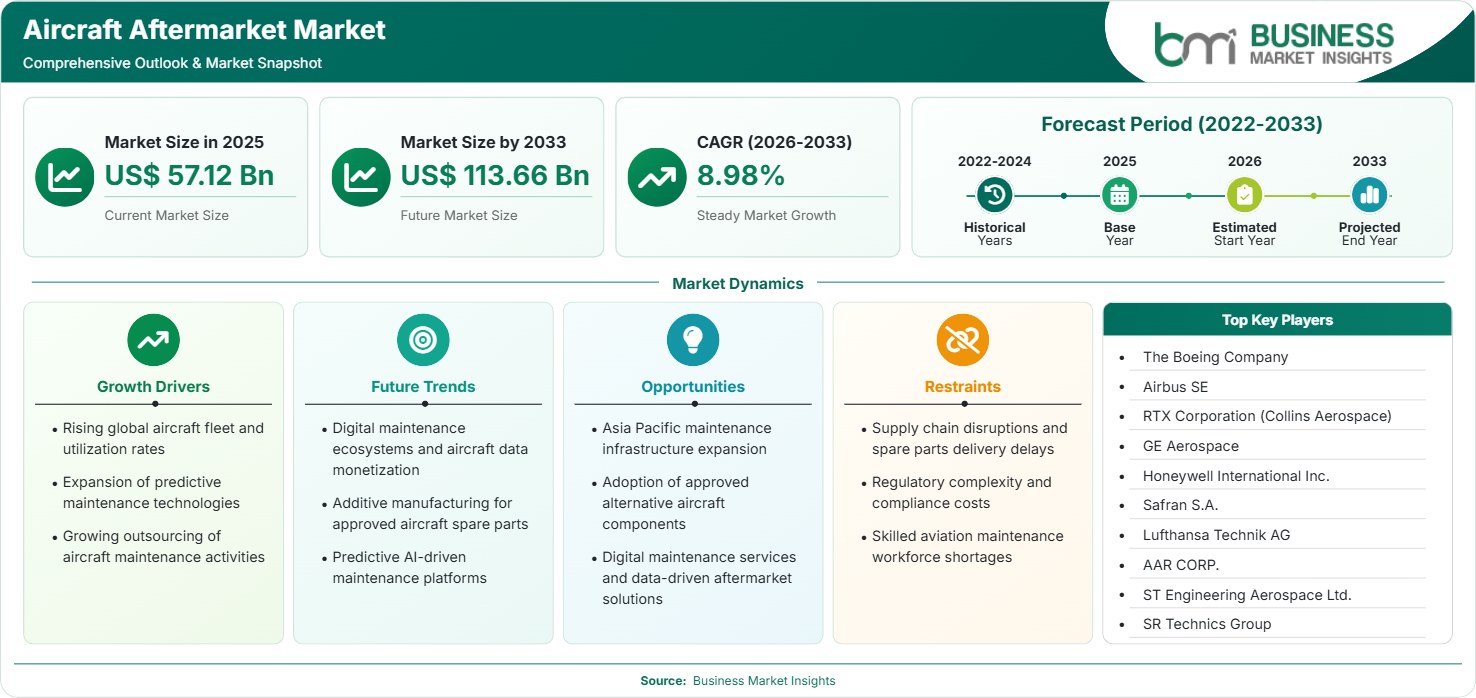
The Aircraft Aftermarket Market size was valued at US$ 57.12 Billion in 2025 and is projected to reach US$ 113.66 Billion by 2033, growing at a CAGR of 8.98% during 2026–2033. Key drivers include fleet expansion, aging aircraft, rising MRO outsourcing, predictive maintenance adoption, and increasing spare-parts demand. Opportunities stem from digital maintenance ecosystems, PMA acceptance, and Asia-Pacific fleet growth.

Report Coverage
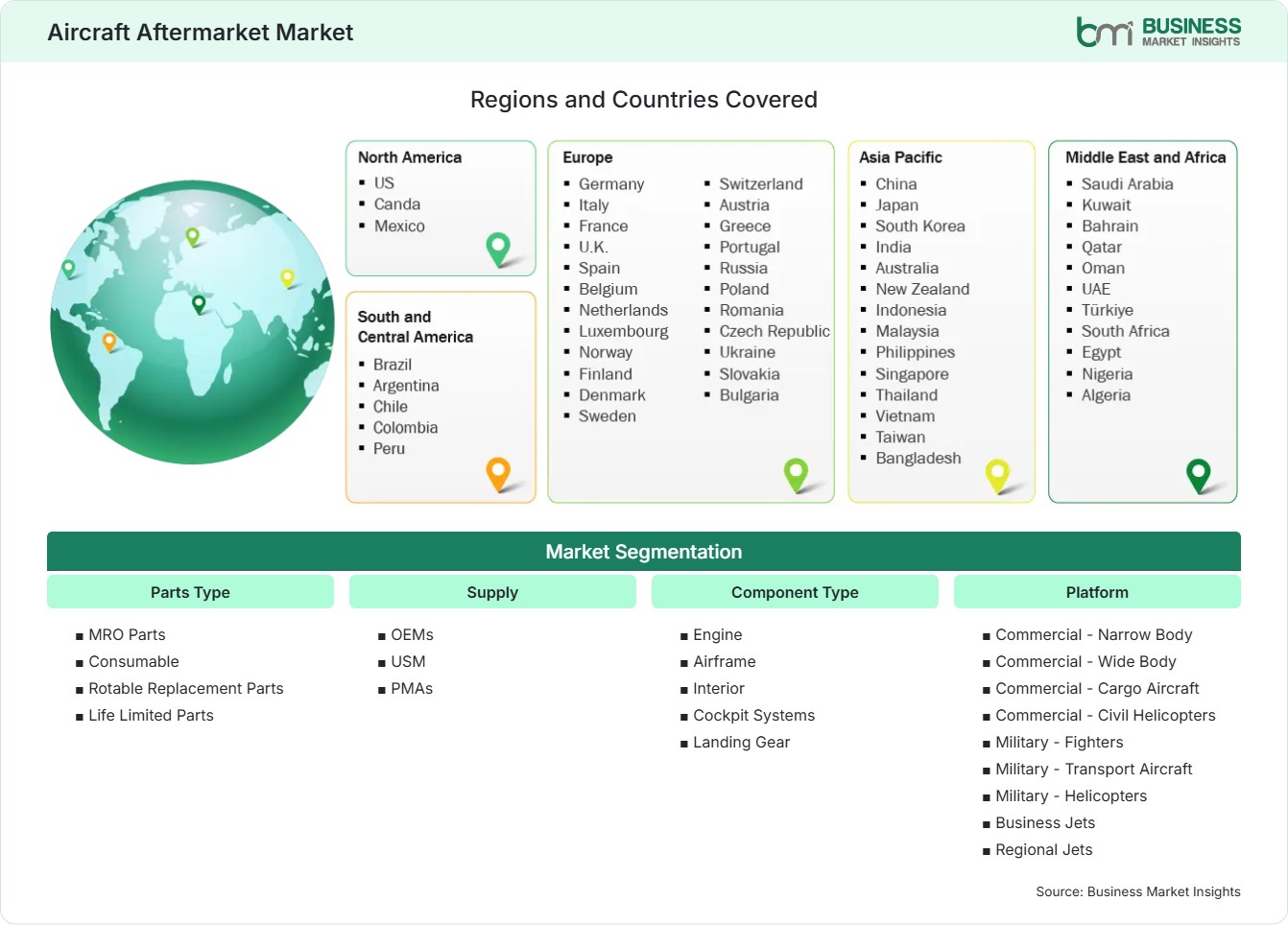
  • Parts Type: MRO Parts, Consumable, Rotable Replacement Parts, Life Limited Parts
  • Supply: OEMs, USM, PMAs
  • Component Type: Engine, Airframe, Interior, Cockpit Systems, Landing Gear
  • Platform: Commercial - Narrow Body, Commercial - Wide Body, Commercial - Cargo Aircraft, Commercial - Civil Helicopters, Military - Fighters, Military - Transport Aircraft, Military - Helicopters, Business Jets, Regional Jets
US$ 57.12 Bn Market size in 2025
US$ 113.66 Bn Market Size by 2033
8.98% CAGR, 2026 - 2033
2026-2033 Forecast Period

AI Overview

Aircraft Aftermarket Market Summary

  • North America Region: North America holds a market share of 34%–37% in 2025, growing with a CAGR of 7.8%–8.4% during 2026–2033. Growth is supported by mature airline fleets, strong MRO infrastructure, digital maintenance adoption, military sustainment programs, predictive analytics investments, parts replacement cycles, expanding engine overhauls, and regulatory compliance requirements.
    US market benefits from large commercial fleets and OEM support networks, advancing at an estimated 8.0%–8.6% CAGR.
  • Fastest Growing Region: Asia Pacific holds 24%–27% share in 2025 and is expanding at 10.5%–11.3% CAGR. Drivers include airline fleet additions, maintenance capacity investments, rising passenger traffic, localized component repair capabilities, expanding aviation hubs, government support, spare-parts demand growth, and increasing outsourcing activities.
  • Leading Segment: Commercial platform accounts for 46%–50% share in 2025 and advances at 8.7%–9.4% CAGR. Demand is driven by high flight utilization, scheduled maintenance requirements, engine overhauls, fleet modernization programs, cabin upgrades, component replacements, operational reliability priorities, and airline cost-optimization initiatives.
  • High Growth Segment: PMAs supply category represents 14%–17% share in 2025 and grows at 10.2%–11.0% CAGR. Expansion is supported by cost-saving requirements, regulatory acceptance, airline procurement diversification, improved quality standards, growing installed aircraft bases, maintenance efficiency goals, and aftermarket competition.
  • Key Market Opportunity: Expansion of predictive maintenance platforms integrated with artificial intelligence allows operators to reduce unscheduled downtime, optimize spare-parts inventory, improve asset utilization, increase maintenance accuracy, and lower lifecycle operating costs.
  • Major Market Players: The Boeing Company, Airbus SE, RTX Corporation (Collins Aerospace), GE Aerospace, Honeywell International Inc., Safran S.A., Lufthansa Technik AG, AAR CORP., ST Engineering Aerospace Ltd., and SR Technics Group.
Strategic Insights

Aircraft Aftermarket Market: Strategic Insights

Aircraft Aftermarket Market Strategic Framework
FREE PDF
Request your free sample
Request free sample
Stakeholder View

Key Takeaways

  • The value chain is increasingly shifting toward integrated service ecosystems combining OEMs, independent MRO providers, digital solution vendors, and certified parts distributors.
  • PMA components, engine maintenance services, and Asia-based repair facilities present the strongest revenue upside owing to airline cost-management priorities.
  • Artificial intelligence, predictive maintenance analytics, and digital-twin technologies are becoming central to maintenance planning and inventory optimization.
  • India, Singapore, and the United Arab Emirates offer compelling investment cases due to growing fleets, strategic connectivity, and aviation infrastructure spending.
  • Strategic acquisitions and partnerships continue to strengthen component support capabilities, engine services portfolios, and regional maintenance footprints.
  • Supply-chain resilience and alternative sourcing strategies are becoming critical competitive differentiators as operators seek reduced maintenance delays.
Geographic Outlook

Aircraft Aftermarket Market Regional Highlights

North America Aircraft Aftermarket Market

North America accounted for 34%–37% Aircraft Aftermarket Market share in 2025 and is projected to register a CAGR of 7.8%–8.4% through 2033. The region benefits from extensive airline operations, aging fleets requiring overhaul activity, strong defense aviation demand, and established MRO networks. Major OEMs and engine manufacturers continue investing in digital maintenance tools and predictive analytics. Increasing retrofit programs and replacement-part requirements support recurring demand across commercial and military aviation segments.

  • Large installed aircraft fleets create sustained demand for engines, avionics, structural repairs, and certified replacement components.
  • Defense modernization programs strengthen long-term maintenance contracts for aircraft sustainment activities.
  • Airlines increasingly adopt predictive maintenance platforms to reduce unscheduled operational disruptions.
  • Strong OEM presence supports rapid component distribution and technical support capabilities.
  • Cargo aviation activity continues supporting aftermarket demand for older aircraft platforms.

US Aircraft Aftermarket Market

The United States represented 76%–80% of the North American Aircraft Aftermarket Market revenue in 2025 and is expected to record an 8.0%–8.6% CAGR through 2033. Extensive domestic air traffic, substantial military aviation expenditure, and mature MRO infrastructure sustain demand. Fleet modernization and engine maintenance requirements remain major revenue generators. Continued investment in digital aviation technologies strengthens operational efficiency and maintenance planning.

  • Major airlines maintain long-term support agreements to improve fleet reliability and cost predictability.
  • Engine overhaul activity remains a primary aftermarket revenue contributor.
  • FAA-certified repair ecosystems support broad maintenance service availability.
  • Aircraft leasing growth encourages component refurbishment and lifecycle extension strategies.

Europe Aircraft Aftermarket Market

Europe captured 27%–30% Aircraft Aftermarket Market share in 2025 and is projected to expand at a CAGR of 8.4%–9.0%. Mature aviation markets, sustainability-driven fleet upgrades, and strong engineering capabilities support demand. Germany leads regional revenue generation, while Eastern European maintenance hubs demonstrate faster expansion nearing 9.5%–10.2% CAGR. Airlines increasingly focus on cabin modernization and fuel-efficiency improvements requiring aftermarket services.

  • Germany remains the leading national market due to extensive aviation manufacturing and maintenance activities.
  • Poland and Romania are emerging as competitive maintenance locations.
  • Fleet retrofits linked to sustainability objectives drive component demand.
  • Engine support agreements continue gaining traction among European airlines.
  • Specialized repair capabilities strengthen regional competitiveness.

Asia Pacific Aircraft Aftermarket Market

Asia Pacific accounted for 24%–27% Aircraft Aftermarket Market share in 2025 and is anticipated to achieve the fastest CAGR of 10.5%–11.3%. Expanding airline fleets, rising passenger traffic, and investments in regional maintenance centers support growth. China represents the largest market, while India delivers the highest expansion potential with double-digit fleet additions. Localization initiatives are increasing component repair and overhaul capabilities.

  • India is attracting substantial MRO investments supported by policy reforms.
  • China continues expanding maintenance capacity alongside fleet growth.
  • Southeast Asian airlines increasingly outsource maintenance services.
  • Regional aviation hubs strengthen spare-parts distribution networks.
  • Business aviation growth supports demand for specialized support services.

Rest of World Aircraft Aftermarket Market

Rest of World held 11%–14% share in 2025 and is expected to grow at a CAGR of 8.8%–9.5%. The Middle East benefits from global transit traffic and wide-body fleet operations. South and Central America are supported by fleet modernization and regional airline recovery. The UAE leads regional service investments, while Saudi Arabia demonstrates strong expansion potential.

  • Gulf aviation hubs support sophisticated engine and component maintenance activities.
  • Brazil remains a key aftermarket center within Latin America.
  • Government aviation investment supports maintenance infrastructure development.
  • Cargo fleet operations contribute recurring servicing requirements.
  • Fleet age profiles sustain replacement-part demand across multiple aircraft categories.
Global Market Geography
FREE PDF
Request your free sample
Request free sample
Segment Analysis

Aircraft Aftermarket Market Segmentation

Parts Type

This segment accounted for 29%–33% share in 2025 and is anticipated to grow at 8.7%–9.3% CAGR. The segment benefits from growing fleet utilization, periodic maintenance requirements, and increased demand for certified replacements. The Aircraft Aftermarket Market scope within parts management continues expanding through digital inventory systems and predictive procurement strategies.

  • MRO Parts: Critical components used during maintenance events, supported by regulatory compliance requirements and increasing overhaul frequencies.
  • Consumable: Includes frequently replaced materials such as seals, lubricants, and fasteners essential for operational continuity.
  • Rotable Replacement Parts: High-value recoverable components that reduce lifecycle costs through refurbishment and repeated service usage.
  • Life Limited Parts: Mandatory replacement items driven by flight-cycle limits and stringent airworthiness regulations.

Supply

Supply represented 22%–26% share in 2025 and is forecast to grow at 9.1%–9.8% CAGR. Procurement diversification, inventory optimization, and cost-control initiatives influence demand dynamics. Reference to Aircraft Aftermarket Market trends includes increasing preference for approved alternatives and used serviceable materials.

  • OEMs: Maintain strong positions through proprietary designs, warranties, technical support, and long-term service agreements.
  • USM: Gains traction through cost-efficient sourcing strategies and sustainable aircraft lifecycle management.
  • PMAs: Increasingly adopted as operators seek regulatory-compliant alternatives that lower maintenance expenditures.

Component Type

Component Type held 31%–35% share in 2025 and is expected to register 9.0%–9.6% CAGR. Expansion is supported by aircraft aging, advanced electronics adoption, and recurring inspection mandates across commercial and defense fleets.

  • Engine: Represents the most maintenance-intensive aircraft system, generating substantial overhaul and replacement demand.
  • Airframe: Driven by structural inspections, corrosion control, and lifecycle extension programs.
  • Interior: Cabin refurbishment and passenger-experience improvements support replacement activity.
  • Cockpit Systems: Digital avionics upgrades stimulate maintenance and retrofit demand.
  • Landing Gear: Regular inspections and overhaul cycles sustain recurring revenue generation.

Platform

Platform represented the leading segment with 46%–50% share in 2025 and is projected to grow at 8.7%–9.4% CAGR. Commercial aviation remains dominant because of utilization intensity, extensive maintenance schedules, and fleet expansion across major airline markets.

  • Commercial - Narrow Body: Supported by short-haul network expansion and high utilization rates.
  • Commercial - Wide Body: Driven by international traffic recovery and long-haul operations.
  • Commercial - Cargo Aircraft: Increasing e-commerce logistics requirements support servicing demand.
  • Commercial - Civil Helicopters: Maintenance demand linked to offshore, emergency, and utility operations.
  • Military - Fighters: Sustainment programs and modernization initiatives generate stable revenue.
  • Military - Transport Aircraft: Operational readiness requirements support recurring maintenance activity.
  • Military - Helicopters: Fleet availability priorities sustain replacement-part demand.
  • Business Jets: Cabin upgrades and premium service requirements stimulate aftermarket spending.
  • Regional Jets: Fleet renewal and regional connectivity expansion support maintenance needs.
Market Forces

Aircraft Aftermarket Market Dynamics

Key Market Drivers

Rising Global Aircraft Fleet and Utilization Rates

Commercial air traffic continues expanding, with IATA reporting passenger demand growth trends supporting sustained aircraft utilization. Increased flight cycles cause wear on the engine, landing gear, and avionics, resulting in greater maintenance needs. Delivery delays of new planes have forced airlines to use their current fleet for longer periods, increasing demand for spare parts. This is the kind of situation that creates a stream of recurring revenue from engine, structural, and cabin parts. Increased focus on operational readiness as a key performance metric drives the need for proactive maintenance and diagnostics.

Expansion of Predictive Maintenance Technologies

Data analytics, artificial intelligence, and sensor-enabled aircraft monitoring are transforming maintenance execution. These technological solutions can determine when components will degrade, even before failures occur, which will help reduce unplanned downtime and maintenance expenses. For companies that use predictive solutions, fleet performance increases along with their inventory management. More and more often, OEMs and MRO service providers are offering analytics within their service contracts and generating recurring revenue digitally. This solution is especially popular with airlines that manage mixed fleets.

Growing Outsourcing of Maintenance Activities

Airlines are increasingly outsourcing maintenance to specialized providers to improve cost efficiency and operational flexibility. Independent MRO firms keep growing their capabilities in engine repair, component overhaul, and structural repairs. Outsourcing allows airlines to utilize technical knowledge without heavy investments in maintenance infrastructure. This business approach seems very beneficial for developing countries' airlines, which expand their fleets very fast. Moreover, the wider use of outsourcing creates a demand for logistics services, inventory management, and replacement parts.

Key Market Opportunities

Asia-Pacific Maintenance Infrastructure Expansion

A healthy growth rate in the number of fleets in India, China, Indonesia, and the rest of Southeast Asia is generating considerable potential for investments in MRO facilities, training centers, and parts repair centers. This will help operators to bring their operations closer and cut down on turnaround time and costs. Governments are investing in aviation infrastructure and bringing in private-sector capital for MRO facilities. Long-term Aircraft Aftermarket Market Forecasts indicate increasing demand concentration in high-growth aviation economies where fleet additions outpace maintenance capacity expansion.

Approved Alternative Components Adoption

Growing acceptance of PMA and certified alternative replacement parts presents a cost-effective opportunity for airlines. Increasing costs for maintenance costs have necessitated diversifying procurement sources beyond OEMs. Increasingly, regulatory bodies acknowledge the availability of approved substitutes that meet their standards for performance and safety. This allows them to save costs during their lifecycles without compromising on compliance. Suppliers providing approved substitutes stand to benefit from recurring revenue streams, especially from airlines and leasing firms.

Digital Service Ecosystems and Data Monetization

Aircraft maintenance data is becoming a commercially valuable asset. Service providers may derive revenue from operational insights through optimization, inventory forecasting, and maintenance planning applications. The use of cloud technology enables real-time information exchange among airlines, OEMs, and repair companies. Greater transparency will allow better decision-making to meet the objectives of operational reliability. Those who can link their maintenance services to analytics platforms will benefit from more lucrative contracts.

Market Restraints and Challenges

Supply Chain Disruptions and Maintenance Delays

Factor: Supply chain instability continues affecting availability of critical components, raw materials, and repair parts.

Impact: Longer lead times delay maintenance schedules and reduce airplane availability. Airlines can be compelled to stretch out the service interval according to the regulatory limit or source their parts at an increased cost. The shortage of labor among technical experts is another factor that adds to operational problems. Higher carrying costs become another consequence as there is the need for inventory buffers.

Regulatory Complexity and Higher Compliance Costs

Factor: Aviation maintenance operates within highly regulated environments requiring extensive certification, documentation, and inspection procedures.

Impact: Compliance demands create a higher administrative workload and operational costs for the supplier or service provider firm. Certification procedures for new parts or new methods of repairs could take much time and money. Disparities between different regulatory frameworks of various countries could also cause certain difficulties. Small-sized providers may find themselves short on resources when dealing with the constantly changing regulatory framework.

Company Analysis

Competitive Landscape

The following Aircraft Aftermarket Market analysis highlights leading participants operating across maintenance, replacement parts, digital support services, and aircraft sustainment.

Company Name

Overview

Products and Services relevant to this market

The Boeing Company

Global aerospace manufacturer with extensive lifecycle support capabilities.

Parts distribution, digital maintenance, component support, engineering services.

Airbus SE

Leading aircraft producer supporting global aftermarket operations.

Fleet services, upgrades, spare parts, maintenance solutions.

RTX Corporation (Collins Aerospace)

Major aviation systems provider serving commercial and defense markets.

Avionics support, interiors, actuation systems, component services.

GE Aerospace

Global engine technology leader with broad service networks.

Engine overhaul, predictive maintenance, performance analytics.

Honeywell International Inc.

Diversified aerospace supplier with strong installed equipment base.

Avionics, auxiliary power systems, repairs, upgrades.

Safran S.A.

Aerospace systems and propulsion specialist with strong aftermarket presence.

Engine services, landing gear support, equipment maintenance.

Lufthansa Technik AG

Independent MRO leader serving airlines worldwide.

Engine, component, cabin, and digital maintenance services.

AAR CORP.

Aviation services provider focused on operational support.

Parts supply, maintenance services, inventory management.

ST Engineering Aerospace Ltd.

Major Asian MRO provider with global footprint.

Airframe maintenance, conversions, component support.

SR Technics Group

Aircraft maintenance specialist serving international operators.

Engine services, line maintenance, technical support.

Trust & Transparency

Research Methodology

The market analysis combines proprietary research with secondary data from government agencies, company disclosures, regulatory filings, industry databases and expert interviews. Market estimates are validated through data triangulation, cross-market benchmarking and analyst review.

View Full Research Methodology

Questions Answered

Frequently Asked Questions

What does an Aircraft Aftermarket Market Report typically evaluate?

An Aircraft Aftermarket Market Report assesses market size, competitive structure, technology developments, regional dynamics, segment performance, investment opportunities, regulatory influences, and future growth prospects.

How does digitalization affect maintenance operations?

Digital solutions improve maintenance planning, reduce unexpected failures, optimize inventory, support predictive servicing, and enhance overall fleet availability through data-driven insights.

What factors influence demand most strongly?

Fleet age, aircraft utilization rates, passenger traffic growth, maintenance regulations, delivery delays for new aircraft, and technological upgrades collectively influence demand patterns.

Why are PMA components becoming more important?

PMA parts offer certified, lower-cost alternatives to OEM products, helping airlines reduce maintenance expenses while maintaining compliance with aviation safety requirements.

Which component category generates the highest aftermarket spending?

Engine-related maintenance and overhaul activities generally account for the largest expenditure because engines require intensive inspections, repairs, performance restoration, and lifecycle management throughout aircraft operations.

Access the Full Aircraft Aftermarket Market Report

Get segment-level forecasts, regional estimates, competitive benchmarking, company profiles and downloadable Excel datasets.

Access the full Aircraft Aftermarket Market Report
350 pages PDF & Excel | 2026-09-02
Similar Research

Related Market Reports